Talk | Stephanie O’Rourke on John Martin and Romantic Extraction
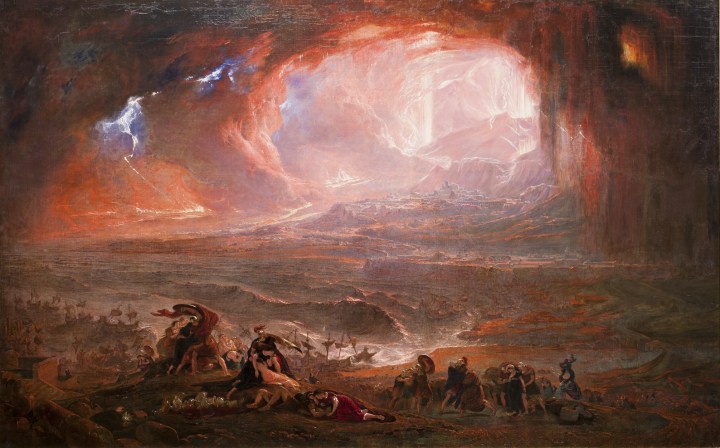
John Martin, The Destruction of Pompeii and Herculaneum, 1822, oil on canvas, 162 × 253 cm
(London: Tate, N00793).
◊ ◊ ◊ ◊ ◊
From the Mellon Centre:
Stephanie O’Rourke | John Martin and Romantic Extraction
Online and in-person, Paul Mellon Centre, London, 22 January 2025, 5pm
The early nineteenth-century artist John Martin bore witness to a rapidly carbonising Britain. Although he is most famous for his dramatic portrayals of epic, historical narratives, Martin was also exceptionally attuned to the transformations visited upon his environment by the rise of industrial resource extraction. His was a world characterised by the subterranean flows of dangerous substances such as noxious gases and sewage, by the desired inflow of natural resources such as water to urban centres and by the invisible spread of less-material phenomena across Britain’s imperial boundaries. In this paper, O’Rourke explores some of the many flows that shaped Martin’s world and his art. We often assume it was J.M.W. Turner’s paintings that best captured the arrival of steam-powered modernity in early nineteenth-century Britain through their explosive treatment of colour and their formal irresolution. But what if it were Martin’s work? What could we come to understand about the conditions of fossil-powered modernity and about romanticism if we took Martin as our guide?
Book tickets here»
Stephanie O’Rourke is a senior lecturer in Art History at the University of St Andrews specialising in eighteenth- and nineteenth-century art. Her second book Picturing Landscape in an Age of Extraction: Europe and its Colonial Networks 1780–1850 (University of Chicago Press, 2025) charts the relationship between landscape and resource extraction in the first half of the nineteenth century. Her prize-winning first book, Art, Science, and the Body in Early Romanticism (Cambridge UP, 2021), examines the changing evidentiary authority of the human body in European romantic thought. She has published widely on the relationship between art and resource extraction, scientific knowledge, and media technologies.










 Enfilade
leave a comment