Call for Papers | Desire and the Urban Imagination, 18–21st Centuries
As noted at the Groupe de Recherche en Histoire de l’Art Moderne (GRHAM) . . .
Ville désirable / ville désirée : Construire les imaginaires urbains par le visuel, XVIIIe–XXIe
Lyon, 10–11 June 2025
Proposals due by 31 January 2025
Les journées d’étude Ville désirable / ville désirée : construire les imaginaires urbains par le visuel, XVIIIe–XXIe, placent la notion de désir, jusqu’ici particulièrement investie par les études psychologiques et psychanalytiques, au cœur des interactions entre la ville et ses images. L’idée d’absence, de manque, ou d’envie à laquelle renvoie cette notion permet de relire et réinterpréter certaines productions visuelles urbaines produites entre le XVIIIème et le XXIème siècles. Si certains travaux notamment en géographie se sont intéressés à l’attractivité (Michel Lussault) ou à l’amabilité des villes (Denis Martouzet), ces journées d’étude permettront d’étudier d’autres dynamiques à l’œuvre au regard de la notion de désir. Qu’il s’agisse de portraits de ville (André Corboz, David Martens), des images du tourisme (Marie-Eve Bouillon, Valérie Perlès, Anne Reverseau), de projections de villes du futur (Marie-Madeleine Ozdoba) que nous disent les visuels dans leur rôle d’intermédiation avec la ville ? Quel rôle ces images jouent-elles dans la lecture de la ville ? Quelles sont les orientations politiques, sociales, économiques des producteurs et que nous révèlent les médias employés en termes d’intentions ? Pouvons-nous parler d’une recherche de désirabilité urbaine dans une pratique de la mise en scène du territoire ? A partir de sources visuelles variées, les journées d’étude entendent donc historiciser les relations complexes qui existent entre réception d’une image et production d’un désir, et ainsi contribuer à une histoire culturelle, sociale et visuelle de la ville.
Les journées d’études se dérouleront les 10 et 11 juin 2025 à Lyon. Les communications d’une durée de 20 minutes seront suivies d’échanges avec la salle. Les propositions de communication ne doivent pas excéder 3000 signes (espaces compris) et doivent être accompagnées d’une courte biographie précisant le rattachement institutionnel des participant.e.s. Merci de préciser à quel(s) axes(s) de l’appel votre proposition s’intègre. Elles sont à envoyer avant le 31 janvier 2025 à l’adresse mail : villedesirable@gmail.com. Une notification aux candidat.e.s les informant de la décision des organisateurs sera adressée fin février 2025.
Comité d’organisation et de sélection des propositions
• Marie Blanc (LARHRA / UGA)
• Johanna Daniel (LARHRA / Université Lyon 2)
• Loïc Sagnard (LARHRA / Université Lyon 2)
• Hugo Tardy (Framespa, Université Toulouse Jean Jaurès)
The complete Call for Papers, detailing the four axes of the study days, along with an indicative bibliography is available here»
(more…)
Call for Papers | Rome in the Nordic Countries
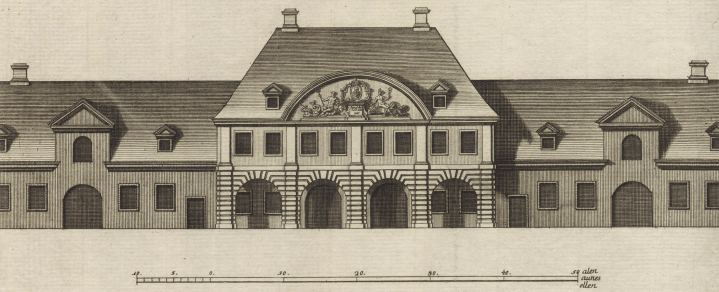
Customs House, Copenhagen.
◊ ◊ ◊ ◊ ◊
From the Call for Papers:
Rome in the Nordic Countries: Images of Ancient and Modern Architecture, 17th–18th Century
Online and in-person, Rome, late November/early December 2025
This conference will draw attention to the artistic and architectural exchanges between Rome and the Nordic countries from the seventeenth to eighteenth century, focusing on the production, marketing, use, and conservation of images, including drawings and engravings, illustrated books, and suites of prints. These works found massive transnational circulation, and their adaptability made them indispensable tools in the history of the arts, and more generally in the broader European cultural expansion. The conference addresses the artistic-architectural relations between the Nordic countries (essentially Denmark, Norway, Sweden, and Finland, but with openness to the entire transalpine world), and the Italian peninsula. The pivot is ancient and modern Rome, the recognized crossroads of cultural elaboration and the centre of a massive and varied publishing production, through which the foundations were laid for the construction of a shared European artistic-architectural language based on Classicism.
Proposals should address issues of cross-cultural exchange, among which we suggest:
Travelling across Europe
• Travelling South, Renaissance to early 18th century: artists/architects, patrons, sketchbooks, diaries
• Travelling North: migration of Italian artists and architects
Books and Prints
• Producing and marketing images of architecture: Rome and the Nordic countries in the European context
• Using and collecting architectural prints
• Vitruvius and Palladio: architectural books in the North
• Architectural libraries
Rome in the North: Functions, Techniques, Styles
• Issues of style: Classicism, Baroque, post-Baroque and early classicism in the architecture of the Nordic countries
• Festive, funerary, and military architecture
• Urban planning and infrastructures: monuments and places
• Models and monuments
Nordic Rome
• The reception of Nordic architectural culture in early modern Italy
The conference will be in Rome, in person and hybrid. Travel expenses will be partially met. Participants will be expected to submit revised and expanded versions of their papers six months after the conference for publication as an edited volume. All proposals (max 1200 words) can be written in English, French, or Italian. Proposals should be sent to nordicromeconference@gmail.com by 31st January 2025.
Scientific Committee
• Antonello Alici, Università Politecnica delle Marche, Ancona
• Mario Bevilacqua, Sapienza Università di Roma; Centro Studi sulla Cultura e l’Immagine di Roma
• Kristin Bliksrud Aavitsland, Universitetet i Oslo
• Kristoffer Neville, University of California, Riverside
• Sabrina Norlander Eliasson, Stockholms universitet; Istituto svedese di Studi classici a Roma
• Saverio Sturm, Università Roma Tre; Centro Studi sulla Cultura e l’Immagine di Roma
• Victor Plahte Tschudi, Arkitektur- og designhøgskolen i Oslo










 Enfilade
leave a comment