Conference | Nature into Art
From ArtHist.net:
Nature into Art
Schloss Nymphenburg, Munich, 11–12 February 2025
Registration due by 2 February 2025
From 26 November 2024 to 16 March 2025, the Alte Pinakothek in Munich is hosting the world’s first major monographic exhibition on Rachel Ruysch. The exhibition is a collaborative effort between the Alte Pinakothek, the Toledo Museum of Art, and the Museum of Fine Arts, Boston. Rachel Ruysch (1664–1750) has always been regarded as one of the most important flower painters in European art, but her life and work have remained insufficiently researched to date. In addition to her perfected fine painting technique, her still lifes—featuring flowers, leaves, fruits, and insects rendered in the finest detail—reflect her interest in botanical and scientific subjects.
In conjunction with the exhibition Rachel Ruysch: Nature into Art and the CODARTfocus in Munich, the workshop Nature into Art will take place February 11–12 at Schloss Nymphenburg in München. The workshop aims to deepen new perspectives gained from the exhibition, particularly regarding the interplay between art and science. The speakers represent the interdisciplinary approach of the exhibition, which are derived from different scientific fields, such as art history, conservational sciences, postcolonial studies, and gender studies, as well as researchers with a botanical focal point. The workshop is intended to sustainably deepen the network of scholars with unique scientific approaches and from different countries, universities, research institutions, and museums. Participation of students from the University of Konstanz will involve the next generation of scholars and raise awareness for current research in the field of early modern painting.
Participation in the event is free of charge, but registration is requested. For more information and to register for the workshop, please contact laura.kromer@uni-konstanz.de until 2 February 2025.
Organizers
Christopher Atkins (Center for Netherlandish Art at the Museum of Fine Arts in Boston), Robert Felfe (University of Graz), Karin Leonhard (University of Konstanz), and Thijs Weststeijn (University of Utrecht)
t u e s d a y , 1 1 f e b r u a r y
9.00 Arrival
9.30 Opening Remarks
10.00 Morning Talks
• Marlena Schneider (Doerner Institut – Bayerische Staatsgemäldesammlungen) — Art Technological Insights on Five Paintings by Rachel Ruysch from the Former Wittelsbach Electoral Collections
• Kirsten Derks (University of Antwerp) — Tried and Tested? Rachel Ruysch’s Working Methods in Her Mature and Late Works
• Larissa van Vianen (University of Amsterdam) — From Observation to Publication: Pierre Lyonet and the Art of 18th-Century Natural History
• Jaya Remond (Ghent University) — Printing Floral Imagery in Northern Europe, c. 1590–1610: Pictorial Discourses and Frames of Representation
13.30 Lunch
14.30 Afternoon Talks
• Marie Amélie Landrin (Sorbonne University) — Rachel Ruysch: Botanical Art at the Intersection of Science and Patronage
• Laura Kromer (University of Konstanz) — The Companion Pieces of Rachel Ruysch: Intertwinings of Pictorial Combination
• Catherine Powell-Warren (KU Leuven) — TBA
17.00 Closing Remarks
17.30 Reception
18.00 Judith Noorman (University of Amsterdam) — Presentation
w e d n e s d a y , 1 2 f e b r u a r y
10.00–12.00 Study day in the exhibition Rachel Ruysch: Nature into Art at the Alte Pinakothek, Munich
Students from the University of Konstanz will offer tailored guided tours.
New Book | Reading the World, British Practices of Natural History
Coming in March from the University of Pittsburgh Press:
Edwin Rose, Reading the World: British Practices of Natural History, 1760–1820 (Pittsburgh: University of Pittsburgh Press, 2025), 408 pages, ISBN: 978-0822948513, $65.
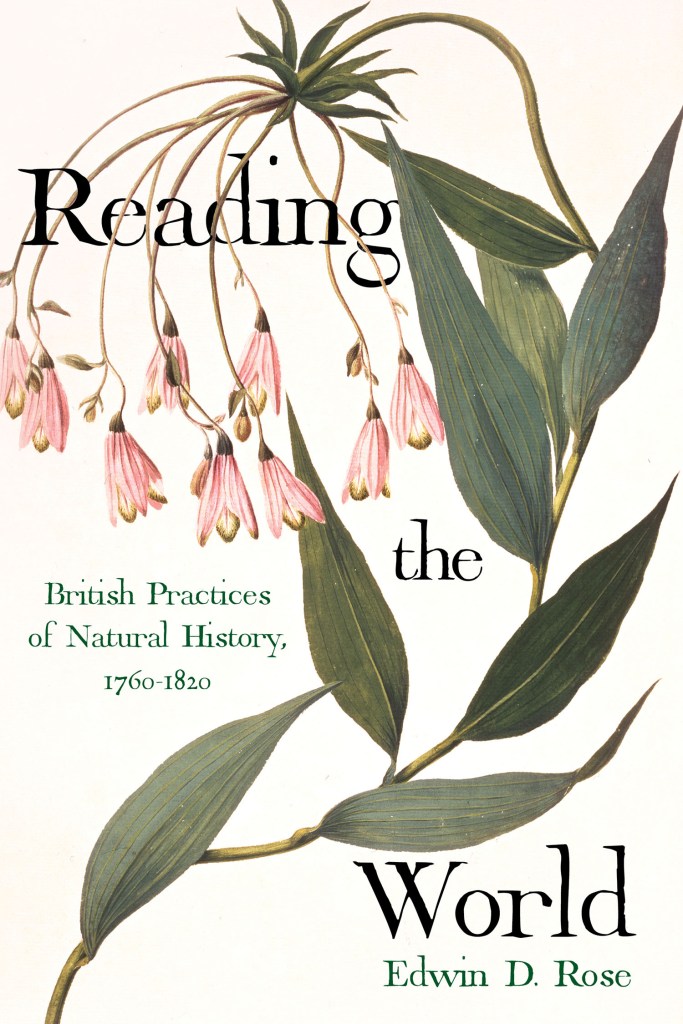 In the eighteenth and nineteenth centuries—a period that marked the emergence of a global modernity—educated landowners, or ‘gentlemen’, dominated the development of British natural history, utilizing networks of trade and empire to inventory nature and understand events across the world. Specimens, ranging from a Welsh bittern to the plants of Botany Bay, were collected, recorded, and classified, while books were produced in London and copies distributed and used across Britain, Continental Europe, the Pacific, Asia, and the Americas. Natural history connected a diverse range of individuals, from European landowners to Polynesian priests, incorporating, distributing, synthesizing, and appropriating information collected on a global scale. In Reading the World, Edwin D. Rose positions books, natural history specimens, and people in a close cycle of literary production and consumption. His book reveals new aspects of scientific practice and the specific roles of individuals employed to collect, synthesize, and distribute knowledge—reevaluating Joseph Banks’s and Daniel Solander’s investigations during James Cook’s Endeavour voyage to the Pacific. Uncovering the range of skills involved in knowledge production, Rose expands our understanding of natural history as a cyclical process, from the initial collection and identification of specimens to the formal publication of descriptions to the eventual printing of sources.
Edwin D. Rose is currently AHRC Research Fellow in the Department of History and Philosophy of Science at the University of Cambridge and Advanced Research Fellow at Darwin College, Cambridge. From May 2025 he will be a Leverhulme Trust Early Career Research Fellow in the School of Philosophy, Religion, and History of Science at the University of Leeds.










 Enfilade
leave a comment