Martina Droth Named YCBA Director
From the press release:
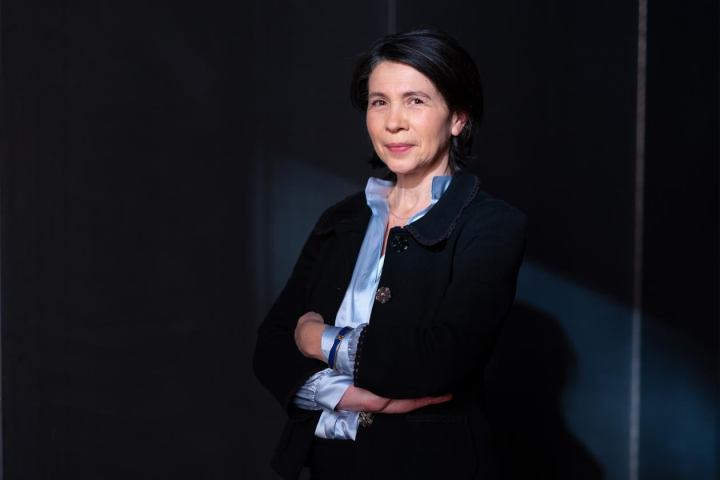
Photo of Martina Droth by Nick Mead.
Martina Droth, an art historian and curator who has served in a series of prominent roles at the Yale Center for British Art (YCBA) over 16 years, will be the museum’s next Paul Mellon Director, Yale President Maurie McInnis announced today.
As the museum’s deputy director and chief curator, Droth has been an integral part of the YCBA team and an active member of the university community, the president wrote in a message to the Yale community, building “an impressive record of achievement through roles of increasing responsibility, from leading the research division and serving as curator of sculpture to her current post. The YCBA will benefit from being led by an art historian and curator who has been instrumental in its success.”
Droth began her new role on January 15. Her tenure begins as YCBA prepares to reopen to the public on March 29, following a two-year renovation that will help safeguard the museum’s collections for generations to come. The museum houses the largest collection of British art outside the United Kingdom.
Droth succeeds Courtney J. Martin, who is now executive director of the Robert Rauschenberg Foundation. Richard Brodhead, a former dean of Yale College and former president of Duke University, has served as YCBA’s interim director since 1 July 2024.
“As interim director I’ve had the privilege to watch the Yale Center for British Art prepare for a dazzling reopening,” Brodhead said. “Martina Droth has been a key driver of this rebirth. With her warmth, breadth of knowledge, transatlantic contacts, and love of the museum’s art and its people, she will make an extraordinary leader for a unique cultural resource. I couldn’t be happier for YCBA’s future.”
Since coming to Yale in 2009, Droth has been instrumental in shaping the museum’s long-range strategy for research, collections, and exhibitions. “She is playing a vital role in reimagining the YCBA’s collection installation and conceiving a new curatorial program in readiness for the museum’s reopening,” McInnis wrote in her message.
Under Droth’s leadership, McInnis said, the YCBA will continue to advance its mission of promoting the understanding and appreciation of British art “through its exceptional collections, groundbreaking exhibitions, field-defining research, and innovative public programs.”
Susan Gibbons, vice provost for collections and scholarly communication at Yale, described Droth as “a brilliant curator with an in-depth understanding of British art history.”
“Her field-changing scholarship on British art studies and extensive experience working with partners across the university and those at external institutions demonstrate her ability to build collaborations and advance YCBA’s mission,” Gibbons said. “Having been such an integral part of the museum for the past 16 years, she will have a seamless transition into her new leadership role.”
As director, Droth, in partnership with staff, faculty, and students, will further enhance educational initiatives, expand community engagement, and foster an intellectual environment that welcomes a breadth of perspectives to be part of the discourse in art and art history, McInnis said. Droth also will build on the museum’s partnerships with Yale’s academic departments to augment its national and international collaborations and outreach.
“My colleagues and I are very much looking forward to working with Martina, who has expertly led the Yale Center for British Art’s curatorial and research endeavors over the past 16 years,” said Stephanie Wiles, the Henry J. Heinz II Director of the Yale University Art Gallery. “We are keen to advance the Art Gallery and the Center’s thriving exhibition partnerships already underway and together to explore new intellectual collaborations engaging Yale’s exceptional art collections.”
Droth has curated numerous high-profile YCBA exhibitions, including Bill Brandt | Henry Moore and Sculpture Victorious: Art in an Age of Invention, 1837–1901, along with the two upcoming exhibitions, Tracey Emin: I Loved You Until the Morning and Hew Locke: Passages, which will mark YCBA’s reopening.
Droth has also secured resources that support the museum’s scholarly initiatives, McInnis noted, including the multi-year Andrew W. Mellon Foundation grants with which she developed the research strategy at the YCBA. Her efforts to advance the museum’s mission have often involved collaborative efforts with renowned external institutions such as Tate Britain, the Fitzwilliam Museum at Cambridge University, and the Getty Museum.
“Hearing the news of Martina’s promotion is a great way to start the year,” said Locke, the British sculptor and contemporary visual artist whose work will be on display during the museum’s reopening. “Having known her for 15 years, it is certain that the institution is in a safe pair of hands. Working with her on my forthcoming exhibition, her support, intellectual rigor and instinctive understanding of the nature of working with artists, made the complex and lengthy process a pleasure. I wish her every success in her new post.”
Beyond her YCBA work, Droth has served on university committees, including the Committee for Art in Public Spaces; co-taught courses with faculty members from the Department of the History of Art in Yale’s Faculty of Arts and Sciences; and brought graduate students into curatorial research.
She oversaw the YCBA’s first joint exhibition with the Yale School of Architecture and facilitated projects integrating visiting artists with students at the Yale School of Art. She has also mentored numerous curators, students, and postdoctoral fellows who have gone on to careers in the academy and museum fields. Her academic work includes many service roles, including co-editing the British Art Studies journal with the Paul Mellon Centre.
Droth said she is deeply honored to step into the role of YCBA director “at this pivotal moment in its history. This wonderful institution has been my home base for 16 years, and I am thrilled to lead it into its next chapter — one where we continue to push the possibilities of scholarship, exhibitions, and public programming. The YCBA’s success has always been built on collaboration—amongst our talented staff, faculty, students, and our wider community—and I look forward to working with all of these groups to continue expanding the museum’s reach, deepen its impact, and make it a vital and welcoming space of cultural exchange, inspiration, and discovery.”
Before coming to Yale, Droth taught at universities and coordinated research and curated exhibitions for major art institutes in the UK. A former chair of the Association of Research Institutes in Art History, she has a deep commitment to the field, characterized by collaborative leadership and excellence in curatorial practice, research, and education, McInnis said.
“Martina’s success over the years is due in large part to her dedication to fostering a culture of collaboration and inclusion,” the president wrote. “A proponent of building partnerships with local communities, Martina has developed programs to connect broad audiences with Yale’s collections.”
At YCBA, Droth initiated “The View from Here: Accessing Art through Photography,” a program for New Haven high school students, in collaboration with the Lens Media Lab at the Institute for the Preservation of Cultural Heritage. And she has introduced students from New Haven Promise into the Curatorial Division of the YCBA and created internship opportunities for undergraduates through, for example, the Association of Research Institutes in Art History. (New Haven Promise is a college scholarship and career development program that supports New Haven Public School students.)
“Martina appreciates how much Yale artists and students are engaged in New Haven, and she partners on and off campus to increase educational opportunities,” said Kymberly Pinder, the Stavros Niarchos Foundation Dean of the Yale School of Art. “She has been a great collaborator with the School of Art, connecting YCBA curators and visiting artists with our students and high school students. She knows the value of the arts to inspire young scholars and create connections within communities. I am excited for how the YCBA, with her leadership, will continue to make these connections and advance the work artists do across Yale and within the city and beyond.”
Droth’s appointment reinforces the YCBA’s dedication to innovative scholarship, teaching, and community engagement, said Paul Messier, the founder and Pritzker Director of the Lens Media Lab at Yale’s Institute for the Preservation of Cultural Heritage. “As an energetic and insightful leader, she combines a collaborative spirit with a distinct vision for the YCBA’s future and its role within Yale, New Haven, and the international landscape of museums and cultural institutions,” he said.
In McInnis’ message, the president thanked Brodhead for providing “exceptional leadership” as interim director. She also thanked members of the search advisory committee, which was chaired by Ned Cooke, the Charles F. Montgomery Professor of American Decorative Arts in the FAS, and members of the Yale community who offered suggestions and ideas during the search process.
“Over the course of the search, the committee learned a great deal about the strengths and untapped potential of the YCBA,” Cooke said. “We gained insight into the established reputation of the institution — its strong collections, ambitious exhibitions, and leading research program — but we also learned about popular perceptions and different audiences.
“The center holds a pivotal role for the Yale community, local audiences, and national and international visitors with a keen interest in British art,” he added. “Martina Droth offers a unique blend of experience at the center, close ties to British art circles, and commitment to a balance of exhibition, research, and outreach. Her experience at the center, collegiality, and passionate insistence on reaching the various potentials of the center give us great confidence in her appointment.”
McInnis said she and the advisory committee benefited from comments they received during the international search. “Based on the insights we gathered, Martina is the ideal leader for the YCBA. I look forward to working with her as she steers the museum toward new heights in realizing its mission and makes it an ever more welcoming space that offers inspiring experiences with art and deepens our engagement with students, scholars, New Haven residents, and visitors from around the world.”
Call for Papers | Desire and the Urban Imagination, 18–21st Centuries
As noted at the Groupe de Recherche en Histoire de l’Art Moderne (GRHAM) . . .
Ville désirable / ville désirée : Construire les imaginaires urbains par le visuel, XVIIIe–XXIe
Lyon, 10–11 June 2025
Proposals due by 31 January 2025
Les journées d’étude Ville désirable / ville désirée : construire les imaginaires urbains par le visuel, XVIIIe–XXIe, placent la notion de désir, jusqu’ici particulièrement investie par les études psychologiques et psychanalytiques, au cœur des interactions entre la ville et ses images. L’idée d’absence, de manque, ou d’envie à laquelle renvoie cette notion permet de relire et réinterpréter certaines productions visuelles urbaines produites entre le XVIIIème et le XXIème siècles. Si certains travaux notamment en géographie se sont intéressés à l’attractivité (Michel Lussault) ou à l’amabilité des villes (Denis Martouzet), ces journées d’étude permettront d’étudier d’autres dynamiques à l’œuvre au regard de la notion de désir. Qu’il s’agisse de portraits de ville (André Corboz, David Martens), des images du tourisme (Marie-Eve Bouillon, Valérie Perlès, Anne Reverseau), de projections de villes du futur (Marie-Madeleine Ozdoba) que nous disent les visuels dans leur rôle d’intermédiation avec la ville ? Quel rôle ces images jouent-elles dans la lecture de la ville ? Quelles sont les orientations politiques, sociales, économiques des producteurs et que nous révèlent les médias employés en termes d’intentions ? Pouvons-nous parler d’une recherche de désirabilité urbaine dans une pratique de la mise en scène du territoire ? A partir de sources visuelles variées, les journées d’étude entendent donc historiciser les relations complexes qui existent entre réception d’une image et production d’un désir, et ainsi contribuer à une histoire culturelle, sociale et visuelle de la ville.
Les journées d’études se dérouleront les 10 et 11 juin 2025 à Lyon. Les communications d’une durée de 20 minutes seront suivies d’échanges avec la salle. Les propositions de communication ne doivent pas excéder 3000 signes (espaces compris) et doivent être accompagnées d’une courte biographie précisant le rattachement institutionnel des participant.e.s. Merci de préciser à quel(s) axes(s) de l’appel votre proposition s’intègre. Elles sont à envoyer avant le 31 janvier 2025 à l’adresse mail : villedesirable@gmail.com. Une notification aux candidat.e.s les informant de la décision des organisateurs sera adressée fin février 2025.
Comité d’organisation et de sélection des propositions
• Marie Blanc (LARHRA / UGA)
• Johanna Daniel (LARHRA / Université Lyon 2)
• Loïc Sagnard (LARHRA / Université Lyon 2)
• Hugo Tardy (Framespa, Université Toulouse Jean Jaurès)
The complete Call for Papers, detailing the four axes of the study days, along with an indicative bibliography is available here»
(more…)
Call for Papers | Rome in the Nordic Countries
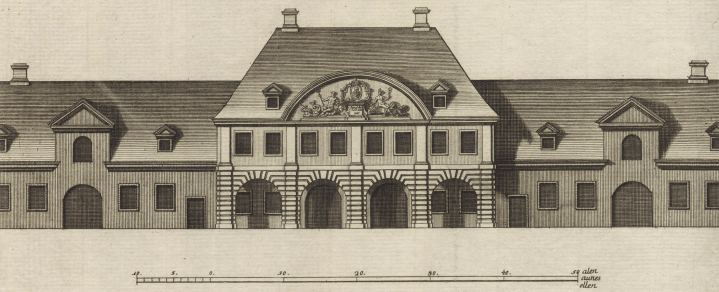
Customs House, Copenhagen.
◊ ◊ ◊ ◊ ◊
From the Call for Papers:
Rome in the Nordic Countries: Images of Ancient and Modern Architecture, 17th–18th Century
Online and in-person, Rome, late November/early December 2025
This conference will draw attention to the artistic and architectural exchanges between Rome and the Nordic countries from the seventeenth to eighteenth century, focusing on the production, marketing, use, and conservation of images, including drawings and engravings, illustrated books, and suites of prints. These works found massive transnational circulation, and their adaptability made them indispensable tools in the history of the arts, and more generally in the broader European cultural expansion. The conference addresses the artistic-architectural relations between the Nordic countries (essentially Denmark, Norway, Sweden, and Finland, but with openness to the entire transalpine world), and the Italian peninsula. The pivot is ancient and modern Rome, the recognized crossroads of cultural elaboration and the centre of a massive and varied publishing production, through which the foundations were laid for the construction of a shared European artistic-architectural language based on Classicism.
Proposals should address issues of cross-cultural exchange, among which we suggest:
Travelling across Europe
• Travelling South, Renaissance to early 18th century: artists/architects, patrons, sketchbooks, diaries
• Travelling North: migration of Italian artists and architects
Books and Prints
• Producing and marketing images of architecture: Rome and the Nordic countries in the European context
• Using and collecting architectural prints
• Vitruvius and Palladio: architectural books in the North
• Architectural libraries
Rome in the North: Functions, Techniques, Styles
• Issues of style: Classicism, Baroque, post-Baroque and early classicism in the architecture of the Nordic countries
• Festive, funerary, and military architecture
• Urban planning and infrastructures: monuments and places
• Models and monuments
Nordic Rome
• The reception of Nordic architectural culture in early modern Italy
The conference will be in Rome, in person and hybrid. Travel expenses will be partially met. Participants will be expected to submit revised and expanded versions of their papers six months after the conference for publication as an edited volume. All proposals (max 1200 words) can be written in English, French, or Italian. Proposals should be sent to nordicromeconference@gmail.com by 31st January 2025.
Scientific Committee
• Antonello Alici, Università Politecnica delle Marche, Ancona
• Mario Bevilacqua, Sapienza Università di Roma; Centro Studi sulla Cultura e l’Immagine di Roma
• Kristin Bliksrud Aavitsland, Universitetet i Oslo
• Kristoffer Neville, University of California, Riverside
• Sabrina Norlander Eliasson, Stockholms universitet; Istituto svedese di Studi classici a Roma
• Saverio Sturm, Università Roma Tre; Centro Studi sulla Cultura e l’Immagine di Roma
• Victor Plahte Tschudi, Arkitektur- og designhøgskolen i Oslo
Journée d’études | Les reflets de Pierrot
Though the first day at the Louvre is by invitation only, the second day at the DFK is open to the public:
Les reflets de Pierrot, de Watteau à Deburau et Prévert et jusqu’à aujourd’hui
Musée du Louvre and Deutsches Forum für Kunstgeschichte, Paris, 21–22 January 2025
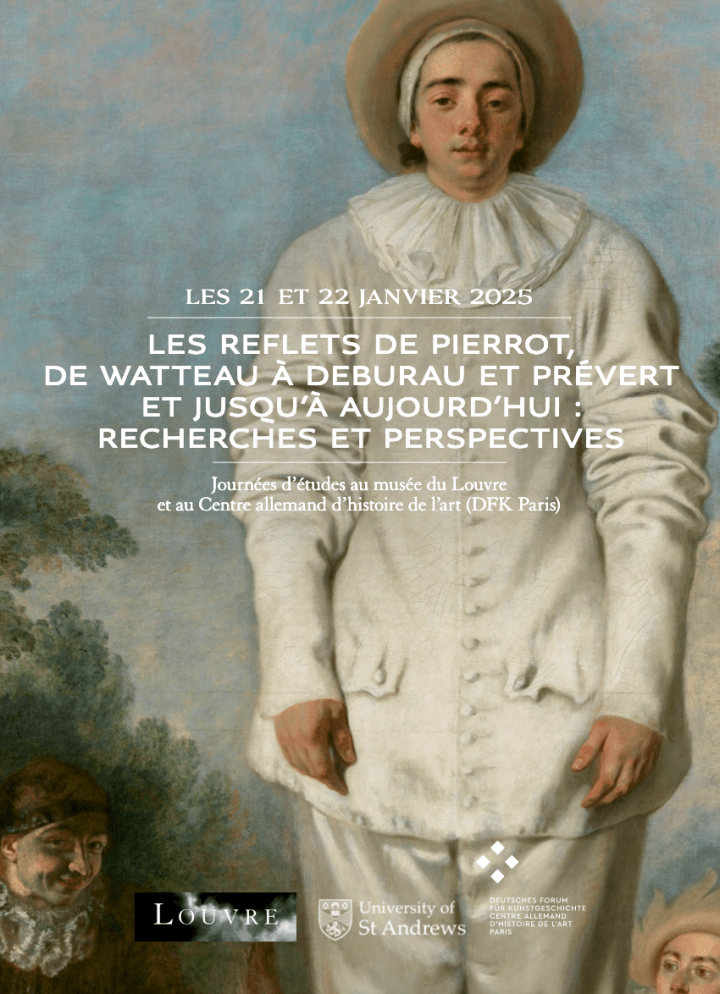 À l’occasion de l’exposition « Revoir Watteau. Pierrot dit le Gilles. Un comédien sans réplique » au musée du Louvre (du 16 octobre 2024 au 3 février 2025), dirigée par Guillaume Faroult et liée notamment à la restauration récente de la célèbre peinture attribuée à Antoine Watteau, Pierrot dit autrefois le Gilles, ces journées d’études sont organisées en collaboration par le département des Peintures du musée du Louvre et le Centre allemand d’histoire de l’art Paris, avec le soutien de l’Université de St. Andrews. Elles ont pour but d’analyser la riche histoire et les nombreuses représentations et réceptions de la figure de Pierrot dans les arts et la culture visuelle des XVIIIe au XXIe siècles. Chercheur·ses, universitaires, conservateur·rices et spécialistes de différentes disciplines ainsi que périodes sont réuni·es pour discuter de l’importance de Pierrot à partir du célèbre et énigmatique tableau du Louvre ainsi qu’en cernant le personnage visuel-théâtral-fictif dont la vogue fut considérable notamment à partir du XIXe siècle.
Pierrot était un personnage issu du répertoire de la Comédie-Italienne qui s’était fait une place sur la scène du théâtre forain, lorsqu’il retint l’attention d’Antoine Watteau au début du XVIIIe siècle. Une figure modeste, voire timide, mais récurrente dans les fêtes galantes du peintre, Pierrot est soudain représenté d’une manière monumentale sur le grand tableau du Louvre, créé probablement par Watteau dans des circonstances et pour des raisons qui restent obscures. Bien qu’aucune source de l’époque ne fasse mention de ce tableau ambitieux et singulier, il est néanmoins incontestable qu’il a participé à la fixation de la représentation de Pierrot au XVIIIe siècle dans son blanc costume et sa pose caractéristique.
L’histoire du tableau, apparu au début du XIXe siècle dans la collection de Dominique Vivant Denon, est liée à la renaissance de Pierrot en tant que personnage vedette des spectacles parisiens, récurrent tant dans d’innombrables œuvres d’art (peintures, gravures, photographies, etc.) que dans l’imaginaire littéraire ainsi que sur la scène théâtrale. Depuis le théâtre de pantomime du Paris romantique, où le personnage était incarné par le célèbre mime Jean-Gaspard Deburau, il est devenu une figure clé des spectacles « fin de siècle ». Cette mythologie vivante a reçu un hommage ultime dans le chef-d’œuvre du cinéma de l’Occupation, Les Enfants du Paradis (Marcel Carné/Jacques Prévert), sorti après la Libération de Paris. Naïf ridicule, mélancolique tuberculeux, objet de railleries ou rusé farceur — tout au long de cette histoire, l’identité de Pierrot réside autant dans sa singularité que dans sa multiplicité, et elle continue à nourrir l’imagination artistique et populaire jusqu’à l’époque contemporaine.
m a r d i , 2 1 j a n v i e r
Musée du Louvre — Session en comité restreint (sur invitation)
9.15 Accueil
10.00 Visite de l’exposition Revoir Watteau. Pierrot dit le Gilles Un comédien sans réplique
14.00 Accueil par Sébastien Allard (musée du Louvre)
14.20 Session 1
Modération Marie-Catherine Sahut (musée du Louvre)
• Pierrot : figure de l’intériorité ? — Aaron Wile (National Gallery of Art, Washington D.C.)
• À l’ombre de Pierrot, Crispin selon Watteau et ses contemporains — Guillaume Faroult (musée du Louvre)
• Pierrot et Oudry : une histoire d’identité — Hélène Meyer (musée du Louvre)
16.20 Session 2
Modération Jörg Ebeling (DFK Paris)
• « La joie du theâtre » : Pierrot dans l’œuvre de Nicolas Lancret — Axel Moulinier (Paris)
• Watteau on the Wall: The Figure of Gilles in Mural Decorations — Lars Zieke (Université d’Iéna)
• De la toile à la scène : variations pierrotiques du XIXe siècle à nos jours — Ariane Martinez (Université de Lille)
m e r c r e d i , 2 2 j a n v i e r
Centre allemand d’histoire de l’art (DFK Paris) — Session ouverte au public (dans la limite des places disponibles)
9.30 Accueil et introduction par Peter Geimer et Elisabeth Fritz (DFK Paris)
10.00 Session 3
Modération Guillaume Faroult (musée du Louvre)
• Pierrot entre deux temps : survivance, disposition, vulnérabilité, de Watteau à Édouard Manet — Marika Takanishi Knowles (University of St Andrews)
• Un petit marchand de tableaux, nommé Meunier. Commerce, brocante et œuvres d’art de la fin de l’Ancien régime au début du XIXe siècle — Oriane Lavit (musée du Louvre)
11.10 Pause café
11.30 Session 4
Modération Markus A. Castor (DFK Paris)
• Deburau Pierrot : initiateur de regards sur le Pierrot, dit Gilles de Watteau — Edward Nye (Université d’Oxford)
• Writing Watteau, Repainting Pierrot in 19th-Century Paris — Judy Sund (CUNY Emerita, New York)
12.40 Pause déjeuner
14.00 Session 5
Modération Yuriko Jackall (Detroit Institute of the Arts)
• Incarner la mélancolie : autour du Pierrot noir (1907) de Karel Myslbek — Petra Kolárová (Galerie Nationale de Prague)
• James Ensor. Pierrot au théâtre des masques — Xavier Tricot (historien d’art et commissaire des expositions à la Maison James Ensor, Ostende)
• « Le pitre sans défense ». Un écrivain regarde le Gilles (Hildesheimer/Watteau) — Peter Geimer (DFK Paris)
15.40 Pause café
16.00 Session 6
Modération Marika Takanishi Knowles (University of St Andrews)
• À la recherche du Pierrot des Enfants du paradis (1945) de Carné et Prévert — Carole Aurouet (Université Gustave-Eiffel, Champs-sur-Marne)
• Pierrot vivant. Quelques réinterprétations du motif dans l’art contemporain — Sophie Eloy (musée de l’Orangerie) et François Michaud (Fondation Louis Vuitton)
• Pierrot « to go » ? Réflexions sur une figure revenante entre introspection et projection — Elisabeth Fritz (DFK Paris)
Talk | Paris Spies-Gans on Sophie Fremiet’s Portrait of a Woman
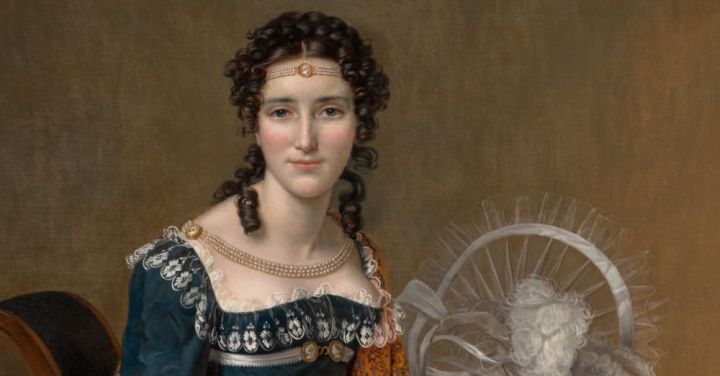
Sophie Frémiet (later Rude), Portrait of a Woman, detail, 1818, oil on canvas, 64 × 46 inches
(Los Angeles: Getty Museum, 2024.25).
◊ ◊ ◊ ◊ ◊
Upcoming at the Getty (which acquired the painting in 2024), as we all watch the fires with ache and concern . . .
Paris Spies-Gans | Breaking Barriers: Sophie Frémiet and the Rise of Women Artists in Europe
Online and in-person, Getty Center, Los Angeles, 4 May 2025, 2pm (originally scheduled for 26 January)
Around the turn of the 18th century, over a thousand women contributed more than 7,000 works to London’s and Paris’ premier exhibitions. It was a transformative moment for women artists in Europe, who exhibited and sold their art in unprecedented numbers. In this context, Sophie Fremiet painted her luminous Portrait of a Woman (1818). Paris Spies-Gans delves into this era to upend longstanding assumptions about women’s opportunities and wrongly forgotten triumphs. Tickets are free, but required for event entrance. Your event ticket will also serve as your Center entrance reservation. To watch online, please register via Zoom.
Paris A. Spies-Gans is a historian of art with a focus on women, gender, and the politics of artistic expression. Her first book, A Revolution on Canvas: The Rise of Women Artists in Britain and France, 1760–1830 (Paul Mellon Centre in association with Yale University Press, 2022), was named one of the top art books of 2022 by The Art Newspaper and The Conversation. It also received several prizes in the fields of British history, art history, and 18th-century studies. She is currently working on her second book, A New Story of Art (US/Doubleday and UK/Viking).
◊ ◊ ◊ ◊ ◊
Note (added 21 January 2025) — The posting has been updated with the rescheduled date.
Talk | Stephanie O’Rourke on John Martin and Romantic Extraction
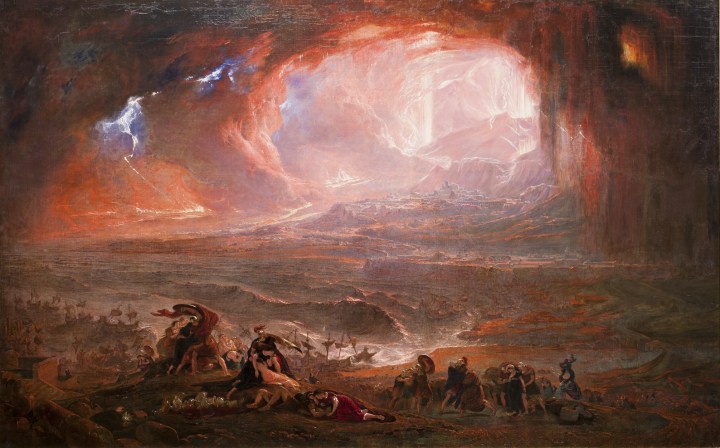
John Martin, The Destruction of Pompeii and Herculaneum, 1822, oil on canvas, 162 × 253 cm
(London: Tate, N00793).
◊ ◊ ◊ ◊ ◊
From the Mellon Centre:
Stephanie O’Rourke | John Martin and Romantic Extraction
Online and in-person, Paul Mellon Centre, London, 22 January 2025, 5pm
The early nineteenth-century artist John Martin bore witness to a rapidly carbonising Britain. Although he is most famous for his dramatic portrayals of epic, historical narratives, Martin was also exceptionally attuned to the transformations visited upon his environment by the rise of industrial resource extraction. His was a world characterised by the subterranean flows of dangerous substances such as noxious gases and sewage, by the desired inflow of natural resources such as water to urban centres and by the invisible spread of less-material phenomena across Britain’s imperial boundaries. In this paper, O’Rourke explores some of the many flows that shaped Martin’s world and his art. We often assume it was J.M.W. Turner’s paintings that best captured the arrival of steam-powered modernity in early nineteenth-century Britain through their explosive treatment of colour and their formal irresolution. But what if it were Martin’s work? What could we come to understand about the conditions of fossil-powered modernity and about romanticism if we took Martin as our guide?
Book tickets here»
Stephanie O’Rourke is a senior lecturer in Art History at the University of St Andrews specialising in eighteenth- and nineteenth-century art. Her second book Picturing Landscape in an Age of Extraction: Europe and its Colonial Networks 1780–1850 (University of Chicago Press, 2025) charts the relationship between landscape and resource extraction in the first half of the nineteenth century. Her prize-winning first book, Art, Science, and the Body in Early Romanticism (Cambridge UP, 2021), examines the changing evidentiary authority of the human body in European romantic thought. She has published widely on the relationship between art and resource extraction, scientific knowledge, and media technologies.
New Book | Printing Colour, 1700–1830
From Oxford UP:
Margaret Morgan Grasselli and Elizabeth Savage, eds., Printing Colour 1700–1830: Histories, Techniques, Functions, and Receptions (Oxford: Oxford University Press, 2025), 448 pages, $185. Proceedings of the British Academy
 Printing Colour 1700–1830 offers a broad-ranging examination of the rich period of invention, experimentation, and creativity surrounding colour printing in Europe between two critically important developments, four-colour separation printing around 1710, and chromolithography around 1830. Its 28 field-defining contributions by 23 leading experts expand the corpus beyond rare fine art impressions to include many millions of colour-printed images and objects. The chapters unveil the explosive growth in the production and marketing of colour prints at this pivotal moment. They address the numerous scientific and technological advances that fed the burgeoning popularity for such diverse colour-printed consumer goods as clothing, textiles, wallpapers, and ceramics. They recontextualise the rise in colour-printed paper currencies, book endpapers and typography, and ephemera, including lottery tickets and advertisements. This landmark volume launches colour printing of the long 18th century as an interdisciplinary field of study, opening new avenues for research across historical and scientific fields.
Elizabeth Savage is Senior Lecturer in Book History and Communications, School of Advanced Study, and Head of Academic Research Engagement, Senate House Library, University of London. In 2020–22, she was an Honorary Fellow at Centre for the Study of the Book, Bodleian Libraries, Oxford University. In 2022–23, she was a Fellow at Linda Hall Library. Her research into pre-industrial European printing techniques, especially for colour, has won awards including the Schulman and Bullard Article Prize. Her latest book is Early Colour Printing: German Renaissance Woodcuts at the British Museum, and she co-edited Printing Colour 1400–1700. She regularly curates and contributes to exhibitions about print heritage, for example at the British Museum and Musée du Louvre. She teaches at London Rare Books School.
Margaret Morgan Grasselli worked for forty years at the National Gallery of Art in Washington, thirty as Curator of Old Master Drawings. Having retired in 2020, she then served as Visiting Lecturer in the department of History of Art and Architecture of the Faculty of Arts and Sciences at Harvard University (2020–22) and Visiting Senior Scholar for Drawings at the Harvard Art Museums (2020–23). An expert on French drawings, she is also an authority on French color prints of the 18th century. She organised the 2003 exhibition at the National Gallery of Art, Colorful Impressions: The Printing Revolution in Eighteenth-Century France, and was the editor and primary author of the accompanying catalogue.
c o n t e n t s
Introduction — Margaret Morgan Grasselli and Elizabeth Savage
Part 1 | Materials and Techniques Printing Colour in 18th-Century Europe
• Tools, Machines, and Presswork for Printing Colour in 18th-Century Europe — Margaret Morgan Grasselli and Elizabeth Savage
• Colour Printing Inks and Colour Inking in 18th-Century Europe — Elizabeth Savage
Part 2 | Relief Techniques: Letterpress, and Colour Woodcut
• Colour Letterpress in Europe in the Long 18th Century — Ad Stijnman
• Elisha Kirkall and His Proposals for Printing in Chiaroscuro, Natural Colours, and Tints, 1720–40 — Simon Turner
• Printing Chiaroscuro and Colour Woodcuts in Paris, Venice, and London c.1725–70 — Tico Seifert
• Bringing Colour to Books and Objects with Decorated Paper in the Long 18th Century — Sid Berger, Michèle Cloonan
• Colour for Commerce: Letterpress-Printed Ephemera in Britain, 1700–1830 — Rob Banham
Part 3 | Mezzotint and Trichromatic Printing
• The Politics of Process Mezzotint: Jacob Christoff Le Blon’s Reputation, 1700–89 — Elizabeth Savage
• From Colour Theory to Colour Practice: Printmakers in Pursuit of the Ideal Pigments in 18th-Century Europe — Dionysia Christoforou, Manon van der Mullen, and Victor Gonzalez
• Colouring the Body: Printed Colour in Medical Treatises during the Long 18th Century — Julia Nurse
• Colour Printing in Late 18th-Century Italy: Édouard and Louis Dagoty, 1770–1800 — Alice Nicoliello
Part 4 | Chalk, Pastel and Watercolour Manner, and Aquatint
• Printed Paintings and Engraved Drawings: Technical Innovations in Colour Printing in 18th-Century France — Margaret Morgan Grasselli
• Coloured Prints in Imitation of Old Master Drawings in 18th-Century Italy: Anton Maria Zanetti the Elder, Benigno Bossi, Francesco Rosaspina and their Contemporaries — Benedetta Spadaccini
• François-Philippe Charpentier and the Development of Aquatint in France in the 1760s — Rena Hoisington
• A Voyage pittoresque in Norway through Colour Prints, 1789–c.1815 — Chiara Palandri
• The Market for Colour Prints in Paris at the End of the 18th Century — Corinne Le Bitouzé
• Multiple-Plate Colour Prints and the Problems of Variant Impressions, Missing Plates, and Disappearing Inks — Margaret Morgan Grasselli
Part 5 | Stipple and a la Poupée
• English Colour-Printed Stipple Engravings, 1774–1800 — David Alexander
• Between Painting and Graphic Arts: Colour Printmaking in Russia, 1750s–1800s — Zalina Tetermazova
• Anne Allen, Jean Pillement, and the Development of à la poupée Printing in France — Geert-Jan Janse
• The Contribution of à la poupée-inked Colour Printing to Natural History Illustration in France, 1800–1870 — Karen Cook
Part 6 | Consumer Goods and Expanding Markets for Colour Printing
• Anatomy to Embroidery: Intaglio Colour-Printed Illustrations in European Books and Periodicals, 1700–1850 — Ad Stijnman
• Early Dye-Patterned Colour on Calico in Europe, 1600–1840 — Susan Greene
• Printed Wallpaper in England in the Long 18th Century — Phillippa Mapes
• Colour Printing on English Ceramics, 1751–70 — Patricia Ferguson
Part 7 | Technical Experimentation and Industrialisation
• William Blake’s Colour Printing: Methods and Materials — Michael Phillips
• Innovation and Tradition in Early 19th-Century Colour Printing — Michael Twyman
• The Beginnings of Commercial Colour Printing in Europe, 1835–40 — Michael Twyman
Conference | Hand-Colouring of Natural History Illustrations, 1600–1850
From ArtHist.net:
The Hand-Colouring of Natural History Illustrations in Europe, 1600–1850
Online and in-person, University of Konstanz, 26–27 February 2025
Organized by Joyce Dixon and Giulia Simonini
This hybrid workshop will explore from different perspectives how and for what purposes printed illustrations of natural history books were hand-coloured. A special focus of the workshop will be the activities and practices of hand-colourers known also as ‘colourists’, ‘afzetters’ (in Dutch) and ‘Illuministen’ (in German), which remain until today understudied. To register, please email lea.stengel@tu-berlin.de.
w e d n e s d a y , 2 6 f e b r u a r y
9.00 Registration
9.30 Introduction / Round table
10.15 Coffee break
10.30 Panel 1 | Colourists
• Stefanie Jovanovic-Kruspel, Leah Karas, Mario Dominik Riedl (Naturhistorisches Museum Vienna) — The Role of Child Labour in Natural History Illustration
• Joyce Dixon (Independent) — ‘A School of Females’: Hand-Colourers in the Edinburgh Studio of William Home Lizars
• Luc Menapace (Bibliothèque Nationale de France) — The Hand-Colouring of Natural History Illustrations in Paris in the First Half of the 19th Century
12.45 Lunch
13.30 Panel 2 | Capturing Changeable Colours
• Cynthia Kok (Mellon Postdoctoral Fellow, Rijksmuseum) —Investigating Iridescence: Mother-of-Pearl in Early Modern Natural Illustrations
• Christine Kleiter (Deutsches Studienzentrum Venice) — How to Represent Iridescent Feathers in Hand-Coloured Prints? Colouring Practices in Pierre Belon’s L’Histoire de la nature des oyseaux (1555)
• Paul Martin (University of Bristol) — Accuracy and Consistency in Colouring of Antiquarian Ichthyology Engravings
15.30 Coffee break
15.45 Panel 3 | Colours in Botanical Illustrations
• Jessie Wei-Hsuan Chen (Royal Netherlands Academy of Arts and Sciences) — Which Color Comes First? Hand-Colouring Gradations on Plants in the 16th and 17th Centuries
• Magdalena Grenda-Kurmanow (Academy of Fine Arts Warsaw) —Ultimate Documentation: Between a Plant Illustration and a Botanical Specimen
• Eszter Csillag (HKBU Jao Tsung I Academy of Sinology) — Michael Boym’s Hand-Coloured Images in Flora sinensis (Vienna, 1656)
19.30 Dinner
t h u r s d a y , 2 7 f e b r u a r y
9.00 Keynote Address
• Alexandra Loske (Curator of the Royal Pavilion, Brighton) — Botanical Illustrator, Flower Painter, and Colour Theorist: Mary Gartside’s Path from the Figurative to the Abstract in Her Early 19th-Century Illustrated Books
10.00 Coffee break
10.15 Panel 4 | Working Processes
• Katarzyna Pekacka-Falkowska (Poznan University of Medical Sciences) — The Colours of Nature in Early 18th-Century Danzig/Gdańsk: Johann Philipp Breyne, Jacob Theodor Klein, and the Hand-Coloured Illustrations
• Cam Sharp Jones (British Library) — Colouring Seba’s Thesaurus
• Giulia Simonini (Technische Universität Berlin) — The Master Plates for August Johann Rösel von Rosenhof’s Insecten-Belustigung: A Family Enterprise
12.15 Lunch
13.00 Closing remarks and discussion
Exhibition | Being There
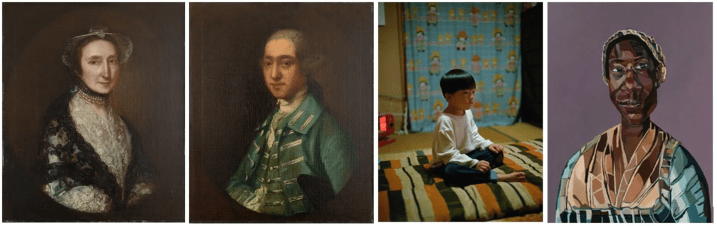
Left to right: Thomas Gainsborough, Portraits of Elizabeth Tugwell and Thomas Tugwell, each ca. 1763, oil on canvas; Paul Graham, Ryo, Japan, 1995, colour coupler print (Courtesy the artist and Anthony Reynolds); Joy Labinjo, She is my wife and truly best part, 2022, oil on canvas (Courtesy Tiwani Contemporary).
◊ ◊ ◊ ◊ ◊
Now on view at No. 1 Royal Crescent:
Being There
No. 1 Royal Crescent, Bath, 14 September 2024 – 23 February 2025
Curated by Ingrid Swenson
Our new exhibition Being There features four recently acquired portraits by Thomas Gainsborough (1727–1788) and eighteen portraits by contemporary artists. The exhibition is the first in The Gallery at No.1 Royal Crescent’s ambitious new programme of contemporary art exhibitions.
The four Gainsborough paintings are presented as key components of a kaleidoscopic group exhibition of portraiture featuring eighteen contemporary British artists selected by guest curator Ingrid Swenson MBE. The title for the exhibition, Being There, is intended to invite visitors to reflect on the experience of artists and their sitters or subject in the act of making the artwork, and to consider what similarities and differences there may be for the role of the artist in Gainsborough’s time and today. Artists in Being There are Michael Armitage, Frank Auerbach, Sarah Ball, Richard Billingham, Glenn Brown, Brian Dawn Chalkley, Kaye Donachie, Paul Graham, Maggi Hambling, David Hockney, Claudette Johnson, Chantal Joffe, Lucy Jones, Joy Labinjo, Melanie Manchot, Celia Paul, Gillian Wearing, and Shaqúelle Whyte.
Painted around 1763, the Gainsborough portraits depict members of the prominent Tugwell family from Bradford on Avon: clothier Humphrey Tugwell and his wife Elizabeth, along with their sons William and Thomas. It is exceptionally rare for a set of four portraits of members of the same family by Gainsborough to survive together. Rarer still is the fact that the sitters are not aristocratic visitors to fashionable Bath, but middle-class manufacturers from a small West Country town.The suite of portraits is remarkable for capturing two generations of a wealthy, upwardly mobile manufacturing family. Housed in their original frames carved by Carlo Maratta, these four portraits must be seen in person to be fully appreciated!
The four Gainsborough portraits were Accepted in lieu of Inheritance tax by HM Government in 2024 and allocated to Bath Preservation Trust.
Fellowships | Royal Museums Greenwich, 2025–26
From Royal Museums Greenwich:
Caird Fellowships, 2025–26
Royal Museums Greenwich, London
Applications due by 29 January 2025
Royal Museums Greenwich (National Maritime Museum, Royal Observatory Greenwich, Cutty Sark, and the Queen’s House) is pleased to announce that applications for the 2025–26 Caird Fellowships programme are now open, with a deadline of 29 January 2025.
The Caird Fellowship programme has for many years facilitated high-quality independent research, providing new perspectives on our sites and collections and supporting our public programmes and displays. We welcome applications from anyone with relevant lived or academic experience who can demonstrate a commitment and ability to undertake independent research. The Museum supports innovative and cross-disciplinary research and is also keen to encourage creative, practice-based, and community-based projects in areas such as the visual arts, heritage, performance, and literature.
We welcome applications within (but not restricted to) a range of areas including art history and creative arts, maritime, social and cultural history, histories of science and technology, conservation studies, museum and heritage studies, material culture studies, historical geography, and literary studies.
An information webinar will be held on 9 January. Details of the webinar and how to apply for the Fellowships can be found here. Please send enquiries to research@rmg.co.uk.










 Enfilade
leave a comment