New Book | Eighteenth-Century Sicily: Rebuilding after Natural Disaster
From Amsterdam UP:
Martin Nixon, Architecture, Opportunity, and Conflict in Eighteenth-Century Sicily: Rebuilding after Natural Disaster (Amsterdam: Amsterdam University Press, 2023), 284 pages, ISBN: 978-9463725736, €134 / $154.
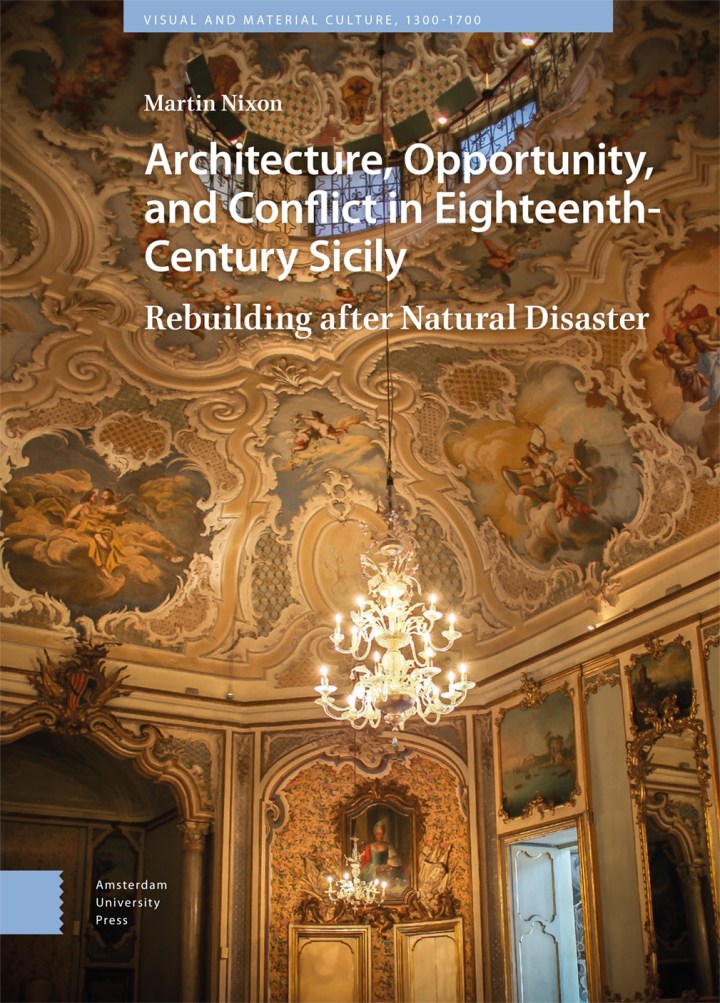 The catastrophic Sicilian earthquake of 1693 led to the rebuilding of over 60 towns in the island’s south-west. The rebuilding extended into the eighteenth century and gave opportunities for the reassertion and the transformation of power relations. Although eight of the towns are now protected by UNESCO, the remarkable architecture resulting from this rebuilding is little known outside Sicily.
This is the first book-length study in English of this interesting area of early modern architecture. Rather than seek to address all of the towns, five case studies discuss key aspects of the rebuilding by approaching the architecture from different scales, from that of a whole town to parts of a town, or single buildings, or parts of buildings and their decoration. Each case study also investigates a different theoretical assumption in architecture, including ideas of the Baroque, rational planning, and the relegation of decoration in architectural discourse.
Martin Nixon is Assistant Professor of Art History at Zayed University, United Arab Emirates. His research interests include Southern Italian art and architecture, architecture and political power, urbanism and territorial transformation, the reception of architectural ornament, and questions of cultural and stylistic hybridity in architecture. Nixon completed his doctoral dissertation on the eighteenth-century rebuilding of the Val di Noto, Sicily with York University in 2018. In 2011, he received the John Fleming Travel Award to assist his doctoral research in Sicily. He completed an MA in Art History at the Open University in December 2007 with a dissertation on the eighteenth-century Sansevero Chapel in Naples.
c o n t e n t s
List of illustrations
Acknowledgments
Introduction
1 Sicily as a Colonial Possession c. 1600–1750: Subordination and Resistance
2 The Hexagonal Towns of Avola and Grammichele: Urbanism, Fortification, and Coercion
3 The Palaces of Noto: Ornament, Order, and Opportunism
4 The Palazzo Biscari in Catania: Lightness, Refinement, and Distinction
5 The Palazzo Beneventano in Scicli: Trauma and Violence
6 The Palaces of Ragusa: Abundance, Famine, and the Grotesque
Conclusion
Glossary
Bibliography
Index
Call for Papers | Lost Cities in a Global Perspective
From ArtHist.net:
Lost Cities in a Global Perspective: Sources, Experience, and Imagery, 15th–18th Centuries
University of Campania ‘Luigi Vanvitelli’, Caserta, 16–17 October 2025
Proposals due by 15 March 2025
In conjunction with the Research Project “The Vesuvian Lost Cities before the ‘Discovery’: Sources, Experience, and Imagery in Early Modern Period” (VeLoCi)
In 1972 Italo Calvino published the book Invisible Cities, encouraging a reflection on modern megalopolises starting from the reactivation of the imaginary arising from the memory of historical cities. In “Cities and Memory 3,” Calvino states that “the city does not tell its past, it contains it like the lines of a hand, written in the corners of the streets, in the grilles of the windows, in the handrails of the stairs, in the antennas of the lightning rods, in the poles of the flags,” underlining how the knowledge of a city passes through the discovery of material elements (space) and immaterial elements (history).
More recently, Salvatore Settis (Se Venezia muore, 2014 / If Venice Dies, 2016) postulated that “Cities die in three ways: when they are destroyed by a ruthless enemy (like Carthage, which was razed to the ground by Rome in 146 BC); when a foreign people settles there by force, driving out the natives and their gods (like Tenochtitlan, the capital of the Aztecs that the Spanish conquistadores destroyed in 1521 and then built Mexico City on its ruins); or, finally, when the inhabitants lose their memory of themselves, and without even realizing it become strangers to themselves, enemies of themselves. This was the case of Athens.”
Many cities across the world have disappeared over the centuries, abandoned (but perhaps never forgotten), destroyed by natural disasters, or buried under new urban layers (Teotihuacán, Chichén Itzá, Copàn, Tulum, Angkor, Petra, Rome, Pompeii, Herculaneum, Brescia), re-emerging for different reasons. Fascinating historians, explorers, archaeologists, architects, and artists, ‘lost cities’—both literally and metaphorically—have continued to exist in literary sources, descriptions, chronicles, and sometimes in iconographic representations.
Pompeii and Herculaneum are two of the most famous cities that disappeared due to natural disasters. Despite historiographical and narrative traditions claiming that their ‘discovery’ occurred only in conjunction with the start of the Bourbon excavations in the 18th century, the VeLoCi project has demonstrated that even before the start of systematic excavations, material traces of the existence of these ancient cities had emerged and that there was no lack of literary, antiquarian, and scientific sources dedicated to their history. In other cases, cities that disappeared following catastrophes or simple stratification were not unearthed, despite their historical past being well known.
What was then the perception, the relationship of coexistence and study and knowledge with the buried/lost cities in the different cultures of the world in the early modern era? What phenomena or episodes have reactivated their systematic research? What are the operational, scientific, and epistemological approaches to the discovery of the past? What are the reasons that suggest seeking and valorising the past?
Starting from the case study of the Vesuvian cities, the international conference Lost Cities in a Global Perspective: Sources, Experience, Imagery in Early Modern Period (XV–XVIII Century) aims to investigate in an interdisciplinary and comparative way the material and imaginary dimensions assumed by lost cities before the birth of archaeology as a science in the 18th and 19th centuries. We invite scholars from a variety of disciplines, including architectural history, art and literary history, history, history of science, archaeology, cultural studies, and other related fields, to submit papers examining cases from any geographical context. Interdisciplinary approaches are particularly welcome, as are contributions that reflect on the exchange of knowledge and cultures at a global level.
Topics may include (but are not limited to):
• Travel Accounts and Exploration: the role of European explorers and missionaries in shaping the narratives of lost cities in Asia, Africa, and the Americas.
• Historiographical approaches: the role of early modern historians and intellectuals in constructing and reconstructing the idea of lost cities.
• Myth and Reality: what role did legends and fantastic narratives have in shaping lost cities and how did they intertwine with emerging archaeological or geographical knowledge.
• Visual Culture and cartography: the role of representations of lost cities in art and cartography.
• Colonialism and Cultural Exchange: the impact of colonial expansion on the perception of lost cities and the relationship with native cultures.
• Material Culture and Archaeology: proto-archaeology and antiquarian research in exploring the physical remains of lost cities and ancient civilizations.
• Literature and Lost Cities: the role of literature in constructing of the idea of lost cities, from utopian and dystopian narratives to adventure tales.
• Cultural Memory and Identity: how did the notion of lost cities has served as a tool for constructing cultural memory and national identity, and how did societies have preserved or forgotten this memory.
• Environmental Factors and Natural Disasters: what role has climate change, natural disasters, and geographical displacement played in the disappearance of cities.
The two-day conference—organised by Giulia Ceriani Sebregondi, Francesca Mattei, and Danila Jacazzi—is promoted by the PRIN 2022 research project “VeLoCi — The Vesuvian Lost Cities before the ‘Discovery’: Sources, Experience, Imagery in Early Modern Period” at the end of its duration and will be hosted at the University of Campania ‘Luigi Vanvitelli’, in Caserta, Italy. VeLoCi will organise and pay for accommodation and reimburse travel costs (economy class) for the speakers. At the end of the conference, the publication of some contributions in a peer-reviewed collective volume will be evaluated. Scientific and organisational secretariat by Giorgia Aureli and Giorgia Pietropaolo.
Participation in the conference is free of charge. The conference languages are Italian and English. Abstracts, in PDF format (maximum 1500 characters, about 250 words) in Italian or English, must include a title and a short biography (maximum 1500 characters, about 250 words). Please send the material to ve.lo.ci.prin@gmail.com by 15 March 2025. Notification of accepted proposals will be sent around 15 April. Please note that this CFP is also open to PhD students and independent scholars.
Scientific Committee
Candida Carrino, Giulia Ceriani Sebregondi, Kathleen Christian, Bianca de Divitiis, Danila Jacazzi, Francesca Mattei, Tanja Michalsky, Massimo Osanna, Francesco Sirano










 Enfilade
leave a comment