Nationalmusée Luxembourg Acquires Three Works by Monique Daniche
As noted by Adam Busiakiewicz at Art History News, the Nationalmusée Luxembourg (MNAHA) recently acquired three portraits by Monique Daniche, who worked in Strasbourg at the turn of the 18th and 19th centuries—one from Tajan (12 June, lot 90) and two from Gros & Delettrez (18 November, lot 283). From the MNAHA:
Michelle Kleyr and Ruud Priem, “New Acquisition: A Female Painter from Strasbourg Steps into the Limelight,” MuseoMag #1 (2025).
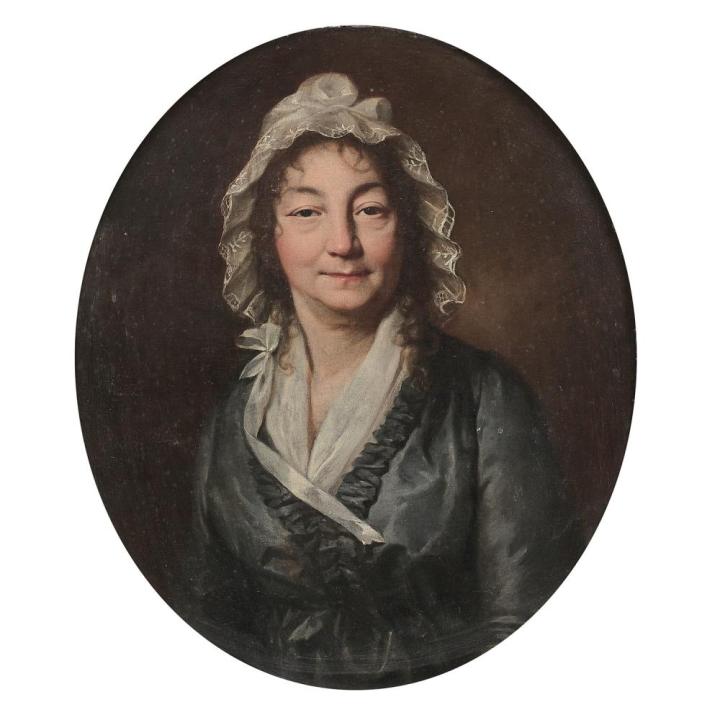
Monique Daniche, Portrait of Catherine Hubscher (1753–1835), known as ‘Madame Sans-Gêne’, ca. 1800 (Luxembourg: MNAHA).
• Monique Daniche, Portrait of Jean Nicolas Michel Tinchant (1770–1835), ca. 1793, oil on canvas, 76 × 62 cm (Luxembourg: MNAHA).
• Monique Daniche, Portrait of Jeanne Louise Thérèse Hebenstreit (1770–1849), ca. 1793, oil on canvas, 76 × 62 cm (Luxembourg: MNAHA).
• Monique Daniche, Portrait of Catherine Hubscher (1753–1835), known as ‘Madame Sans-Gêne’, ca. 1800, oil on canvas, 64 × 55 cm (Luxembourg: MNAHA).
Many museums around the world are actively trying to redress the balance in their collections of European paintings before 1850 where, in general, female portraits and especially works painted by women artists are far outnumbered by their male counterparts. With a limited budget and stiff international competition, the museum’s department of fine arts is always looking for rare opportunities to acquire work in that field on the art market. This year [2024], we were fortunate enough to acquire no less than three works by the French painter Monique Daniche (1737–1824), who was working as a much sought-after portraitist for the Strasbourg elite in the late 18th and early 19th century. Preliminary research on these portraits has revealed some remarkable stories so far.
Little is certain about Daniche’s biography and oeuvre. We know that her father Jean Tanisch (c.1700–1775) was born near Trier and recorded living between 1736 and 1742 in the Valsesia alpine valley, where he married Monique’s Tuscan mother, Rose Rossi (c.1714–1778). Our painter was born in 1737 as Marie Monique Rose Tanisch in Varallo (Piedmont), before her family relocated to Strasbourg around 1743. Although they changed their surname to ‘Daniche’ to make it sound more French, Monique kept signing her work as ‘Tanisch’. Her family was made up of painters, with her father teaching Monique and her younger siblings Ursule (1742–1822), Antoine Clément (b.1744), and Pierre (b.1752).
Almost none of their paintings are signed, and it is difficult to determine which work should be attributed to which specific family member, especially since they worked together on some paintings during their careers, Monique and Ursule in particular. As no signed works by Ursule are known to date, we assume that she collaborated exclusively with her older sister, perhaps as her assistant. Both women lived and worked together in Strasbourg all their lives, did not marry, and never seem to have left Alsace. The early years of their careers focused primarily on religious paintings for the altars of churches in Strasbourg and the surrounding area. With the dispossession and dispersal of church property during the political upheavals of the French Revolution, the sisters’ painting practice shifted to an entirely different genre, with Monique Daniche concentrating almost exclusively on portraiture from 1790 onwards.
Much of the information we have about the life and work of Monique Daniche was unearthed by the Strasbourg historian Alain Luttringer in a publication of Cahiers alsaciens d’archeologie, d’art et d’histoire 43 (2000). The addresses of her residences and workshops, the fact that the sisters employed a servant and lent considerable amounts of money, and an idea of the extent of Monique’s original oeuvre are entirely based on his research. Luttringer identified at least 35 works painted by Monique Daniche, with another 12 works attributed to her. Overall, it is a small artistic oeuvre, of which just over a dozen works have survived. . . .
The full essay is available here»










 Enfilade
leave a comment