New Book | The Empire’s New Cloth
Available soon from Yale UP (and please note Rado’s upcoming BGC talk, noted below) . . .
Mei Mei Rado, The Empire’s New Cloth: Cross-Cultural Textiles at the Qing Court (New Haven: Yale University Press, 2024), 208 pages, ISBN: 978-0300275148, $75.
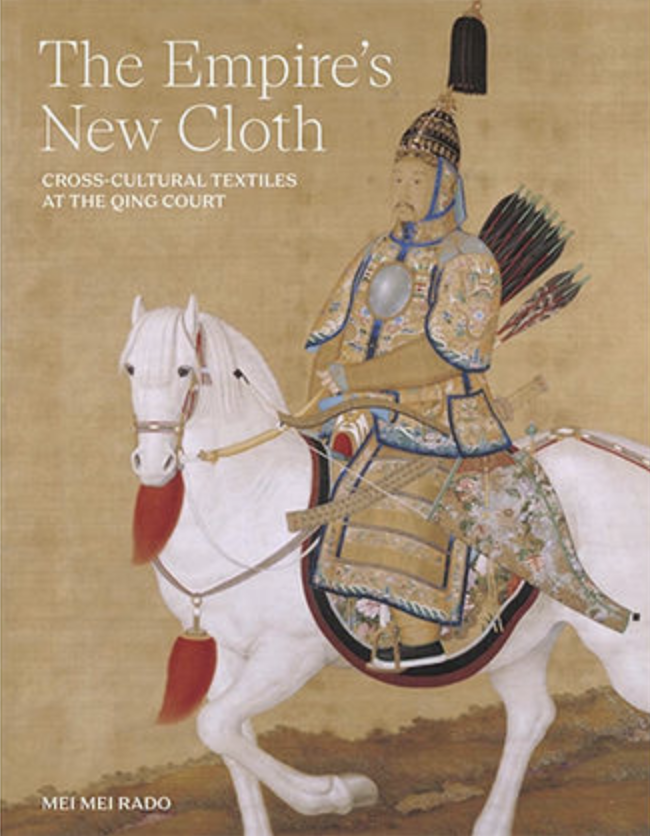 A groundbreaking study of textiles as transcultural objects in the Qing court that provides a new understanding of the interconnectedness of the early modern world
In the early modern period luxury textiles circulated globally as trade goods and diplomatic gifts, fostering cultural exchange between distant regions. By the eighteenth century, both China and Europe had developed a splendid tradition of silk and tapestry weaving. While the role of Chinese silk imports in Europe has been well studied, this book reconstructs the forgotten history of the eastward movement of European textiles to China and their integration into the arts and culture of the Qing Empire. The Empire’s New Cloth explores how Qing court workshops adapted European textile designs and techniques and uncovers the specific uses and meanings of these textiles in imperial military ceremonies, religious spaces, and palace interiors. Through careful study of a wide range of previously unpublished objects, Mei Mei Rado illuminates how these cross-cultural textiles provided the visual and material means for the Qing ruler to convey political messages. By revealing how Qing imperial patrons and artisans responded and assigned meanings to European influences, this beautifully illustrated volume highlights the reciprocity in eighteenth-century Sino-European exchanges and centers textiles within the dynamic global flow of objects and ideas.
Mei Mei Rado received her MA from the University of Chicago and her PhD from Bard Graduate Center, New York, where she is currently an assistant professor. Her research and teaching focus on the history of textiles, dress, and decorative arts in China and France from the eighteenth to the early twentieth centuries, especially on Sino-French exchanges. From 2020 to 2022 she was associate curator of costume and textiles at Los Angeles County Museum of Art, and previously she has held research fellowships in the Department of European Sculpture and Decorative Arts at the Metropolitan Museum of Art and in the Department of Court Arts at the Palace Museum, Beijing..
◊ ◊ ◊ ◊ ◊
Mei Mei Rado | The Empire’s New Cloth
Bard Graduate Center, New York, 19 February 2025, 6pm
Registration is available here»
Call for Applications | Chinese Object Study Workshops, 2025
From ArtHist.net:
Materials and Methods in Chinese Calligraphy
University of Michigan Museum of Art, Ann Arbor, 9–13 June 2025
On Jewelness: Buddhist Materiality in Sino-Himalayan Art, 1400–1800s
Asian Art Museum of San Francisco, 18–22 August 2025
Applications due by 3 March 2025
An essential element in the training of art historians and curators is object-based learning in an immersive and supportive museum environment. This hands-on experience is critically important to scholars’ developing skills in close observation, connoisseurship, and art historical and conservation analysis. The China Objects Study Workshop—currently administered by the National Museum of Asian Art and starting 2025 the University of Michigan Museum of Art—is designed to cultivate a sensitivity to the importance of objects and a holistic understanding of art that can only be achieved through in-person examination. The workshops, occurring twice yearly, provide selected graduate students in the field of pre modern Chinese art history with an immersive experience in the study of objects through a week-long intensive session at rotating North American museums. During the week the students also develop insights into museum operations and practices as well as working relationships that can advance scholarly exchange and enduring professional connections.
The program is funded by the Kingfisher Foundation and administered by the University of Michigan Museum of Art. The program is open to graduate students enrolled in, or accepted to, a PhD program in the field of Chinese art history at a North American or European university. Graduate students from other art history–related programs and/or who are working closely with Chinese art objects are welcome to apply as well. Applicants may be of any nationality and may apply for more than one workshop. Housing, most meals, and a transportation stipend will be provided for each participant.
Students are welcome to apply for both workshops in a single application, addressing their background and interest in each workshop in separate application statements. One recommendation letter for the two workshop topics is sufficient. The application deadline is March 3, and decisions will be announced by March 31. To apply, please visit the link here.
The two following workshops are offered in 2025:
Materials and Methods in Chinese Calligraphy
University of Michigan Museum of Art, Ann Arbor, 9–13 June 2025
This workshop aims to engage participants in an immersive study of the materials, tools, and techniques used in writing and researching calligraphy. Participants will closely examine a rich collection of Chinese calligraphy from the Lo Chia-Lun Collection of Chinese Calligraphy at the University of Michigan Museum of Art in Ann Arbor, MI, alongside pieces from the museum’s longstanding collection of Chinese art. The workshop will cover all aspects of calligraphy as an art object as well as the writing process and methods. This includes materials and techniques for writing and mounting, seal placement, and para-matter and content (such as frontispiece, signature, colophon, etc.). Through the practice of close looking and group discussion in front of the pieces, the workshop helps participants understand the formation of styles and modes of display and reception. In doing so, the workshop encourages participants to master the skills necessary for researching any given piece of calligraphy within a historical context and to explore new possibilities for establishing research methodologies that expand the study of Chinese art history as a holistic field.
Workshop Leaders
• Lihong Liu, University of Michigan
• Qianshen Bai, Zhejiang University
• Natsu Oyobe, University of Michigan Museum of Art
On Jewelness: Buddhist Materiality in Sino-Himalayan Art, 1400–1800s
Asian Art Museum of San Francisco, 18–22 August 2025
Jewels are a ubiquitous presence in Buddhist literary and material culture. From the Three Jewels of Buddhism to the visual and material instantiation of the wish-fulfilling jewel, the frequent appearance of jewels as metaphor and material inspires cross-disciplinary inquiries into Buddhist world-making. How might a close study of objects shed new light on jewelness in Buddhist discourse and visual culture? This workshop explores the theme of jewelness through a selection of Sino-Himalayan objects in the collection of the Asian Art Museum of San Francisco. Drawing on Buddhist objects from the 14th to the 19th centuries that highlight the connection between China and the Himalayas, the workshop will offer students the hands-on opportunity to study a range of media. They include stone carvings, glazed ceramics, glass, bronze images, precious stone inlays, illuminated manuscripts, relics and reliquaries, sculptures in dry lacquer and wood, as well as pigments and painted representations. Topics to be explored include luster, luminescence, and translucency; related ritual and technological processes; history of transcultural exchanges; broader aesthetics of opulence and splendor in Chinese and Tibetan Buddhism; and the dialectics of transparency and opacity, concealment and revelation.
Workshop Leaders
• Wen-shing Chou, Hunter College & The Graduate Center, CUNY
• Ellen Huang, ArtCenter College of Design
• Jeffrey S. Durham, Asian Art Museum of San Francisco










 Enfilade
leave a comment