Lea Stephenson Announced as PAFA Curator
From the press release, via Art Daily:
 The Pennsylvania Academy of the Fine Arts (PAFA), the first museum and school of fine arts in the United States, today announced Lea Stephenson as the next Kenneth R. Woodcock Curator of Historical American Art, effective 10 February 2025. In this role, Stephenson will work to strengthen the development, research, presentation, and growth of PAFA’s renowned collection of historical American art, reporting directly to Interim Museum Director Harry Philbrick. “We are thrilled to welcome Lea to PAFA,” said Philbrick. “Her extensive background as a curator and educator and her deep knowledge of American art and art history make her an excellent addition to our team.”
Currently, Stephenson is a PhD candidate in art history at the University of Delaware, completing her dissertation on “‘Wonderful Things’: Egyptomania, Empire, and the Senses, 1870–1992,” which looks at American and British artists and collectors in Egypt during the Gilded Age. Stephenson is also the Luce Foundation Curatorial Fellow in American Paintings and Works on Paper for Historic Deerfield in Massachusetts, expanding the collection, curating exhibitions and programming, writing for publication, and fundraising.
“It is an honor to be chosen as the next Kenneth R. Woodcock Curator of Historical American Art,” said Stephenson. “It is an especially exciting time to be joining PAFA, particularly with the work in progress to curate the museum’s first, new permanent exhibition in some 20 years and prepare for its installation in 2026. PAFA is an American treasure and central to the story of America’s art history, and I could not be more excited to join.”
Stephenson’s experience in the museum world includes her recent work as exhibition curator for Historic Deerfield as well as contributions to exhibitions at the University of Delaware, The Preservation Society of Newport County (Rhode Island), Dallas Museum of Art, The Clark Art Institute (Williamstown, Massachusetts), and Marie Selby Botanical Gardens (Sarasota, Florida). A published author, Stephenson has written multiple essays including “Racial Capital: Peter Marié’s Miniatures and Gilded Age Whiteness” and “The Potter Overmantel: Black Presence and the Sense of ‘Touch’.” She has two forthcoming essays: “Early Transformations in American Art: From the Colonies to an Emerging Republic,” which examines Deerfield Academy’s American art collection and major themes in American art history, specifically 18th-century to Federal period paintings and works on paper, and the other on James Wells Champney’s illustrations and collaborations with Elizabeth Williams Champney.
Stephenson holds a BA in art history from Temple University and a MA in the history of art from Williams College.
Exhibition | Art of Commerce: Trade Catalogs in Watson Library

.
Voss und compagnie, Muster zu Zimmer-Verzierungen und Ameublements, 1794–95, 2 volumes with color illustrations, 27 × 43 cm
(New York: The Watson Library, The Metropolitan Museum of Art).
◊ ◊ ◊ ◊ ◊
Not exactly an 18th-century exhibition, but fun to see the narrative start there. From The Met (where the following text includes links).
Art of Commerce: Trade Catalogs in Watson Library
The Metropolitan Museum of Art, New York, 6 January — 4 March 2025
Art of Commerce: Trade Catalogs in Watson Library features a selection of the library’s extensive holdings of sale catalogs. Watson Library has almost two thousand trade catalogs published in many countries from the eighteenth century to the present. Objects featured include furniture, jewelry, tiles, ironwork, glasswork, lighting, stoves, tableware, textiles, decorative paper, artist’s materials, fashion, typography, automobiles, and musical instruments. Numerous catalogs illustrate works of art or related objects now in The Met collection.
The library has strong holdings of Art Deco trade catalogs including Modern furniture design = Le dessin moderne des meubles—a colorful furniture portfolio by Czech architect Karel Vepřek—and Van Clef Arpels présentent, an elegantly illustrated accessories publication designed by Draeger Frères, the most innovative graphic designers and printers of the period. Both catalogs are on display in the exhibition.
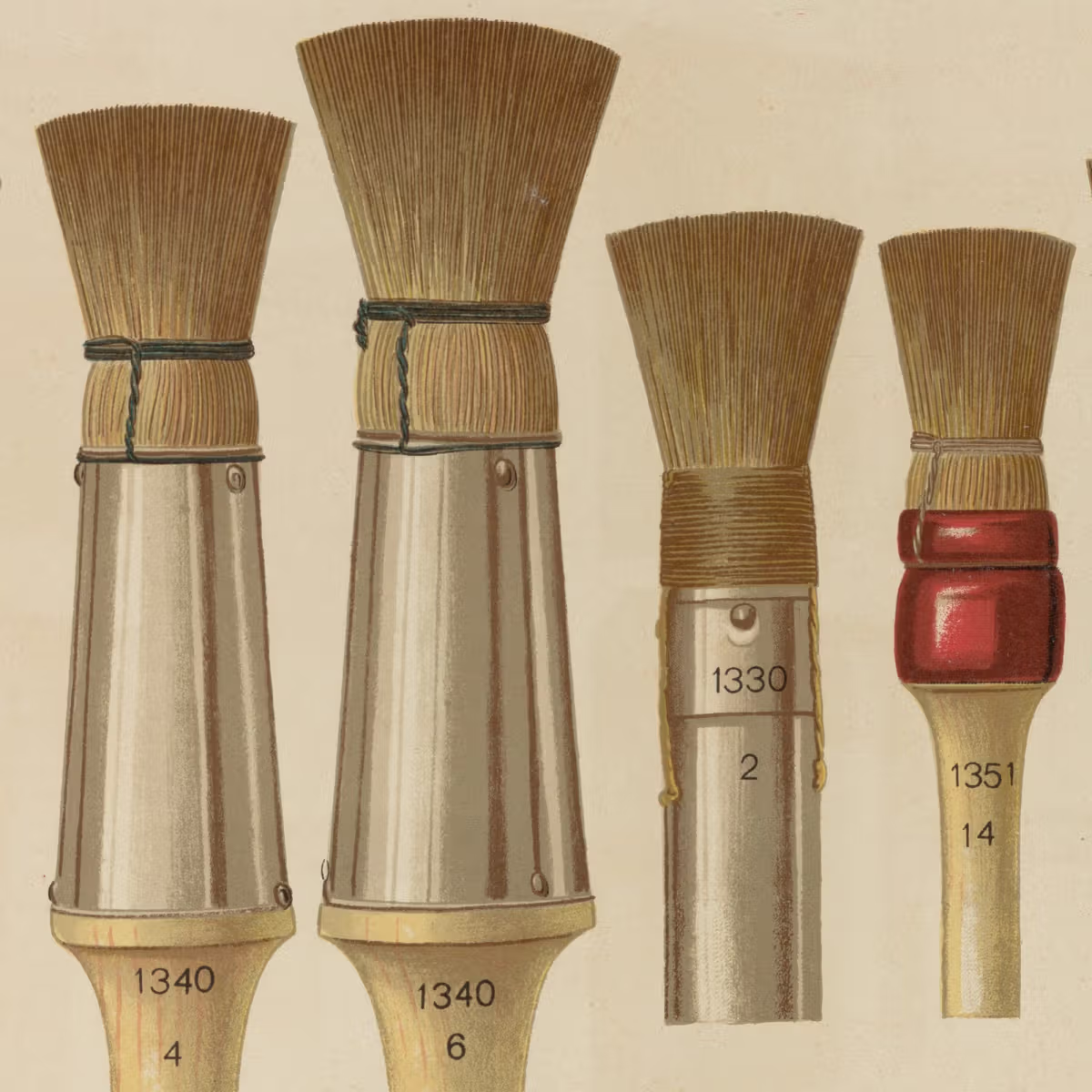
Detail of a page of brushes from Pinselfabrik Ernst Findeisen GmbH. Erstklassige Pinsel-Fabrikate Für Kunst-Handwerk u. Industrie: Ernst Findeisen, Ravensburg (Ravensburg: Ernst Findeisen, early 20th century), illustrated book, 1 volume, 21 × 31 cm (New York: The Watson Library, The Metropolitan Museum of Art).
Trade or sale catalogs—also called commercial or manufacturer’s catalogs—are printed publications advertising products of a particular trade or industry. Sale catalogs were often used in shops or showrooms to promote a company’s products. Examples include the massive Reed and Barton catalog Artistic workers in silver & gold plate from 1885 that illustrates the entire inventory of the company. Since their invention, automobiles have been creatively promoted through catalogs. Automobile catalogs in the library’s collection range from vivid brochures to oversized car showroom copies with moveable diagrams and transparencies to intrigue and persuade the customer, including 1953 Chevrolet and 1961 Buick.
Sale catalogs are valuable sources for determining the date and authenticity of objects and are often highly expressive of their historical moment. They frequently represent the most innovative and creative examples of printing and graphic design, used by manufacturers and publishers to best illustrate their products. Watson’s trade catalogs include striking illustrations reproduced in lithography, chromolithography, embossing, and pochoir. Many of the catalogs in the exhibition have striking designs and demonstrate graphic innovation that can be as compelling as the objects they promote.
Among the more unusual and appealing trade catalogs in the exhibition is a German Art Nouveau-inspired cake decorating book from 1910 and a baby carriage catalog from 1934 offering Art Deco styled tubular steel baby prams. These trade catalogs demonstrate the distillation of major art movements applied to quotidian objects.
The earliest trade catalog in the exhibition is Muster zu Zimmer-Verzierungen und Ameublements, a neo-classical interior design catalog by luxury German manufacturer Voss und Compagnie, offering entire rooms that can be bought en masse or as separate pieces. It is illustrated with richly toned hand-colored engravings that detail the design and color of the objects.
One of the library’s most fragile and weighty catalogs is Album des principaux modeles de verres: produits spéciaux en verre coulé. It is a magical trade catalog with sixty-five intact glass samples manufactured by French glassmaker Saint-Gobain. Founded during the time of Louis XIV, the company remains a manufacturer of glass for construction.
The majestic ironwork catalogue of Maison Garnier has pink-tinted papers and was bound in Morocco leather as a special copy for Rémy Garnier, the son of the firm’s founder. The firm’s initials are boldly blind stamped on the cover.
The most unusual and perhaps unexpected catalog, Urinoirs, illustrates the decorative ironwork structures of urinals (or pissoirs) that adorned the streets of Paris from the 1840s to the mid-twentieth century. The ornamentation of these structures demonstrates an impulse to beautify the animated street life of Paris and other cities.
Many of the trade catalogs have been digitized. All of the trade catalogs in Watson Library are accessible and can be consulted in the Florence and Herbert Irving Reading Room. The thirty-three on display will be available immediately after the exhibition’s closing in early March 2025. Information on using the library is here.










 Enfilade
leave a comment