New Book | The Sensory Experience in 18th-Century Art Exhibitions
The volume originated from a June 2021 conference on the topic. From the University of Heidelberg’s arthistoricum.net, where all contents are available free of charge
Gaëtane Maës, Isabelle Pichet, and Dorit Kluge, eds., L’expérience sensorielle dans les expositions au XVIIIe siècle / The Sensory Experience in 18th-Century Art Exhibitions (Heidelberg: arthistoricum.net-ART-Books, 2024 / Passages online, Volume 25), 274 pages, ISBN: 978-3985011544 (hardcover) / ISBN: 978-3985011537 (PDF).
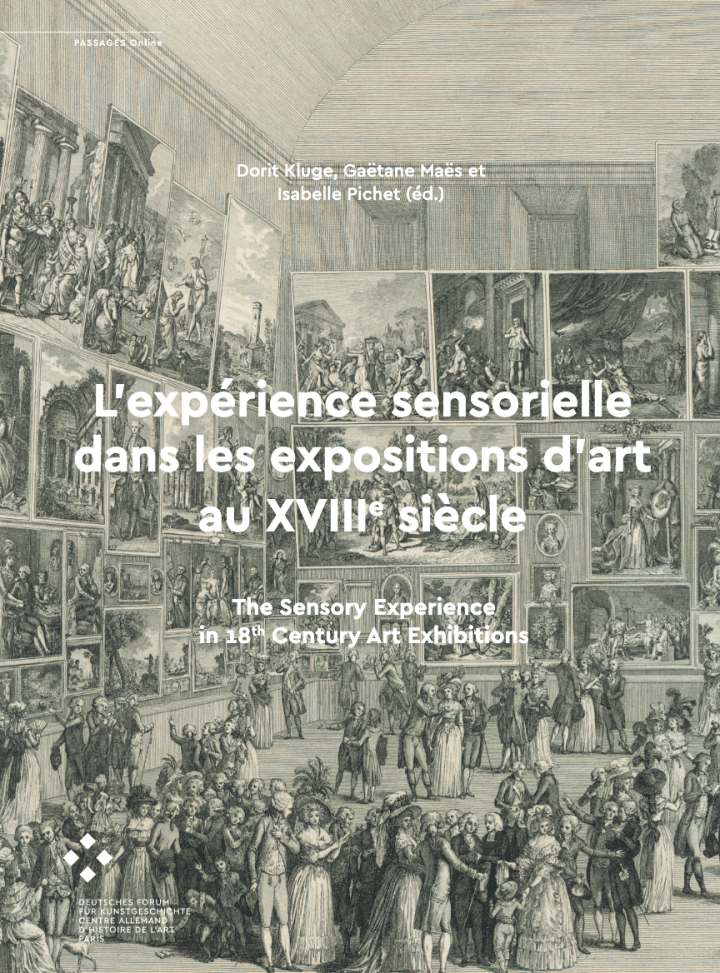 In the 18th century, the art exhibitions organised in the Louvre in Paris by the Académie royale de Peinture et de Sculpture created an unprecedented cultural event, which quickly aroused the curiosity and envy of the public in the French provinces and other nations. A visit to the Salon du Louvre or any other art exhibition, where the desire to be entertained and to learn are intertwined, is an experience that appeals to all the senses. It is therefore possible to introduce the notion of ‘sensory experience’, since not only sight, but also hearing, touch, smell and taste are called upon in varied and complex ways at every moment of the visit. Using a variety of approaches, this book aims to capture the sensations experienced by visitors to art exhibitions in Europe during the long eighteenth century (1680–1815), drawing on visual and textual sources from the period.
c o n t e n t s
Introduction — Gaëtane Maës, Dorit Kluge, Isabelle Pichet (translated from the French by Nicole Charley)
Partie 1 | L’expérience sensorielle dans les œuvres
• Viewing Blindness at the Paris Salon — Emma Barker
• Les saisons en exposition: L’expérience des sensations à travers les sculptures de Jean-Antoine Houdon — Friederike Vosskamp
• Exhibitions of Automata in Ireland in the Age of Enlightenment — Alison Fitzgerald
Partie 2 | L’expérience sensible dans les œuvres
• Depicting identity or emotion? Clairon vs. Dumesnil at the Salon of the Louvre — Gaëtane Maës
• Ducreux’s Yawning: Attention, Sensation, and the Ambiguity of Affect — Lisa Hecht
• Les plaisirs du public: L’érotisation du regard dans les expositions de la Royal Academy au XVIIIe siècle — Jan Blanc
• The Minds and Bodies of Women in the Salon Views of Gabriel de Saint-Aubin: A ‘peintre de la vie moderne’ in the Age of Enlightenment — Kim de Beaumont
Partie 3 | L’expérience spatiale de la visite
• Une surface au service de l’expérience sensorielle: Le mur des espaces d’exposition au XVIIIe siècle — Valérie Kobi
• Le conditionnement de l’expérience du sensible — Isabelle Pichet
• L’émerveillement « rationalisé » des visiteurs des ‘country houses’ dans la Grande-Bretagne du XVIIIe siècle — Sophie Soccard
Partie 4 | L’expérience de la critique
• ‘I’m Dying up Here!’: Disappointing History Painting — Mark Ledbury
• L’aveugle aux Salons de Denis Diderot — You Gyeong Lee
• L’identité de la critique d’art allemande: Un glissement du visuel/descriptif vers l’auditif/narratif — Dorit Kluge
• Le langage du corps face à l’art: Entre affection, discussion et contemplation — Markus Castor
Résumés
Abstracts
Auteurs
Crédits
Online Talks | HECAA Emerging Scholars Showcase, 2025
From the Historians of Eighteenth-Century Art & Architecture:
HECAA Emerging Scholars Showcase
Online, Tuesday, 18 February 2025, 11.00am–12.30pm EST
A beloved HECAA tradition, the Emerging Scholars Showcase serves as a platform for emerging scholars to connect with the wider HECAA community and get feedback on their research. We would appreciate your presence and participation in this meaningful event!
• Emily Hirsch (Brown University) — Flemish Sculptors and Terracotta, ca. 1600–1750
• Siraye Herron (University of Oklahoma) — Degrees of Indigenous Autonomy: Aestheticizing Artistic Survivance in Colonial Cuzco, 1690s–1780s
• Katie DiDomenico (Washington University in St. Louis) — Visions of Colonial Suriname, ca.1667–1795
• Katie Cynkar (University of Delaware) — Myth Making and Remembrance: A Sensorial Examination of Framed North Carolina Plantation-Made Cloth Samples, 1861–1865
• Amelia Goldsby (University of Iowa) — Trees as Bodies of Communication: The Arboreal Aesthetic in French Painting, 1780–1870
• Benet Ge (Williams College) — Looked Through: Edward Orme’s Transparent Prints between Britain and Canton
To attend, please register here»
As always, direct all questions, suggestions (and love) to hecaa.emergingscholarsrep@gmail.com.
Warmly,
Demetra Vogiatzaki
HECAA Board Member At-Large, Emerging Scholars Representative










 Enfilade
leave a comment