New Book | Thinking Women and Art in the Long Eighteenth Century
From Amsterdam UP:
Mechthild Fend, Jennifer Germann, and Melissa Hyde, eds., Thinking Women and Art in the Long Eighteenth Century: Strategic Reinterpretations (Amsterdam: Amsterdam University Press, 2025), 414 pages, ISBN: 978-9048558827, €153 / $168.
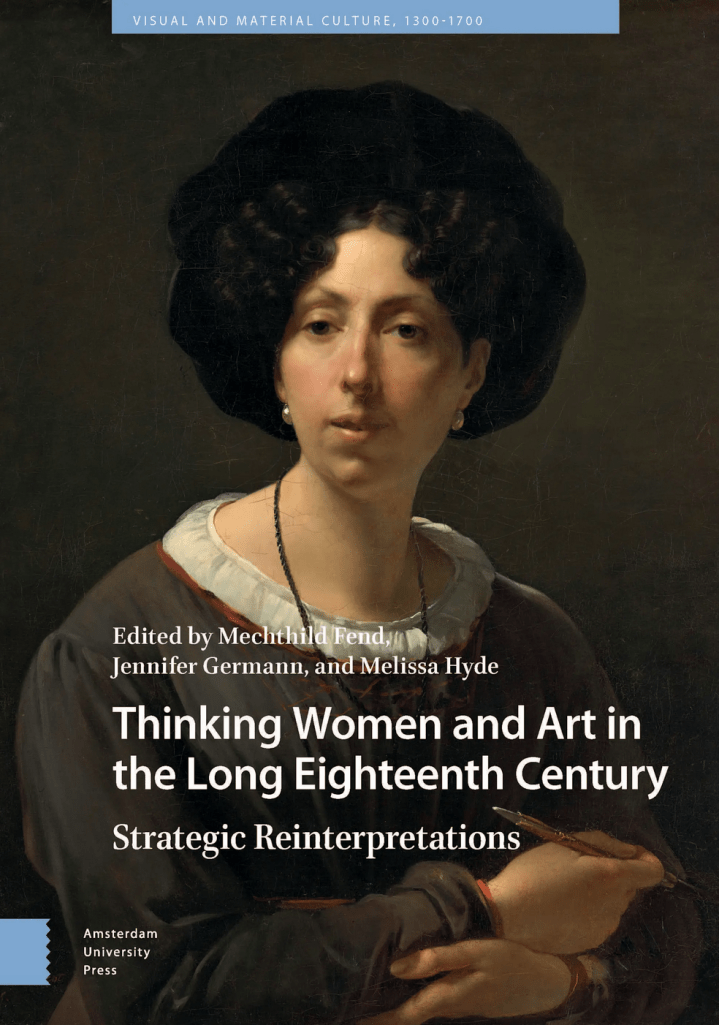 This collection of essays represents state-of-the-art feminist scholarship in the field of eighteenth-century French and British art and visual culture. Topics range from women and their activities in art and science, to gendered representations of childhood and animals to fashion, femininity and temporality. Some chapters center on individual genres like hunting portraits, or on specific paintings, such as David Martin’s Portrait of Dido Elizabeth Belle and Lady Elizabeth Murray (ca. 1780) or Marie Guillemine Benoist’s Portrait of a Young Black Woman (Madeleine) (1800). Others make contributions on the work of familiar actors like Jean-Siméon Chardin or Élisabeth Louise Vigée Le Brun. The volume also brings to the fore lesser-known figures including Marie-Thérèse Reboul, Madeleine Basseporte, Marguerite Le Comte, and Gabrielle Capet. Written by eleven distinguished (art) historians, the assembled essays engage with and honor the work of the late Mary D. Sheriff, whose unpublished chapter on women artists’ self-portraiture opens the book.
Mechthild Fend is Professor of History of Art, Goethe-University Frankfurt. She specializes in French eighteenth- and nineteenth-century art, with particular interests in feminist art history and its historiography, images of the body, and medical imagery. Her books include Fleshing out Surfaces: Skin in French Art and Medicine, 1650–1850, published in 2017.
Jennifer Germann is an art historian specializing in women’s history and eighteenth-century French and British art. She has published in Eighteenth-Century Studies, American Art, and Studies in Eighteenth-Century Culture. She is the author of Picturing Marie Leszczinska (1703–1768): Representing Queenship in Eighteenth-Century France (2015).
Melissa Hyde is Professor of Art History and Distinguished Teaching Scholar, University of Florida. She publishes on gender, the visual arts, and women artists and Rococo and its afterlives in the long eighteenth century in France. Books include Becoming a Woman in the Age of Enlightenment (with Mary Sheriff) (2017), as well as numerous edited volumes.
c o n t e n t s
Acknowledgements
Preface
Introduction
Mary D. Sheriff: Charting New Possibilities for Feminist Art History — Mechthild Fend, Jennifer Germann, and Melissa Hyde
Overture
1 Women and Modes of Self-Portraiture: Fashion, Motherhood, Sensibilité — Mary D. Sheriff
Part I | Art as Social Practice
2 The Woman Artist and the Uncovering of the Social World — Lynn Hunt
3 ‘La touche d’une femme’: Women Artists in the Age of Revolutions — Paris Spies-Gans
Part II | Gender and Fashion
4 Chardin’s Girls: The Ethics of Painting — Ewa Lajer-Burcharth
5 Thinking Animals: Dogs and Men in Eighteenth-Century French Hunting Art — Amy Freund
6 Temporality and Figures de mode: Fashion, Costume, and Gender in Eighteenth-Century Drawings and Prints — Susan L. Siegfried
Part III | Women in Natural History
7 Marie-Thérèse Reboul (Mme Vien): More Than a Footnote in Art History — Melissa Hyde
8 Mlle Basseporte’s Jardin, Mlle Biheron’s Cabinet: Artist-Scientists and Their Spheres of Sociability — Nina Rattner Gelbart
Part IV | Encounters in Portraiture
9 Marguerite Le Comte’s Smile: Portrait of an Amatrice — Mechthild Fend
10 Imperial Family Portraits: Gender, Race, and Social Rank in The Portrait of Dido Elizabeth Belle and Lady Elizabeth Murray — Jennifer Germann
11 Madeleine of the Americas: Resituating Benoist’s Portrait of a Young Black Woman in Colonial Art — Anne Lafont
Index
Call for Papers | The Business of Art, au féminin, ca. 1660s–1945
From the Call for Papers:
The Business of Art, au féminin: Women’s Enterprise in the French Art Economy, Late 1600s to 1945
Centre André-Chastel, Institut National d’Histoire de l’Art (INHA), Paris, 26–27 September 2025
Proposals due by 16 March 2025

Waldon Fawcett, U.S. Treasurey: Two Women with Stacks of Paper Money, ca. 1907 (Washington: Library of Congress, 96510963).
Bringing together the history of art, the history of women, and economic history, this colloquium will investigate women’s role in the financing of artistic production and development in France (painting, sculpture, architecture, decorative arts, engraving, photography, etc.). Embracing an extended time frame, we intend to interrogate both continuities and transformations in their roles across a significant period, starting from the policies and practices of artistic patronage initiated by Louis XIV up to the particular circumstances of the Occupation. Across this longue durée, women will be approached as agents making and moving the money required for artistic invention and production (their own as well as others’) and as integral actors in the operation of art markets, within the bounds imposed by their marital and legal status.
The colloquium will particularly focus on strategies of adapting, circumventing, and assertion deployed by French women or women working in France to negotiate masculine circuits of capital(ists)—strategies that may have gone beyond a mere male/female coexistence to include collaboration, emulation, competition, and conflict. Determined by their access to education, knowledge, and economic information, this positioning emerges clearly in discussions about the financial and legal subordination of women, whether single, married, or widowed. We will study their ability to assemble capital, invest in their own names or via proxies, operate shops, form enterprises, and organize companies. We will also interrogate the limits of their range of action and empowerment, and inquire into the possible existence of economic practices specific to women in the arts.
Contributions will take the form of individual or collective case studies addressing, but not limited to, the following topics:
• Figures and dynasties of female merchants, gallery owners, publishers, sponsors, philanthropists, entrepreneurs, investors, shareholders, and borrowers
• Collective modes of financing (religious orders, committees of female patrons, lay women’s associations) and defense of women’s economic interests (trade unions, networks of female solidarity, etc.)
• Modes of wealth accumulation (inheritance, dowry, marriage, salaries), dissolution (sales, liquidations, bankruptcy, misappropriation), and transmission (legacies, gifts, succession)
• Financing strategies (banking, personal loans, investment) and their institutional contexts (financing specific to wartime, black markets, etc.)
• The visibility or invisibility (purposeful or not) of women at the head of businesses and in financing operations
• The spectrum and specificity of artistic domains in which women invest (for instance, favored arenas like engraving and decorative arts)
Proposals (in French or English) should be sent to the three organizers Nastasia Gallian (nastasia.gallian@sorbonne-universite.fr), Elsa Jamet (elsa.jamet@hotmail.fr), and Justine Lécuyer (justine.lecuyer@hotmail.fr) by 16 March 2025. Please include a summary of the paper (500 words maximum) and a short biographical note (300 words maximum). This call is open to students holding a MA2 and to current doctoral candidates, as well as to all established researchers. Presentations can be in French or English and will last twenty minutes. This is an in-person colloquium, though in exceptional cases the organizers may be able to accommodate virtual participation. The scientific committee will inform participants of their acceptance or rejection in early April. Publishing a volume of proceedings based on the colloquium presentations is envisioned.
Scientific Committee
• Jérémie Cerman, Professor of Modern and Contemporary Art History (France, Université d’Artois, CREHS)
• Natacha Coquery, Professor Emeritus of Early Modern History (France, Université Lumière Lyon, LAHRA)
• Clare Haru Crowston, Dean of the Faculty of Artsn Professor of History (Canada, The University of British Columbia)
• Charlotte Foucher Zarmanian, Scientist, Modern and Contemporary Art History (France, EHESS, CRAL)
• Nastasia Gallian, Associate Professor of Early Modern Art History (France, Sorbonne Université, Centre André- Chastel)
• Charlotte Guichard, Professor of Early Modern Art History (France, École normale supérieure, PSL)
• Melissa Hyde, Associate School Director, Professor and Distinguished Teaching Scholar (USA, University of Florida, College of the Arts)
• Elsa Jamet, Temporary Research and Teaching, PhD in Modern and Contemporary Art History (France, Université de Lille, IRHIS)
• Justine Lécuyer, PhD in Modern and Contemporary Art History (France, Sorbonne Université, Centre André- Chastel)
• Kim Oosterlinck, General Director of the Royal Museums of Fine Arts of Belgium, Professor of Finance (Belgium, Université libre de Bruxelles)
• Anne Perrin, Professor of Early Modern Art History (France, Université de Toulouse – Jean Jaurès / FRAMESPA)
• Élodie Vaudry, Associate Professor of Modern and Contemporary Art History (France, Sorbonne Université, Centre André-Chastel)
• Alexia Yates, Professor of Modern History, historian of economic life (Italy, Florence, European University Institute)
s e l e c t i v e b i b l i o g r a p h y
D’ERCOLE Maria Cecilia et MINOVEZ Jean-Michel (dir.), Art & économie: Une histoire partagée [actes du colloque international de l’Association française d’histoire économique, Toulouse, 18–19 novembre 2016], Toulouse, Presses universitaires du Midi, 2020.
DERMINEUR Elise, Women and Credit in Pre-Industrial Europe, Turnhout, Brepols, 2018.
DOUSSET Christine, « Commerce et travail des femmes à l’époque moderne en France », Les Cahiers de Framespa, 2, 2006, en ligne : https://journals.openedition.org/framespa/57.
DUBY Georges et PERROT Michelle (dir.), Histoire des femmes en Occident, Paris, Plon, 1991–1992, vol. 3, 4 et 5.
FONTAINE Laurence, « Espaces économiques féminins et crédit », dans L’économie morale. Pauvreté, crédit et confiance dans l’Europe préindustrielle, Paris, Gallimard, 2008, p. 134–163.
GREEN David R., OWENS Alastair, MALTBY Josephine et RUTTERFORD Janette (dir.), Men, Women, and Money: Perspectives on Gender, Wealth, and Investment, 1850–1930, Oxford, Oxford University Press, 2011.
KHAN B. Zorina, « Invisible Women: Entrepreneurship, Innovation, and Family Firms in Nineteenth-Century France », The Journal of Economic History, 76, n°1, mars 2016, p. 163–195.
LABARDIN Pierre et ROBIC Paulette, « Épouses et petites entreprises: Permanence du XVIIIe au XXe siècle », Revue Française de Gestion, 188–189, 2008, p. 97–117.
LALLIARD François, « Femmes d’argent, argent des femmes: construction du genre et monétarisation de la vie sociale dans la haute société aristocratique. L’exemple des Wagram (XIXe siècle-début du XXe siècle) », dans L’argent des familles. Pratiques et régulations sociales en Occident aux XIXe et XXe siècles, (dir. Florent Le Bot, Thierry Nootens et Yvan Rousseau), Trois-Rivières et Québec, Centre interuniversitaire d’études québécoises, 2019, p. 179–192.
LANZA Janine, From Wives to Widows in Early Modern Paris: Gender, Economy, and Law, Aldershot, Ashgate, 2007.
LAURENCE Anne, MALTBY Josephine et RUTTERFORD Janette (dir.), Women and their Money, 1700–1950: Essays on Women and Finance, New York, Routledge, 2009.
MARTINEZ Cristina S. et ROMAN Cynthia E. (dir.), Female Printmakers, Printsellers, and Print Publishers in the Eighteenth Century: The Imprint of Women, c. 1700–1830, Cambridge, Cambridge University Press, 2024.
THÉBAUD Françoise, Écrire l’histoire des femmes et du genre, Paris, ENS Éditions, 2007.
TILLY Louise A. et SCOTT Joan W., Les femmes, le travail et la famille, Paris, Rivages-Histoire, 1987 (édition originale 1978).
YATES Alexia, « The Invisible Rentière: The Problem of Women and Investment in Nineteenth-Century France », Entreprises et histoire, 2, 2022, p. 76–89.
Cat. expo. [New York, Grey Art Museum ; Montréal, Musée des Beaux-arts ; Paris, Musée de l’Orangerie, 2024–2025], Berthe Weill: Art Dealer of the Parisian Avant-Garde, Paris, Flammarion, 2024.










 Enfilade
leave a comment