New Book | Art and Artifice in Visual Culture
From Routledge:
Sonia Coman, Vasile-Ovidiu Prejmerean, and Michael Yonan, eds., Art and Artifice in Visual Culture, Eighteenth Century to the Present (New York: Routledge, 2025), 210 pages, ISBN (hardback): 978-1032756783, $180 / ISBN (ebook): 978-1003478898, $50.
 This edited volume explores the notion of ‘artifice’ in modern visual culture, ranging from the eighteenth century to the present, in countries around the globe.
Artifice has been regarded as a primarily Western phenomenon, playing as it does a central role in European art theory since the Renaissance. This volume proposes that artifice is better understood as a transcultural artistic phenomenon and requires far broader conceptualization across international contexts. It acquaints readers with works of art, visual modes of communication, and concepts originating in France, Germany, the United States, Japan, and China, and includes painting, sculpture, drawings, prints, photographs, film, and virtual reality/augmented reality (VR/AR) objects. Contributors demonstrate how practices of artifice function as both symbol and form, in parallel and divergent ways, in multiple cultural settings.
Sonia Coman, PhD is a Contributor and Consultant at Smarthistory and Director of Digital Engagement at Washington National Cathedral. Vasile-Ovidiu Prejmerean is a PhD candidate at Université de Fribourg, Switzerland. Michael Yonan, PhD is a Professor of Art History and Alan Templeton Endowed Chair in the History of European Art, 1600–1830, at the University of California, Davis.
c o n t e n t s
List of Illustrations
List of Contributors
Introduction: Art and Artifice in a Transcultural Perspective — Sonia Coman, Vasile-Ovidiu Prejmerean, Michael Yonan
Part 1 | Artifice and Spectatorship
1 Fractured Perception: Drawings, Prints, and Verres Casses — J. Cabelle Ahn
2 Rococo Aesthetics and the Problem of Trompe l’Oeil — Michael Yonan
3 Degas’s ‘Histories’ and the Foreshadowing Artifice of Self-Candaulism — Vasile-Ovidiu Prejmerean
Part 2 | Haptic Illusions
4 Suggestive Surfaces: The Self-Referential Texture of Woodgrain in Japanese Woodblock Prints — Kit Brooks
5 Reconsidering the Origins of Yongzheng Guwantu: From the Aniconic Period to Vimalakīrtinirdeśa Sūtra — Chih-En Chen
6 Fooling Art History: John F. Peto and William Harnett — Yinshi Lerman-Tan
Part 3 | Alternative Realities
7 First Nations’ Wampum Belts: A Colonial Vision of Artifice in Eighteenth-Century New France — Clémence Fort
8 ‘An Opportunity to Grapple with the Picture Plane…’: The Stereo-Illusion’s History of Frustration — Eszter Polonyi
9 Self-Reference and Medium-Reference in Virtual Reality and Trompe l’Oeil — Sonia Coman
Index
Morgan Library & Museum Seminar | Drawing Nature, 1500–1900
The Morgan presents this day-long seminar for graduate students:
Drawing Nature, 1500–1900
The Morgan Library & Museum, New York, Friday, 4 April 2025
Proposals due by 21 February 2025
Led by Sarah Mallory, Assistant Curator of Drawings and Prints at the Morgan; Olivia Dill, Moore Curatorial Fellow at the Morgan; and Roberta J. M. Olson, Curator of Drawings Emerita at The New York Historical
European and North American Natural History drawings made before 1900 are historically understood as either works of fine art or as scientific records. The Morgan Library & Museum’s significant collection of natural history drawings, however, provides an opportunity to rethink longstanding divisions between the arts and sciences. This seminar will focus on collection holdings made by artists working in The Netherlands, Germany, England, France, and the Americas, from ca. 1450 to ca. 1850. Participants will have the opportunity to closely examine a large selection of works by Maria Sibylla Merian, Mark Catesby, Madeleine Françoise Basseporte, Georg Dionysius Ehret, John James Audubon, and many others. Lively discussions will address the production and subsequent uses of natural history drawings, including the ways in which techniques of observation and scientific developments informed drawing praxis. Key too will be instances in which artistic practice conditioned the production of empirical knowledge. We will also consider how gender, patronage, collecting practices, and colonial expansion inform natural history drawings.
This seminar is open to graduate students of the history of art, the history of science, and related fields, and also to graduate students interested in the conservation of works on paper. Applicants are kindly invited to submit a one paragraph statement which should include the following:
• Name and email
• Academic institution
• Class year
• Field of study
• Interest in natural history drawings and relevance of the seminar to your research
Applications should be submitted electronically with the subject header ‘Drawing Nature Seminar’ to drawinginstitute@themorgan.org by 21 February 2025. Participants will be notified by March 4.
AIC Receives Horvitz Collection of over 2200 Works of French Art
.
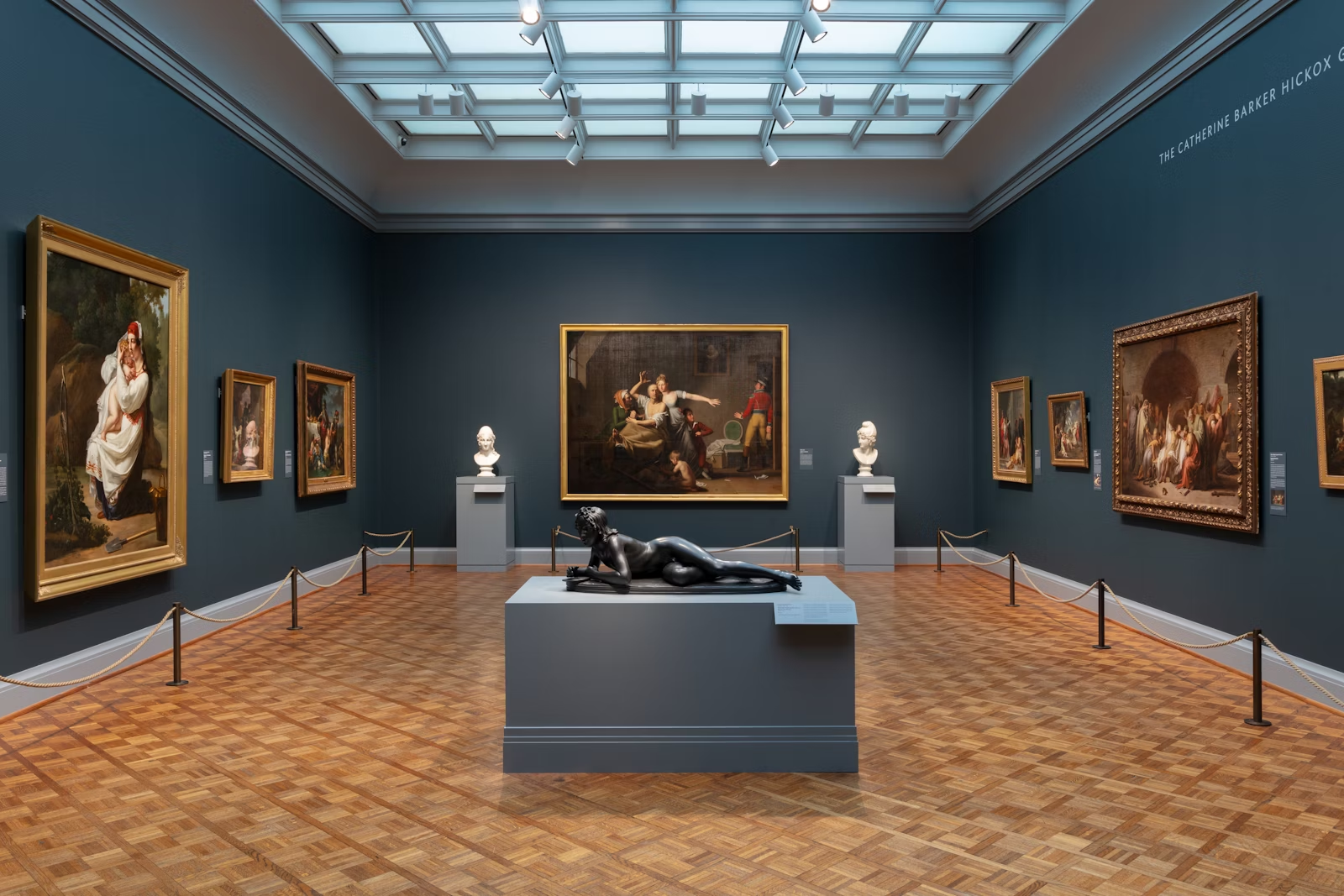
Installation view of French Neoclassical Paintings from The Horvitz Collection at the Art Institute of Chicago, 2024.
◊ ◊ ◊ ◊ ◊
From the AIC press release (11 February 2025) . . .
The Art Institute of Chicago is honored to announce a transformative gift of 16th- to 19th-century French art from Jeffrey and Carol Horvitz. The Horvitz Collection is the preeminent collection of French Old Master paintings, drawings, and sculptures in the United States, and while the Art Institute is already renowned for one of the most comprehensive collections of 19th-century French art worldwide, this unparalleled gift will allow the museum to provide its visitors with a 300-year panorama of French art that is wholly unique outside of France.
This gift is made up of nearly 2,000 drawings, 200 paintings, and 50 sculptures, and includes works by well-known artists Charles Le Brun, François Boucher, Jean-Honoré Fragonard, Jacques-Louis David, and Théodore Géricault; numerous works by women artists, including Anne Vallayer Coster, Élisabeth Vigée Lebrun, Marie-Gabrielle Capet, and Adélaïde Labille-Guiard; and rare works of art where few or none otherwise exist in America, such as artworks by Jacques Bellange, Reynaud Levieux, and Nicolas Prevost.

Jean-Charles-Niçaise Perrin, Death of Seneca, ca. 1788 (Chicago: AIC, Horvitz Collection).
The collection has been built over four decades and continues to grow and evolve. For the last three decades, it has been widely featured in thematic exhibitions in museums across the United States and Europe. More recently, two spectacular exhibitions in late 2024 at the Art Institute—French Neoclassical Paintings from The Horvitz Collection and Revolution to Restoration: French Drawings from The Horvitz Collection—featured just a small portion of the paintings and drawings in this vast collection.
To ensure the care, stewardship, accessibility, and long-term sustainability of the collection and programming for French art, phased financial gifts will accompany the collection and are expected to become one of the largest financial gifts in the history of the Art Institute. These funds will be dedicated to supporting French art across the permanent collection—conserving and caring for works, creating special exhibitions, supporting museum staff, and conducting groundbreaking research.
Jeffrey Horvitz explains, “We have always envisioned this collection remaining as a whole in order to be more than the sum of its parts, and for it to go to a major American museum where the most visitors can experience these artistic treasures, where scholars and curators can avail of the resources and advance this important research, and where our enthusiasm will resonate long after we are gone. We spent years thinking about where the collection should ultimately go—there was no more perfect choice than the Art Institute.”
This ongoing collaboration is the result of significant partnership between Jeffrey and Carol Horvitz; Alvin Clark, the Horvitzes’ curator of French drawings, paintings, and sculpture; and the Art Institute. Carol is an active member of the museum’s Board of Trustees and works closely with the museum regarding other aspects of the Horvitz’s collection, including superb Chinese cinnabar lacquer and the most significant collection of contemporary Japanese ceramics outside of Japan. Many of these works were loaned to the recent acclaimed Art Institute exhibition Radical Clay: Contemporary Women Artists from Japan, which was seen by more than 100,000 visitors.
“We are so grateful to Jeffrey and Carol for this impactful gift,” James Rondeau, President and Eloise W. Martin Director of the Art Institute of Chicago said. “Their continued support and passion for the museum is truly special, not only because it will allow millions of visitors to experience a fuller story of French art, but also because their generous financial support of the ongoing care and research of this collection will allow us to continue advancing our broader mission.”










 Enfilade
leave a comment