Exhibition | Better on Paper

.
John Pike, Fan: Land of Matrimony and Land of Celibacy, London, late 18th century, paper and wood
(Wellesley College Special Collections)
◊ ◊ ◊ ◊ ◊
From the press release for the exhibition:
Better on Paper: Recent Acquisitions of Prints, Drawings, Photographs, and Books
Davis Museum, Wellesley College, Massachusetts, 7 February — 1 June 2025
Curated by Amanda Gilvin and Ruth Rogers
Better on Paper is a new exhibition that spotlights and celebrates some of the thousands of newly acquired and previously unseen works of art on paper, including prints, drawings, photographs, books, and other objects, acquired by the Davis Museum and the Wellesley College Library Special Collections over the last decade. The exhibition emphasizes contemporary art, while also showcasing many new acquisitions of art from past centuries. More than 100 recent gifts and purchases will be on view in Better on Paper, along with two other new exhibitions at the Davis Museum all highlighting new acquisitions.
“Better on Paper presents a stunning array of visionary works of art from Wellesley’s collections in this collaboration between the College Library’s Special Collections and the Davis,” said Amanda Gilvin, the exhibition’s co-curator and Interim Co-Director, Sonja Novak Koerner ’51 Senior Curator of Collections, and Associate Director of Curatorial Affairs.
The exhibition calls attention to Wellesley’s decades-long leadership in the field of the study of photography, Gilvin said. She notes works that will be on view and are now part of the Davis collection include Nigerian artist Taiye Idahor’s Ekundayo; prominent African American photographer in the 1970s and 1980s Ming Smith’s Self Portrait, Harlem, NY; work by locally-based multimedia artist Jo Sandman; Chitra Ganesh’s Architects of the Future, City Inside Her; and Magdelena van de Passe after Crispijn de Passe the Elder’s Spring. Special Collections will present 18th-century publisher John Pike’s satirical fan The Land of Matrimony [and] Land of Celibacy and Swiss graphic designer Romano Hänni’s artist book It is Bitter to Leave Your Home: A True Story Depicted in Typographic Images.

.
Motonori Taki, Kōkei Saikyūhō [Emergency Remedies for the Benefit of People], Kyōto: Izumoji Bunjirō; Edo: Hanabusa Daisuke han, ca. 1790
(Wellesley College Special Collections)
◊ ◊ ◊ ◊ ◊
The Davis and the Wellesley College Library Special Collections have joined together to mount Better on Paper to pay homage to these new acquisitions that represent Wellesley’s commitment to inclusive excellence. Often collaborating with Wellesley faculty, staff, and students, curators have acquired the objects in the exhibition to support and expand the Wellesley College curriculum. The prints, drawings, photographs, books, and other objects in Better on Paper originate from around the globe, spanning diverse makers and approaches, and dating to many periods.
“It is a tremendous opportunity for the College Library’s Special Collections to be off the shelves and on view to a wider audience,” said Ruth R. Rogers, Curator of Special Collections and Visiting Lecturer, Art Department. “Better on Paper allows us to share a selection from the range of international, rare books, contemporary artists’ books, and other evidence of material communication that are the basis of teaching and research on campus.
Building these collections supports today’s Wellesley Method: object-based and human-centered learning across disciplines. “We invite you to study, learn, and teach in this exhibition—and to find out more about the many other works on paper in the Davis Museum and Special Collections,” Gilvin said.
Better on Paper was co-curated by Amanda Gilvin and Ruth Rogers with contributions from Nicole Berlin, Associate Curator of Collections, Alicia Bruce, Friends of Art Curatorial Project Manager and Researcher, Yuhua Ding, Kemper Assistant Curator of Collections and Academic Affairs, L. Goins ‘26, 2024 Summer Curatorial Intern, James Oles, Adjunct Curator of Latin American Art and Senior Lecturer, Art Department, Mariana S. Oller, Associate Curator of Special Collections, and Semente, Curator of Education and Public Programs. The exhibition is presented with generous support from the Anonymous ’70 Endowed Museum Program Fund, Marjorie Schechter Bronfman ’38 and Gerald Bronfman Endowment for Works on Paper, and Wellesley College Friends of Art at the Davis.
Exhibition | Nevers in the World
From the press release for the exhibition:
Nevers in the World
Davis Museum, Wellesley College, Massachusetts, 7 February — 1 June 2025
Curated by Nicole Berlin, with Alicia Bruce and Yuhua Ding
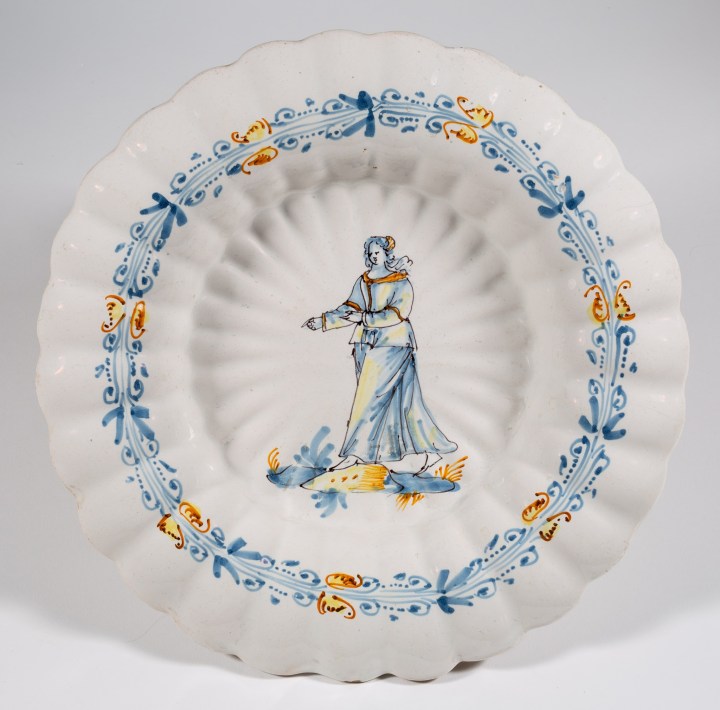
Gadrooned Dish, ca. 1700, Faience, made in Nevers (Davis Museum, Wellesley College, 2023.3.24).
Nevers in the World is an intimate exhibition of 11 newly-acquired seventeenth- to nineteenth-century French ceramics that were recently donated to the Davis Museum at Wellesley College. The French faience vessels are highly stylized glazed ceramics, created using a tin-glaze technique that originated in the Middle East, likely around Iraq, as a response to the vibrant white porcelain of China. Over time, this technique spread to Egypt, Spain, Italy, and eventually France, where it evolved into a distinctive art form.
The exhibition spotlights these beautifully glazed vessels, used mostly for dining tables, and illustrate a cross-cultural migration from their early origins in Iraq to the early iterations of Italian pieces and expanded color palettes and shapes by the French.
“When the generous gift of French faience arrived and our Curatorial team first saw it in storage, we were immediately excited by the many ways we could integrate it into both the permanent collection and a temporary exhibition,” said Nicole Berlin, Associate Curator of Collections at the Davis Museum and the Nevers show curator. “The vibrant colors, whimsical shapes, and the centuries-old ceramic glazing technique open up a wealth of creative possibilities for showcasing this remarkable collection.”
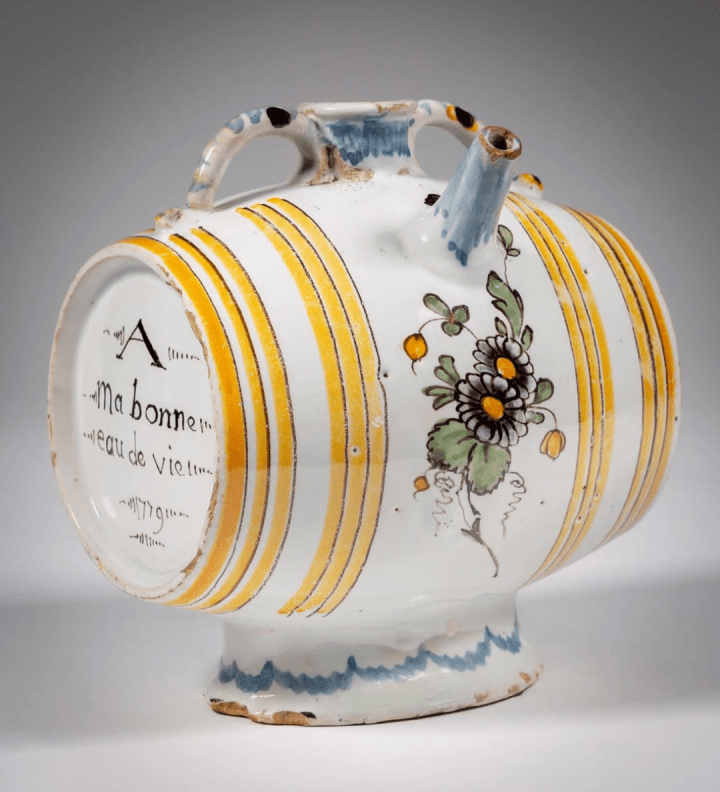
Spirit Cask, 1779, Faience, made in Nevers (Davis Museum, Wellesley College, 2023.3.26).
Nevers in the World is a selection of artworks from the generous bequest of the late Wellesley Trustee Emeritus Sidney R. Knafel, who spent decades assembling a world renowned collection of French ceramics. These objects demonstrate how artistic innovation can flourish through cross-cultural exchange. During the seventeenth and eighteenth centuries, a group of artisans in Nevers, France created extraordinary ceramic vessels using the faience technique. Invented nearly a millennium earlier, faience describes a glaze for ceramics that includes tin. In eighth-century Iraq, craftspeople discovered that adding tin to ceramic glaze produced an opaque, white surface suitable for colorful decoration. As the method spread across Asia and Europe, Italians called it maiolica. In France, it became known as faience, after the Italian city of Faenza.
In 1565, French aristocrat Henriette of Cleves married Italian politician Louis of Gonzaga, Duke of Nevers. The couple brought artisans from Italian maiolica centers to Nevers, where they introduced a style of storytelling through images in addition to tin-glaze. By 1600, European demand for Chinese porcelain spurred workshops in Nevers to attempt imitations in faience. Nevers artisans quickly developed a distinctive style that reached its zenith in popularity under King of France Louis XIV (1638–1715), when it featured in his elaborate dinner parties at Versailles. Today, these objects continue to tell stories about the people who made and used them.
Nevers in the World was curated by Nicole Berlin, Associate Curator of Collections with Alicia Bruce, Friends of Art Curatorial Project Manager and Researcher, and Yuhua Ding, Kemper Curator of Collections and Academic Affairs. This exhibition is supported by the Sandra Cohen Bakalar ‘55 Fund, the Judith Blough Wentz ’57 Museum Programs Fund, and Wellesley College Friends of Art at the Davis.










 Enfilade
leave a comment