New Book | Maria Theresa Empress
From Yale UP:
Richard Bassett, Maria Theresa Empress: The Making of the Austrian Enlightenment (New Haven: Yale University Press, 2025), 520 pages, ISBN: 978-0300243987, $38.
 A major new biography of Maria Theresa, the formidable Habsburg Empress
Maria Theresa was the single most powerful woman in eighteenth-century Europe. At the age of just twenty-three she succeeded to the Habsburg domains only to find them contested by almost every power in Europe. Over the next forty years, she became a fierce leader and opponent, as well as a devoted wife and mother to sixteen children. In this engrossing biography, Richard Bassett traces Maria Theresa’s life and complex legacy. Drawing on hitherto unpublished sources, Bassett reveals her keen sense of moderation and tolerance, innovative ideas on free trade and finance, and studied reluctance to resort to policies of territorial expansion. Yet Maria Theresa’s modernisation policies were not entirely progressive. Antisemitism and an enduring suspicion of Protestantism greatly affected the lives of her subjects. This is a gripping study of one of the world’s most influential leaders, revealing how Maria Theresa confounded gendered expectations and left a lasting mark on Europe.
Richard Bassett is the author of several books, most notably For God and Kaiser, the first history of the Habsburg army to be published in English. An authority on Central Europe where he has worked for 45 years, he is a Bye-Fellow of Christ’s College Cambridge and a visiting professor at the Central Europe University of Budapest.
Call for Papers | History of Map Collecting
From ArtHist.net:
History of Map Collecting: Vienna, Central Europe, and Beyond
University of Vienna, 12 June 2025
Organized by Eva Chodějovská and Silvia Tammaro
Proposals due by 17 March 2025
This one-day event will be held on 12 June 2025 at University of Vienna. Organised jointly by the Vienna Center for the History of Collecting (University of Vienna, Austria) and the Moravian Library in Brno (Czech Republic), the conference will be accompanied by a poster exhibition on Bernard Paul Moll (1697–1780) and his map collection, formed in 18th-century Vienna and now preserved at the Moravian Library.
Vienna—thanks to personalities of international fame such as the archduke Leopold Wilhelm, Eugene of Savoy, Albert von Sachsen-Teschen, and others—was one of the most important centres of collecting in the early modern period. This international conference aims to go beyond the general public’s conceptions of the collecting of paintings, drawings, and sculptures in two ways. Firstly, to enlarge the group of collected objects to printed sheets with a special focus on maps; secondly, there are important pieces of collectors’ interests of this kind kept in Vienna worth displaying and discussing (including the world-famous Blaeu-Van der Hem Atlas preserved in the Austrian National Library). Based on a long-lasting scholarly discussion of maps as objects of art and products of science, we welcome case studies addressing the practices of map collecting from the 17th to 20th centuries, including the creation of composite atlases in Central Europe.
A paper title, an abstract of 5–8 sentences, and a short CV in English are welcome by 17 March 2025. The acceptance notification is scheduled on 31 March 2025. Presentations should be 20 minutes. The conference language is English. Travel costs will be reimbursed up to €200. The conference is supported by “Stadt Wien Kultur/City of Vienna Culture.” Should you have further questions, please contact the organisers, Eva Chodějovská (chodejovska@mzk.cz) and Silvia Tammaro (silvia.tammaro@univie.ac.at).
Lectures | Barbara Kirshenblatt-Gimblett on Warsaw’s POLIN Museum
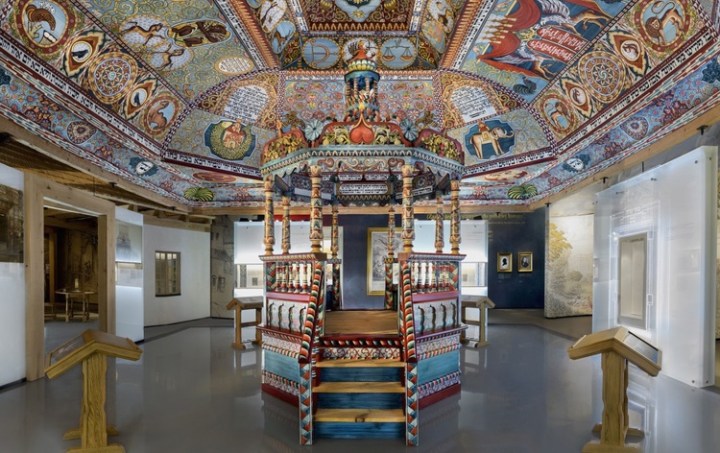
.
Rebuilding of the painted ceiling, timber-frame roof, and bimah (platform where the public reading from the Torah scroll is performed) of the wooden synagogue that once stood in Gwoździec and is now a centerpiece of the 18th-century gallery, “The Jewish Town” (Warsaw: POLIN Museum of the History of Polish Jews; photo by Magdalena Starowieyska and Darek Golik).
◊ ◊ ◊ ◊ ◊
From BGC:
Barbara Kirshenblatt-Gimblett | Materializing History
The Making of POLIN Museum’s Core Exhibition
Leon Levy Foundation Lectures in Jewish Material Culture
Bard Graduate Center, New York, 27 February, 20 March, 20 April 2025
Each year, Bard Graduate Center presents the Leon Levy Foundation Lectures in Jewish Material Culture, a three-lecture series dedicated to the study of the Jewish past through its material remains. Join us for this year’s lectures.
The Museum of the History of Polish Jews is located on the site of the Warsaw ghetto. It began without a building, collection, or funds. Its greatest asset was the story it would tell, a thousand-year history of Polish Jews. In exploring the creation of POLIN Museum’s Core Exhibition and its extensions, this series of lectures by curator Barbara Kirshenblatt-Gimblett will reveal how the museum materialized history and created and discovered novel kinds of objects.
Bard Graduate Center gratefully acknowledges the Leon Levy Foundation’s support of these lectures.
◊ ◊ ◊ ◊ ◊
Masterplan: Theatre of History
Thursday, February 27, 6pm
This first lecture explores how the Masterplan attempted to plot the thousand-year history of Polish Jews in space, how the exhibition evolved as a theater of history, and how the materializing of history led to the creation of a new kind of object.
Materializing History: The Making of POLIN Museum’s Core Exhibition
Thursday, March 20, 6pm
A centerpiece of the Core Exhibition is the 85 percent-scale painted ceiling and timber-frame roof of the seventeenth-century wooden synagogue that once stood in Gwoździec—today in Ukraine—but was destroyed during World War I. This object exemplifies how material practices produce new knowledge and unique kinds of objects in the process.
The Post-Jewish Object
Thursday, April 20, 6pm
Learn about POLIN Museum’s most recent temporary exhibition, which highlighted ‘post-Jewish’ property, defined by dispossession resulting from the fate of Jews during and after the Holocaust.










 Enfilade
leave a comment