Exhibition | Small but Mighty! Models, Toys, and Miniature Ships
.
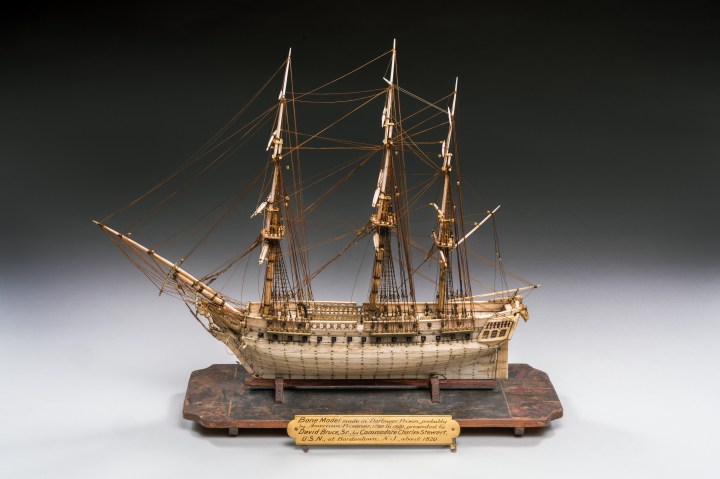
Attributed to an unknown French prisoner in Dartmoor Prison, Napoleonic War Model (Unidentified British Frigate), ca. 1790–1820, bone with a wooden stand covered in paper, 16 × 12 × 3 inches (Philadelphia: Independence Seaport Museum, Gift of Elizabeth Blaisdell, 1969.091).
◊ ◊ ◊ ◊ ◊
From the press release (3 February 2025) . . .
Small but Mighty! Models, Toys, and Miniature Ships
Independence Seaport Museum, Philadelphia, opening 20 March 2025
For centuries, people of all ages have been intrigued by model ships. Made for myriad reasons ranging from pure enjoyment to promotional tools, most are unique objects made by hand. Opening on 20 March 2025, a new permanent exhibition at the Independence Seaport Museum (ISM) will display nearly 50 rarely seen models dating from the early 19th century to the later 20th century, along with related paintings and prints. Primarily made of wood, the models were also fashioned out of paper, bone, and metal. Among the examples to be displayed are extraordinarily detailed and realistic models, such as the Heavy Cruiser USS Indianapolis, as well as highly stylized toy models intended for adults and children.
“Guests to the ISM over the years have remarked at the amazing range of ship models, toys, and pond models in our permanent collection,” said Peter Seibert, museum president and CEO. “This new exhibition has given us the opportunity to not only exhibit some of the public’s favorite examples along with many that have rarely ever been shown before. Young and old alike will love exploring these masterpieces of miniature craftsmanship.”
Over the centuries, ships models were used for various purposes. Some were design sources, known as half hulls, used in building larger vessels, while others were used for sport, such as pond models that were raced. Model ships were made as toys for children, and highly crafted, expensive models were intended as toys for adults. Other models were made to commemorate new vessels and were presented to shipbuilders or owners; some that were made by prisoners were used to exchange for food. Model ships were also used as tokens of remembrance either made by those who were on particular boats or those who were simply avid towards certain boats. Most of the models in the Independence Seaport Museum’s collection are ‘scratch built’, meaning that the craftsmen had to shape each piece from raw or lightly prepared materials rather than using premade parts. This method can be complex: metal casting is often used to produce the funnels, propellers, and other elements of a highly detailed model.
Among the most noteworthy ship models to be on view is the Heavy Cruiser USS Indianapolis. The legendary ship—launched on 7 November 1931 at the New York Shipbuilding Company in Camden, New Jersey to deliver the bomb to end World War II—was sunk by Japanese submarine 1-58 on 30 July 1945, after being hit by two torpedoes. Within just twelve minutes, the ship sank and the majority of the crew was launched into the water, while the remaining 300 or so crew members were left onboard. Three days later, a random sighting by a pilot led to the rescue of some of the sailors. (Today, the USS Indianapolis is most famous because its story was recounted in a scene in the movie Jaws.) This model of the Indianapolis, built in 1934–38 by Walter H. Gerber, a German mechanical engineer who originally worked at Cramp’s Shipyard in New York and then later transferred to Cramp’s Shipyard in Philadelphia, is massive in size: it measures 12 feet long by 17 inches wide. It was originally constructed as a radio-controlled, in-water model that had the capability to power its inside mechanics as well. The maker also has an interesting story: Gerber came under scrutiny from the United States government during World War II because he was fixated on the accuracy of the model and came from an enemy country. Afraid that information about the United States Navy would fall into the wrong hands, his actions were monitored and his home was raided, looking for cameras and other equipment supposedly to have been reported and/or voluntarily turned over to the government. Nothing of significance was found.
Another exquisite model of early shipbuilding is the Napoleonic War Model. Made entirely of bone by French prisoners in the British Dartmoor Prison, it was likely traded for food (prisoners were held on British prison ships during the Napoleonic wars; other similar models may have been made by American prisoners during the war of 1812). This model depicts an unidentified British frigate with 50 guns and has a decorative paper-covered wooden stand dating from about 1790 to 1820. With no provenance, it is assumed to be French and made for the British. The model, considered a folk-art masterpiece, was presented to David Bruce, Sr. by Commodore Charles Stewart, United States Navy, at Bordentown, New Jersey, in about 1820. Stewart was a Philadelphian who served in the navy for 63 years, playing key roles in the Quasi-War, Barbary Wars, and the War of 1812.
On 10 August 1893, the Steamer Priscilla, made by the Delaware River Iron Shipbuilding and Engine Works Company (John Roach & Sons) in Chester, Pennsylvania, for the Old Colony Steamboat Company, launched. Three years later, she was recreated as a child’s toy by R. Bliss Manufacturing Company in Pawtucket, Rhode Island, known for making inexpensive but realistic toys. One of these large toy ships made of chromolithographed paper attached to a wooden frame is equipped with wheels for motion, is a highlight of Small but Mighty! Measuring 37 inches long by 20 inches high and 5 inches wide, it is in pristine condition and illustrates the color and beauty of late 19th-century ships. This faithfully executed toy offered children a duplicate of the type of vessels actively used on America’s waterways. Toys such as these were sailed on the floors of large Victorian homes and enjoyed by children and, likely, adults as well.
The racing of small model yachts began in England in the 1870s, spread across the European continent, and eventually came to the United States. (New York’s Central Park Lake was built expressly for people to use in sailing pond models.) Organizations such as the Model Yacht Association determined rules and umpired regattas of two types: open water sailing and pond sailing. By 1950, five classes of model yachts were used, including the Marblehead or ‘M’ Class (also known as the 50/800 Class). Their small, manageable size made this sport appealing to those who could not handle a full-scale boat or those with limited financial resources. One such example of an ‘M’ Class model made in 1949, the Pond Yacht Almary II, is featured in the exhibition. It was made by Albert Link (born in Fishtown, Pennsylvania, 1909–1993) and is considered to be one of the biggest and best of its kind. Link worked as a machinist for Smith, Kline, and Beecham in Philadelphia. Link built approximately 15 model sailboats in his lifetime (the Almary II was his eighth) and raced them at Gustine Lake in Fairmont Park, Concourse Hunting Park, League Island Swimming Pool in Philadelphia as well as on Cooper River in Camden, New Jersey, and Long Island, New York. In 1950, he was a national prize winner at the New York Yacht Club and again in 1954 at Cooper River. He stopped racing that same year.
For children of all ages who are fascinated with model ships, Small but Mighty! Models, Toys, and Miniature Ships will delight and inform.
Call for Papers | Out of Scale
From ArtHist.net:
Out of Scale: From ‘Miniature’ Material Cultures to the Anthropic Principle
The Courtauld Institute of Art, London, 16–18 June 2025
Organized by Wenjie Su, Yizhou Wang, and Stephen Whiteman
Proposals due by 15 March 2025
Scale—the relative dimension, magnitude, or scope of objects, and their proportional relationship to the observer—is often understood through the lens of individual or collective visual assumptions. As inhabitants of the terrestrial sphere, we tend to rely on our bodies and cultural paradigms to interpret the scale of geographical terrain, human-made structures, material artifacts, social phenomena, and historical events. Technological advancements—from maritime expeditions to space exploration, from telescopic and microscopic investigations to the detection of cosmic microwave background—have urged humanity to redefine its scale of existence. Meanwhile, various philosophical and religious traditions have long pondered humanity’s place and purpose in relation to natural and supernatural realms.
By exploring designs and creations conceived on a micro-scale or as small-sized, this conference invites discussion on human creativity and human existence through the theme of scale. Examples abound across diverse human traditions, including burial and ritual objects, microarchitecture, portrait miniatures, and accessorial items such as netsukes, snuff boxes, and pocket watches. These objects appear diminutive when compared to the human body, the ‘worlds’ they represent, or their counterparts within more dominant socio-cultural systems. At times dismissed as frivolous and superficial, these streamlined and recontextualized objects can evoke out-of-scale resonances, transcending the original limitations of data or resources.
This conference connects studies that examine the art historical, historiographical, and ideological significance of scaled objects. First, we aim to deepen discussions on the sensorial, spiritual, intellectual, and technical implications of scaling. Particularly understudied are ephemeral objects and repositioned sites, such as lab settings and festival stagings. Second, we seek to investigate how the scale—of originals, reproductions, or paradigms—has shaped the central or peripheral status of specific objects and sites in art historical scholarship. Third, we aim to highlight the unique contributions that humanities and art historical scholars can make in addressing cutting-edge intellectual challenges in fields including AI and astrophysics. Throughout the global history of visual and material cultures, creatively re-scaled objects have played a central role in conceiving and simulating worlds that surpass our optical and epistemological thresholds. By exploring how humans have continually shifted scales to position themselves within and across realms, this conference reflects on humanity’s inherently limited yet endlessly creative perspective and envisions pathways to launch beyond boundaries.
Further questions and topics include but are not limited to:
• Material, aesthetic, sensory, and affective qualities unique to small-scale objects
• Practices of modeling and scaling in the production of scientific knowledge, such as mapping and laboratory experiments
• The dialectics of miniature and monumentality
• Relationships between scale, virtuality, and reality
• Critical reflections on the interpretational framework of ‘miniaturization’, such as the so-called miniature paintings of various Asian and Islamic traditions
• Challenges posed by small-scale objects or fragments in archaeological, museum, and pedagogical contexts
• The role of scale-shifting in methodological turns, such as global history, gender criticism, and eco-criticism
We invite proposals from scholars in a range of disciplines, including art and architecture history, museum studies, cultural history, intellectual history, and the history of science. Please send an abstract (ca. 250 words) for a 20-minute presentation and a 150-word bio as a single PDF file by 15 March 2025 to w-su@nga.gov; yizhouwang@hkbu.edu.hk; and stephen.whiteman@courtauld.ac.uk. Acceptance notification: 30 March 2025.
Conveners
Wenjie Su (Princeton University; CASVA)
Yizhou Wang (Hong Kong Baptist University)
Stephen Whiteman (The Courtauld Institute of Art)
Keynote Speakers
Andrew James Hamilton (The Art Institute of Chicago)
Wei-Cheng Lin (The University of Chicago)
The conference will be held 16–18 June 2005 at the Courtauld Institute of Art. Optional group viewing sessions will be arranged on June 18 in or around London. Accepted speakers will be invited to propose objects from London-based collections or sites that resonate with the themes of scale and the miniature.










 Enfilade
leave a comment