Ten Axioms: Drimmer and Nygren on Art History and AI
I was slow finding this essay on artificial intelligence, but it strikes me as immensely helpful (it seems someone asks me about art and AI at least once a week these days). –CH
Sonja Drimmer and Christopher Nygren, “Art History and AI: Ten Axioms,” International Journal for Digital Art History 10 (2023): 5.01–10. Link»
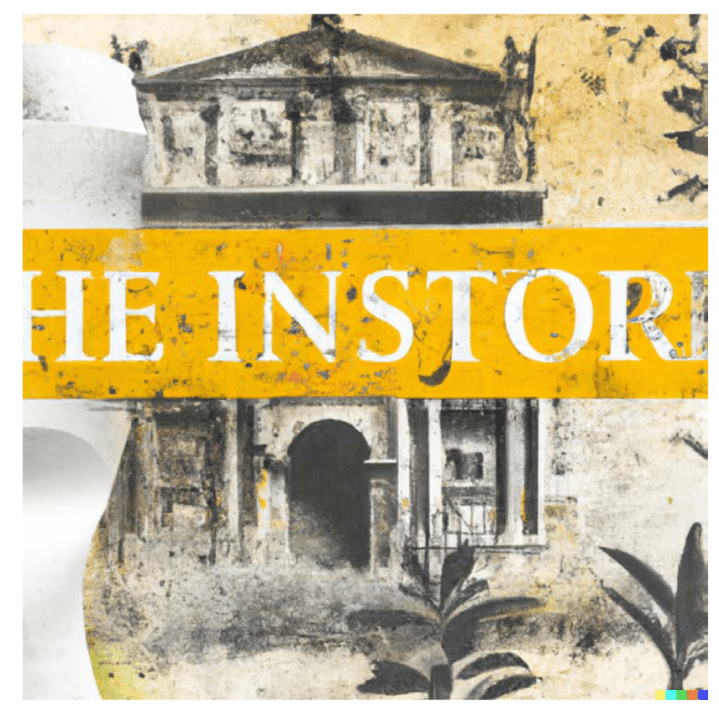
One of a handful of digital images accompanying the article created by Dall-e-2 using the following prompt: “the history of art as understood by artificial intelligence.”
Abstract | AI has become an increasingly prevalent tool for researchers working in Digital Art History. The promise of AI is great, but so are the ethical and intellectual issues it raises. Here we propose 10 axioms related to the use of AI in art historical research that scholars should consider when embarking on such projects, and we make some proposals for how these axioms might be integrated into disciplinary conversations.
Sonja Drimmer is associate professor of medieval art in the Department of the History of Art and Architecture at the University of Massachusetts Amherst. Her research is chiefly concerned with the book arts of the Middle Ages, addressing in particular issues of mediation, collaborative production, and replication. She is the author of The Art of Allusion: Illuminators and the Making of English Literature, 1403–1476 (University of Pennsylvania, 2018), which received High Commendation for Exemplary Scholarship from the Historians of British Art.
Christopher J. Nygren is associate professor of early modern art in the Department of the History of Art and Architecture at the University of Pittsburgh. In 2022, his book, Titian’s Icons: Charisma, Tradition, and Devotion in the Italian Renaissance (Penn State, 2020), won the Phyllis Goodhart Gordan Prize for best book in Renaissance studies from the Renaissance Society of America. Profesoor Nygren is also developing several collaborative research projects, including in the Digital Humanities. From 2017 to 2019 he served as Principal Investigator on “The Morelli Machine,” a project funded by the National Science Foundation that sought to examine whether computational methods might be used in the attribution of Old Master paintings.
Conference | Traveling Marble, 18th–20th Centuries
From ArtHist.net:
Traveling Marble: Agents, Networks, Technologies, 18th–20th Centuries
Thorvaldsen’s Museum, Copenhagen, 10 April 2025
Organized by Amalie Skovmøller and Ariane Varela Braga
Through thousands of years, white marble stones have been quarried and circulated to be consumed for architectural and artistic purposes worldwide. The stones are known from ancient Greek and Roman cultures, but during the 18th, 19th, and 20th centuries, white marble assumed a central role in the formation of European and Western art- and cultural history reaching far beyond the boundaries of antiquity. As a material signifying cultural prestige, white marble became a popular material for building and decorative projects, and the Imperial powers of Europe established new quarry facilities all over the world. These growing marble networks circulated white stones in far-reaching patterns of distribution from central Europe to the USA and from the Mediterranean to Scandinavia. Moving large quantities of solid stone requires a complex infrastructure, developed and maintained to support the increasing consumption. Yet scholars of art history and architectural studies have traditionally addressed white marble through the lens of aesthetics, leaving its omnipresence and global condition largely unexplored.
This seminar explores the distribution patterns of white marble, with particular emphasis on the 18th, 19th, and 20th centuries, but with perspectives on antiquity. Framing white marble as both a local and global phenomenon, the seminar shifts focus from the traditional emphasis on artists and their materials towards unseen networks of quarry owners, extractors and trading agents. In doing so, the seminar probes questions related to how quarries have been organized through time and the role played by marble consortiums, associations and federations, who have regulated labour, transportation, and distribution over time. The seminar thus targets patterns of distribution, such as trading routes by land and sea, and the technical improvements realized over time, bringing scholars together to discuss how to gather and share data on the extraction and circulation of marble to lay the first foundations for a future global archive of white marble distribution for this period. Please note that registration is required for attendance.
Organized by Institut for Kunst- og Kulturvidenskab / Amalie Skovmøller. In collaboration with Ariane Varela Braga / UNED, Madrid
p r o g r a m m e
9.30 Registration and coffee
10.00 Welcome by Amalie Skovmøller and Ariane Varela Braga
10:15 Morning Talks
• A World in Marble — Amalie Skovmøller
• Materials That Connect: The Circulation of White Marble in the Ancient Mediterranean — Alessandro Poggio
• Ancient Naxian Marble Quarries and Dedications: Documentation and Study from the 18th Century to Today — Rebecca Levitan
13.15 Afternoon Talks
• 18th-Century Norwegian Marble in Copenhagen — Kent Alstrup
• The Workshop of Antonio Caniparoli & Figli in Carrara 1850 to 1930 — Sandra Beresford
• Reading into Greenland Marble: ‘A Noble Danish Material’ — Jonathan Foote
• Marble for the Duce: The Networks of Agents, Merchants, and Marble Workers at Foro Mussolini — Ariane Varela Braga
• The ‘Archivi del Marmor Project (AMP)’ — Cristiana Barandoni and Luca Borghini
16.15 Final discussion










 Enfilade
leave a comment