Exhibition | Hogarth’s Progress
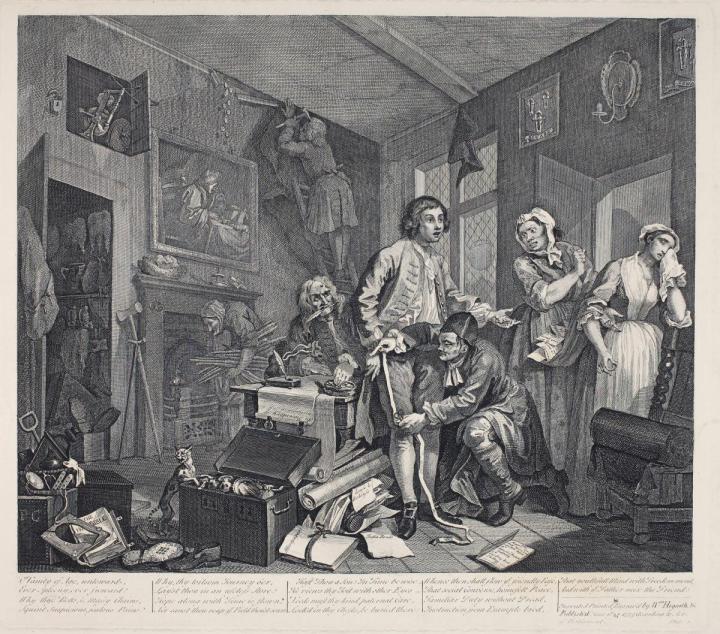
William Hogarth, The Rake’s Progress, Plate 1, published 25 June 1735, etching and engraving
(Allen Memorial Art Museum, Oberlin College, 1975.203)
◊ ◊ ◊ ◊ ◊
Now on view at Oberlin:
Hogarth’s Progress
Allen Memorial Art Museum, Oberlin College, Ohio, 31 January — 10 August 2025
Organized by Marlise Brown
English artist William Hogarth (1697–1764) used his art to hold up a moralizing mirror to all levels of 18th-century society. From rakes to harlots and aristocrats to the clergy—no one was exempt from his biting yet humorous art.
In 1731, Hogarth began creating a series of artworks that he termed ‘modern moral subjects’, which focused on the immoral bend of contemporary London while satirizing the vice and folly of his characters. This exhibition focuses on his first two ‘modern moral subjects’: The Harlot’s Progress (1732), which is a narrative in six scenes, and The Rake’s Progress (1735), which is completed in eight scenes. These sets, offered on subscription, sold out quickly because they were immensely popular with people from all walks of life in England.
Hogarth’s term ‘progress’ was inspired by the book The Pilgrim’s Progress, first published by the English author John Bunyan in 1678. However, unlike the protagonists in Bunyan’s moralizing Christian allegory, Hogarth’s ‘Harlot’ and ‘Rake’ do not grow or learn from life’s experiences. Instead, Hogarth’s narrative series exposes the shallowness of aristocracy, the vices and indulgences of modern London, and showcases complicated ideas in a new form of visual theater.
Organized by Marlise Brown, Assistant Curator of European and American Art.
Call for Papers | ‘Deviant’ Women and the Visual Arts
From ArtHist.net:
‘Deviant’ Women and the Visual Arts
University of Bristol, 10 July 2025
Proposals due by 5 May 2025
The Women and the Visual Arts Research Cluster at the University of Bristol is excited to announce our forthcoming symposium taking place at the University of Bristol on Thursday, 10th July 2025. Women have long been viewed as ‘deviant’ in their roles as artists, authors, models, patrons, and collectors. Their paths to becoming artists or patrons may ‘deviate’ from the norm, their chosen medium or subjects may diverge from those expected by the market, and their representations of themselves and those around them may be unorthodox compared to the art historical canon. How can we, as researchers, contextualise this ‘deviancy’ in our work on women and the visual arts?
We welcome submissions that think about women’s ‘deviancy’ in their relationship to the visual arts in diverse ways: women who push the boundaries on what has been seen as the norm or whose work is divergent from accepted standards. While we are explicitly seeking contributions that foreground the visual, we are excited to hear from colleagues working across fields and disciplines, including (but not limited to) history of art, visual culture, classics, film and theatre studies, history, religious studies, and those doing practice-based research.
Potential topics could include, but are not limited to
• Exhibiting and collecting strategies used by women or the curation and collecting of work by women
• Self-representation and self-portraiture — identity and sexuality
• Transnational feminine identities — culture, race, immigration, and exile
• The nude and representations of the body
• The archive — the formation of celebrity, reception, and legacy
• Women and the environment
• Women’s work — motherhood, domesticity, labour, artist collectives
• ‘Deviant’ use of artistic medium through textual approaches, the applied arts, craft, performance, etc.
In addition to proposals for papers, we also welcome submissions for videos or artist talks related to the symposium’s themes. To apply, please submit a 150- to 200-word abstract with a short bio to Helena Anderson (helena.anderson@bristol.ac.uk) and Valéria Fülöp-Pochon (vf15404@bristol.ac.uk) by Monday, 5th May 2025.










 Enfilade
leave a comment