Exhibition | Hogarth’s Progress
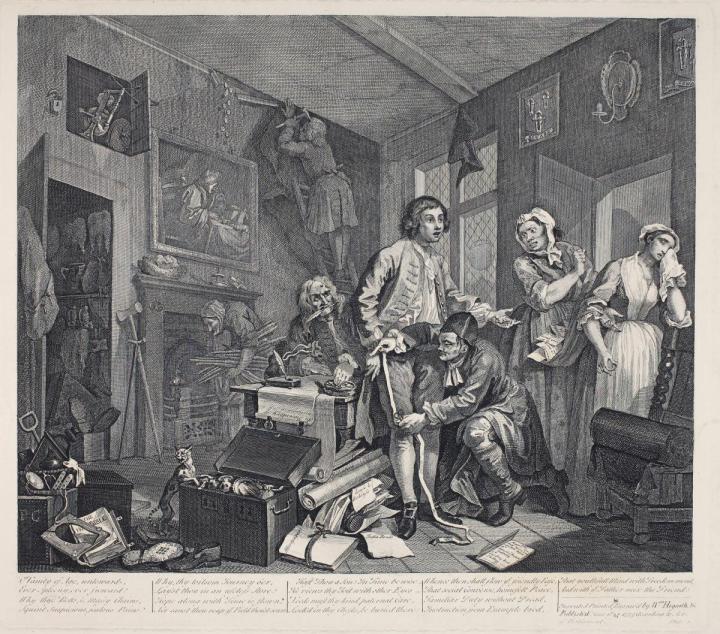
William Hogarth, The Rake’s Progress, Plate 1, published 25 June 1735, etching and engraving
(Allen Memorial Art Museum, Oberlin College, 1975.203)
◊ ◊ ◊ ◊ ◊
Now on view at Oberlin:
Hogarth’s Progress
Allen Memorial Art Museum, Oberlin College, Ohio, 31 January — 10 August 2025
Organized by Marlise Brown
English artist William Hogarth (1697–1764) used his art to hold up a moralizing mirror to all levels of 18th-century society. From rakes to harlots and aristocrats to the clergy—no one was exempt from his biting yet humorous art.
In 1731, Hogarth began creating a series of artworks that he termed ‘modern moral subjects’, which focused on the immoral bend of contemporary London while satirizing the vice and folly of his characters. This exhibition focuses on his first two ‘modern moral subjects’: The Harlot’s Progress (1732), which is a narrative in six scenes, and The Rake’s Progress (1735), which is completed in eight scenes. These sets, offered on subscription, sold out quickly because they were immensely popular with people from all walks of life in England.
Hogarth’s term ‘progress’ was inspired by the book The Pilgrim’s Progress, first published by the English author John Bunyan in 1678. However, unlike the protagonists in Bunyan’s moralizing Christian allegory, Hogarth’s ‘Harlot’ and ‘Rake’ do not grow or learn from life’s experiences. Instead, Hogarth’s narrative series exposes the shallowness of aristocracy, the vices and indulgences of modern London, and showcases complicated ideas in a new form of visual theater.
Organized by Marlise Brown, Assistant Curator of European and American Art.










 Enfilade
leave a comment