Conference | Textiles in Early Modern Venice
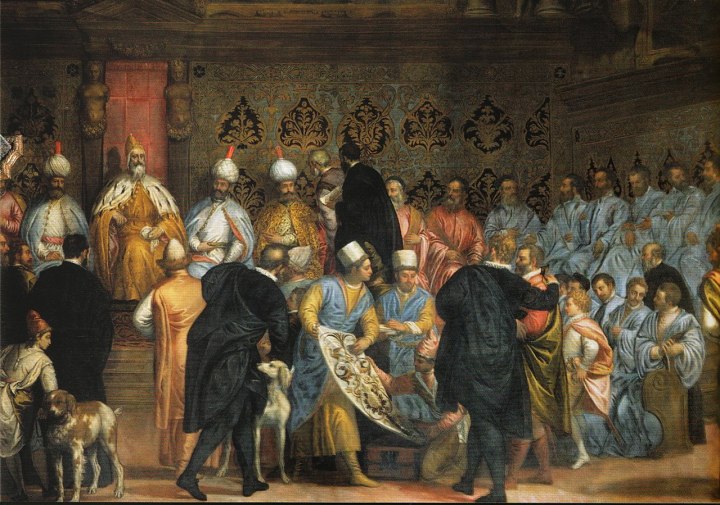
Carlo Caliari, Embassy of Shah ‘Abbas I to Venice, 1595
(Venice: Doge’s Palace)
◊ ◊ ◊ ◊ ◊
From ArtHist.net:
Trade, Production, and Consumption of Textiles and Dress in Early Modern Venice
Centro Tedesco di Studi Veneziani, Venice, 28–29 May 2025
Organized by Jola Pellumbi, Sara van Dijk, and Torsten Korte
Registration due by 25 May 2025
Venice in the early modern period flourished as a centre of textile production and trade, shaping and fostering global networks of connections that directly impacted dress in Europe and elsewhere. Due to Venice’s impenetrable location, its proximity to the centre of Europe, and a long-standing tradition of merchants and seafarers, Venice had positioned itself as a principal gateway between Europe and the East. Whether it was through the importation of luxury goods such as textiles and carpets, exports of beauty products and perfumes, or exchanges of ambassadorial gifts, Venice aided in the dissemination and infiltration of ideas, styles, and designs between Europe and the East. Furthermore, due to the flourishing art production and the thriving printing press in 16th-century Venice, textile patterns and dress styles were able to spread throughout Europe and the rest of Venice’s trading posts around the world influencing fashions, designs, methods of production, and patterns of consumption. Apart from the unaffected patrician government attire, infiltrations of new styles were particularly noticeable in Venice itself, throughout Carnival festivities, dogal and ambassadorial processions, operas and theatres, gambling dens, and in everyday life where both spaces and bodies were adorned.
This conference aims to generate a discussion about the role of Venice as a centre of a global network of connections as seen through its trade, production, and consumption of textiles and dress as well as carpets, haberdashery, beauty products, perfumes, dyes, feathers, jewellery, and design. Registration (€15 + €2 administrative costs) can be booked here until 25 May.
Organised by Jola Pellumbi and Sara van Dijk (Dressing the Early Modern Network) and Torsten Korte (University of Bern), in collaboration with the Centro Tedesco di Studi Veneziani and the University of Bern, and generously supported by the Fritz Thyssen Foundation.
w e d n e s d a y , 2 8 m a y
18.00 Evening Lecture
The Mysterious Blue in Dürer’s Feast of the Rosary (1506): On the Problem of Interpreting Textile Colours in the Painting — Philipp Zitzlsperger (University of Innsbruck)
19.00 Ricevimento at the Centro Tedesco di Studi Veneziani
t h u r s d a y , 2 9 m a y
9.30 Registration and coffee
10.00 Welcome
10.10 Session 1 | Luxury and Trade
Chair: Luca Molà
• From Venice to Lyon and Vice Versa: The Road to a New Trade in Fashionable Silk Fabrics, 17th to 18th Century — Moïra Dato (University of Bern)
• Francesco Zen: Luxury Trade and Technological Innovation between Venice and Constantinople in the Early 16th Century — Elisa Puppi (Università Ca’ Foscari Venezia)
• Venetian Trade of Italian Textiles in Hungary until the End of the 16th Century — Maxim Mordovin (Eötvös Loránd University, Budapest)
• Beyond Luxury: The Circulation of Silk Waste in Early Modern Venice (1500–1650) — Sofia Gullino (Università degli Studi di Padova)
12.00 Lunch break
14.00 Session 2 | Global Connections
Chair: Catherine Kovesi
• Circulating Civilisation: Venetian Glass Beads as Agents of Global (Ex)Change — Sandrine Welte (Università Ca’ Foscari Venezia)
• ‘Sempre Magnifico’: Catherine de’ Medici through the Eyes of Venetian Ambassadors — Emily Averiss (Warburg Institute, University of London)
• Under the Radar or over the Top? Clothing of Jerusalem Pilgrims in the Late 15th Century — Alicia Wolff (University of Heidelberg)
15.30 Coffee and tea break
16.00 Session 3 | The Politics of Dress
Chair: Jola Pellumbi
• Sartorial Rhetoric: Dress and Anglo-Venetian Relations in the Early 16th Century — Grace Waye-Harris (University of Adelaide)
• The Collective Wig: Political Power and Periwigs in 18th-Century Venice — Liz Horodowich (New Mexico State University)
17.00 Closing remarks
17.15 Farewell and aperitivo
◊ ◊ ◊ ◊ ◊
Note (added 23 April 2025) — This posting originally appeared April 22; it was moved back to April 19th for improved continuity with other posts.
Venice Archaeological Museum Reopens Courtyard of Agrippa
The original core collection of ancient sculpture that would become the Archaeological Museum of Venice was on public view in the Marciana Library—built by Sansovino and Scamozzi—starting in 1596. Of the several courtyards of the Procuratie Nuove, the Courtyard of Agrippa is the only one designed by Scamozzi. From the press release (via Art Daily) . . .
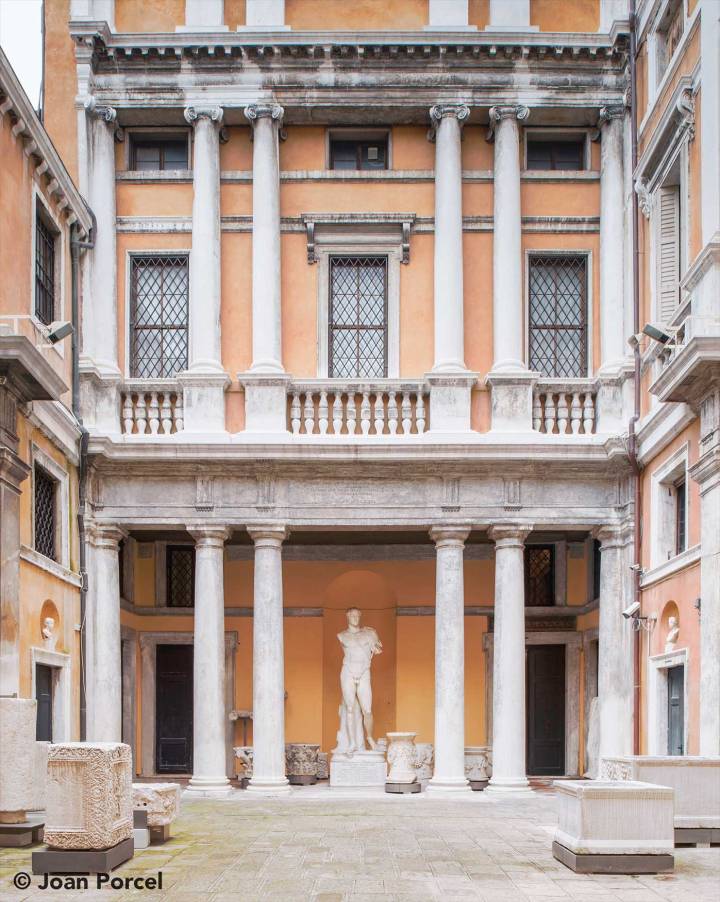
Courtyard of Agrippa. Photo from the website of the National Archaeological Museum of Venice.
The Museo archeologico nazionale di Venezia (National Archaeological Museum of Venice)—part of the Musei archeologici nazionali di Venezia e della Laguna (National Archaeological Museums of Venice and the Lagoon)—announces the reopening of the Courtyard of Agrippa, marking the beginning of a new chapter in the museum’s history. Starting May 6, the museum reopens its historic entrance at No. 17 Piazzetta San Marco, directly facing the Doge’s Palace. This new access complements the existing one through the Correr Museum and signifies the launch of a significant reorganization process. It also underscores the museum’s commitment to accessibility and a renewed, inclusive visitor experience.
In line with this vision, the museum route returns to the original order established between 1924 and 1926 by Carlo Anti, a distinguished classicist, professor of Archaeology, and later rector of the University of Padua. The itinerary offers a chronological narrative of Greek and Roman art through sculpture—from the 5th century BC to the late imperial era—alongside ceramics, bronze statuettes, coins, and other precious objects collected and donated by the Venetian aristocracy between the 16th and 19th centuries.
To enhance the visitor experience, a new independent ticketing system for the Archaeological Museum and the Marciana Library is introduced and added to the existing one, along with an annual subscription that provides unlimited, flexible access to the collections. A newly created multifunctional space will also showcase prestigious artifacts and provide visitors with updates on the museum’s ongoing reinstallation project.

The Courtyard of Agrippa is visible at the left edge of this screenshot from Google Maps.
These initiatives represent the first tangible step in the formation of a new institution under Italy’s Ministry of Culture: the Musei archeologici nazionali di Venezia e della Laguna (National Archaeological Museums of Venice and the Lagoon), established in May 2024 under the direction of Marianna Bressan. This institution encompasses the Museo archeologico nazionale di Venezia, the Museo di Palazzo Grimani, the Parco archeologico di Altino (Archaeological Park of Altino), and the upcoming Museo archeologico nazionale della laguna di Venezia (National Archaeological Museum of the Venice Lagoon) on the island of Lazzaretto Vecchio. Together, they promote an integrated and coherent cultural offering that enhances the archaeological heritage of Venice and its lagoon.
To celebrate this reopening, the courtyard will also host a striking site-specific installation during the preview days of the 2025 Venice Architecture Biennale. Lines by Kengo Kito, curated by Masahiko Haito and supported by anonymous art project, will be installed both in the Courtyard of Agrippa and Room V of the Museum. The work establishes a dialogue with Venetian cultural heritage and Renaissance architecture, sparking a reflection on the interaction between art and public space.
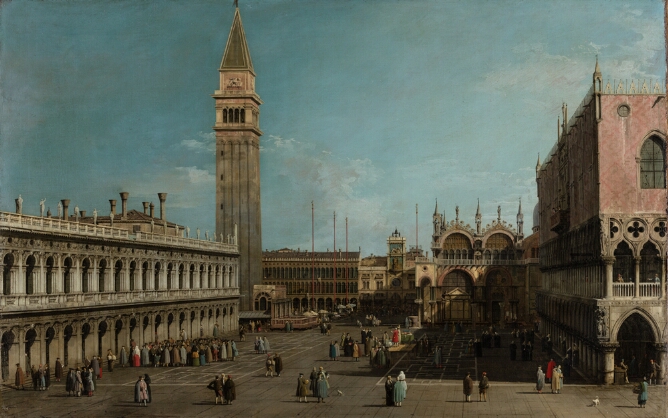
Canaletto, The Piazzetta, Venice, Looking North, ca. 1740 (Pasadena: Norton Simon Museum). The Marciana Library is visible to the left, in front of the bell tower.
Also part of the exhibition, a temporary conservation intervention—also supported by anonymous art project—on the wall behind the statue of Agrippa, weathered by time and humidity. The work includes surface dust removal, consolidation, and subtle tone harmonization, aiming to create a dynamic relationship between ancient, modern, and contemporary art. This experimental restoration model may inform future developments within the museum. The artistic project will contribute to further enhance this restoration, underlining the importance of the continuous comparison between the historicity of the place and current artistic expressions.
“The reopening of the museum’s historic entrance on Piazzetta San Marco,” states Marianna Bressan, Director of the Musei archeologici nazionali di Venezia e della Laguna, “is the first tangible act in Venice by this new institution. It reflects the cultural vision we aim to develop. The intervention in fact returns to the city and to the world a jewel of Renaissance architecture, studies the distribution of ancient sculptures and the architectural space for a mutual valorisation, proposes a conceptually flexible installation, part permanent exhibition and part visitable depot. Furthermore, it intends to reconnect the relationship of the Archaeological Museum with Venice both physically, through the access directly from the Piazza level, and in the proposal of cultural fruition: in the room adjacent to the ticket office, the Museum will recount step by step the phases of its rebirth, visitors, both male and female, by subscribing, will be able to return as many times as they want to see the progress, to participate in the dedicated events, to familiarize themselves with the collections and the history of this place, so linked to the history of Venice itself.”
Crossing the museum’s new threshold, visitors are welcomed into the Courtyard of Agrippa, home to the monumental statue believed to depict the Roman statesman and general Marcus Vipsanius Agrippa (63 BC – AD 12). This space acts as a bridge between the Marciana area’s architecture, Venice’s political centre, and the legacy of classical antiquity collecting. The statue introduces the deep connection between Venice and ancient Rome, a theme echoed throughout the museum’s collection. This link reveals how collecting was a strategic tool to bolster the cultural and political identity of the Serenissima.
Having become part of public collections in the 1860s, the work represents a significant historical testimony, which confirms a long tradition of private collections donated to the Republic and begun in the early decades of the sixteenth century by Domenico Grimani (1461–1523). Integrating his uncle’s donation with his own collections, in 1587 Giovanni Grimani (1506–1593) donated part of his collection to the Serenissima and committed to setting up the Statuary in the anteroom of the then ‘Libreria’ Marciana, opened to the public in 1596 among the first examples of a public museum in the world. The Grimani donations marked the beginning of a process of active involvement of the Venetian patriciate in strengthening the prestige of the State. Numerous members of the Venetian nobility, in fact, would follow their example, donating part of their collections to the city. The predominance of ancient works of art, especially Roman, becomes clear evidence of the desire to associate Venice with a historical tradition that, although not part of its foundation, could legitimise it as a cultural, political and military power. The collection of ancient art thus becomes a bridge between the Serenissima and the great Roman history, strengthening the position of Venice as heir to the dominion and power of the Roman Empire, especially in the eastern Mediterranean.
In a program that aims to offer a complete cultural experience, the new independent entrance to the museum, designed for those who wish to visit only the Archaeological Museum, integrates with the existing access from the Museo Correr.
The addition of a new passageway restores the Courtyard of Agrippa to its original visibility and accessibility: the space, in fact, is the only one among the courtyards of the Procuratie Nuove designed by Vincenzo Scamozzi, one of the greatest interpreters of the Renaissance architectural language.
To re-establish the visit according to the original route, the new entrance corresponds to a separate ticket. To this is also added an adjacent multifunctional space, where stone works belonging to the permanent collection will be set up, creating a real visitable depot. Here, an infographic designed to be flexible and updatable will tell visitors about the process of re-setting up the National Archaeological Museum of Venice, which begins with the reopening of the Courtyard of Agrippa.
Finally, to make the offer as inclusive and usable as possible, an annual subscription will be introduced, which will allow flexible entry to the collections, as well as access to the Museum’s event program. The initiative thus opens the institution to the city, building visitor loyalty and guaranteeing them a more dynamic visit.
The reopening of the Courtyard of Agrippa marks an important step in the process of reorganization and enhancement of the archaeological heritage of Venice, which finds new synergy within the National Archaeological Museums of Venice and the Lagoon. Within this institution, belonging to the Ministry of Culture, the different facets of the identity and history of the Venetian territory are integrated.
The Museum of Palazzo Grimani and the National Archaeological Museum offer a historical-artistic narrative on collecting linked to archaeology and classical art: Palazzo Grimani, in particular, celebrates, through the reorganization of the Tribuna, the collecting experience of the Grimani family—specifically the patriarch of Aquileia, Giovanni—while the National Archaeological Museum of Venice tells the story of Venetian collecting.










 Enfilade
leave a comment