Exhibition | Pleasures Houses in the Paris Countryside
Now on view at the Museum of the Royal Estate of Marly:
Maisons de Plaisance des Environs de Paris de Louis XIV à Napoléon III
Musée du Domaine royal de Marly, Marly-le-Roi, 11 April — 31 August 2025
Curated by Anaïs Bornet
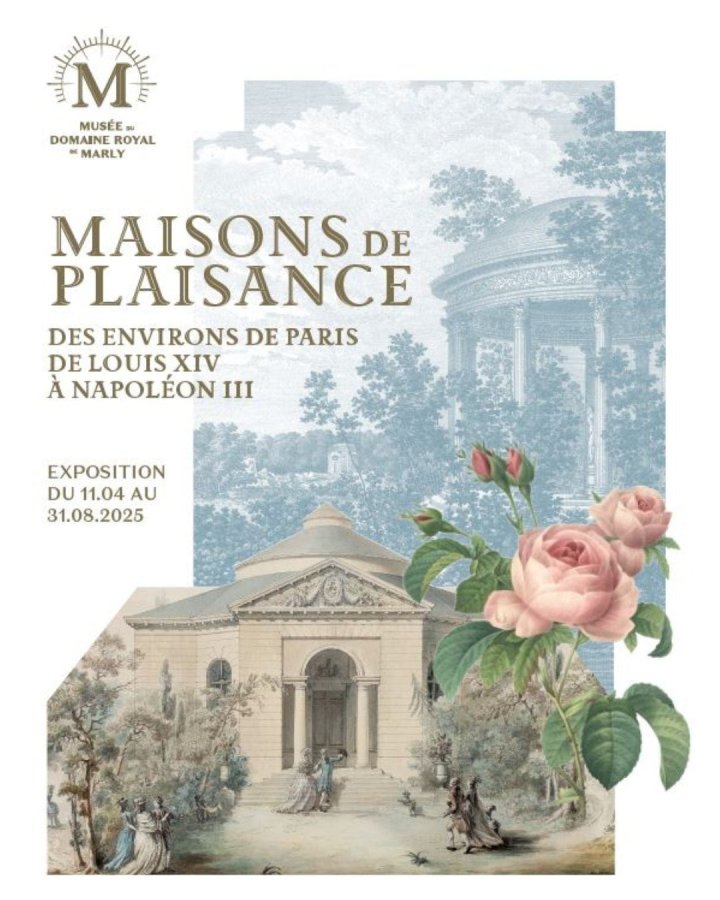 Dès la Renaissance, en Ile-de-France, une élite fortunée quitte la ville à la belle saison et s’installe dans de somptueuses résidences « aux champs » pour s’y détendre et s’y divertir. La maison de plaisance est un lieu de représentation autant que de détente. Elle incarne la richesse et le goût de son propriétaire. Estampes, peintures et objets décoratifs des XVIIe, XVIIIe et XIXe siècles témoignent de cette histoire qui a contribué à façonner le paysage francilien. Ces œuvres illustrent un art de vivre et les transformations sociales de la fin de l’Ancien Régime et du XIXe siècle : divertissements en vogue, désir d’intimité et de confort, place des femmes et développement de la bourgeoisie, lien avec la nature… Environ soixante-dix œuvres empruntées à des collections publiques et privées prennent place au sein du parcours permanent du musée du Domaine royal de Marly pour dialoguer avec ses collections.
Also, see the recent publication:
Anaïs Bornet and Francesco Guidoboni, eds., Maisons de plaisance des environs de Paris (Rome: Edizioni Artemide, 2023), 232 pages, ISBN: 978-8875754402, €30.
New Book | Maisons de plaisance des environs de Paris
Co-editor Anaïs Bornet has curated an exhibition on the same topic, which recently opened at the Musée du Domaine royal de Marly. From Edizioni Artemide:
Anaïs Bornet and Francesco Guidoboni, eds., Maisons de plaisance des environs de Paris (Rome: Edizioni Artemide, 2023), 232 pages, ISBN: 978-8875754402, €30.
Texts by Janine Barrier, Andrea Baserga, David Beaurain, Hervé Bennezon, Karine Berthier, Anaïs Bornet, Françoise Brissard, Roselyne Bussière, Ekaterina Bulgakova, Bernard Chevallier, Jérémie David, François de Vergnette, François Gilles, Francesco Guidoboni, Laetitia Jacquey-Achir, Desmond-Bryan Kraege, Louis-Joseph Lamborot, Marianne Mercier, Alexandra Michaud, Lucie Nottin, Claire Ollagnier, Camilla Pietrabissa, Jean Potel, Daniel Rabreau, Gabriel Wick.
 Autrefois situées « aux champs », les demeures de plaisance franciliennes—châteaux, maisons, pavillons aux dimensions variées—permettaient à une élite fortunée de quitter Paris lors de la belle saison, et de se détendre dans un environnement champêtre loin du tumulte de la ville. Avec l’annexion à la capitale de nombreuses anciennes résidences de villégiature, et le développement continu de la métropole parisienne menant au Grand Paris d’aujourd’hui, s’ouvrent de nouveaux questionnements sur les liens existants entre la ville et ce patrimoine autrefois éloigné.
Cet ouvrage collectif s’intéresse particulièrement aux maisons de plaisance bâties entre la moitié du XVIIe siècle et la fin du XIXe siècle, au sein des limites actuelles de l’Ile-de-France. Souvent méconnus et peu valorisés, les vestiges de la villégiature francilienne (non royale) de cette période se trouvent au cœur de l’actualité; ces bâtiments, pour certains encore préservés, se trouvent aujourd’hui face à diverses problématiques de conservation, d’adaptation aux nouveaux besoins, d’accueil du public, etc., mais sont également souvent menacés par les transformations urbaines qui répondent aux évolutions de la société du XXIe siècle.
Dans l’espoir de permettre aux franciliens de se réapproprier leur patrimoine, les textes réunis dans le présent volume s’attachent à offrir aux lecteurs un aperçu du phénomène de la villégiature en Ile-de-France, en retranscrivant l’histoire d’anciennes maisons de plaisance, certaines disparues, d’autres réhabilitées ou encore à l’avenir incertain, entre art de vivre, décors raffinés, jardins sophistiqués, réceptions et promenades dans des sites naturels aux vues panoramiques spectaculaires…
The table of contents can be seen here»
Exhibition | Biedermeier: The Rise of an Era
Now on view at the Leopold Museum, with the full press release available at Art Daily . . .
Biedermeier: The Rise of an Era / Eine Epoche im Aufbruch
Leopold Museum, Vienna, 10 April — 27 July 2025
Curated by Johann Kräftner with Lili-Vienne Debus
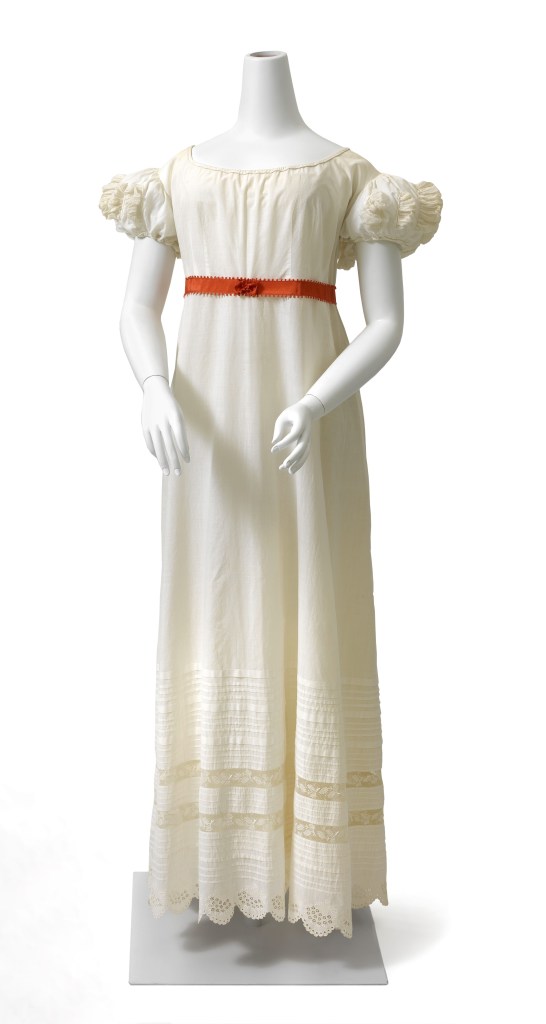
Day Dress, ca. 1816 (Wien Museum; photo by Birgit and Peter Kainz).
The fascinating era of the Biedermeier, which lasted from around the time of the Congress of Vienna in 1814/15 to the revolutions of 1848, delineates a period in Europe that was shaped by political upheaval and social revolts, which profoundly changed society. The congress resulted in the restitution of absolutism and princely rule, heralding a long phase of political restoration founded on a suppression of democratic aspirations. The resigned population turned away from politics and revolutionary ideals for fear of reprisals, seeking refuge in the private sphere. Themes of longing for security and harmony in everyday life entered the pictorial worlds of the Biedermeier.
Aside from all the political friction, the Biedermeier was also an era of great innovation and esthetical changes. The most important driving force was the industrial progress, which led to the construction of the first railway lines and spectacular suspension bridges, like the one connecting Buda and Pest. These technological revolutions resulted in decisive changes in the development of art. Many of these innovations did not emanate from Vienna as the center of the Habsburg Monarchy, but rather from the splendid cities of the crown lands, such as Budapest, Prague, Ljubljana, Trieste, Venice, and Milan.
The art of the monarchy was shaped by international exchange. Thus, the exhibition showcases not only the Viennese masters, including Ferdinand Georg Waldmüller and Friedrich von Amerling, but also Miklós Barabás and József Borsos from Budapest, Antonín Machek and František Tkadlík from Prague, as well as the artists active in Lombardy-Venetia Francesco Hayez and Jožef Tominc (Giuseppe Tominz).

Secretary, Bohemia, ca. 1820 (Prague: The Museum of Decorative Arts; photo by Gabriel Urbánek and Ondřej Kocourek).
Despite the severe poverty of the time, which affected large segments of the population, the simultaneous economic upturn yielded a bourgeoisie whose members wanted to be depicted in confident portraits. Alongside portraits celebrating realistic likenesses of the depicted and the documentation of their social status, the pictorial worlds were dominated by themes from everyday life: family portraits, genre paintings, and renderings of the artists’ own surroundings. Despite the Biedermeier’s typical restrictions to the microcosm of the everyday and one’s immediate surroundings, artists of the period also looked further afield to far-flung countries and cities in order to satisfy people’s curiosity and interest in foreign cultures. Featuring around 190 works from Austrian and international collections, ranging from paintings and graphic works to furnishings, glassware and dresses, the exhibition presents a varied picture of this era.
Curator: Johann Kräftner
Curatorial Assistance and Project Coordination: Lili-Vienne Debus
Johann Kräftner and Hans-Peter Wipplinger, eds., Biedermeier: Eine Epoche im Aufbruch / The Rise of an Era (Cologne: Walther König, 2025), 328 pages, ISBN: 978-3753308159, €40.
The catalogue, in German and English, includes essays by Lili-Vienne Debus, Sabine Grabner, Johann Kräftner, Stefan Kutzenberger, Michaela Lindinger, Fernando Mazzocca, Juliane Mikoletzky, Adrienn Prágai and Radim Vondráček, as well as a prologue by Hans-Peter Wipplinger.
◊ ◊ ◊ ◊ ◊
Note (added 23 April 2025) — This posting originally appeared April 22; it was moved back to April 21st for improved continuity with other posts.
Call for Papers | 18th-C. Painting between Italy and the Hapsburg Empire
From ArtHist.net:
Settecento Malerei: Cultural Transfer between Italy and the Habsburg Territories
Department of Art History of the University of Vienna, 23–24 October 2025
Organized by Eleonora Gaudieri and Erika Meneghini
Proposals due by 30 May 2025
This two-day workshop aims to explore 18th-century Italian painting as the focus of transfer phenomena between the Italian peninsula and the territories of the then Habsburg Empire, with Vienna at its centre. The high quality and renowned tradition of Italian painting, fostered by a dense network of international connections, enabled numerous artists of Italian origin or Italians by adoption to pursue successful careers at the Habsburg imperial court in Vienna. This phenomenon must be understood within the context of broader diplomatic and artistic networks that connected Vienna with key centres on the Italian peninsula such as Venice, Bologna, Rome, and Naples.
The beginning of the Settecento was characterised by a considerable expansion of the transalpine art market, driven by a strong interest in collecting Italian artworks. This phenomenon attracted numerous Italian artists, including many painters, to Vienna and to the allied courts of the German prince-electors, such as the Schönborn and Wittelsbach Houses. At the same time, a number of Austrian painters were encouraged to further their training in Italy, where they were profoundly influenced by the local visual language.
The workshop will address two main currents. First, it will investigate the meanings and functions of Italian painting within the socio-political and cultural context of the Habsburg imperial court in Vienna and its allied courts. Second, it seeks to explore the various dynamics that fostered the transfer of Italian painting and Italian artistic knowledge to Vienna and the territories of the then Habsburg Empire. We welcome innovative proposals that address the following topics:
• The reception of Italian painting in Vienna and allied territories, and the role of workshops and art academies in this process
• Italian painting as a medium of Habsburg representation
• The role of regional schools of Italian painting in the context of Viennese and Central European art collections
• Grand Tour and Kavalierstour
• The reconstruction of networks of diplomatic, artistic, and patronage relations
Contributions addressing other topics relevant to the workshop’s main focus are also welcome.
Please send your proposal—in English, German, or Italian—including the title of your presentation, an abstract (approx. 300 words), and a short CV to settecentomalerei@gmail.com by 30 May 2025. Speakers will have 20 minutes for their presentations. Applicants will be informed about the acceptance of their proposals by 30 June 2025. The conference languages are English, German, and Italian. The conditions and procedures for reimbursement of travel and accommodation costs will be communicated following confirmation of participation.
If you have any questions, please contact the organisers:
Dr. Eleonora Gaudieri, eleonora.gaudieri@univie.ac.at
Project assistant (APART-GSK funding programme)
Department of Art History, University of Vienna
Erika Meneghini, erika.meneghini@univie.ac.at
PhD Candidate
Department of Art History, University of Vienna










 Enfilade
leave a comment