The Decorative Arts Trust Launches Collecting250
From the press release:
Collecting250
The Decorative Arts Trust
New Online Resource Commemorates the Semiquincentennial through 250 Objects from across America.
The Decorative Arts Trust is pleased to share Collecting250.org, an interactive online resource that celebrates the importance of objects in narrating the history and evolution of the United States and the communities contained within. To commemorate America’s 250th, the United States Semiquincentennial, the Trust asked museums and historical societies to submit images and information about objects in their collections that tell powerful stories about national, state, or local identity. Collecting250 showcases 250 objects from over 140 institutions, and the release is timed in conjunction with the commencement of festivities honoring the 250th anniversary of the American Revolution’s first salvos in Massachusetts in 1775.
“We sought objects that are attached to a specific place, time, and people,” shares Trust Executive Director Matthew A. Thurlow. “Our aim was to present 250 objects from public collections across the country, thereby drawing attention to the broad swath of institutions that steward decorative arts of historical significance. This project aligns beautifully with the Trust’s mission to promote and foster an interest in decorative arts and material culture through our role as a community foundation elevating curatorial efforts to steward and study objects.”
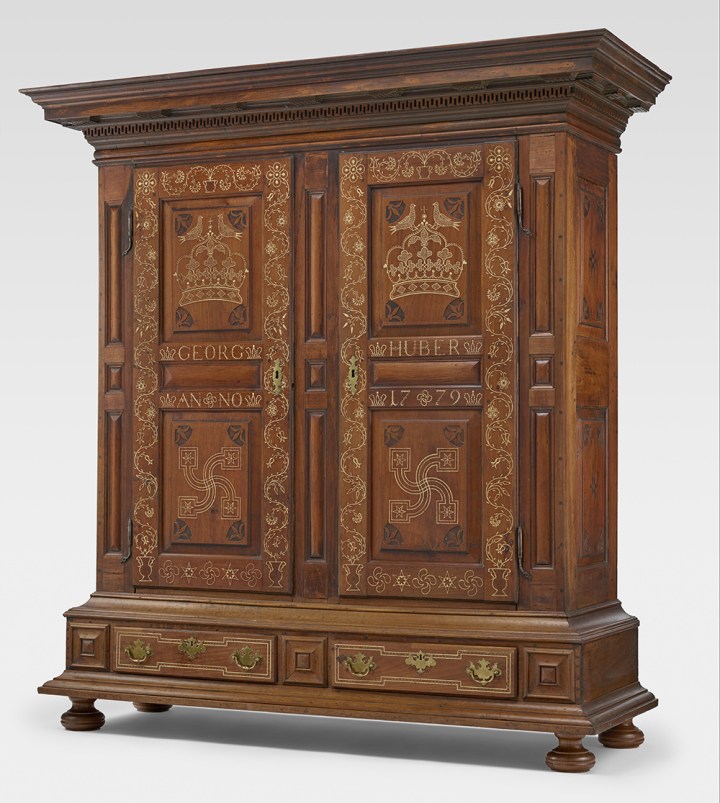
Kleiderschrank (Clothes Press), 1779, Lancaster County, Pennsylvania; walnut, yellow pine, oak, sulfur, iron; 6 feet 10 inches × 6 feet 6 inches × 27 inches (Philadelphia Museum of Art, 1957-30-1).
All 50 states and the District of Columbia are represented, and each record contains an image, tombstone information, and a description of the object’s importance. The ability to search for entries based on location, category, and keyword provides the chance to make exciting and enlightening discoveries in unexpected places. The Trust developed connections with museums and historical societies beyond our traditional network, allowing them to highlight extraordinary artistic achievements in the west, including a mid-19th-century bed covering (New Mexico History Museum) featuring churro wool yarn and colcha embroidery introduced by early Spanish settlers.
There is an interplay between objects that are isolated from one another by time, location, maker, and function. For example, two disparate entries associated with the care and storage of textiles: a humble, late-19th-century pressing iron (Illinois State Museum) that Mississippian Bettye Kelly brought to Joliet, IL, in the 1960s; and a stunning sulfur-inlaid kleiderschrank (Philadelphia Museum of Art) made in Manheim, Pennsylvania, in 1779 for Georg Huber. The former speaks to the Great Migration of African Americans northward in the 20th century; the latter to the Germanic communities that were thriving on the eastern seaboard during the American Revolution.
The tradition of basket weaving has been practiced and perfected by various cultures over the past 10,000 years. Two entries separated by a century and the entire continent of North America illustrate the cultural convergences and impulses behind the production of basketry. In 1905, Aleksandra Kudrin Reinken, the daughter of a Unangax̂ (Aleut) mother and Russian father used her community’s traditional weaving techniques to create a basket (Hood Museum of Art) for a tourist clientele that incorporates ornamentation from prints, magazines, and perhaps even a Whitman’s Chocolate Sampler box. In 2007, Mary Jackson, an internationally recognized master of sweetgrass basketry, completed Never Again (Gibbes Museum of Art), inspired by the traditional Gullah rice fanner baskets that she learned to create from her mother and grandmother and that were once made and used on Lowcountry plantations.
Collecting250 is free and open to the public. Visit Collecting250.org to start exploring. The Decorative Arts Trust, founded in 1977, is a nonprofit organization that promotes and fosters the appreciation and study of the decorative arts through programs, partnerships, and grants. Learn more at decorativeartstrust.org.
Four Educator Guides, designed specifically for the Collecting250 project, are also available.
◊ ◊ ◊ ◊ ◊
Note (added 20 December 2025) — The post was updated to include the link for the educator guides.
Call for Applications | Associate Editor, J. of the History of Collections
From Oxford UP:
Journal of the History of Collections
Associate Editor applications invited
Applications due by 19 May 2025
Oxford University Press (OUP) invites applications for the position of Associate Editor for the Journal of the History of Collections. We are particularly seeking candidates with expertise in Eastern European, Asian, 18th–21st-century Western art histories, and Classical art more broadly. We are not looking to expand our expertise in early modern or Renaissance art at this time. Ideally, the candidate will take up the position in mid-2025.
The journal is dedicated to the investigation and exploration of all aspects of collecting activity, with no limits on time period or subject matter. From its inception in 1989, the journal has sought to provide a platform from which researchers can speak to each other across disciplinary boundaries. The journal appeals to those with an interest in ethnography, natural sciences, archaeology, the history of medicine, decorative arts, the social history of museums and galleries, the collecting and display of painting and sculpture, and related fields.
Candidates should have a broad base of knowledge in the field of the journal; considerable experience in peer-reviewing; a strong record of recognised scholarship; time to devote to the journal; a strong grasp of the English language (particularly in written form); an interest in reading and publishing in the field of the history of collecting; the ability to undertake critical review of manuscripts; good communication skills; an appreciation of publication ethics; and good networks in the field. Previous journal editor experience is beneficial but not required.
Applicants can be based in any country. We particularly welcome applications from groups traditionally under-represented in academic publishing, including but not limited to women, Black and minority ethnic candidates, and those with disabilities. If you are interested in the role but unsure whether it is appropriate for you, please don’t hesitate to reach out to the Publisher for the Journal of the History of Collections at Oxford University Press, Sharmin Islam: sharmin.islam@oup.com.










 Enfilade
leave a comment