Restoration of the Williamsburg Bray School Completed
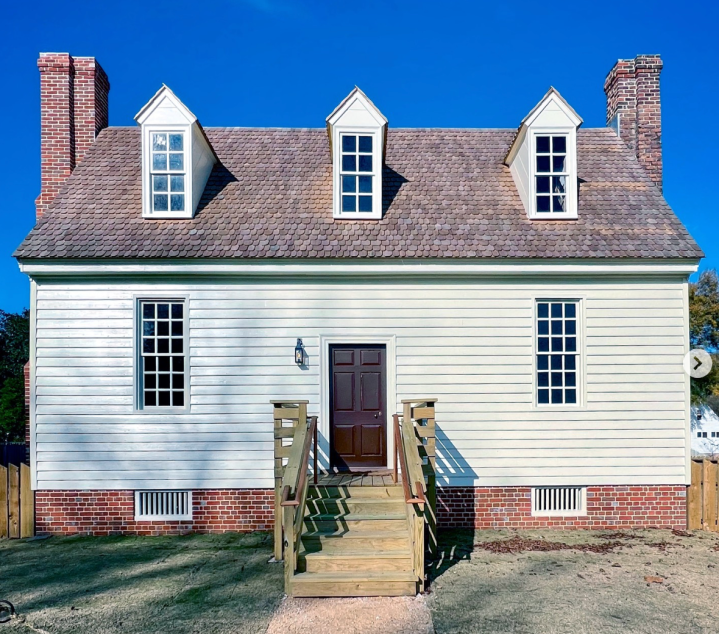
Opened in 1760, the Bray School is believed to be the oldest surviving building in the United States for the education of Black children. As noted by Lauren Walser in her Preservation article, the school “taught a pro-slavery, faith-based curriculum based on the teachings of the Church of England.” Photo from the Instagram account of Bruce A. deArmond, which foregrounds historic architecture.
◊ ◊ ◊ ◊ ◊
The story of the recovery of the Bray School at Colonial Williamsburg is recounted in the latest issue of Preservation (Spring 2025). The formal dedication of the restored building took place on 1 November 2024. It opens to the public this spring. From Colonial Williamsburg:
The Williamsburg Bray School was one of the earliest institutions dedicated to Black education in North America. From 1760 to 1774, teacher Ann Wager likely taught hundreds of students between the ages of three and ten. Students learned the tenets of the Anglican Church and subjects including reading, and for girls, sewing. The Bray School’s deeply flawed purpose was to convince enslaved students to accept their circumstances as divinely ordained. Hidden in plain sight on the William & Mary campus for over 200 years, the Williamsburg Bray School now stands in Colonial Williamsburg’s Historic Area as the Foundation’s 89th original structure. . . .
The Bray School will be used as a focal point for research, scholarship, and dialogue regarding the complicated story of race, religion, and education in Williamsburg and in America.
◊ ◊ ◊ ◊ ◊
From Colonial Williamsburg:
Maureen Elgersman Lee and Nicole Brown, eds., The Williamsburg Bray School: A History through Records, Reflections, and Rediscovery (Williamsburg: Colonial Williamsburg, 2024), 176 pages, ISBN: 978-0879353032, $20.
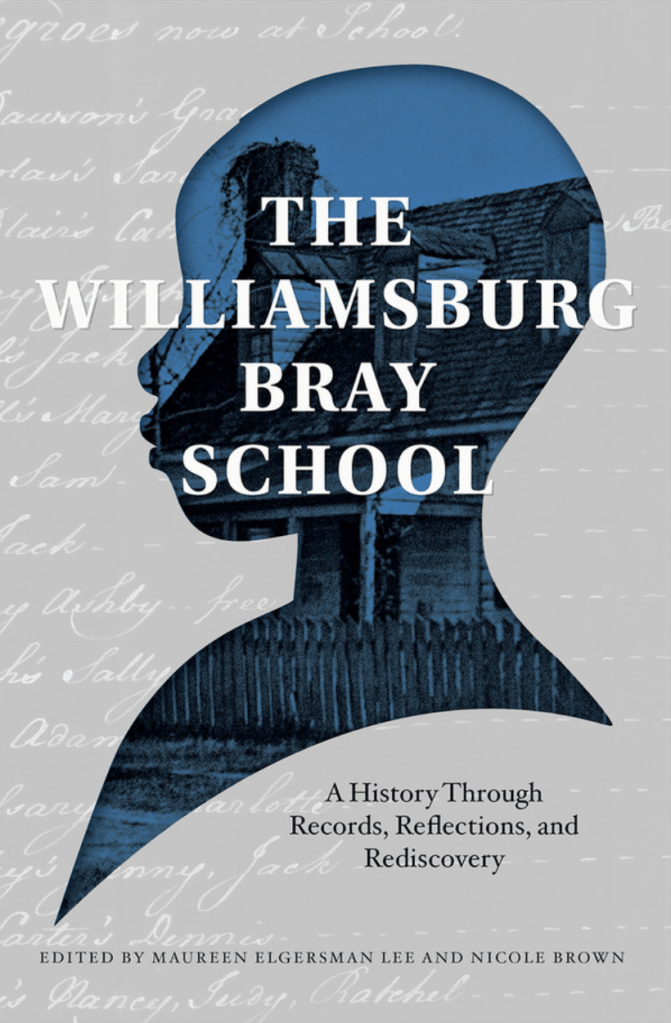 Seven letters tracing the arc of the Williamsburg Bray School—from its founding in 1760 to its closing in 1774—provide the foundation for a collection of essays that explore the school’s history and its implications for the enslaved and free Black children who attended. These letters are some of the surviving correspondence between the Williamsburg school’s administrators and the Associates of Dr. Thomas Bray, a London-based Anglican charity whose charge was to minister to what it saw as the spiritual needs of African Americans. The essayists reflect on the evolution of the Williamsburg Bray School, offering a variety of perspectives on the school and the children who attended it. Some pieces reflect years of research and writing on the establishment of the school. Others, including writings from some of the descendants of these students, represent more recent opportunities to reflect on the school and its historical context. In addition to a short history of the school, a map that pinpoints where the children resided in Virginia’s colonial capital, and photographs of the historic letters, the book delves into the 21st-century discovery of the Williamsburg Bray School building, its subsequent move from the William & Mary campus to Colonial Williamsburg’s Historic Area, and the restoration of the structure that can help tell the complicated story of race, religion, and education in Williamsburg and early America. Author Antonio Bly also shares the poignant story of Isaac Bee, a student at the school who broke the bonds of his enslavement to a Williamsburg planter and rose up from slavery to freedom.
Maureen Elgersman Lee, director of the William & Mary Bray School Lab, holds both a master’s degree and a doctorate in African American Studies. She is an award-winning professor and author of numerous books and articles on the history of Blacks in the Americas.
Nicole Brown is Graduate Assistant for the William & Mary Bray School Lab and a PhD Candidate in American Studies at William & Mary; she was previously a Program Design Manager at The Colonial Williamsburg Foundation. As a first-person historical interpreter, Brown portrays a variety of women including Ann Wager, the 18th-century white teacher at the Williamsburg Bray School, and Monticello’s Martha Wayles Skelton Jefferson. Brown’s ongoing academic research centers Black literacy in the Atlantic World via interdisciplinary and descendant-engaged scholarship.










 Enfilade
leave a comment