Bethlehem’s Moravian District Added to UNESCO’s World Heritage List
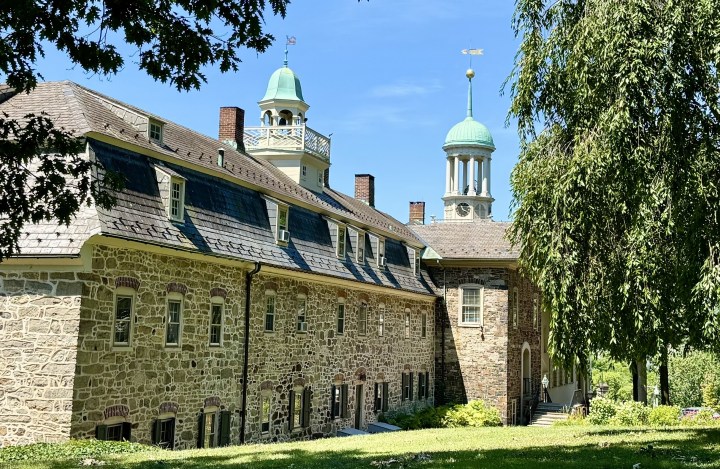
Bell House Complex, built in 1746, 56 West Church Street, Bethlehem.
◊ ◊ ◊ ◊ ◊
Last year, the Historic Moravian Bethlehem District in Pennsylvania (consisting of nine buildings, four ruins, and a cemetery) was added to UNESCO’s World Heritage List. Eve Kahn describes her visit to the city of Bethlehem (70 miles north of Philadelphia) in the latest issue of Preservation (Spring 2025) . . .
I am having a heady preservationist moment in mid-air. It’s a crystalline winter morning in Bethlehem, Pennsylvania, a city known for industriousness and architectural stewardship since the 1740s. I have been escorted up sinuous staircases to the domes belfry of Central Moravian Church’s Sanctuary, a gabled and stuccoed building that has welcome worshipers since it opened in 1806. From my perch overlooking Main Street, I admire the church’s well-kept tower clockfaces and its planes of gray slate roofing, supported by walls six feet thick. All around, Moravian setters’ 18th-century masonry buildings have adapted into bustling museums, businesses, and homes, cheek by jowl with their Victorian and Art Deco counterparts . . . (p. 21).
UNESCO designated the place [of Bethlehem] as part of what is officially called a “transnational serial property,” along with three 18th-century hamlets in Europe: Herrnhut in Germany, Gracehill in Northern Ireland, and Christiansfeld in Denmark. All were set up as Christian communities by members of the Moravian Church, a Protestant sect founded in the 1450s in what is not the Czech Republic. Fleeing persecution, the community dispersed, and in the 1700s a group of adherents revived the Moravian Church. They eventually scattered worldwide to worship and proselytize. In 1741, some especially intrepid Moravians settled on Pennsylvania acreage at the confluence of the Lehigh River and Monocacy Creek, on land that white explorers had recently swindled from the Lenape people (p. 22).
◊ ◊ ◊ ◊ ◊
From the National Park Service press release (26 July 2024) . . .
Secretary of the Interior Deb Haaland today applauded the selection of the Historic Moravian Bethlehem District in Bethlehem, Pennsylvania, to the United Nations Educational, Scientific and Cultural Organization’s (UNESCO) World Heritage List. The list highlights cultural and natural heritage sites around the world considered to be of outstanding value to humanity.
“The United States is deeply honored to be included in UNESCO’s World Heritage List with the listing of the Historic Moravian Bethlehem District where visitors from around the world are able to learn about the rich history of Moravian settlements, their cultural tradition and spiritual ideals,” said Secretary Haaland. “This designation is a recognition of the incredible work of the National Park Service and its local partners to preserve an important part of American—and world—history.”
This designation is UNESCO’s 26th—and the first transnational World Heritage listing—in the United States. In addition to the Historic Moravian Bethlehem District, the listing of Moravian Church Settlements includes the historic settlements of Herrnhut, founded in 1722 in Germany, and Gracehill, established in 1759 in Northern Ireland. The three areas join as an extension of the Moravian settlement of Christiansfeld in Denmark, founded in 1773, which was added to the World Heritage List in 2015, to form a single World Heritage listing for Moravian Church Settlements.
“This well-deserved designation demonstrates the lasting, global influence of the Moravian Church and the preservation of some of America’s most treasured landmarks that support and illustrate our heritage and history,” said National Park Service Director Chuck Sams.
The Historic Moravian Bethlehem District is also a national historic landmark. Established in 1741 as a planned community, it was the religious and administrative center of Moravian activities in North America. Similar to the other three settlements, many of its buildings still serve their original purpose. In 2022, Secretary Haaland authorized the National Park Service (NPS) to develop a nomination of Moravian Church Settlements for World Heritage List consideration.
NPS supported this effort with the full cooperation of property owners, the City of Bethlehem, Bethlehem Area Moravians and Moravian University. NPS advised the Bethlehem World Heritage Commission and guided them through the technical requirements of the nomination process as well as communicated with the governments of Germany, the United Kingdom, and Denmark on the development of the nomination.
The NPS is the principal U.S. government agency responsible for implementing the World Heritage Convention in cooperation with the Department of State. The NPS manages all or part of 19 of the 26 U.S. sites. Inclusion of a site in the World Heritage List does not affect U.S. sovereignty or management of the sites.










 Enfilade
leave a comment