Seminar | African Ivory: Past and Present
From the seminar flyer:
African Ivory: Past and Present
Huguenot Museum, Rochester, 4 June 2025
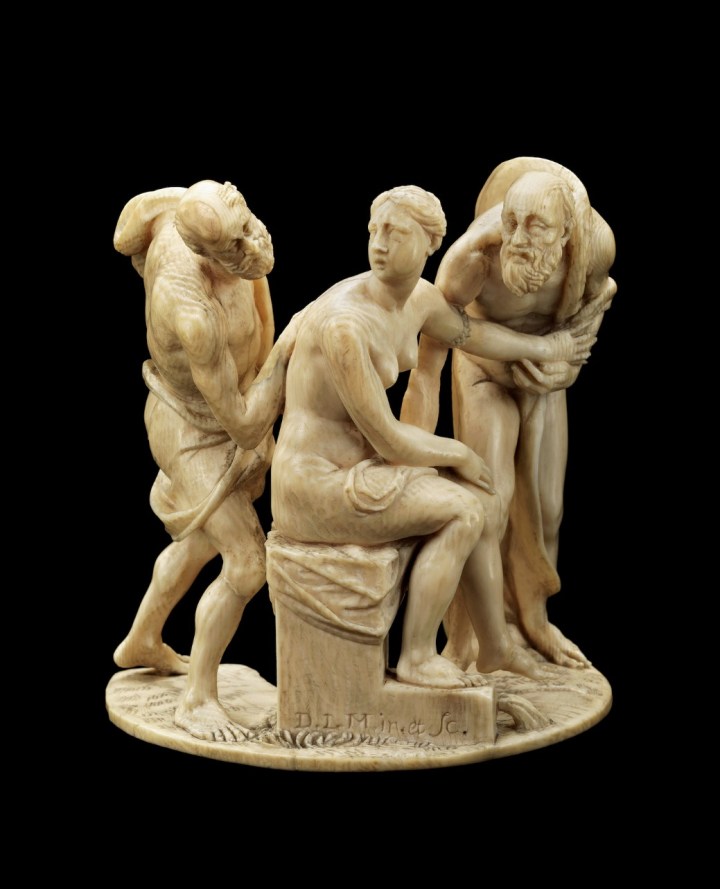
David Le Marchand, Susanna and the Elders, ca. 1720, African ivory (Rochester: Huguenot Museum). More information is available here.
Recent UK legislation—the Ivory Act of 2018 and the January 2025 amendment—makes the acquisition and loan of objects containing antique ivory challenging for regional and independent museums. This seminar hosted by the Huguenot Museum—following the acquisition, loan, and display of three ivory carvings by Huguenot sculptors—will share case studies, discuss best procedure in negotiating recent legislation, and consider approaches to press and marketing. To register, please send your name, email address, and institutional affiliation to Tessa Murdoch, chair@huguenotmuseum.org. The fee of £15 per person will include a buffet lunch. Payment can be made on the day in cash or card, or in advance by BACS transfer. Please note any dietary requirements.
p r o g r a m m e
11.00 Lucy Vigne (Independent Consultant) — Illicit Trade in African Ivory Today
11.40 Martin Levy, FSA — Ivory, the Antique Trade, and the Impact of Recent International Legislation
12.45 Lunch
1.35 Leanne Manfredi (V&A Purchase Grant Fund) and Mariam Rosser-Owen (Curator Middle East, Asia Department, V&A) — The Ivory Act of 2018 and Recent Amendments
Meeting the Challenges of the Ivory Act is a network led by the Pitt Rivers Museum and the Victoria and Albert Museum to support curators at Prescribed Institutions who are required to assess applications for exemption to the Ivory Act.
2.15 Nigel Israel (Independent Scholar) — Identifying Ivories
3.30 Tea
New Book | Objects and Material Cultures in the Dutch Republic
From Amsterdam UP:
Judith Noorman and Feike Dietz, eds., Objects, Commodities, and Material Cultures in the Dutch Republic: Exploring Early Modern Materiality across Disciplines (Amsterdam: Amsterdam University Press, 2024), 272 pages, ISBN: 978-9048562770, €129.
 How did objects move between places and people, and how did they reshape the Republic’s arts, cultures and sciences? ‘Objects’ were vitally significant for the early modern Dutch Republic, which is known as an early consumer society, a place famous for its exhaustive production of books, visual arts, and scientific instruments. What happens when we push these objects and their materiality to the centre of our research? How do they invite us to develop new perspectives on the early modern Dutch Republic? And how do they contest the boundaries of the academic disciplines that have traditionally organized our scholarship?
In Objects, Commodities and Material Cultures, the interdisciplinary community of specialists around the Amsterdam Centre for the Study of Early Modernity innovatively explores the diverse early modern world of objects. Its contributors take a single object or commodity as a point of departure to study and discuss various aspects of early modern art, culture, and history: from natural objects to consumer goods, from knowledge instruments to artistic materials. The volume aims to unravel how objects have moved through regions, cultures, and ages, and how objects impacted people who lived and worked in the Dutch Republic.
Judith Noorman is Associate Professor of Art History at the University of Amsterdam and leads the Dutch Research Council project The Female Impact, 2021–2026. As Director of the Amsterdam Centre for Studies in Early Modernity, she has organized the Object Colloquia Series, which laid the foundation for this book.
Feike Dietz is Professor of Global Dynamics of Dutch Literature at the University of Amsterdam. Her research focuses on the relationship between early modern texts, knowledge, and reading, with special attention devoted to youth, women, and girls.
c o n t e n t s
Acknowledgements
1 Feike Dietz and Judith Noorman — Introduction: Objects, Commodities and Material Cultures in the Dutch Republic
2 Weixuan Li and Lucas van der Deijl — The Anatomical Atlas: Govert Bidloo and Gerard de Lairesse’s Anatomia Humani Corporis (1685)
3 Djoeke van Netten — The Bullet and the Printing Press: Objects Celebrating the Battle of Gibraltar (1607)
4 Saskia Beranek — A Baluster: Amalia van Solms and the Global Trade in Japanese Lacquer
5 Lieke van Deinsen and Feike Dietz — The Graphometer and the Book: How Petronella Johanna de Timmerman (1723/1724–1786) Merged Science and Poetry
6 Hanneke Grootenboer, Cynthia Kok, and Marrigje Paijmans — Shells: Shaping Curiosity in the Dutch Republic
7 Gabri van Tussenbroek — The VOC Boardroom: A Forensic Investigation into the Built Environment
8 Maartje Stols-Witlox — The Muller: Insights into Practical Artistic Knowledge through Re-Making Experiments
9 Judith Noorman — Blue Paper: Its Life, Origin, History, and Artistic Exploration
List of illustrations with photo credits
Index










 Enfilade
leave a comment