New Book | Le Comte d’Angiviller
From Éditions Monelle Hayot:
Monelle Hayot and Antoine Maës, Le Comte d’Angiviller: Directeur des Arts sous Louis XVI (Saint-Rémy-en-l’Eau: Éditions d’art Monelle Hayot, 2025), 384 pages, ISBN: 979-1096561421, €60.
 Gentilhomme de la manche, le comte d’Angiviller (1730–1809) élève le futur Louis XVI et ses frères. Dès son accession au trône en 1774, Louis XVI le nomme directeur des Bâtiments. Son rôle est immense. Fondateur du musée du Louvre il orchestre les travaux et constitue les collections en acquérant des œuvres majeures. Il est responsable de tous les bâtiments royaux, achète Rambouillet pour le roi. Angiviller préside au sort des manufactures de Sèvres et des Gobelins, dirige l’Académie de peinture et de sculpture, ainsi que l’Académie de France à Rome.
L’époque révolutionnaire fait de lui un témoin oculaire majeur de faits historiques auxquels il participe. Le roi lui demande d’émigrer en Espagne. D’une fidélité sans faille, il revient pour aider le roi en danger, mais sa tête est sur la liste des aristocrates à décapiter. Il part pour l’Allemagne dont il ne reviendra jamais.
Angiviller avait un secrétaire, Narcisse, qui recopiait toute sa correspondance avec le roi. Il fut le témoin de sa vie et émigra avec lui. Sur ses vieux jours, Narcisse écrit ses mémoires pour la marquise de Capellis qui vit au château de Saint-Rémy-en-l’Eau, lieu de naissance d’Angiviller. Ce manuscrit inédit est entièrement retranscrit à la fin de cet ouvrage.
Lecture | Meredith Martin on Unpacking the Choiseul Box
This month at BGC:
Meredith Martin | Unpacking the Choiseul Box
An Iris Foundation Awards Lecture
Bard Graduate Center, New York, 22 April 2025

Louis-Nicolas van Blarenberghe (miniaturist; 1716–1794) and Louis Roucel (goldsmith; ca. 1756–1787), tabatière Choiseul (Choiseul snuffbox), ca. 1770/71, gouache on vellum, assembled in an architectural gold setting, 8 × 6 × 2.4 cm (Paris: Louvre).
This interactive lecture will explore the famous Choiseul snuffbox, a tiny but extraordinary monument of the eighteenth century that features views of the Parisian mansion and art collection of the Duc de Choiseul, foreign minister to Louis XV. The snuffbox, or tabatière, became a cause célèbre in France in 2023 when it was offered for sale to the tune of nearly four million euros. The Louvre launched a massive public campaign to raise funds to acquire the box and published a scholarly tome dedicated to giving readers “all the keys you still need to unlock the secrets of this highly prized tabatière.” And yet in all the recent literature around this object, no mention has been made of its deep, unsettling connections to colonialism and enslavement at the level of material, iconography, patronage, and use. This talk will seek to ‘unpack’ this box and will invite attendees to confront its materiality and multisensory dimensions through digital reconstructions produced in collaboration with Bard Graduate Center’s digital humanities team.
Meredith Martin is a professor of art history at New York University and a founding editor of Journal18. A specialist in early modern French art and empire, she is the coauthor (with Gillian Weiss) of the prizewinning book The Sun King at Sea: Maritime Art and Galley Slavery in Louis XIV’s France (Getty, 2022; French edition 2022), which is related to an exhibition that she and Dr. Weiss are co-curating for the Institut du monde arabe in Paris. Martin is also the author of Dairy Queens: The Politics of Pastoral Architecture from Catherine de’ Medici to Marie-Antoinette (Harvard, 2011), and a coauthor of Meltdown: Picturing the World’s First Bubble Economy (2020), which is related to an exhibition she co-curated for the New York Public Library. Together with Phil Chan, Martin reimagined and restaged a lost French ballet from 1739 known as the Ballet des Porcelaines, which premiered at the Metropolitan Museum of Art in 2021 and was performed throughout the US and Europe in 2022. She is currently working on a multimedia collaborative project called Colonial Networks, which explores links between Haiti/Saint-Domingue and the Paris art world during the late eighteenth and early nineteenth centuries.
28th Annual Iris Foundation Awards — In 1997 Susan Weber created the Iris Foundation Awards to recognize scholars, patrons, and professionals who have made outstanding contributions to the field of decorative arts, design history, and material culture. Meredith Martin will receive the Iris Award for Outstanding Mid-Career Scholar on April 23 at the Cosmopolitan Club. This year’s other recipients are Irene Roosevelt Aitken (Outstanding Patron), Julius Bryant (Outstanding Lifetime Achievement), and Katherine Purcell (Outstanding Dealer). Proceeds benefit the Bard Graduate Center Scholarship Fund.
New Book | La Tabatière Choiseul
Published in October by Faton:
Michèle Bimbenet-Privat, ed., La Tabatière Choiseul: Un monument du XVIIIe siècle (Dijon: Éditions Faton, 2025), 256 pages, ISBN: 978-2878443721, €49.
 Acquise en 2023 par le musée du Louvre, la tabatière Choiseul est incontestablement la plus originale et la plus célèbre des tabatières du XVIIIe siècle. La précieuse monture en or de l’orfèvre Louis Roucel sert d’écrin à six miniatures de Louis Nicolas Van Biarenberghe mettant en scène le flamboyant duc de Choiseul, le grand ministre de Louis XV, au faîte de sa gloire. Toutes les facettes de la vie quotidienne de ce personnage généreux et arrogant s’y succèdent, soulignant son travail acharné, parfois solitaire, indissociable de l’exercice du pouvoir. La tabatière Choiseul séduit aussi par sa description minutieuse du cadre de vie raffiné du ministre, de son immense collection de tableaux et d’objets d’art, esquissant ainsi une réflexion sur les relations entre art et pouvoir. Elle offre enfin une multitude d’énigmes à résoudre sur son origine, ses possesseurs successifs, la signification des scènes, l’identification des lieux et des personnages représentés.
Exhibition | Music and the Republic
Now on view at the Musée des Archives Nationales:
Music and the Republic: From the French Revolution to the Popular Front
Hôtel de Soubise, Paris, 26 March — 14 July 2025
Curated by Marie Ranquet, Sophie Lévy, and Christophe Barret
 L’exposition Musique et République, de la Révolution au Front populaire—organisée avec le concours du Conservatoire national supérieur de musique et de danse de Paris—souhaite mettre en lumière les liens entre la musique et la construction de la République. De la Révolution, qui organise de nouvelles institutions et utilise la musique pour fonder un sentiment patriotique, au Front populaire de 1936, qui fait le pari de l’émancipation sociale du citoyen par l’accès aux loisirs et à la culture, la formation et la pratique musicale permettent à la fois le partage d’un patrimoine sonore commun et l’expression personnelle, parfois subversive.
Les Archives nationales retracent l’histoire de cette rencontre entre le citoyen et la musique. Des partitions inédites retrouvées dans les fonds des Archives nationales, des instruments de musique étonnants ou oubliés, des correspondances politiques, des commandes passées à des compositeurs prestigieux et de nombreux autres documents, racontent une histoire mouvementée : celle d’un siècle et demi de production, d’éducation et de pratique musicales, envisagées en regard de l’idée républicaine.
Commissariat scientifique
• Marie Ranquet, conservatrice en chef du patrimoine aux Archives nationales
• Sophie Lévy, responsable des archives au Conservatoire national supérieur de musique et de danse de Paris
Commissariat technique
• Christophe Barret, chargé d’expositions au département de l’Action culturelle et éducative des Archives nationales
Musique et République: De la Révolution au Front populaire (Paris: Éditions Snoeck, 2025), 168 pages, ISBN: 978-9461619464, €30. With contributions by Adrián Almoguera, Mathias Auclair, Rémy Campos, Myriam Chimènes, Peter Hicks, Sophie Lévy, Marie Ranquet, Émeline Rotolo, and Charles-Éloi Vial.
New Historical Fiction | Allegro
From Other Press, where one can also find a playlist for the book:
Ariel Dorfman, Allegro: A Novel (New York: Other Press, 2025), 272 pages, ISBN: 978-1635424485, $18.
 This thrilling historical mystery starring Mozart tells of friendship and betrayal, and how music allows us to defy death—from the acclaimed author of Death and the Maiden and The Suicide Museum.
In 1789 Wolfgang Amadeus Mozart visits the grave of Johann Sebastian Bach in Leipzig, looking for a sign, a signal, an answer to an enigma that has haunted him since childhood: Was Bach murdered by a famous oculist? And years later, was Handel a victim of the same doctor? Allegro follows his investigation, from the salons of London to the streets of Paris, recreating an enthralling and turbulent time, full of rogues and brilliant composers, charlatans and presumptuous nobles. Running parallel to this search is the rise of Mozart, his knowledge and fame, his trials and losses.
Ariel Dorfman is a Chilean-American author, born in Argentina, whose award-winning books in many genres have been published in more than fifty languages and his plays performed in more than one hundred countries. Among his works are the plays Death and the Maiden and Purgatorio, the novels The Suicide Museum (Other Press, 2023), Widows, and Konfidenz, and the memoirs Heading South, Looking North and Feeding on Dreams. He lives with his wife Angélica in Santiago, Chile, and Durham, North Carolina, where he is the Walter Hines Page Emeritus Professor of Literature at Duke University.
New Book | On the Calculation of Volume
The shortlist for this year’s International Booker Prize was announced on Tuesday. Included is the first installation Solvej Balle’s seven-part novel On the Calculation of Volume. As noted by Hilary Leichter in her review for The New York Times (25 January 2025), the central character is an antiquarian bookseller “specializing in illustrated works from the 18th century.” I’ve not yet read the book, but that feels just about perfect to me. –CH
From New Directions:
Solvej Balle, On the Calculation of Volume, Part I, translated from the Danish by Barbara Haveland (New Directions, 2024), 160 pages, ISBN: 978-0811237253, $16.
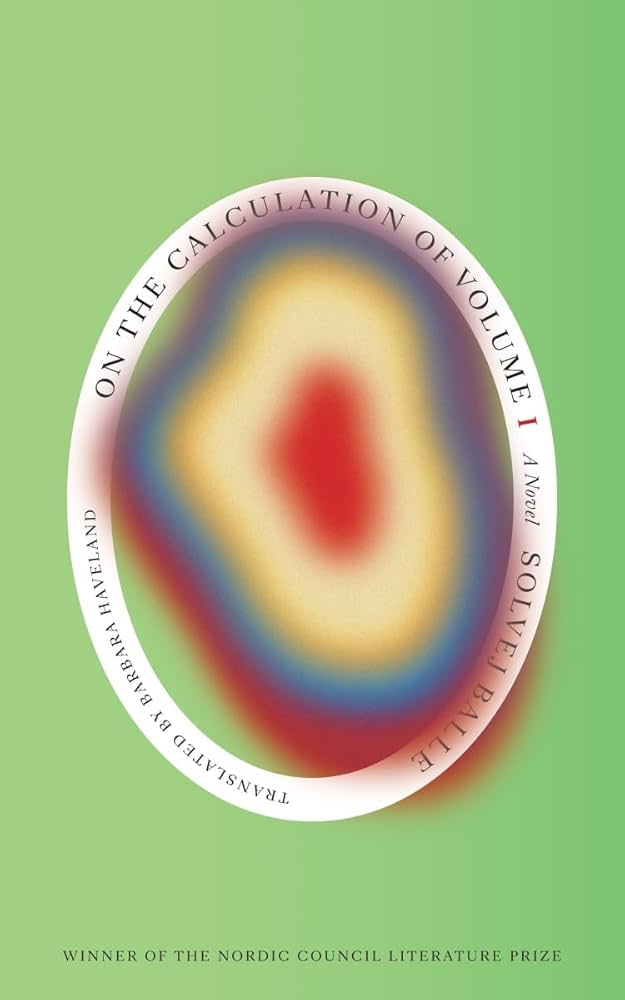 Tara Selter, the heroine of On the Calculation of Volume, has involuntarily stepped off the train of time: in her world, November eighteenth repeats itself endlessly. We meet Tara on her 122nd November 18th: she no longer experiences the changes of days, weeks, months, or seasons. She finds herself in a lonely new reality without being able to explain why: how is it that she wakes every morning into the same day, knowing to the exact second when the blackbird will burst into song and when the rain will begin? Will she ever be able to share her new life with her beloved and now chronically befuddled husband? And on top of her profound isolation and confusion, Tara takes in with pain how slight a difference she makes in the world. (As she puts it: “That’s how little the activities of one person matter on the eighteenth of November.”)
Balle is hypnotic and masterful in her remixing of the endless recursive day, creating curious little folds of time and foreshadowings: her flashbacks light up inside the text like old flash bulbs. The first volume’s gravitational pull―a force inverse to its constriction―has the effect of a strong tranquilizer, but a drug under which your powers of observation only grow sharper and more acute. Give in to the book’s logic (its minute movements, its thrilling shifts, its slant wit, its slowing of time) and its spell is utterly intoxicating. Solvej Balle’s seven-volume novel wrings enthralling and magical new dimensions from time and its hapless, mortal subjects. As one Danish reviewer beautifully put it, Balle’s fiction consists of writing that listens. “Reading her is like being caressed by language itself.”
Solvej Balle was born in 1962, made her debut in 1986 with Lyrefugl, and she went on to write one of the 1990s’ most acclaimed works of Danish literature, According to the Law: Four Accounts of Mankind (praised by Publishers Weekly for its blend of “sly humor, bleak vision, and terrified sense of the absurd with a tacit intuition that the world has a meaning not yet fathomed”). Since then, she’s published a book on art theory, Det umuliges kunst, 2005, a political memoir Frydendal og andre gidsler, 2008, and two books of short prose Hvis and Så, published simultaneously in 2013. On the Calculation of Volume is Solvej Balle’s major comeback, not just to Danish or Nordic fiction, but―expanding the possibilities of the novel―to all of world literature.
Barbara J. Haveland (born 1951) is a Scottish literary translator, resident in Copenhagen. She translates fiction, poetry, and drama from Danish and Norwegian to English. She has translated works by many leading Danish and Norwegian writers, both classic and contemporary, including Henrik Ibsen, Peter Høeg, Linn Ullmann, and Carl Frode Tiller.
New Book | Oxford Libraries: Architecture
Coming soon, with distribution by The University of Chicago Press:
Geoffrey Tyack, with photographs by Dan Paton, Oxford Libraries: Architecture (Oxford: Bodleian Library Publishing, 2025), 336 pages, ISBN: 978-1851246052, £50 / $80.
 Curated illustrations of the architectural design and history of the most beautiful libraries in Oxford and a close look at the artistic prowess of the architects responsible.
The libraries of the colleges and the University of Oxford are among the finest, but also among the least-known, buildings in the city. Ranging in date from the thirteenth to the twenty-first centuries, they embody successive changes in internal design and architectural taste. Libraries were originally established as repositories of knowledge in the form of manuscripts and printed books, and until fairly recently, they were used only by scholars. Over time, the University’s libraries, and those of the constituent colleges, attracted wealthy donors, some of whom, like John Radcliffe, gave generously to the provision of impressive and architecturally innovative buildings in which to house the books. These buildings are still among the most impressive features of Oxford’s architectural landscape, helping to define its visual identity. Architectural styles range from medieval wooden stalls to the concrete and glass of twentieth-century Brutalism, and notable architects include Sir Christopher Wren, Nicholas Hawksmoor, Sir Giles Gilbert Scott, James Gibbs, Sir Edwin Lutyens, and Arne Jacobsen. With specially commissioned photography, this profusely illustrated book invites readers through the doors of over fifty beautiful and iconic libraries, revealing how they are steeped in history, learning, and cultural change.
Geoffrey Tyack is an emeritus Fellow of Kellogg College, University of Oxford, and the Director of Stanford University Centre in Oxford.
Dan Paton is a commercial photographer specialising in architecture, lighting, interiors, and the built environment, as well as portrait, PR, and event photography.
Book | Jewish Treasures from Oxford Libraries
This is a book that I should have noted years ago; David Stern’s review for Mosaic usefully introduces the collectors, many of whom lived in the 18th century. –CH
Distributed by The University of Chicago Press . . .
Rebecca Abrams and César Merchán-Hamann, eds., Jewish Treasures from Oxford Libraries (Oxford: Bodleian Library Publishing, 2020), 304 pages, ISBN: 978-1851245024, $55.
 Representing four centuries of collecting and a thousand years of Jewish history, this book brings together Hebrew manuscripts and rare books from the Bodleian Library and Oxford colleges. Highlights of the extraordinary collections include a fragment of Maimonides’ autograph draft of the Mishneh Torah, the earliest dated fragment of the Talmud, exquisitely illuminated manuscripts of the Hebrew Bible, stunning festival prayer books, and one of the oldest surviving Jewish seals in England. Lavishly illustrated essays by experts in the field bring these outstanding works to life, exploring the personalities and diverse motivations of their original collectors. Saved for posterity by religious scholarship, intellectual rivalry, and political ambition, these extraordinary collections also detail the consumption and circulation of knowledge across the centuries, forming a social and cultural history of objects moved across borders from person to person. Together, they offer a fascinating journey through Jewish intellectual and social history.
Rebecca Abrams is Royal Literary Fund Fellow at Brasenose College, Oxford and author of The Jewish Journey: 4000 Years in 22 Objects.
César Merchán-Hamann is the Victor Blank Hebraica and Judaica curator in the Bodleian Library and director of the Leopold Muller Memorial Library at the University of Oxford.
c o n t e n t s
Librarian’s Foreword — Richard Ovenden
Preface — Martin J. Gross
Introduction to the Bodleian Library and College Collections — César Merchán-Hamann
1 The Laud Collection — Giles Mandelbrote
2 The Pococke Collection — Benjamin Williams
3 The Huntington Collection — Simon Mills and César Merchán-Hamann
4 The Kennicott Collection — Theo Dunkelgrün
5 The Canonici Collection — Dorit Raines
6 The Oppenheim Collection — Joshua Teplitsky
7 The Michael Collection — Saverio Campanini
8 The Genizah Collection — Nadio Vidro
9 The College Library Collections — Rahel Fronda
From Collectors to Readers — Piet van Boxel
Notes
Further Reading
Contributors
Picture Credits
Index
Online Talk | Karen Jensen on Cataloging Rare Maps
From the registration page:
Karen Jensen | An Introduction to Cataloging Rare Maps
Online, 30 April 2025, 3pm (Eastern Time)
The Bibliographic Standards Committee (BSC) of the ACRL Rare Books and Manuscripts Section (RBMS) invites you to the webinar, “An Introduction to Cataloging Rare Maps.” The session will introduce rare map cataloging with the original RDA Toolkit; it will include discussion of DCRM(C)—Descriptive Cataloging of Rare Materials (Cartographic)— highlighting the distinctive aspects of cataloging pre-twentieth century maps. The aim is to assist those who rarely work with maps. Participants will become familiar with searching for cataloging records in WorldCat and selecting the best record for the map in hand. They will be able to decide when a new record is justified and be able to add an original cataloging record. The webinar will also briefly review map subject analysis and Library of Congress call numbers.
Karen Jensen is Head of Cataloguing and Collection Maintenance at Concordia University Library in Montreal.
Representing nearly 8,500 individuals and libraries, the Association of College and Research Libraries (ACRL), the largest division of the American Library Association, develops programs, products, and services to help those working in academic and research libraries learn, innovate, and lead within the academic community. Founded in 1940, ACRL is committed to advancing learning, transforming scholarship, and creating diverse and inclusive communities.
New Book | Global Germany Circa 1800
From PSU Press (and for now, 30% off with discount code NR25) . . .
Todd Kontje, Global Germany Circa 1800: A Revisionist Literary History (University Park: Penn State University Press, 2025), 266 pages, ISBN: 978-0271099668, $60.
 Global Germany Circa 1800 asks two interrelated questions: How did Germans participate in the European conquest of the world, and how were they different from other imperial powers? In other words, what is the relation between the German form of empire, the old Reich, and the modern European empires that emerged in the global age? Todd Kontje presents a revisionist literary and intellectual history, inviting readers to consider how we might understand ‘Germany’ at the turn of the nineteenth century if we remove the nation-state as the inevitable goal of cultural and political development. Focusing on the pivotal years around 1800, when many of the concepts that define the modern era first came into being, Kontje investigates how thinkers in and around Weimar―from Goethe, Schiller, and Kant to Georg Forster, Heinrich von Kleist, and Alexander von Humboldt―worked within existing political structures to make sense of the region’s place in the world. Ultimately, he reveals how Weimar, a remote artist hub long thought to exemplify the insularity of a soon-to-be-unified nation, was in fact utterly worldly, and in a manner very different from the political capitals of imperial nation-states like London and Paris. Accessible and entertaining, this literary history is essential reading for German studies students and scholars, and it will appeal to audiences in world history, empire studies, intellectual history, and comparative literature.
Todd Kontje is Distinguished Professor of German and Comparative Literature at the University of California, San Diego. He is the author of four books, including Georg Forster: German Cosmopolitan, winner of the 2023 DAAD/GSA Prize for the Best Book in Literature and Cultural Studies.
c o n t e n t s
Preface
Acknowledgments
Introduction
1 The World in Letters
2 The World in Motion
3 Goethe’s Journey to the Center of the Earth
4 Schiller and the Drama of Empire
5 Kleist and the Revolution
6 Alexander von Humboldt and the Anthropocene
Conclusion
Notes
Bibliography
Index










 Enfilade
leave a comment