Exhibition | Florence and Europe: Arts of the 18th Century

Now on view at the Uffizi:
Florence and Europe: Arts of the Eighteenth Century at the Uffizi
Firenze e l’Europa: Arti del Settecento agli Uffizi
Curated by Simone Verde and Alessandra Griffo
The Uffizi Galleries, Florence, 28 May — 28 November 2025
Masterpieces by Goya, Tiepolo, Canaletto, Le Brun, Liotard, Mengs, and other masters; spectacular views of iconic places of the Grand Tour in Italy; the monumental Mystic Marriage of St. Catherine by French painter Pierre Subleyras, restored live on display before the public’s eyes; the sensual curiosities of the Cabinet of Erotic Antiquities reconstructed according to the fashion of the Age of Enlightenment. The Uffizi Galleries bring the 18th century back to life with the exhibition Florence and Europe: Arts of the Eighteenth Century at the Uffizi, curated by the director Simone Verde and the head of 18th-century painting Alessandra Griffo. Installed in the airy, frescoed rooms on the ground floor of the museum, the exhibition includes a selection of around 150 works, including paintings, sculptures, furniture, porcelain, prints, and a large tapestry, many exhibited for the first time in the Gallery and others seen for the first time in ten years due to the museum’s extension works.
The exhibition recounts, through art, an era of crucial changes for Western thought, aesthetics, and taste, and also for the Uffizi itself, which, in the 18th century, was completely transformed from a dynastic treasure chest of royal collections into a modern museum, the first in the world. It was precisely at this time, in fact, that the pact established by the last Medici descendant, Anna Maria Luisa, certifying the end of the dynasty in 1737, bound the boundless store of works to Florence “for the ornament of the State,” and it was Pietro Leopoldo, Grand Duke of Tuscany, who in 1769 allowed citizens, on the feast day of Florence’s patron saint, St. John (24 June), to visit the museum freely. Structural changes intertwined with the great wave of political, cultural, and aesthetic transformations throughout Europe, which the Grand Dukes in Florence managed to intercept with the Uffizi Galleries, transforming the city and the museum into a microcosm where the new climate of the Continent could be felt.
Simone Verde states: “Florence and Europe aims to trace an extremely multifaceted century through its aesthetic culture, interweaving the general narrative of the context with the management of the Uffizi Galleries as Europe’s first modern museum. It’s a complex story rich in subtexts and nuances that we have constructed with patience and dedication, making works from the collection that have not been seen for many years, or have never been exhibited, available to the public.”
Alessandra Griffo states: “The works on display, besides being of great quality, have the merit of offering insights into a century that was crucial for the formation of the modern mentality, sensibility and even taste. Today, millions of people come to Florence every year, attracted by the myth of the early Renaissance: the rediscovery of this period occurred precisely during the 18th century.”
More information is available here»
Exhibition | Museum of Costume and Fashion in Florence Reopens
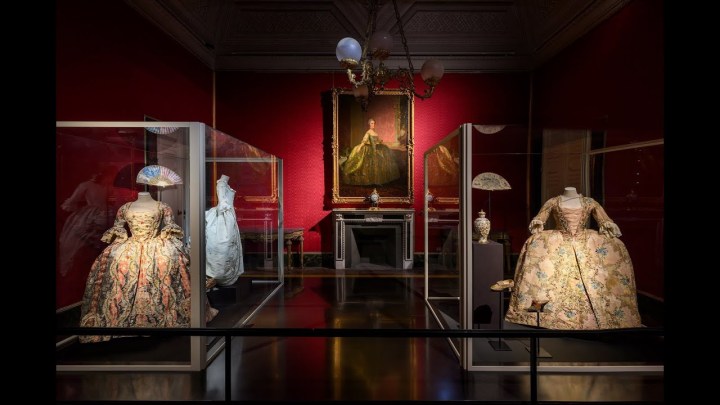
On view at the Museum of Costume and Fashion at the Pitti Palace:
New Arrangement of the Museum of Costume and Fashion
Museo della Moda e del Costume, Florence, ongoing
The history of fashion from the 18th century to the 2000s illustrated by captivating glimpses in an interplay between art and the historical environment of the Museum
After four years of renovation, the elegant historical premises of the Palazzina della Meridiana, the rooms that traditionally house the collections of the Museum of Costume and Fashion, have reopened completely. The Museum was inaugurated in 1983 at Pitti Palace—already known for being the ‘temple’ of fashion in the post-war period—and was the first Italian State museum dedicated to the history of fashion, haute couture, and the evolution of taste through the centuries. The new installation offers visitors a selection of rare and precious dresses accompanied by accessories—shoes, hats, fans, parasols, and bags—that exemplify through suggestions and samples a vast collection which in total has more than 15,000 items, and which will be put on display over time and according to rotations grouped by typologies, themes and leitmotifs, while always maintaining the criterion of the new arrangement which aims to propose a journey through the evolution of fashion and taste seen in their historical development, from the 18th century to the present day.
Another characteristic element of the new arrangement is indeed the interplay, strongly recommended by Director Simone Verde and the Museum’s curator Vanessa Gavioli, between the dresses and accessories and the most diverse forms of art, first of all painting, through the comparison between the gorgeous dresses on display and some fascinating coeval portraits and paintings, which help to make fashion also through the representations of painters such as Carle Vanloo, Laurent Pecheux, and Jean-Sébastien Rouillard, passing through the elegant portraits by the 19th-century ones such as Tito Conti, Giovanni Boldini, Edoardo Gelli, and Vittorio Corcos, to get to some of the most relevant artists of the Italian avant-garde including Massimo Campigli, Giulio Turcato, Corrado Cagli, and Alberto Burri. After all, fashion is by definition an art that has always lived in symbiosis with the most diverse disciplines, and the new arrangement of the Museum aims to recreate an ideal palimpsest in which, at a glance, one can also catch the relationships between different arts. Therefore not only between fashion and painting, but also between fashion and plastic arts (the match between the handles of porcelain vases and the sleeves of 18th-century dresses are intriguing); fashion, theatre, and sculpture (the relationship between Mariano Fortuny’s dress worn by Eleonora Duse and the actress’s face sculpted by Arrigo Minerbi is a particularly fascinating example); but also between fashion and architecture, with the dresses that stand in close connection with the historical space around, the furnishings and frescoes of the Palazzina della Meridiana; to end with a visual dialogue, virtually reconstructed thanks to the use of video screens, between the current arrangement and the historical ones, from the years in which in Florence, at Pitti Palace, in those same rooms that we can visit again today, Italian high fashion was establishing itself internationally according to a tradition that runs seamlessly to the present.










 Enfilade
leave a comment