Exhibition | Museum of Costume and Fashion in Florence Reopens
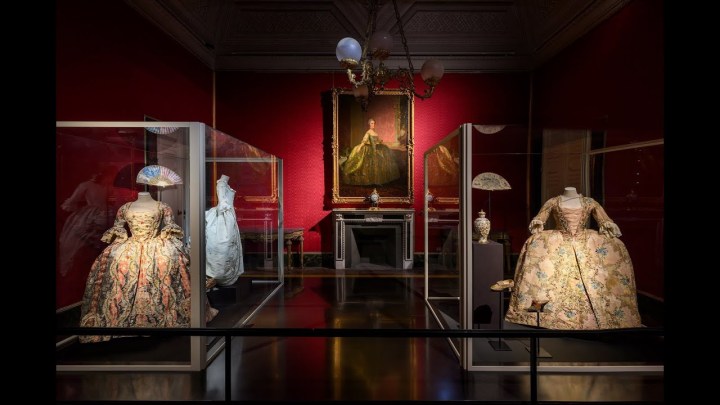
On view at the Museum of Costume and Fashion at the Pitti Palace:
New Arrangement of the Museum of Costume and Fashion
Museo della Moda e del Costume, Florence, ongoing
The history of fashion from the 18th century to the 2000s illustrated by captivating glimpses in an interplay between art and the historical environment of the Museum
After four years of renovation, the elegant historical premises of the Palazzina della Meridiana, the rooms that traditionally house the collections of the Museum of Costume and Fashion, have reopened completely. The Museum was inaugurated in 1983 at Pitti Palace—already known for being the ‘temple’ of fashion in the post-war period—and was the first Italian State museum dedicated to the history of fashion, haute couture, and the evolution of taste through the centuries. The new installation offers visitors a selection of rare and precious dresses accompanied by accessories—shoes, hats, fans, parasols, and bags—that exemplify through suggestions and samples a vast collection which in total has more than 15,000 items, and which will be put on display over time and according to rotations grouped by typologies, themes and leitmotifs, while always maintaining the criterion of the new arrangement which aims to propose a journey through the evolution of fashion and taste seen in their historical development, from the 18th century to the present day.
Another characteristic element of the new arrangement is indeed the interplay, strongly recommended by Director Simone Verde and the Museum’s curator Vanessa Gavioli, between the dresses and accessories and the most diverse forms of art, first of all painting, through the comparison between the gorgeous dresses on display and some fascinating coeval portraits and paintings, which help to make fashion also through the representations of painters such as Carle Vanloo, Laurent Pecheux, and Jean-Sébastien Rouillard, passing through the elegant portraits by the 19th-century ones such as Tito Conti, Giovanni Boldini, Edoardo Gelli, and Vittorio Corcos, to get to some of the most relevant artists of the Italian avant-garde including Massimo Campigli, Giulio Turcato, Corrado Cagli, and Alberto Burri. After all, fashion is by definition an art that has always lived in symbiosis with the most diverse disciplines, and the new arrangement of the Museum aims to recreate an ideal palimpsest in which, at a glance, one can also catch the relationships between different arts. Therefore not only between fashion and painting, but also between fashion and plastic arts (the match between the handles of porcelain vases and the sleeves of 18th-century dresses are intriguing); fashion, theatre, and sculpture (the relationship between Mariano Fortuny’s dress worn by Eleonora Duse and the actress’s face sculpted by Arrigo Minerbi is a particularly fascinating example); but also between fashion and architecture, with the dresses that stand in close connection with the historical space around, the furnishings and frescoes of the Palazzina della Meridiana; to end with a visual dialogue, virtually reconstructed thanks to the use of video screens, between the current arrangement and the historical ones, from the years in which in Florence, at Pitti Palace, in those same rooms that we can visit again today, Italian high fashion was establishing itself internationally according to a tradition that runs seamlessly to the present.










 Enfilade
leave a comment