LACMA Acquires Manuel de Arellano’s Precursors of Casta Painting
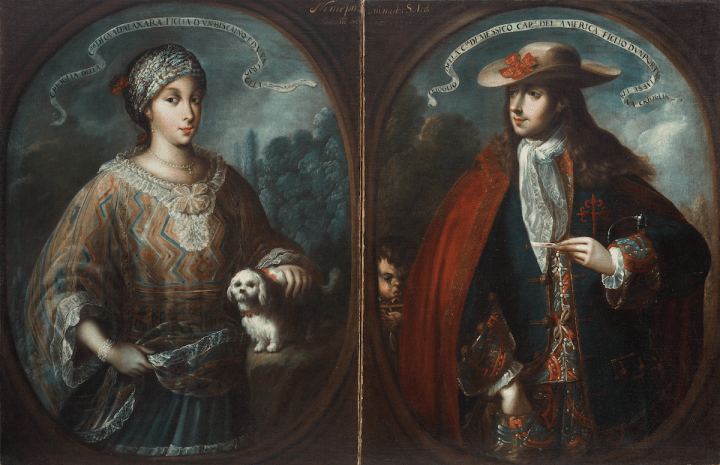
Manuel de Arellano, Creole Woman from the City of Guadalajara and Creole Man from Mexico City, ca. 1710, oil on canvas, each 109 × 84.5 cm (Los Angeles County Museum of Art, gift of the 2025 Collectors Committee with additional funds from an anonymous donor, photo courtesy of Colnaghi, Madrid).
◊ ◊ ◊ ◊ ◊
As noted at the Art History News blog; from the LACMA essay (30 April 2025) by Ilona Katzew, who leads the museum’s Latin American department:
This week we added a unique pair of paintings by Manuel de Arellano (1662–1722) to the collection. The works are remarkable in terms of their execution, subject, and pivotal place in the history of 18th-century Mexican painting. Conceived as a pair, they depict a man and a woman within a fictive oval frame, a format traditionally reserved for distinguished figures. Yet, they are not portraits of actual individuals but of different racial types. In fact, these two paintings are groundbreaking precursors of the famous casta (caste) paintings, a distinctive pictorial genre invented in Mexico to depict multiracial families that spanned the entire 18th century.
Manuel de Arellano came from a prominent dynasty of artists active in Mexico City. He trained with his father, Antonio de Arellano (1638–1714), and by 1690 he was working independently and creating paintings marked by a great deal of experimentation. These works developed during a period of political shifts and mounting social and racial tensions in Mexico City. In 1692, just a few years before the ascent of the Bourbons to the Spanish throne (1700), a major riot erupted in the main square, when the Indigenous population and mixed-raced working-class, outraged over the scarcity of basic food staples and the mishandling of power, set fire to the viceregal palace, threatening to overthrow the colonial government.
Spaniards born in the Americas—known as Criollos (Creoles)—grew equally frustrated with imperial authorities, who treated them as second-class citizens and often passed them over for important civil and ecclesiastical posts. Added to this, the common misconception in Europe that everyone in the Americas was a degraded hybrid further tarnished the reputation of Creoles, casting into question their ability to rule. Arellano’s works responded to these concerns by constructing a view of a mixed yet orderly and prosperous society. His monumental view of the transfer of the original image of the Virgin of Guadalupe to her new shrine is a tour de force that captures Mexico City’s complex social hierarchy in minute detail.
LACMA’s new acquisitions are the first paintings to single out Mexico’s diverse population, setting forth the path for the development of casta painting across the 18th century. The inscriptions on the works identify the racial types and situate them geographically. They read: “Creole Woman from the City of Guadalajara, Daughter of a Basque Man and a Creole Woman” and “Creole Man from Mexico City, Capital of America, the Son of a Portuguese Man and a Creole Woman.” The unusual scrolling banderoles in Italian may be related to the original commission and their intended use, a subject that requires further study. . . .
The full essay (with reading suggestions) is available here»










 Enfilade
leave a comment