Print Quarterly, June 2025
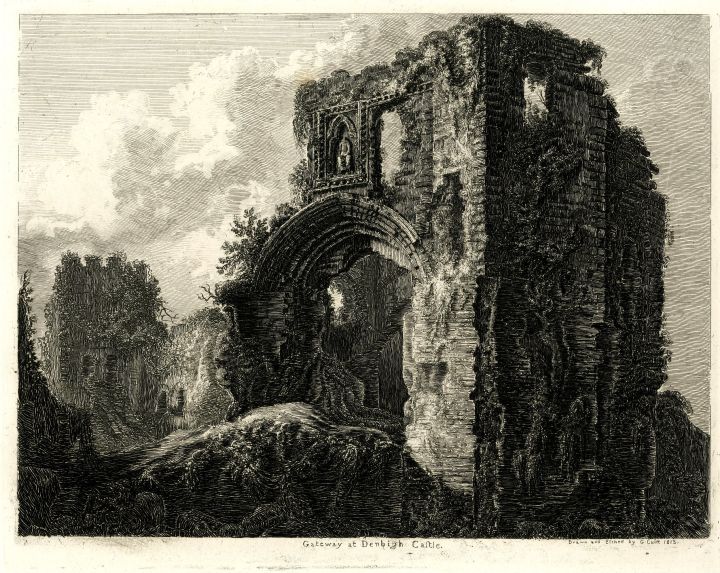
George Cuitt, Gateway at Denbigh Castle, 1813, etching, 252 × 315 mm
(London, British Museum), reproduced on p. 200.
◊ ◊ ◊ ◊ ◊
The long eighteenth century in the latest issue of Print Quarterly:
Print Quarterly 42.2 (June 2025)
a r t i c l e s
• Jane Eade, “A Mezzotint by Jacob Christoff Le Blon (1667–1741) at Oxburgh Hall,” pp. 143–53. This article examines a newly discovered impression of Jacob Christoff Le Blon’s colour mezzotint after Sir Anthony van Dyck’s (1599–1641) portrait of The Three Eldest Children of Charles I at Windsor Castle. The author discusses Le Blon’s invention of his revolutionary printing technique, the print’s distribution history, the operations of Le Blon’s workshop known as the ‘Picture Office’, as well as the circumstances surrounding the Oxburgh Hall impression, including its recent conservation treatment.
• Stephen Bann, “Abraham Raimbach and the Reception of Prints after Sir David Wilkie in France,” pp. 154–67. This article establishes the premise that Sir David Wilkie (1785–1841) introduced a new style of narrative painting in England that would prove influential for painting throughout Europe. It was previously thought that Paul Delaroche (1797–1856) popularized this new narrative style a couple of decades later in France. Since the French public had no local access to Wilkie’s paintings, it is here shown that it was the reproductive engravings of Abraham Raimbach that brought Wilkie to their attention. In doing so, this idea challenges the centrality of Delaroche’s sole influence on European painting.
• Paul Joannides, “John Linnell, Leonardo Cungi and the Vault of the Sistine Chapel,” pp. 168–84. This article discusses John Linnell’s (1792–1882) mezzotints after the Sistine Chapel ceiling and the recently discovered drawings on which the prints were based. The drawings, once a single sheet, are here attributed to Leonardo Cungi (1500/25–69); in its entirety, it is the earliest known copy to show the complete ceiling in full detail.
n o t e s a n d r e v i e w s
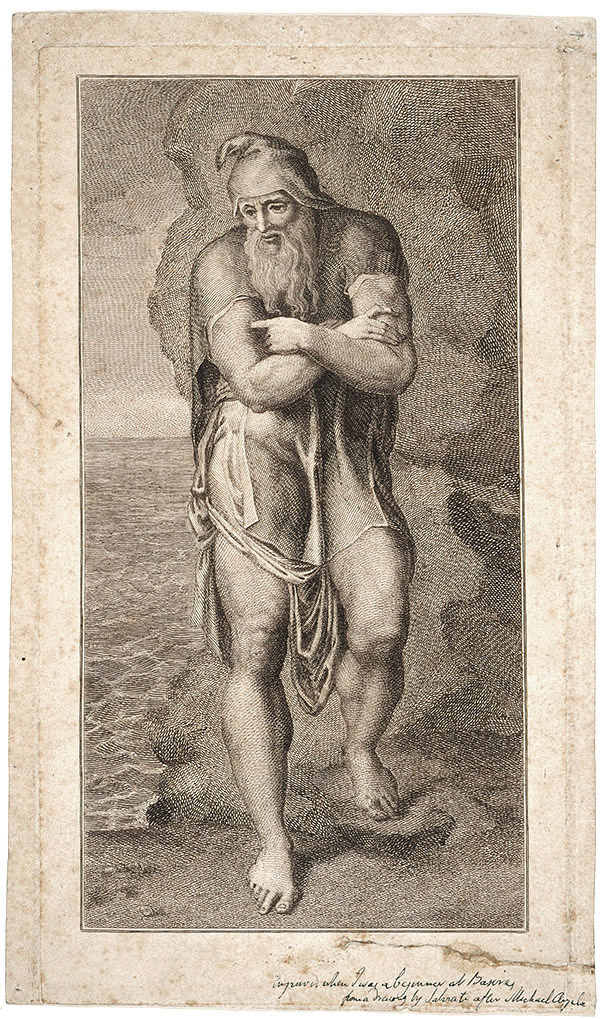
William Blake, Joseph of Arimathea among the Rocks of Albion, ca. 1773, engraving, 254 × 138 mm (Cambridge, Fitzwilliam Museum), reproduced on p. 192.
• Ulrike Eydinger, Review of Jürgen Müller, Lea Hagedorn, Giuseppe Peterlini and Frank Schmidt, eds., Gegenbilder. Bildparodistische Verfahren in der Frühen Neuzeit (Deutscher Kunstverlag, 2021), pp. 185–87.
• Nigel Ip, Review of Owen Davies, Art of the Grimoire (Yale University Press, 2023), pp. 187–89.
• Antony Griffiths, Review of Mario Bevilacqua, ed., Edizione Nazionale dei Testi delle Opere di Giovanni Battista Piranesi. I. Opere giovanili, ‘Vedute di Roma’, ‘Pianta di Roma e Campo marzo’ (De Luca Editori d’Arte, 2023), pp. 191–92.
• Mark Crosby, John Barrett and Adam Lowe, Note on William Blake as an apprentice engraver, pp. 192–93.
• Ersy Contogouris, Review of Pascal Dupuy, ed. De la création à la confrontation. Diffusion et politique des images (1750–1848) (Presses Universitaires de Rouen et du Havre, 2023), pp. 194–95.
• Cynthia Roman, Review of David Atkinson and Steve Roud, Cheap Print and Street Literature of the Long Eighteenth Century (Open Book Publishers, 2023), pp. 197–98.
• Sarah Grant, Review of Peter Boughton and Ian Dunn, George Cuitt (1779–1854), ‘England’s Piranesi’: His Life and Work and a Catalogue Raisonné of His Etchings (University of Chester Press, 2022), pp. 199–201.
• Timon Screech, Review of Akiko Yano, ed., Salon Culture in Japan: Making Art, 1750–1900 (British Museum Press, 2024), pp. 201–03.
• Bethan Stevens, Review of Evanghelia Stead, Goethe’s Faust I Outlined: Moritz Retzsch’s Prints in Circulation (Brill, 2023), pp. 240–43.










 Enfilade
leave a comment