In Memoriam | David Bindman (1940–2025)
Posted recently (3 June) by the Paul Mellon Centre:
David Bindman (1940–2025)
by Sarah Victoria Turner
 We are saddened to hear that David Bindman (1940–2025) Emeritus Professor of the History of Art at University College London and Fellow of the Hutchins Center for African and African American Research, Harvard University, has passed away after a short illness.
David has been an immensely influential figure in British art over the last sixty years, writing on Blake (the subject of his first published article in 1966), Hogarth, Roubiliac, the French Revolution and caricature, and race and representation. His book Blake as an Artist (1977) endures as a key text, while his Hogarth for the World in Art series (1981) remains a standard introduction to the artist. His publications for the Paul Mellon Centre (PMC) include Karl Friedrich Schinkel ‘The English Journey’ (with Gottfried Reimann, 1993) and the multiple-award-winning Roubiliac and the Eighteenth-Century Monument (with Malcolm Baker, 1995). He was a founding figure in the multi-volume project Image of the Black in Western Art (2006 to date) and co-editor of thirteen volumes in the series. . .
Keep reading here»
Call for Papers | Posterity and Fortunes of 17th- and 18th- C. Artists
From Le blog de l’ApAhAu::
Create and After? / Créer et après?
Posterity and Critical Fortunes of 17th- and 18th- Century European Artists
Postérité et fortune critique des artistes européens des XVIIᵉ et XVIIIᵉ siècles
Salle Vasari, Galerie Colbert, 2 rue Vivienne, Paris, 7–8 November 2025
Proposals due by 28 June 2025
According to Antoine Schnapper, one of the tasks of the art historian is to “go against the tide of neglect and oblivion.” Art history has been built on a selection of works and events deemed worthy of remembrance. Conversely, artists, artefacts, and other objects deemed unworthy of an era, a trend, or a discourse have been neglected or obscured. The notions of ‘critical fortune’, ‘posterity’ and ‘reception’ highlight this dynamic. The artists of the 17th and 18th centuries who enjoy lasting recognition escape oblivion, while others, less valued, disappear from the narrative. These contrasting fates are rooted in a variety of factors: changing aesthetic sensibilities, the material nature of the works, historical upheavals, and their visibility in museum collections.
The history of European art has its origins in the writing of artists’ biographies, from Vasari to Félibien to Dezallier d’Argenville. It is based not only on the objective appreciation of works, but also on the judgements made by artists, the public, critics, historians, and the art market, which can alter or reinforce an artist’s position. Since the end of the 19th century and the birth of art history as a discipline, historians such as Henry Jouin (1878; 1888; 1890), Jules Guiffrey (1877), Pierre Marcel (1914; 1924), and Jean Locquin (1912; 1933) have set out to fill these gaps by shedding light on the mechanisms that led to certain artists being forgotten. However, these early studies, which were often based on specific cases, did not provide an overall analysis of the oblivion or marginalisation of artists. Since the 1960s, many artists of the 17th and 18th centuries have been rediscovered or reassessed thanks to monographs accompanied by catalogues raisonnés. New methodologies and easier access to sources have enriched this research, thanks to digital technologies that bring to light previously unpublished information on artists’ careers and their influences. The rise of social history and gender studies has made it possible to place artists in broader contexts, and the study of materials and techniques offers new perspectives on artistic creation. These tools have considerably renewed the approach to monographs, providing a more nuanced reading of artists’ careers. However, the traditional monograph, even when accompanied by a catalogue raisonné, is not always sufficient to provide a comprehensive overview of the critical fortunes of artists.
While there are still many forgotten or neglected artists, the wealth of publications in recent decades provides fertile material for new general reflections, fleshed out by new approaches to the discipline, such as studies. This colloquium therefore proposes to question the notion of posterity, reception, and critical fortune, not only from the point of view of the artist, but also from that of the amateur, cultural institutions, and the public in the 17th and 18th centuries. It will look at the factors and mechanisms that contributed to the rise or fall of certain artists. It is therefore intended to be a reflection on the test that all artists must overcome: time. What role have critics, academies, Salons, the public, and cultural institutions played in this dynamic? What influence have the art market and collectors had on the recognition of artists? In addition, this symposium will look at the challenges faced by art historians when faced with material gaps: how do we deal with an artist or a work for which sources are rare or absent?
◊ ◊ ◊ ◊ ◊
The first theme of this colloquium will focus on the notion of posterity. In his Salon of 1765, Diderot stated: “The artist, in his studio, must feel around him the gaze of a severe and incorruptible posterity.” In so doing, he emphasised the need for artists not to work ‘for their own century’, but to create a future legacy. Taken from the Latin posteritas, posterity refers to the time that comes after, the future. As early as the 17th century, Furetière’s dictionary bears witness to this conception that it is the artist’s responsibility to look after his posterity. It was up to him to ensure that he would be remembered. Many artists in the 17th and 18th centuries directed their careers in this direction. This focus of the symposium will therefore seek to explore the means put in place by artists to ensure their posterity. How did artists’ personal strategies—whether in terms of constructing their image or managing their relations with patrons, critics or institutions—influence their posterity ? In addition, we would like to encourage papers on the material resources that certain artists have deployed to guarantee the longevity of their works. This includes, for example, a certain technical mastery to ensure the longevity and transmission of their works.
Preferred topics
• The use of writing in the construction of posterity : analysis of artists’ memory strategies
• Analysis of the use of prints to promote and disseminate a work of art
• Building a legacy: transmission within families and artists’ studios
• Absence, indifference and refusal of posterity
• The impact of the materiality of works of art on posterity: ephemeral creations, time-tested techniques, etc.
◊ ◊ ◊ ◊ ◊
The second theme of the colloquium will be reception. This term refers to the way in which a work or an artist is perceived and appreciated by the public, who are the main players here. Reception is subjective, sensitive and dependent on the tastes of an era, as well as the social and political influences of the time. By ensuring that his work is well received during his lifetime, the artist takes a step towards success and immortality. Tastes evolve regularly, and works are constantly re-evaluated in the light of one artist’s, one audience’s and one era’s view of another. Criteria differ according to time and place and can therefore be received differently by each century and each new generation. Sometimes it is the works themselves that fall victim to this process, particularly when restoration work alters the original appearance of the objects. This constant questioning of taste can be damaging for some artists, but beneficial for others. The aim is to study how these contexts have influenced artistic criticism and the fortunes of artists. How have political and social events altered the criteria by which works are judged? How does the material state of a work affect its reception?
Preferred topics
• The use and role of the written work in the reception of artists and their works : press articles, critical reviews of the Salons, Academy lectures, treatises, etc.
• The influence of taste on the reception of artists according to the context of space and time
• Lack of interest in an artist, a factor in the destruction of works
• The disappearance of works, a factor in the oblivion of artists
• Consequences of the emergence of the concept of genius in the 18th century on the reception of artists and their works
◊ ◊ ◊ ◊ ◊
The final theme of this symposium will be the notion of critical fortune. This methodical examination of an artist’s reception reflects not only the aesthetic and intellectual judgements made about their work, but also the evolution of their reputation and influence in art history. Critical fortune thus acts as a selective memory, determining which artists are preserved in history and which others sink into oblivion. It influences not only the individual trajectories of artists, but also our understanding of the evolution of styles and aesthetic debates over time. In this sense, critical fortune becomes an essential filter in the writing of art history, structured by the choices of what is valued and what is omitted. Favourable critical fortune can propel an artist to the rank of ‘master’, while unfavourable fortune can condemn him or her to indifference. However, such fortunes are often unstable, subject to fluctuations in trends, social contexts and power dynamics in the art world. This focus will explore transformations in the perception of artists : how were certain artists revalued in the 19th and 20th centuries? What are the reasons for these critical revisions, and how have these reassessments altered their place in art history ? In this way, writing the critical fortune will renew the discourse on an artist for generations to come.
Preferred topics
• The role played by monographs in building the critical fortunes of artists past and present.
• The importance of the vocabulary used to describe artists: ‘master’, ‘small’, ‘great’, ‘minor artist’, ‘major artist’, etc.
• The influence of museums (museography, exhibitions, etc.), universities (conferences, seminars, publications, etc.), the art market and the press.
• New methodologies: what contribution can they make to the writing of critical fortune ?
• Regimes of historicity: the influence of the socio-historical context on the writing of art history and on heritage issues.
Presentations will last twenty minutes and will take the form of individual and collective case studies, focusing, among other things, on the themes listed in the call for papers. Proposals (600–700 words) must be submitted, along with a short biography, to fortunecritique@gmail.com by 28 June 2025. A publication will be considered after the conference.
Organizing Committee
• Élisa Bérard, PhD candidate in Art History, Sorbonne University, Centre André-Chastel
• Romane Delsinne, PhD candidate in Art History, Sorbonne University, Centre André-Chastel
• Enzo Menuge, PhD candidate in Art History, Sorbonne University, CNRS, Centre André-Chastel
Scientific Committee
• Christine Gouzi, Professor of Modern Art History, Sorbonne University, Centre André-Chastel
• Étienne Jollet, Professor of Modern Art History, Paris I Panthéon-Sorbonne
◊ ◊ ◊ ◊ ◊
b i b l i o g r a p h y
BARBILLON, Claire, CHEVILLOT Catherine, MARTIN, François-René, Histoire de l’art du XIXe siècle, 1848–1914 : bilans et perspectives, actes du colloque École du Louvre-musée d’Orsay, 13–15 septembre 2007, Paris, École du Louvre, 2012.
BARTHES Roland, « La mort de l’auteur », In : Manteia, n°5, 4e trimestre, 1968, p. 12–17.
BONFAIT Olivier, « Réception et diffusion. Orientations de la recherche sur les artistes de la période moderne », In: Histoire de l’art, n°35–36, 1996, p. 101–114.
BONFAIT Olivier, « Conclusion : une génération La Fosse ? Nouveaux lieux et paradigmes de la peinture en France autour de 1700 », In : Bulletin du Centre de recherche du château de Versailles [en ligne], 15, 2018.
BRISAC Anne-Laure (dir.), Perspective : la monographie d’artiste. 4/2006, [revue], Paris, Armand Colin – La revue de l’INHA, 2007.
BOURDIEU Pierre, « L’illusion biographique », In : Actes de la recherche en sciences sociales, n°66–67, 1987, p. 95–104.
CHASTAGNOL, Karen, « Charles de La Fosse et la peinture d’histoire autour de 1700 », In : Bulletin du Centre de recherche du château de Versailles [en ligne], 15, 2018.
DIDEROT Denist, Salons, vol. 1 (1759–1761–1763), texte établi et présenté par J. Seznec et J. Adhémar, 2nde édition, Londres, Oxford Clarendon Press, [1957] 1975.
DIMIER Louis, Histoire de la peinture française du retour de Vouet à la mort de Le Brun, Paris et Bruxelles, 2 vol., 1926–1927.
DOSSE François, Le Pari biographique. Écrire une vie, Paris, La Découverte, 2005.
FEBVRE Lucien, « Penser l’histoire de l’art », In : Annales, économies, sociétés, civilisations, n°5/1, janvier-mars 1950, p. 134–136.
FEBVRE Lucien, « Résurrection d’un peintre : à propos de Georges de La Tour », In : Annales. Économies, sociétés, civilisations, t. 5, 1950, n°1, p. 129–134 ; rééd. Par Brigitte Mazon dans Lucien Febvre. Vivre l’histoire, Paris, R. Lafont/A. Colin, coll. « Bouquins », 2009, p. 260–265.
GOUZI Christine, « L’histoire de l’art selon Antoine Schnapper », in Commentaire, Numéro 129 (1), 2010, p. 151–158.
GOUZI Christine, « Préface », In : Antoine Schnapper, Jean Jouvenet 1644–1717 et la peinture d’histoire à Paris, Paris, Arthena, [1974] 2010.
GOUZI Christine, « L’histoire dans les règles de l’art : la monographie », In : actes du colloque Artistes, collections et musées : hommage à Antoine Schnapper, Paris, INHA, 2009, Paris, Presses de l’Université Paris-Sorbonne, 2016.
GOUZI Christine, « Préface », In : Nicolas-Guy Brenet. 1728–1792, Paris, ARTHENA, 2023.
JOLLET Etienne, « La temporalité dans les arts visuels : l’exemple des Temps modernes », in Revue de l’art, N° 178(4), 2012, p. 49–64.
JOUIN Henry, Charles Le Brun et les Arts sous Louis XIV, Paris, Imprimerie nationale, 1889.
LOCQUIN Jean, La peinture d’Histoire en France de 1747 à 1785, Paris, 1912 (rééd. 1978).
MARCEL Pierre, La Peinture Française au début du XVIIIᵉ siècle. 1690–1721, Paris, Ancienne maison Quantin, 1906.
PASSINI, Michela, L’oeil et l’archive : une histoire de l’histoire de l’art, Paris, La Découverte, 2017.
RIS (de) CLÉMENT, Les Amateurs d’autrefois, Paris, E. Plon & Cie, 1877.
ROSENBERG, Pierre, « Roberto Longhi et le XVIIᵉ siècle français », In : De Raphaël à la Révolution, les relations artistiques entre l’Italie et la France, Paris, Skira, 2005, p. 27–36 (1ère éd. dans G. Previtali [dir.], L’Arte di scrivere sull’arte. Roberto Longhi nella cultura del nostro tempo, Roma, Editori riuniti, 1982).
SCHNAPPER Antoine, « Les tâches de l’historien de l’art. », In : Contrepoint, n°2, 1973, p. 161–172.
SHAFTESBURY, Characteristics of Men, Manners, Opinions, Times, réédité par Lawrence E. Klein, University of Nevada, Las Vegas, [1711], 2000.
THUILLIER Jacques, CHÂTELET, Albert, La peinture française. De Le Nain à Fragonard, Genève, Skira, 1964.
THUILLIER Jacques, La peinture française au XVIIe siècle, vol. 2., Genève, Skira, 1992.
VAISSE Pierre, « Du rôle de la réception dans l’histoire de l’art », in Histoire de l’art, n°35-36, 1996, p. 3–8.
WARESQUIEL (de) Emmanuel, Il nous fallait des mythes : La Révolution et ses imaginaires de 1789 à nos jours, Paris, Tallandier, 2024.
WOOD, Christopher, A History of Art History, Princeton, University Press, 2019.
e x h i b i t i o n s
• Dunkerque, Lille, Valenciennes, 1980 : La Peinture française aux XVIIe et XVIIIe siècles, Dunkerque, musée des Beaux-Arts, Valenciennes, musée des Beaux-Arts, Lille, Palais des Beaux-Arts, 1980, Dunkerque, musée des Beaux-Arts, 1980 (dir. Jacques Kuhnmünche et Hervé Oursel).
• Ottawa, 1976 : Le siècle de Louis XV : peinture française de 1710 à 1774, Ottawa, musée des Beaux-Arts du Canada, 19 mars – 2 mai 1976, Ottawa, Galerie nationale du Canada, 1976 (dir. Pierre Rosenberg).
• Sceaux, 2013 : 1704, Le Salon, les Arts et le Roi, Sceaux, domaine départemental, musée de l’Île-de-France, 22 mars – 30 juin 2013, Milan, Silvana Editoriale, 2013 (dir. Dominique Brême et Frédérique Lanoë).
• Tours, Toulouse, 2000 : Les Peintres du roi, 1648–1783, Tours, musée des Beaux-Arts, 18 mars – 18 juin 2000 ; Toulouse, musée des Augustins, 30 juin – 2 octobre 2000, Paris, Réunion des musées nationaux, 2000.
Exhibition | Women Artists: 1300–1900
Now on view, as noted at the blog Art History News:
Women Artists: 1300–1900 / Ženy, mistryně, umělkyně 1300–1900
National Gallery Prague, Waldstein Riding School Prague, 29 May — 2 November 2025
Curated by Olga Kotková

Elisabetta Sirani, Omphale, ca. 1660-61 (Dresden: Gemäldegalerie Alte Meister , Gal.-Nr. 388).
The exhibition presents the artistic work of women from the Middle Ages to the end of the 19th century. Exhibited artworks highlight the unique qualities of women’s work, particularly in painting, sculpture, drawing, and graphic art, as well as in the applied arts, revealing a lesser-known dimension within the history of art. Attention is given to the description of the environment in which female artists worked; social connections and influences shaping their work and the themes women explored in their art.
For the first time, visitors have a chance to see a comprehensive exhibition of female artists who were active in Central Europe, the Netherlands, and present-day Italy in the period 1300–1900. The exhibition is focused on this period because it marks a turning point in the status of women artists: they gradually gained access to art academies, and both aristocratic and urban women were actively engaging in art. Female artists were increasingly taking control of their careers, gradually establishing themselves professionally and socially. However, only a few were able to run an art studio like male artists. The theme of the exhibition underscores a key message: while gender influences artistic expression and has historically limited women’s opportunities for recognition and education, what truly matters is talent, skill, and the determination to succeed in a still male-dominated world.
It may come as a surprise to some that women’s daring fantasies were already manifested during the medieval period, revealing how deeply religious women, especially nuns and monastics, harboured both erotic and maternal desires. Visitors will also be captivated by the stories of female painters from the Renaissance, many of whom were victims of violence and intrigue; the cruelty they endured was often reflected in their artistic work. Many sought to match the output of their male counterparts, proving that they were just as skilled, if not more so.
In the 17th and 18th centuries, numerous talented women made their mark north of the Alps, achieving success as scientists, painters, and travellers. A very inspiring story is that of Maria Sibylla Merian, who in 1699 undertook an adventurous expedition to Suriname to study insects. In the late 18th century and the early decades of the 19th century, several prominent female painters emerged, including Angelica Kauffmann, Barbara Krafft Steiner, and Amalie von Peter. Their paths were followed by other artists. Thanks to their talent, family support, and education, they were able to fully dedicate themselves to professional artistic creation, which brought them self-fulfilment, respect, and recognition.
Conference | Baldassarre Fontana and Stucco Decoration across Europe
From ArtHist.net:
Stucco Decoration across Europe
Baldassarre Fontana and Other Travelling Stucco Artists
Online and in-person, Olomouc and Kroměříž, Czech Republic, 16–18 June 2025
Focusing on the the life and work of Baldassarre Fontana (1661–1733), this conference addresses stucco artists working across Europe in the seventeenth and early eighteenth centuries. Fontana created a number of remarkable works, particularly in the territories that are now the Czech Republic and Poland. The conference aims to present new findings pertaining to material studies within the broader context of the migration phenomenon, showcasing diverse methodological approaches and the latest techniques for studying, interpreting, restoring, preserving, and conserving stucco decorations across Europe.
The conference is organized as part of the Stucco Decoration across Europe project (STUDEC), co-financed by the European Union thanks to the Erasmus+ programme, KA220-HED – Cooperation partnerships in higher education. The conference is held under the auspices of the Swiss Embassy in the Czech Republic and the Italian Cultural Institute in Prague. Partners of the conference are Archbishopric of Olomouc and Archbishopric Château and Garden in Kroměříž.
Scientific Committee
Alberto Felici (SUPSI Mendrisio), Giacinta Jean (SUPSI Mendrisio), Martin Krummholz (Palacký University Olomouc), Ondřej Jakubec (Palacký University Olomouc), Michał Kurzej (Jagiellonian University in Cracow), Serena Quagliaroli (University of Turin), Jan Válek (Institute of Theoretical and Applied Mechanics of the Czech Academy of Sciences), Jana Zapletalová (Palacký University Olomouc)
Organising Committee
Jana Zapletalová, Martin Krummholz, Ondřej Jakubec
Organisational Assistance
Štěpánka Malíková, Jan Malý, Jiří Mikuš, Natálie Nosková, Anna Rýcová
m o n d a y , 1 6 j u n e
8.00 Registration
9.00 Welcome and Greetings
• Marialuisa Pappalardo, Director of the Istituto Italiano di Cultura di Praga
• Lorenza Fässler Pascuzzo, Deputy head of Mission, Swiss Embassy to the Czech Republic
• Jana Zapletalová, Palacký University Olomouc
9.20 Section 1 | Baldassarre Fontana between Chiasso, Rome, and Moravia: Education, Life, Patrons, and Networking
Directed by Jana Zapletalová and Martin Krummholz
• Stefania Bianchi and Mark Bertogliati — Baldassarre Fontana: Professional Success and Patrimonial Fortune
• Federico Bulfone Gransinigh — Baldassarre Fontana in Rome: Collaborations and Apprenticeships between Hypotheses and Certainties
• Laura Facchin — Baldassarre Fontana and Ercole Ferrata’s Workshop in Rome: The Legacy of Alessandro Algardi
• Katarzyna Brzezina-Scheuerer — Hohenaschau and the Stucco Decorations in Bavaria in the Late 17th Century
• Jana Zapletalová — The Unknown Beginnings of Baldassarre Fontana’s Work in Moravia
12.15 Lunch break
14.00 Section 2 | Baldassarre Fontana in Poland: Impacts and the Art of Stucco of His Time
Directed by Matej Klemenčič and Piotr Krasny
• Michał Kurzej — Stuccoes in Bookkeeping: The Cracow Work of Baldassarre Fontana in Light of Archival Sources
• Mariusz Smoliński — Baldassarre Fontana and the Stucco Decoration of the Pawlowski Chapel in Doboszowice (Silesia)
• Martin Krummholz — Early Commissions of Santino Bussi (1664–1736): Payments to Stucco Workers in Central Europe around 1700
• Marina Dell´Omo — Stuccatori e pittori lombardi e ticinesi nell’Europa centrale, tra legami personali e rapporti con la committenza: Qualche esempio
16.15 Optional Visit: Corpus Domini Chapel in former Jesuit Convict, led by Jan Malý and Medea Uccelli
t u e s d a y , 1 7 j u n e
8.00 Departure to Kroměříž Château
9.30 Section 3 | Baldassarre Fontana’s Stucco Decoration in the Sala Terrena, Kroměříž Château
Directed by Alberto Felici and Jana Zapletalová
• Jana Zapletalová — Brief Art Historical Introduction
• Alberto Felici and Giovanni Nicoli — Emergency Interventions
• Jan Válek, Sylwia Svorová Pawełkowicz, and Petr Kozlovcev — Materials and Manufacturing Techniques
• Sylwia Svorová Pawełkowicz and Jan Válek — Original Finishes and Subsequent Coatings
• Peter Majoroš — The Colour Conception
12.00 Lunch break / time to visit the Castle and Gardens
15.00 Departure from Kromeriz to Olomouc
16.30 Section 4 | Stucco Manufacturing Techniques and Their Conservation Issues
Directed by Giacinta Jean and Alberto Felici
• Alberto Felici, Giovanni Nicoli, and Medea Uccelli — The Cleaning of Stucco Decorations: Conservation Treatments between Historical-Aesthetic Instances and Operational Practice
• Jan Vojtěchovský and Daniela Jakubů — Stucco Decoration of the Chapel of St. Isidore in Křenov and Its Surface Treatments
• Blanka Veselá and Zuzana Wichterlová — Study of Original Stucco Techniques by Bartolomeo Muttoni and Their Polychromy in the Baroque Chapel of Kácov Castle
• Marta Caroselli, Eleonora Cigognetti, Alberto Felici, Giovanni Nicoli, and Alessia Grandoni — Consolidation of Stucco Decorations, Laboratory Tests, and Field Applications
w e d n e s d a y , 1 8 j u n e
9.00 Section 5 | Materiality, Authenticity, and Perception of 17th- and 18th-Century Stucco Decorations
Directed by Serena Quagliaroli and Edi Guerzoni
• Serena Quagliaroli — Some Preliminary Observations on the History of Stucco Restoration: Comparing Cases from Piedmont and Eastern Europe
• Andrzej Siwek — Conservation Works on the Interior of St. Anne’s Church in Cracow in the 2nd Half of the 20th Century and Their Place in the State of Research on Fontana’s Artistic Legacy
• Daniela Russo, Marie-Claire Canepa, Annalisa Dameri, Andrea Longhi, Irene Malizia, Paola Manchinu, and Chiara Ricci — The Stucco Decoration of the Sala Verde at the Castello del Valentino: Study, Preservation, and Proposals for Conservation
• Stefania De Blasi and Edi Guerzoni — The Color of Stuccoes: Towards a History of Restoration in 1990s Piedmont from the Pinin Brambilla Barcilon Archive and the Case of the Former Santa Croce Convent in Turin
• Renata Tišlová, Zdeněk Kovářík, and Zdeňka Míchalová — Material and Technological Beginnings of Stucco Marble Art in the Czech Lands at the Turn of the 17th and 18th Centuries
12.00 Lunch break
13.30 Section 6 | Predecessors and Contemporaries of Fontana: Interactions between Stucco Workers, Architects and Other Artists
Directed by Ondřej Jakubec and Massimo Romeri
• Giuseppe Dardanello — Stuccatori luganesi to the Challenge of Painted Quadratura: Competition and Interaction between Decorative Techniques and Choices of Taste in the Decorative Worksite of Stupinigi
• Frančiška Oražem, Sara Turk Marolt, and Matej Klemenčič — From Lombard Tradition to Bavarian Innovation: The Transformation of Stucco and Altarpiece Production in Carniola in 1730s to 1750s
• Piotr Krasny — Gesamtkunstwerk, Bel Composto, or Homogenous Arrangement? On the Problems with Describing Early Modern Interior Decorations by Artists from the Region of Lake Como and Lake Lugano
14.45 Final discussion
New Book | Beyond Adornment: Jewelry and Identity in Art
From The Getty:
Yvonne Markowitz and Susanne Gänsicke, with contributions by Emily Stoehrer, Beyond Adornment: Jewelry and Identity in Art (Los Angeles: J. Paul Getty Museum, 2025), 184 pages, ISBN: 978-1606069622, $40.
 Why do people wear jewelry? What meaning does it hold for the wearer? And what does the wearer hope it will convey to those they encounter—or to someone viewing their image decades, even centuries, later?
Artistic renderings of the human figure—in portraiture, sculpture, and other media—in a range of allegorical, historical, and religious images often showcase jewelry. The ornaments depicted in such designs offer an abundance of information that not only heightens our understanding of the subject but also provides insights into the imagination of the artist. Jewelry enhances our enjoyment of works of art because it is visually compelling, sensuous, and laden with an array of associations and symbolic meanings. Bringing together spectacular and significant art objects depicting figures wearing sumptuous personal adornments that define who they are within the specific milieus in which they lived, this richly illustrated and accessible volume represents a novel, interdisciplinary approach to the ways in which jewelry can be studied and understood.
Susanne Gänsicke is senior conservator of antiquities at the J. Paul Getty Museum.
Yvonne J. Markowitz is the Rita J. Kaplan and Susan B. Kaplan Curator Emerita of Jewelry at the Museum of Fine Arts, Boston.
c o n t e n t s
Timothy Potts — Foreword
Introduction — Yvonne Markowitz and Susanne Gänsicke
1 Susanne Gänsicke — Projecting a Powerful Presence
2 Susanne Gänsicke — In Search of the Spiritual
3 Yvonne Markowitz — For Those We Love and Mourn
4 Susanne Gänsicke — An Illustrious Past Serving the Present
5 Yvonne Markowitz — Fantasizing the Present
Emily Stoehrer — The Theater of Everyday Life: Dressing the Part
About the Authors
Acknowledgments
Illustration Credits
Index
Selldorf Architects to Lead New Masterplan for The Wallace
From the press release:

Annabelle Selldorf, Principal of Selldorf Architects, photographed at The Frick just before it reopened in April following a five-year renovation led by Selldorf.
The Wallace Collection is pleased to announce that Selldorf Architects, in collaboration with Purcell and Lawson Ward Studio, has been appointed to lead the design and delivery of a transformational masterplan for Hertford House, the museum’s historic home in London.
This ambitious project will reimagine and revitalise the museum’s spaces for the 21st century, preserving the charm and unique character of the building while improving access, sustainability, and visitor experience. The masterplan marks a significant investment in the long-term future of the museum and its ability to connect diverse audiences with one of the world’s most remarkable art collections. Selldorf Architects, renowned for their work with leading cultural institutions including The National Gallery, the recently reopened Frick Collection, and the Neue Galerie, will serve as Lead Design Architect.
They are joined by Purcell, the UK’s largest team of heritage architects and long-standing heritage consultants to the Wallace Collection, and Lawson Ward Studio, who developed the original project brief and who bring expertise in cultural learning environments—the practice being responsible for the recently opened Roden Centre for Creative Learning at the National Gallery. Together, the team brings exceptional international experience in museum and gallery design, combined with a deep understanding of Hertford House and the operational needs of the Wallace Collection. Their joint appointment has been made under public procurement regulations and represents a once in a lifetime opportunity to re-visit the collection and its setting and to enhance the experience for its friends and visitors.
The announcement comes in the Collection’s 125th anniversary year and as it celebrates a number of significant milestones in public engagement. It recently welcomed over 500,000 visitors in a single year for the first time, helped by the 2020 launch of an international lending programme that has extended the Collection’s impact and contributed to a series of acclaimed exhibitions. Among these, Frans Hals: The Male Portrait brought together the artist’s best male portraits from collections across the UK, Europe, and North America. In 2023, Portraits of Dogs: From Gainsborough to Hockney proved hugely popular with audiences, and last year, Ranjit Singh: Sikh, Warrior, King made an important contribution to extending the museum’s audience. The forthcoming display of Caravaggio’s Victorious Cupid (1601–02)—a major loan from Berlin’s Gemäldegalerie and the first time the painting has been shown in the UK—will be another landmark moment, reinforcing the Collection’s growing ambition and profile on the international stage.
The masterplan will address a wide range of priorities: from improving visitor welcome and circulation to enhancing gallery spaces, creating a new Learning Centre, upgrading environmental conditions and improving accessibility throughout the historic site. There is also potential to reimagine the museum’s dedicated temporary exhibition space, restaurant and event facilities, and for critical improvements to be made to staff and back-of-house areas—all designed with sensitivity to the listed building and its distinctive character.
Director of the Wallace Collection, Dr Xavier Bray, said: “The Wallace Collection occupies a unique place in the national and international museum landscape—an exceptional collection in an extraordinary historic home. We are delighted to be working with Selldorf Architects, Purcell and Lawson Ward Studio on the next chapter in the museum’s history. Their thoughtful, collaborative approach and track record of working with complex heritage buildings gives us great confidence as we embark on this transformational journey.”
Annabelle Selldorf, Principal of Selldorf Architects, said: “We are looking forward to working with the Wallace Collection to enhance the unique experience of visiting Hertford House, making their magnificent collection of paintings, decorative arts and arms and armour more accessible. Engaging a wider audience with art and the building’s beautiful architecture is vital and the project presents an exciting opportunity to re-examine essential aspects of the visitor’s experience. Bringing people closer to art matters to us and is a core part of our firm’s work.”
The Wallace Collection’s masterplan is currently in its early stages, with detailed design development, stakeholder engagement and technical surveys set to continue throughout 2025. A comprehensive fundraising campaign is being developed to realise the bold ambitions of the masterplan. The project aims to deliver an integrated and phased programme of works that will support the museum’s evolving offer, public engagement ambitions, and long-term sustainability goals.
Call for Papers | Interrogating the Female Gaze
From ArtHist.net:
Spectacle and Spectatorship: Interrogating the Female Gaze
Fifth Annual International Women in the Arts Conference
Online and in-person, University of Arkansas Rome Center, Rome, 4–6 November 2025
Convened by Consuelo Lollobrigida and Adelina Modesti
Proposals due by 14 July 2025
Laura Mulvey in her pioneering analysis of visual pleasure (“Visual Pleasure and Narrative Cinema,” 1973) posited filmic creation, artistic practice, and cultural representation as the projection of patriarchal fantasy and product of a male gaze that objectifies the body of woman as spectacle. Similarly John Berger in his Ways of Seeing (1972) defined Western art history as primarily a history of the representation of women by men for the gratification of the male spectator. But what implications does this have for the female creator, viewer of art, or reader? What about the female gaze? Or the female body as represented by women, or even the male body for the female spectator? What about women’s visual pleasure?
AIWAC 5’s theme invites papers that interrogate the ‘look’ for women as makers (artistic practitioners, writers, performers, musicians), as patrons of art, and as spectators. The historical time frame and geographical area is open, including up to contemporary times.
Possible topics include
• Female visual (and other) pleasures in the arts
• The female ‘eye’: women as patrons and collectors of art
• Definitions of spectacle, including theatre (spettacolo), music and film, and women’s engagement as dramatists, filmmakers, actors, performers, scriptwriters, musicians, and composers
• Woman as spectacle
• The female gaze: women artists and makers; women and architecture
• Female spectatorship
• Writing and reading women
• Female models and agency
Conference papers will be published in the “AIWAC acta colloquia” postprint series in collaboration with Brepols Publishers, after a peer review process.
To submit a proposal
• Write an abstract in English in Word (max. 500 words, excluding authors name(s) and contact details)
• Include a short bio (150 words max)
• Save the proposal as: ‘AIWAC5_name and family name’
• Include a short CV
• Email to clollobr@uark.edu and amodesti@unimelb.edu.au
Proposals are due by 14 July 2025. Successful applicants will receive a notification by 31 July. A remote presentation might be considered, even if in-presence presentation will have priority. Talks should be no longer than 20 minutes. The organizers cannot contribute towards transport or accommodation costs of speakers or attendees. A registration fee will be communicated along with the acceptance of papers. Excluded papers won’t be notified. The conference will take place at University of Arkansas Rome Center and will combine selected paper presentations with keynote speakers. The final program will be communicated by the beginning of October 2025.
Exhibition | Joseph Wright of Derby: Life on Paper
Now on view at the Derby Museum and Art Gallery, as noted by The Art Newspaper:
Joseph Wright of Derby: Life on Paper
Derby Museum and Art Gallery, 23 May — 7 September 2025
Curated by Lucy Bamford
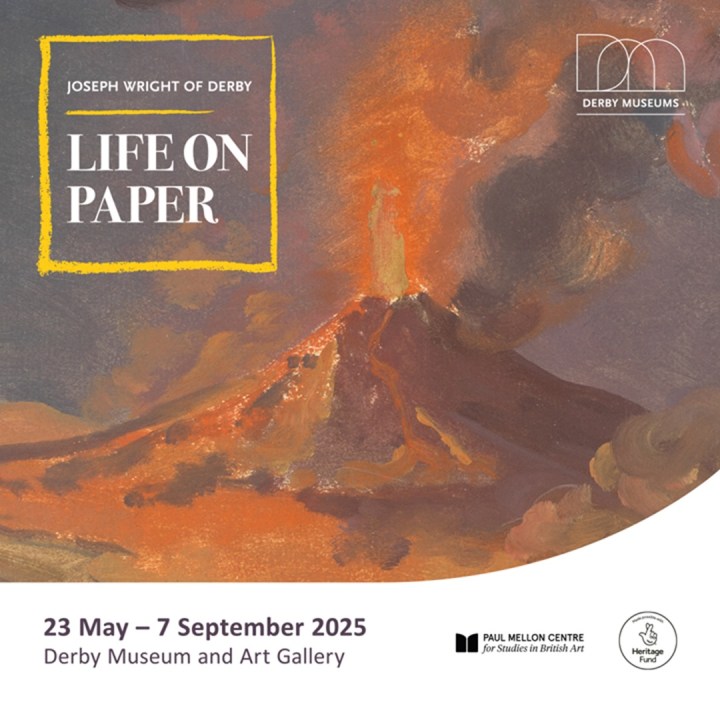 In 2022, Derby Museums made its most significant acquisition in twenty years, with a remarkable self-portrait of Joseph Wright of Derby. Completed around 1772, this was the first and only occasion that Wright depicted himself as an artist. Curiously, it was with the specific trappings of a draughtsman—rather than a painter—that he pictured himself. Inspired by the self-portrait, this exhibition explores the role of drawing within the story of Wright’s life through 50 works on paper from Derby Museums’ collection. Rarely before seen outside Derby, they include early works made in training to remarkable ‘one-off’ productions, such as his self-portrait in pastel.
Studies of the works of the Old Masters and classical statuary provide a glimpse of his interests and influences. Elsewhere, illustrated letters reveal a collaborative side to his practice, as he sought advice from friends concerning subjects as diverse as chemical experiments and scenes from Shakespeare. Wright’s works on paper constituted a valuable expression of his personal, as well as professional, experience as an artist. The result is an exhibition that reveals this much-loved artist at his most experimental and exuberant, as well as his most vulnerable and human.
Image: Joseph Wright, Vesuvius in Eruption, ca. 1774, gouache on paper (Derby Museums).
Call for Papers | Making Early Modern Materialisms, 16th–18th Centuries
From the Call for Papers, which includes the French:
Making Early Modern Materialism(s), 16th–18th Centuries
Fabriquer le(s) matérialisme(s), XVIe–XVIIIe siècles
ENS de Lyon, 30–31 January 2026
Organized by Isabelle Moreau and Jennifer Oliver
Proposals due by 15 June 2025

Bernard Palissy (atelier de) Brique à alvéoles multiples (RMN-Grand Palais, musée de la Renaissance, château d’Ecouen / René-Gabriel Ojéda).
This conference will investigate the contribution made by artisanal and technical practices to materialist thought in early modern scholarly contexts (16th–18th centuries).
Materialism is often presented as a “philosophical discourse produced ‘on the basis of’ or ‘in the name of’ a scientific practice” (Moreau and Wolfe, 2020, our translation), while the history of materialism itself has tended to overlook artisanal know-how, privileging the history of ideas. This situation might be accounted for in two ways. Firstly, any “formulation, from actual observed occurrences, of assertions that cannot be decided on through experimentation” (Andrault, 2017, our translation) thus involves a ‘speculative’ aspect. The role played by theorisation has tended to obscure the practical dimensions of the knowledge being mobilised. Our aim is to reverse this perspective, through attention to the shaping influence of artisanal knowledge and practice on early modern ways of thinking about materiality.
Secondly, the concept of a ‘scientific revolution’ has long been a central tenet in the history of science (Duris, 2016), along with a narrow definition of what ‘science’ is, and the foregrounding of major scholarly figures (Bret, 2016). Like the history of materialism, “the history of science, privileging the study of ideas, has ignored the role of artisans” (Hilaire-Pérez, 2016, translation ours). The recent reconsideration of the of the ‘scientific revolution’ among historians of science—in the field of the life sciences in particular—has opened up a new awareness of the interactions and hybridisations of knowledge between the theoretical and the practical (Hilaire-Pérez, 2016). Applying such a shift in perspective to our study of early modern materialisms is already beginning to bear fruit (see for example the ‘Experimenting the Early Modern Elements’ online conference organised by the Writing Technologies research network, 2021) allowing us to evaluate the impact of artisanal skills and techniques on the various debates on nature and the origins of life.
The role of literary and aesthetic productions in these interactions and hybridisations will also be in focus here. For example, as Frédérique Aït-Touati has recently shown (Théâtres du monde: fabrique de la nature en occident, 2024), real and conceptual theatres (the theatrum mundi and ‘theatre of nature’) were vital sites of exchange and experimentation that allowed for the evaluation and evolution of models of nature.
The period in question—from the 16th to the 18th centuries—is one of many significant scientific and technical discoveries. It also sees the coexistence of very different versions of materialism and even ‘different practices of materialism’ (Pépin, 2012, translation ours). Just as the evolution of science and technology is not linear, materialist discourse is not homogenous. On the other hand, ‘there are many research subjects (reflections on matter, atomism, magic and esotericism, Genesis and theories of the earth, biblical chronology…) that defy religious orthodoxy and draw on scientific research’ (Van Damme, 2016, translation ours). When we attend to know-how and technique, it is striking that the same experiment, the same observation, or the same manipulation of materials can lead to different conclusions and be made to serve diametrically opposed visions of the world. The insistence on empirical experience and autopsy (or seeing for oneself) is also, for that matter, accompanied by repeated warnings about the difficulty of these approaches. Even those with the sharpest eyes and the nimblest fingers will still find, in some cases, that they don’t know a thing, to borrow the expression of Niels Steensen on the anatomy of the brain. The same goes for the micro-anatomy of insects, whose delicate nature, according to Swammerdam, far outstrips the finest cutting edge of his blades. But these limitations on human handiwork do not dampen Swammerdam’s respect for the experience of artisans over scholarly speculations (Duris, 2019). The importance attributed to technical skill and the precision of instruments overturns received ideas of their relationship to knowledge, and calls into question the assumed division of expertise. In order to open up this field of enquiry, we will consider artisanal practices and techniques in their widest sense, in whatever domain (medicine, natural sciences, physics or astronomy).
We especially welcome contributions exploring the following themes:
• Artisanal epistemologies and practical intelligence: the contributions of artisans and practitioners to materialist thought. This theme could be approached from a sociology of sciences perspective, addressing the heterogeneity of actors brought together in experimental contexts and the diversity of practices over the long term of the 16th, 17th, and 18th centuries. One might also revisit the figure of the materialist philosopher with a focus on hybridisation and the mixing of skills, as seen in the ‘scholar-artisans’ brought to light in recent historiography (Hilaire-Pérez, 2016).
• Materialist practices / practices of materialism: anchoring materialist thought within a history of spaces and materials. What are the most important hybrid spaces of knowledge or ‘trading zones’ (Long, 2015) (anatomical theatres, salons, academies, cabinets of curiosity, gardens, etc.)? How are they subject to reappropriation or repurposing? One might also reflect on the textual circulation of materialist thought (from books of secrets to clandestine manuscripts), not least the apparent contradiction between a culture of secrecy and publications aimed at sharing know-how (the notion of ‘useful knowledge’, Berg, 2007; treatises on ‘reduction into art’, Dubourg-Glatigny and Vérin, 2008).
• The materialist tool-box. What practices and skills are most influential in feeding into materialist thought, or, on the contrary, are used by opponents of materialism? Contributions could also reflect on the double paradigm of ‘hand and eye’ in carrying out experiments to support a materialist reading of nature.
• The literary workshop of materialism. It might be productive to consider the incorporation of artisanal images and vocabulary in materialist thought; fictional adaptations of artisanship and artisanal instruments in philosophical fictions; the force of analogy in materialist texts and of literary form in the development of materialist thought.
Abstracts (300 words) should be sent, along with a short CV, to isabelle.moreau@ens-lyon.fr and jennifer_oliver@fas.harvard.edu by the 15th June 2025. Accepted contributors will be notified in July 2025. The conference proceedings are to be published in a special issue of Libertinage et philosophie à l’époque classique (XVIe–XVIIIe siècle).
Organisers
Isabelle Moreau (ENS Lyon) and Jennifer Oliver (Harvard)
Comité scientifique
Isabelle Moreau (ENS Lyon), Jennifer Oliver (Harvard), Kate Tunstall (Oxford), Caroline Warman (Oxford)
◊ ◊ ◊ ◊ ◊
Bibliographie Indicative / Indicative Bibliography
Adamson, Glenn. 2007. Thinking Through Craft, Oxford.
Aït-Touati, Frédérique. 2024. Théâtres du monde. Fabriques de la nature en Occident, Éditions La Découverte.
Andrault, Raphaële. 2017. « Leibniz et la connaissance du vivant », dir. Mogens Laerke, Christian Leduc, David Rabouin, Leibniz. Lectures et commentaires, Vrin, p. 171–190.
Berg, Maxine. 2007. « The Genesis of “Useful Knowledge” », History of Science, vol. 14, p. 123–133.
Bert, Jean-François et Lamy, Jérôme. 2021. Voir les savoirs. Lieux, objets et gestes de la science, Anamosa.
Bret, Patrice. 2016. « Figures du savant, XVe–XVIIIe siècle », dir. Liliane Hilaire-Pérez, Fabien Simon, Marie Thébaud-Sorger, L’Europe des sciences et des techniques. Un dialogue des savoirs, XVe–XVIIIe siècle, PUR, p. 95–102.
Charbonnat, Pascal. 2013. Histoire des philosophies matérialistes. Éditions Kimé.
Charbonnat, Pascal. 2006. « Matérialismes et naissance de la paléontologie au 18e siècle ». Matière Première, 1 (1), p. 31–54.
Dubourg-Glatigny, Pascal et Vérin Hélène (dir.). 2008. Réduire en art. La technologie de la Renaissance aux Lumières, Paris, MSH.
Duris, Pascal. 2016. Quelle révolution scientifique ? Les sciences de la vie dans la querelle des Anciens et des Modernes (XVIe–XVIIIe siècle), Éditions Hermann.
Duris, Pascal. 2019. « Changement et préformation. La métamorphose des insectes chez Swammerdam », dir. Juliette Azoulai, Azélie Fayolle & Gisèle Séginger, Les métamorphoses entre fiction et notion. Littérature et sciences (XVIe–XXIe siècle), LISAA éditeur, p. 43–54.
Halleux, Robert. 2009. Le Savoir de la main : savants et artisans dans l’Europe pré-industrielle, Armand Colin.
Hilaire-Pérez, Liliane. 2016. « L’artisan, les sciences et les techniques (XVIe–XVIIIe siècle) », dir. Liliane Hilaire-Pérez, Fabien Simon, Marie Thébaud-Sorger, L’Europe des sciences et des techniques. Un dialogue des savoirs, XVe–XVIIIe siècle, PUR, p. 103–110.
Jacob, Christian (dir.). 2011. Lieux de savoir 2. Les mains de l’intellect, Albin Michel.
Long, Pamela O. 2015. « Trading Zones in Early Modern Europe », Isis, 106–4, p. 840–847.
Mandressi Rafael. 2013. « Le corps des savants. Sciences, histoire, performance », Communications, 92, 2013. Performance – Le corps exposé. Numéro dirigé par Christian Biet et Sylvie Roques. p. 51–65.
Moreau, Pierre-François et Wolfe, Charles T. 2020. « Entretien sur l’histoire du matérialisme », Revue de synthèse, 141 (1-2), p. 107–129.
Mothu, Alain (dir.). 2000. Révolution scientifique et libertinage, Brepols.
Mothu, Alain. 2012. La pensée en cornue. Matérialisme, alchimie et savoirs secrets à l’âge classique, SÉHA/ARCHÉ.
Oosterhoff, Richard J., Marcaida, José Ramón, Marr, Alexander (dir.). 2021. Ingenuity in the Making. Matter and Technique in Early Modern Europe, University of Pittsburgh Press.
Pépin, François (dir.). 2012. Les matérialismes et la chimie. Perspectives philosophiques, historiques et scientifiques, Éditions Matériologiques.
Roberts, Lissa, Schaffer, Simon, Dear, Peter (dir.). 2007. The Mindful Hand: Inquiry and Invention from the Late Renaissance to Early Industrialisation, Amsterdam.
Smith, Pamela H., 2014–. The Making and Knowing Project, Columbia University, https://www.makingandknowing.org/.
Smith, Pamela H., Meyers, Amy R. W., Cook, Harold J. (dir.). 2014. Ways of Making and Knowing. The Material Culture of Empirical Knowledge, The University of Michigan Press.
Van Damme, Stéphane. 2016. « Les sciences à l’épreuve du libertinage », dir. Liliane Hilaire-Pérez, Fabien Simon, Marie Thébaud-Sorger, L’Europe des sciences et des techniques. Un dialogue des savoirs, XVe-XVIIIe siècle, PUR, p. 473–485.
Waquet, Françoise. 2015. L’ordre matériel du savoir. Comment les savants travaillent, XVIe–XXIe siècle, CNRS Éditions.
Call for Papers | Image and Text in Travel Narratives
From the Call for Papers:
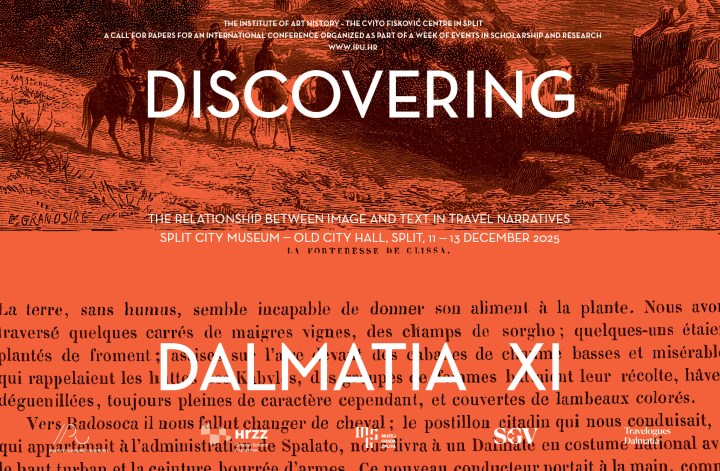
Discovering Dalmatia XI
The Relationship Between Image and Text in Travel Narratives
Split, 11–13 December 2025
Proposals due by 15 July 2025
Keynote Speaker: Heather Hyde Minor, Professor of Art History, Concurrent Professor of Romance Languages and Literatures, University of Notre Dame
Travelogues take shape through the wide range of travel experiences recorded in books, periodicals, diaries, letters, drawings, paintings, prints, and photographs. They represent invaluable historical and cultural sources in which textual and visual narratives are often intertwined in order to convey complex impressions of places, people, and cultural heritage in as much detail as possible. In forming such responses, artist-authors are engaged in an intense dialogue with place, often leaving behind experiences recorded in both text and image. These documents of experience strongly mark, in turn, the spaces they mediate, often becoming models themselves for future travel writers. Among those regions recorded in travel narratives, Dalmatia occupies a significant place: often depicted in this rich relationship between image and text, these together shape a layered perception of its complex identity.
This year’s Discovering Dalmatia conference in Split is specifically dedicated to exploring the ways in which these two forms of representation intertwine within the travel genre. The focus will be on the dynamic relationship between words and images: on the function of visual elements (illustrations, graphics, photographs) within, and alongside, the travel text, and on how—together—they shape the narrative tone of the travelogue and the perception of a particular place. We encourage presenters to think about diachronic perspectives—which follow changes in the relationship between image and text over time—as well as the dialogical nature of this interaction, and how this might raise questions about authorship, credibility, cultural translation, and intermediality in travel literature.
The visual component of the travelogue has often worked to confirm the credibility of the text or to attract a reading audience fascinated by the ‘exotic’ southeastern edge of Europe. At the same time, images bring their own visual rhetoric—sometimes supporting and sometimes replacing the written narrative. Theoretical approaches that consider image and text not as parallel, but as interdependent semiotic systems, are necessary for understanding the specifics of the travel genre. We therefore invite contributions that offer theoretical reflections on this relationship, or which discuss concrete case studies, particularly those concerning travel accounts about Dalmatia and within the intense period of study trips to the region from the eighteenth to the mid-twentieth century.
The conference aims to bring together scholars from different disciplines—the history of art, architecture, literature, visual culture, anthropology, and media studies—to reflect on how the interrelationship between image and text in travelogues contributes to the construction of meaning, memory, and cultural identity. Dalmatia, with its rich presence in the European travel writing tradition, offers particularly fertile ground for such research.
We ask participants to reflect on two central questions:
• How do visual and textual representations of places, particularly Dalmatia, work together in shaping perceptions of space, heritage, identity, and otherness?
• What historical and conceptual models help us understand the relationship between image and text in travel literature?
We welcome proposals that examine a wide range of travel material that combines text and image. It is our hope that the conference will contribute to a deeper understanding of various aspects of the interplay of image and text, to promote rich reflections on Dalmatia’s place in the European cultural imagination, as well as to defining the travelogue as an autonomous, multidisciplinary, and multimedia practice. Proposals for 20-minute papers, consisting of a 250-word abstract and a short CV in Croatian or English, should be sent via email as a PDF attachment to discoveringdalmatia@gmail.com by 15 July 2025.
Registration will take place on the evening of the 10th of December, the closing address will take place on the 13th of December, and the hosts will organise coffee and refreshments for conference participants during breaks. No participation fee will be charged for this conference. The organisers do not cover travel and accommodation costs. The organisers can help participants to find reasonably-priced accommodation in the historic city centre. Papers and discussions will be conducted in English. The duration of a spoken contribution should not exceed 20 minutes. Presentations will be followed by discussions. We propose to publish a collection of selected papers from the conference.
Scientific Committee
Joško Belamarić (Institute of Art History – Cvito Fisković Centre Split)
Davide Lacagnina (University of Siena, School of Specialization in Art History)
Tod Marder (Rutgers University, Department of Art History)
Katrina O’Loughlin (Brunel University London)
Cvijeta Pavlović (University of Zagreb, Faculty of Humanities and Social Sciences, Department of Comparative Literature)
Marko Špikić (University of Zagreb, Faculty of Humanities and Social Sciences, Department of Art History)
Ana Šverko (Institute of Art History – Cvito Fisković Centre Split)
Elke Katharina Wittich (Leibniz Universität Hannover)
Sanja Žaja Vrbica (University of Dubrovnik, Arts and Restoration Department)
Organizing Committee
Joško Belamarić (Institute of Art History – Cvito Fisković Centre Split)
Tomislav Bosnić (Institute of Art History – Cvito Fisković Centre Split)
Ana Ćurić (Institute of Art History)
Katrina O’Loughlin (Brunel University London)
Ana Šverko (Institute of Art History – Cvito Fisković Centre Split)
Sanja Žaja Vrbica (University of Dubrovnik, Arts and Restoration Department)
The conference is organized as part of the Croatian Science Foundation project Travelogues Dalmatia IP-2022-10-8676.










 Enfilade
2 comments