New Book | America, América
As someone long unsettled by the ambiguity around the word ‘American’ (I recall being confused by it as a kid), I found Greg Grandin’s July 4 opinion piece for The New York Times immensely satisfying. His latest book appeared in April from Penguin. –CH
Greg Grandin, America, América: A New History of the New World (Penguin Press, 2025), 768 pages, ISBN: 978-0593831250, $35.
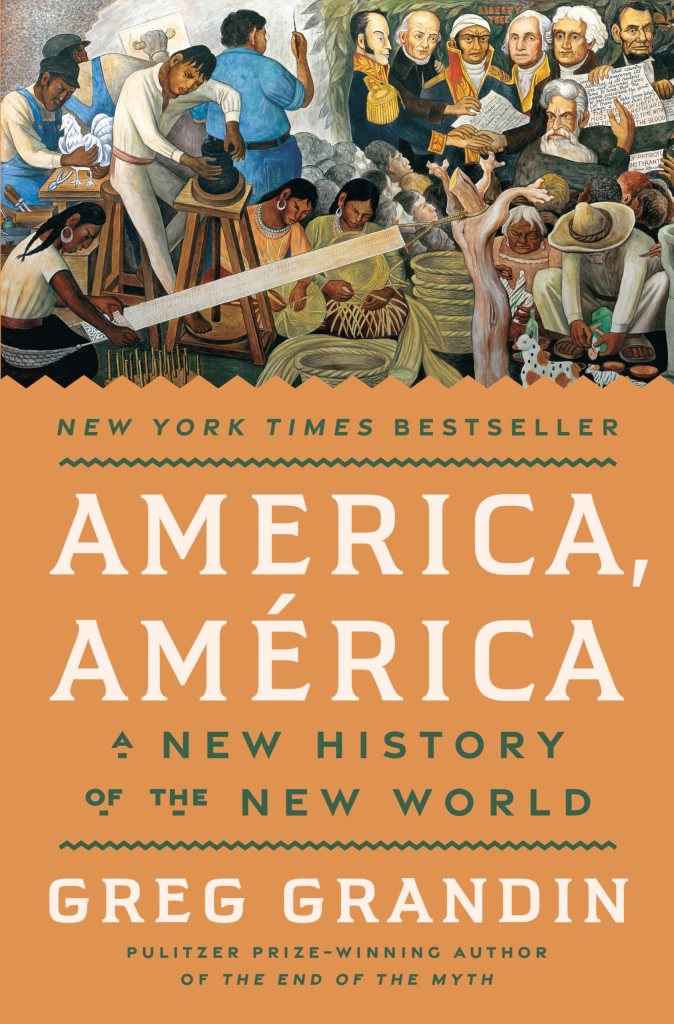 From the Pulitzer Prize–winning historian, the first comprehensive history of the Western Hemisphere, a sweeping five-century narrative of North and South America that redefines our understanding of both.
The story of how the United States’ identity was formed is almost invariably told by looking east to Europe. But as Greg Grandin vividly demonstrates, the nation’s unique sense of itself was in fact forged facing south toward Latin America. In turn, Latin America developed its own identity in struggle with the looming colossus to the north. In this stunningly original reinterpretation of the New World, Grandin reveals how North and South emerged from a constant, turbulent engagement with each other.
America, América traverses half a millennium, from the Spanish Conquest—the greatest mortality event in human history—through the eighteenth-century wars for independence, the Monroe Doctrine, the coups and revolutions of the twentieth century, and beyond. Grandin shows, among other things, how in response to U.S. interventions, Latin Americans remade the rules, leading directly to the founding of the United Nations; and how the Good Neighbor Policy allowed FDR to assume the moral authority to lead the fight against world fascism.
Grandin’s book sheds new light on well-known historical figures like Bartolomé de las Casas, Simón Bolívar, and Woodrow Wilson, as well as lesser-known actors such as the Venezuelan Francisco de Miranda, who almost lost his head in the French Revolution and conspired with Alexander Hamilton to free America from Spain; the Colombian Jorge Gaitán, whose unsolved murder inaugurated the rise of Cold War political terror, death squads, and disappearances; and the radical journalist Ernest Gruening, who, in championing non-interventionism in Latin America, helped broker the most spectacularly successful policy reversal in United States history. This is a monumental work of scholarship that will fundamentally change the way we think of Spanish and English colonialism, slavery and racism, and the rise of universal humanism. At once comprehensive and accessible, America, América shows that centuries of bloodshed and diplomacy not only helped shape the political identities of the United States and Latin America but also the laws, institutions, and ideals that govern the modern world. In so doing, Grandin argues that Latin America’s deeply held culture of social democracy can be an effective counterweight to today’s spreading rightwing authoritarianism.
A culmination of a decades-long engagement with hemispheric history, drawing on a vast array of sources, and told with authority and flair, this is a genuinely new history of the New World.
Greg Grandin is the author of The End of the Myth, which won the Pulitzer Prize; The Empire of Necessity, which won both the Bancroft and Beveridge prizes in American history; Fordlandia, which was a finalist for the Pulitzer Prize, the National Book Award, and the National Book Critics Circle Award; and a number of other widely acclaimed books. He is the Peter V. and C. Vann Woodward Professor of History at Yale University.
Exhibition | Philadelphia, The Revolutionary City
From the APS:
Philadelphia, The Revolutionary City
American Philosophical Society Museum, Philadelphia, 11 April — 28 December 2025
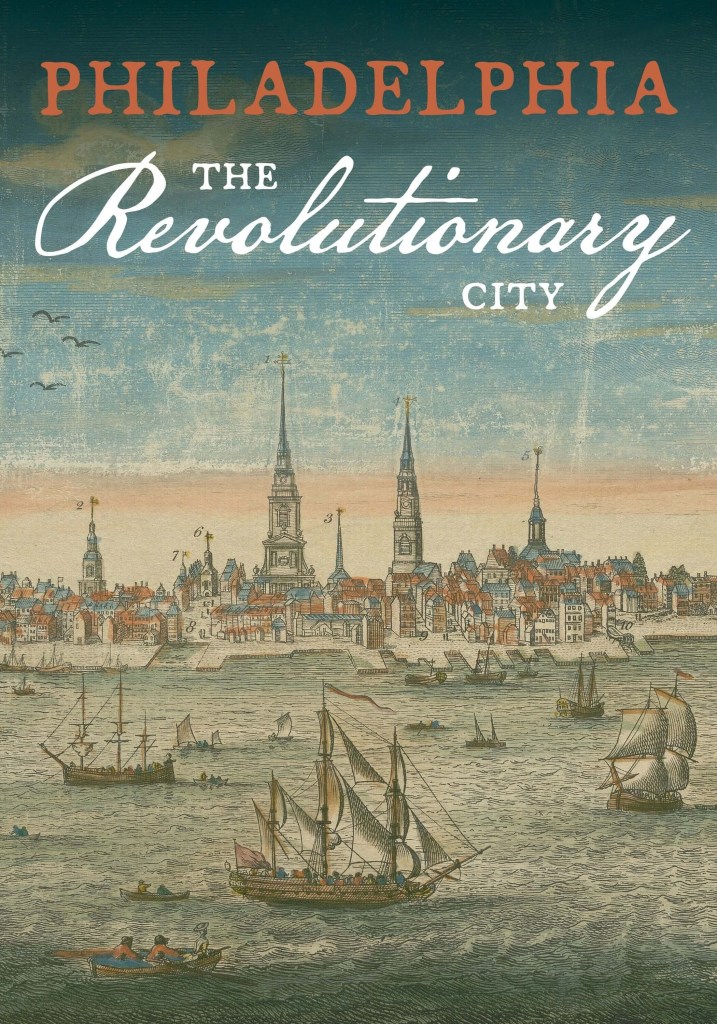 Philadelphia, The Revolutionary City illuminates the lived experiences of Philadelphians leading up to, during, and after the fight for independence. It showcases historic documents and material culture, ranging from diaries and newspapers to political cartoons and household objects. Beginning with the Stamp Act in 1765, the exhibition traces key events through the late 1780s and the impacts they had on communities living within and around the city. The exhibition features a range of voices and stories, offering windows into this turbulent period of change and presenting Revolution-era Philadelphia as a vibrant and growing city.
This exhibition is inspired by the innovative digital archive The Revolutionary City: A Portal to the Nation’s Founding, recently launched by the American Philosophical Society, the Historical Society of Pennsylvania, and the Library Company of Philadelphia, in partnership with the Kislak Center for Special Collections, Rare Books and Manuscripts and the Museum of the American Revolution. Philadelphia, The Revolutionary City brings together rare manuscript material and objects from the APS’s Library and Museum holdings, and the collections of these partners, as well as loans from regional institutions, and nearby historic houses and museums.
The related publication is distributed by the University of Pennsylvania Press:
Philadelphia, the Revolutionary City (Philadelphia: The American Philosophical Society Press, 2025), 110 pages, ISBN: 978-1606181225, $30. With contributions by Patrick Spero, Michelle Craig McDonald, John Van Horne, David R. Brigham, Caroline O’Connell, and Bayard Miller.
The book includes a fully-illustrated object checklist with information for each item as well as a curatorial statement about the project’s development. Additionally, it features three essays, one from each of the directors of the special collection libraries, focusing on key objects within each collection, plus an essay on the origins of the digital project and its ongoing work. Each essay offers a unique perspective on Philadelphia’s revolutionary history and a range of stories that can be found in these archives and on the digital portal.










 Enfilade
leave a comment