New Book | Canova: La Riconoscenza
From Hirmer, with distribution by The University of Chicago Press:
Fernando Mazzocca, Canova: La Riconoscenza (Munich: Hirmer Publishers, 2025), 200 pages, ISBN: 978-3777443034, $52.
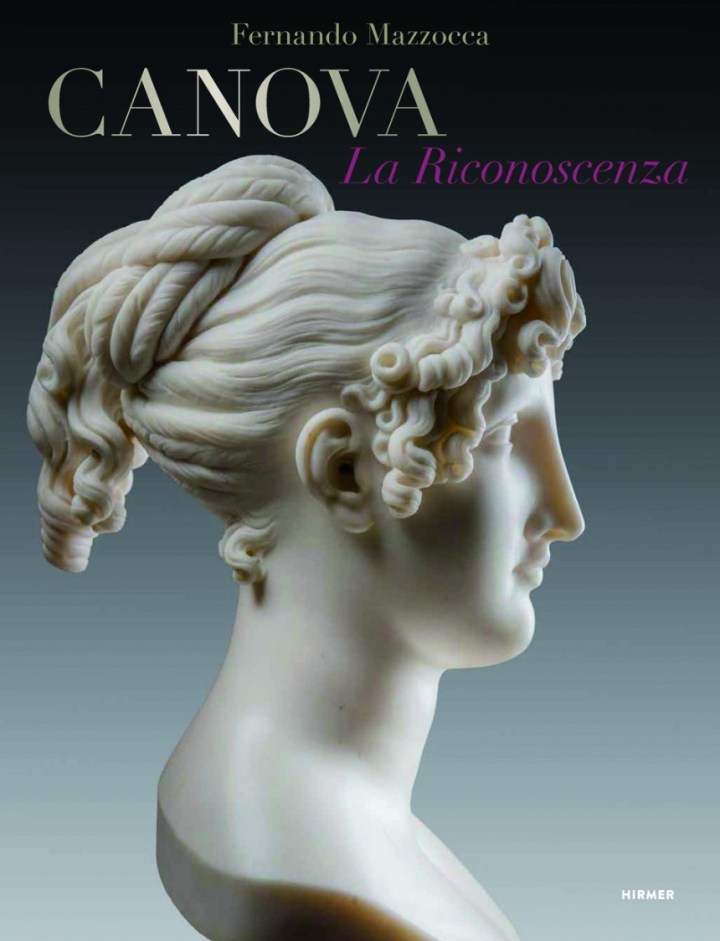 Antonio Canova (1757–1822) invented a new genre with his ‘ideal heads’. They were intended as gifts for close friends and persons he admired as an expression of his affection and gratitude. Starting with his famous bust, La Riconoscenza, this magnificent large-format volume offers an impressive survey of his unique expressions of friendship. La Riconoscenza, Canova’s masterpiece, was long thought to have been lost. Created as a tribute to his most important critic, the cultural theorist Quatremère de Quincy, the sculpture was commissioned by the artist Marquise de Grollier as a gift for their mutual friend. Together, these three distinguished individuals left their mark on the cultural life of their time. Here, Fernando Mazzocca traces the history of the genesis of La Riconocenza through the remarkable correspondence of Canova, de Grollier, and de Quincy.
Fernando Mazzocca is a leading Canova specialist and a former professor at the Università Ca’ Foscari in Venice and La Statale in Milan.
Workshop | Art and Conflict in Times of Climate Change
From the conference programme:
Art and Conflict in Times of Climate Change
Forum Transregionale Studien, Berlin, 17–18 July 2025
Organized by Emily McGiffin, Feng Schöneweiß, T Pritchard, and Antonio Montañes Jimenez
A British Academy SHAPE Research Project in collaboration with the 4A_Lab (KHI in cooperation with Stiftung Preußischer Kulturbesitz) and the Forum Transregionale Studien.
Climate change has happened more than once in the histories of planet Earth and those of human beings. Notably more recent, and historically documented, occurrences include the so-called Medieval Climate Anomaly (ca. 950–1250 CE), the Little Ice Age (ca. 1300–1850) and indeed the contemporary Anthropogenic climate crisis in times of the Anthropocene. From the Russian famine at the beginning of the 17th century following severe winters triggered by volcanic eruptions in Peru, to severe flooding in Kenya, Tanzania and Burundi displacing almost a million people, such climatic shifts have affected and are affecting enormous numbers of people around the planet.
Unsurprisingly, endemic to the periods of climate changes are conflicts. These conflicts drastically affect human lives, thus we find both conflicts and the climatic shifts that precipitated them reflected in and entangled with cultural productions. One example is the paintings created by Dutch masters of people ice-skating and revelling on frozen rivers and enjoying the curious prosperity brought by conflict with Spain. Another is from Song-dynasty China: Facing deforestation and military conflicts with northern Jurchen powers, metropolitan regions of the Song increasingly shifted from firewood to coal as energy source, which corelated with producing some of the finest porcelain glazes in Chinese history. These historical instances resonate strongly with the contemporary music of Syrian activists, who are grappling with the effects of drought and Civil war. In multifaceted ways, the making of arts, broadly defined as the cultural expression of human lived experience, has been entangled with both the violent forces of climatic change, conflicts, and crises.
To examine the complex connections and correlations between art and conflict in times of climate change, this workshop focuses on (1) how cultures have been shaped by the concurrent forces of war and changing environments, and (2) how these lived experiences are expressed through art and literature. Researchers will contribute works-in-progress across disciplinary boundaries, including anthropology, art and cultural history, environmental and digital humanities, postcolonial literature, besides film and media studies. Taking a necessarily planetary perspective, the workshop will interrogate and explore artistic creation and armed conflicts in historical and contemporary climate changes, and will explore pertinent and indeed timely topics across historical and geographical boundaries.
Core questions
• How was/is artistic creation, and cultural expression in general, conditioned and/or oriented by non-human beings and beyond-human factors, such as deforestation, ocean currents, monsoon, El Niño, orbital facing, and volcanic activities?
• How have these factors been represented, and what are the complexities of representing and recording such profound cultural memories?
• How were/are violence and environmental disruption intertwined within cultural memories, and constituted in material, oral, visual and textual cultures?
• What methodologies could contemporary researchers use and develop to address the aforementioned questions from interdisciplinary perspectives?
• How could formats of interdisciplinary collaboration, such as this workshop, enhance academic research on common questions, further knowledge transfer across sectors, and enable actions for positive changes?
Contacts
Feng Schöneweiß, 4A_Lab Postdoctoral Fellow, feng.schoeneweiss@khi.fi.it
Antje Paul, 4A_Lab Program Coordinator, antje.paul@khi.fi.it
t h u r s d a y , 1 7 j u l y
9.30 Welcome by Georges Khalil (Forum Transregionale Studien) and Hannah Baader (4A_Lab / Kunsthistorisches Institut in Florenz – Max-Planck-Institut)
9.50 Welcome by Feng Schöneweiß (4A_Lab)
10.00 Concept Note by T Pritchard (The University of Edinburgh)
10.20 Keynote
• Katrin Kleemann (German Maritime Museum – Leibniz Institute for Maritime History) — Climate History Perspectives: Echoes of Conflict and Culture
11.00 Coffee Break
11.30 Panel 1 | Extraction, Transition, and Repair
Chair: T Pritchard (The University of Edinburgh)
• Rebecca Macklin (University of Aberdeen) — Visualising Relations in the Tar Sands: Extraction, Aesthetics, and Repair
• Emily McGiffin (The University of Warwick) — ‘God has riches, I have cows’: Field Notes on Cultural Heritage in the Bauxite Zone
12.30 Lunch
13.30 Panel 2 | Anthropologies of Collaboration and Conflicts
Chair: Christopher Williams-Wynn (Freie Universität Berlin)
• Antonio Montañes Jimenez (University of Oxford) — Scarcity, Family Memories, and Conflict: Methodological Notes and Collaborative Insights
• Freya Hope (University of Oxford) — Anarchy, Art, and Alternative Worldmaking: New Travellers’ Historicity of Resistance
14.30 Coffee Break
15.00 Film Screening (work in progress) and Discussion (hybrid)
Film and presentation: Matthias De Groof, University of Antwerp / University of Amsterdam
Discussants: Antonio Montañes Jimenez, Rebecca Macklin, Emily McGiffin, and Feng Schöneweiß
16.30 Coffee Break
17.00 Lecture (online and in-person)
Chair: Hannah Baader (4A_Lab / KHI)
• Sugata Ray (UC Berkeley) — Das Paradies: The Anthropocene Extinction in the Early Modern World
f r i d a y , 1 8 j u l y
9.30 Panel 3 | Climate and the Arts of Change
Chair: Parul Singh (Kunsthistorisches Institut in Florenz – Max-Planck-Institut)
• Tenaya Jorgensen (Trinity College Dublin) — Climatic Stress and Political Fragmentation: Environmental ‘Pull Factors’ in Viking Raiding Strategies in Ninth-Century Francia
• Feng Schöneweiß (4A_Lab) — Celadon Aesthetics, Gunpowder, and Energy Transition in Song-dynasty China
• T Pritchard (The University of Edinburgh) — ‘As if the world should straight be turn’d to ashes’: Comprehending Climate Change and Conflict in the Early 17th Century
11.00 Coffee Break
11.30 Panel 4 | Resilience and Memories (hybrid)
Chair: Mahroo Moosavi (4A_Lab)
• Ammar Azzouz (University of Oxford) — A Revolution of Art
• Rebecca Hanna John (Zentralinstitut für Kunstgeschichte) — Preservation and Extinction: On the Entanglement of Ecological and Decolonial Perspectives in Jumana Manna’s Artistic Practice
12.30 Lunch
13.30 Roundtable Discussion
15.00 Concluding Remarks by Emily McGiffin and Feng Schöneweiß










 Enfilade
leave a comment