Exhibition | Adèle de Romance (1769–1846)
Now on view at the Fragonard Museum in Grasse (with more information available here, pp. 124–27):
Adèle de Romance: A Liberated Painter / Peintre Libre
Musée Fragonard, Grasse, 14 June — 12 October 2025
Curated by Carole Blumenfeld
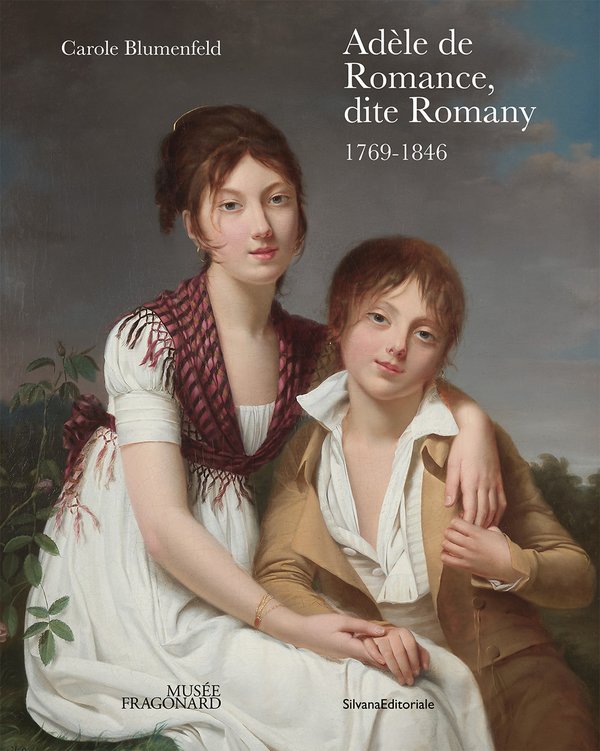 After dedicating the summer 2023 exhibition to the Lemoine sisters and their cousin Jeanne Élisabeth Chaudet, the Jean-Honoré Fragonard Museum will celebrate Adèle de Romance in 2025. This painter, whose life was as brilliant as it was tumultuous, embodies all the opportunities that the end of the 18th century and the beginning of the 19th century offered to talented artists.
Born from an illegitimate union between the Marquis Godefroy de Romance, Adèle de Romance (1769–1846) was eventually recognized and adopted by her father at the age of 8. Her younger half-sister, whose personal life perfectly met their father’s expectations, received many signs of trust from him. Despite this, Adèle de Romance now had a name and enjoyed one of the largest collections of Nordic and French paintings, including many works by Fragonard. Concerned with her education, the Marquis de Romance guided all her personal choices, from her passion for painting to the birth of her first child at the age of 18. Adèle then married the miniaturist François Antoine Romany, a mismatched union whose sole purpose was to give her a status. When her father left France in August 1791 to defend the counter-revolutionary ideas that mattered to him, Adèle de Romance was forced to conceal her partly aristocratic origins and to live… by her brushes.
After a divorce, which she willingly kept her married name, she began a series of small portraits of prominent figures. She took advantage of the fame of her subjects and, for four decades, played with a multitude of surnames, embracing public exposure and presenting dozens of works. Witnessing the upheavals of her time, she made the most of the political and social context that favored portraiture. Better than many other artists, she succeeded in capturing the desire for reinvention of the personalities she painted, presenting a gallery of portraits that reflected France. Adèle de Romance participated in a time when images were about to play an unprecedented role. Portraits, a rather insignificant genre in a monarchy—where only one person matters and everyone else is nothing—acquired a new level of interest in a Republic. It then became a vector of virtues, talents, services, and memories.
Adèle de Romance did not have the privilege of joining the royal collections, the birthplace of today’s national collections. Paying tribute to this painter who managed to live from her art first required finding her works. Thus, with the exception of the rich corpus preserved in the collections of the Comédie-Française, the paintings of Adèle de Romance held in French public collections are not only rare but rarely exhibited. Many of her portraits remained with the descendants of the sitters, who kindly allowed them to be displayed for the Grasse exhibition, thus honoring this woman who, very early on, understood that culture and artistic talents were a remarkable passport to being accepted, regardless of her origins, and having a voice in a world dominated by men.
From Silvana:
Carole Blumenfeld, Adèle de Romance, dite Romany, 1769–1846 (Milan: Silvana Editoriale, 2025), 232 pages, ISBN: 978-8836661121, €35.
Adèle de Romance appartient à cette caste ténue de femmes qui, sans jamais se poser en séditieuses, surent hanter les lisières du monde établi et frayer, dans les anfractuosités d’un ordre contraignant, un sentier d’autonomie patiemment conquis. Douée d’un discernement affûté et d’un sens exquis de la conjoncture, la portraitiste sut, avec adresse et aplomb, tirer parti des ondulations du temps et des vents favorables, pour jouer des équivoques de sa propre identité et en faire un atout, pour ses modèles et pour elle-même. Adèle de Romance devint pleinement maîtresse de son destin en peignant les visages d’autrui, qu’elle signait parfois de son nom de naissance, « de Romance », mais le plus souvent : « Romany », « Rom… », « Romanée », « de Romany » ou « DR »… Ces jeux de recomposition nominale, souples et ductiles, savamment dosés, relèvent d’une poétique du nom propre, où l’identité se dit autant par esquive que par assertion.
c o n t e n t s
Philippe Costamagna — Preface
Carole Blumenfeld — Peindre pour s’appartenir: Marie Jeanne de Romance, Adèle de Romance, dite Romany, Adèle Romanée, Adèle Romany-de-Romance, AR
Carole Blumenfeld — Catalogue des Oeuvres Exposées
Arbre généalogique d’Adèle de Romance
Chronobiographie
Liste des œuvres présentées aux Salons
Annexes
Index
Bibliographie










 Enfilade
leave a comment