Exhibition | 1793–1794: Un Tourbillon Révolutionnaire
A second iteration of the exhibition on view previously at the Musée Carnavalet:
1793–1794: Un Tourbillon Révolutionnaire
Musée de la Révolution française, Vizille, 27 June — 23 November 2025
 Entre 1793 et 1794, « l’An II de la République » marque les débuts mouvementés de la toute première république française. Des idéaux de la Révolution aux grands procès politiques, de la liesse aux insurrections populaires, les premiers mois du nouveau régime emportent tout sur leur passage, jusqu’au quotidien des Français. Un véritable tourbillon révolutionnaire, nourri d’espoirs et de peurs.
Cette exposition revient sur des mois décisifs pour l’histoire de France : l’arrestation des Girondins, l’assassinat de Marat, l’exécution de Marie-Antoinette jusqu’à la chute de Robespierre. Voici donc « la Terreur », décryptée à la lumière des recherches historiques les plus récentes.
L’exposition 1793–1974: Un tourbillon révolutionnaire est une adaptation de l’exposition Paris 1793–1794: Une année révolutionnaire conçue par le musée Carnavalet – Histoire de Paris.
The Art of the Ephemeral in 18th-Century France
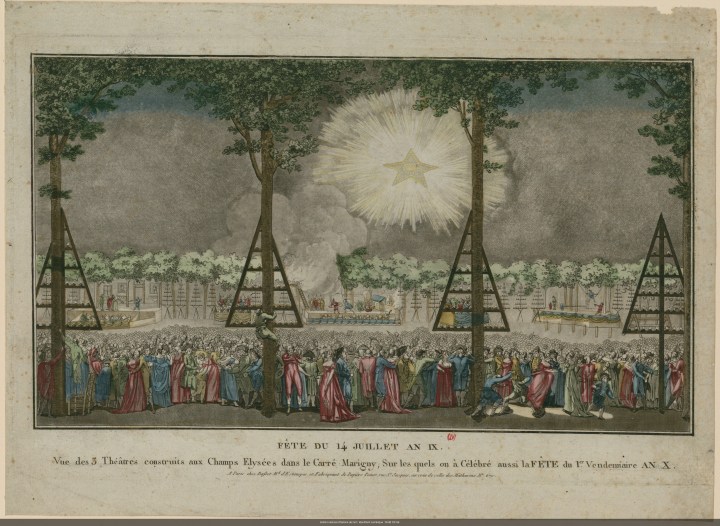
Paul-André Basset, Fête du 14 Juillet An IX, ca. 1801, hand-colored engraving, 28 × 44 cm (Paris: Bibliothèque de l’Institut National d’Histoire de l’Art). The print depicts the national holiday, as celebrated on the Champs-Élysées and organized by Chalgrin, commemorating the storming of the Bastille in 1789.
◊ ◊ ◊ ◊ ◊
All contents from this special issue of Status Quaestionis are available as free downloads:
Here Today, Gone Tomorrow?
The Art of the Ephemeral in Eighteenth-Century France
Status Quaestionis: Language, Text, Culture 28 (2025)
Edited by Elisa Cazzato
This monographic issue of Status Quaestionis explores the notion of ephemerality in French artistic culture during the long eighteenth-century. The volume is highly interdisciplinary, featuring articles from art and theatre history, costume-making, and performance studies, extending the notion of the ephemeral to a wide range of examples. The authors investigate how, in order to exist, ephemerality needs materiality, since any creative process intersects with the material requirement that both artworks and performances need: materials, locations, settings, scripts, costumes, and bodies. This dichotomy enables historians to further analyse the cultural and political meanings of the ephemeral, connecting artworks to social contexts, dance costumes to movements, and public festivals to human reception. Rather than focusing solely on aesthetics, the volume interrogates how the ephemeral was experienced, recorded, and remembered and how its traces persist in artworks, texts, and collective memory. The contributions question the boundary between presence and absence, visibility and oblivion, reflecting on the long-term cultural implications of transience. In seeking what remains of the ephemeral, the volume challenges dominant narratives and reconsiders the politics of cultural memory.
This special issue was inspired by the intellectual discussions that took place during the international conference organised at Ca’ Foscari University of Venice in June 2023. The conference was part of the research project SPECTACLE, funded by the European Union’s Horizion 2020 research and innovation programme under the Marie Skłodowska-Curie grant agreement no. 893106.
t h e m a t i c a r t i c l e s
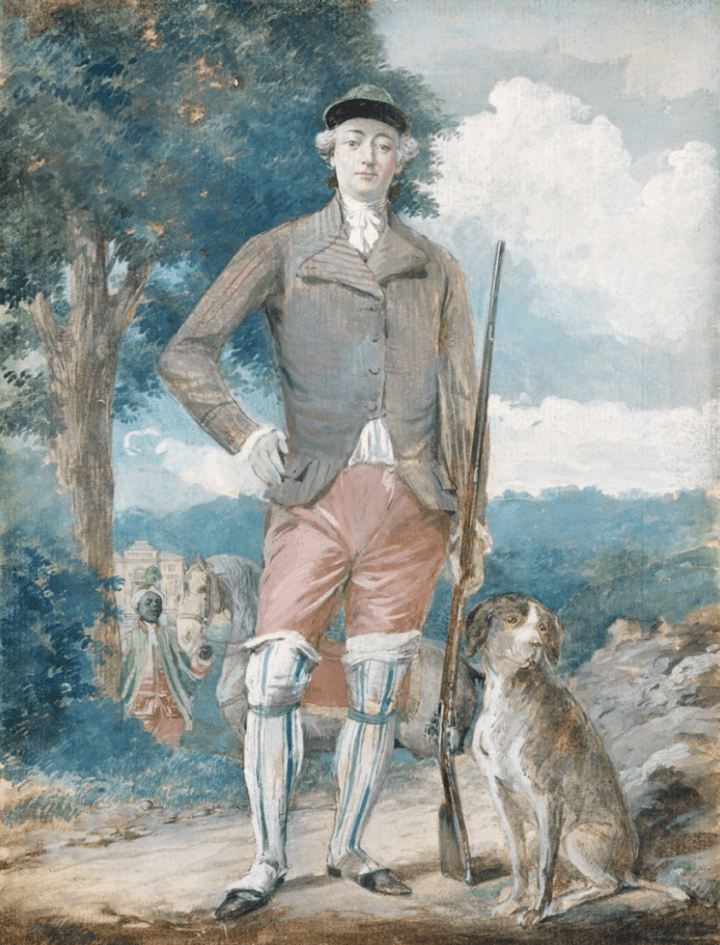
Jean-Baptiste-Philibert Moitte, The Comte d’Artois as a Hunter, ca. 1777, gouache on paper, 22.9 × 30 cm (Amiens, Musée de Picardie). Figure 1 from the article by Noémie Étienne and Meredith Martin.
• Introduction: Here Today, Gone Tomorrow? The Art of the Ephemeral in Eighteenth-Century France — Elisa Cazzato
• ‘Mais, le lendemain matin’: Residues of the Ephemeral in Eighteenth-Century French Art — Mark Ledbury
• Spectacular Blindness: Enslaved Children and African Artifacts in Eighteenth-Century Paris — Noémie Étienne and Meredith Martin
• L’art du comédien au tournant des Lumières: Conscience de l’éphémère et sensibilité mémorielle — Ilaria Lepore
• L’expérience éphémère d’Ériphyle (Voltaire, 1732): Matériaux tangibles et réécritures d’une dramaturgie passagère — Renaud Bret-Vitoz
• Un événement unique: Le théâtre de la Révolution entre surgissement et disparition — Pierre Frantz
• Ephemeral Emblem: Jacques-Louis David and the Making of a Revolutionary Martyr — Daniella Berman
• Les feux d’artifices des frères Ruggieri à l’intérieur d’un théâtre: L’autonomie de l’éphémère dans le Paris du XVIIIe siècle — Emanuele De Luca
• Tra utopia e ricerca del consenso: Fuochi e apparati effimeri di epoca napoleonica a Milano tra il 1801 e il 1803 — Alessandra Mignatti
• Witnesses of the Past: Costumes as Material Evidence of the Ephemeral Performance — Petra Zeller Dotlačilová
• Noverre’s Lament: Inscription, Posterity, and the Ephemeral Art of Dance — Olivia Sabee
• Ephemerality on the Fringe: Exploring the Venues Hosting Power Quadrilles in Brussels on the Eve of Waterloo and Beyond (1814–1816) — Cornelis Vanistendael
Miscellaneous articles and reviews are available here»
◊ ◊ ◊ ◊ ◊
Elisa Cazzato is research fellow at the University of Naples Federico II. She holds a PhD in art history from the University of Sydney, and she is a former Marie Skłodowska-Curie Global Fellow. For her project SPECTACLE she was a visiting scholar at the CELLF of the Université Sorbonne and in the New York University’s Department of Art History. Her publications include articles in the peer-review journals Studi Francesi, Dance Research, Humanities Research Journal, and RIEF. She is currently writing her first book on the life and career of Ignazio Degotti.










 Enfilade
leave a comment