Exhibition | Marie Antoinette Style
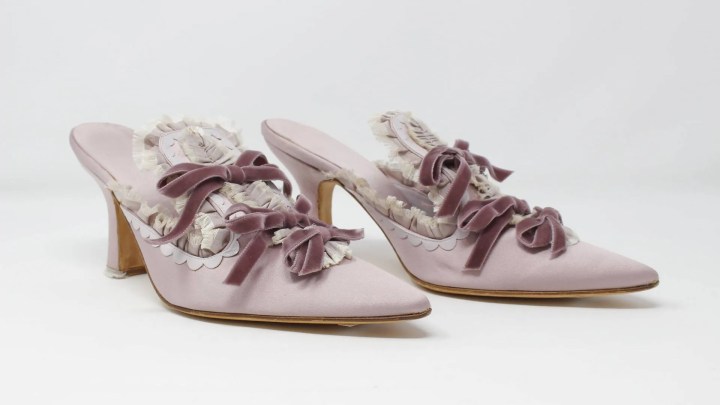
Manolo Blahnik, Antonietta, 2005.
◊ ◊ ◊ ◊ ◊
Curator Sarah Grant provides a preview of the exhibition with a focus on scent in a recorded talk from the study day The Museum and the Senses, held at the Barber Institute of Fine Arts (February 2025). From the press release for the exhibition:
Marie Antoinette Style
Victoria & Albert Museum, London, 20 September 2025 – 22 March 2026
Curated by Sarah Grant
Opening in September 2025 at V&A South Kensington, Marie Antoinette Style will be the UK’s first exhibition on the French queen Marie Antoinette (1755–1793). It will explore the origins and countless revivals of the style shaped by the most fashionable queen in history. Marie Antoinette not only contributed to the fashions, interiors, gardens, and fine and decorative arts of her own time, but continued to influence more than two and a half centuries of graphic and decorative arts, fashion, photography, film, and performance. This excessive, lavish, and feminine style will come to life through some 250 objects, including exceptional loans from the Château de Versailles never before seen outside France. Historical and contemporary fashion, alongside audio visual installations and immersive curation, will explore how and why Marie Antoinette, the person, has provided a constant source of inspiration. The exhibition will consider afresh the legacy of this complex figure whose style, youth, and notoriety have contributed to her timeless appeal. The exhibition will also trace the cultural impact of the Marie Antoinette style and her ongoing inspiration for leading designers and creatives, from Sofia Coppola and Manolo Blahnik to Moschino and Vivienne Westwood.

François-Hubert Drouais, Portrait of Marie Antoinette, Queen of France, in a Court Dress, 1773, oil on canvas (London: V&A, Jones Collection, 529-1882).
On display will be exceptionally rare personal items owned and worn by Marie Antoinette including richly embellished fragments of court dress, the Queen’s own silk slippers, and jewels from her private collection. Other highlights include personal effects such as the queen’s dinner service from the Petit Trianon, a selection of her accessories, and intimate items from her toilette case. A scent experience will re-create scents of the court and the perfume favoured by the Queen herself. The exhibition will also feature contemporary clothing including couture pieces by designers such as Moschino, Dior, Chanel, Erdem, Vivienne Westwood, and Valentino, along with costumes made for Sofia Coppola’s Oscar winning Marie Antoinette (staring Kirsten Dunst), as well as shoes designed for the film by Manolo Blahnik.
Sarah Grant, curator of Marie Antoinette Style, said: “The most fashionable, scrutinised, and controversial queen in history, Marie Antoinette’s name summons both visions of excess and objects and interiors of great beauty. The Austrian archduchess turned Queen of France had an enormous impact on European taste and fashion in her own time, creating a distinctive style that now has universal appeal and application. This exhibition explores that style and the figure at its centre, using a range of exquisite objects belonging to Marie Antoinette, alongside the most beautiful fine and decorative objects that her legacy has inspired. This is the design legacy of an early modern celebrity and the story of a woman whose power to fascinate has never ebbed. Marie Antoinette’s story has been re-told and re-purposed by each successive generation to suit its own ends. The rare combination of glamour, spectacle, and tragedy she presents remains as intoxicating today as it was in the eighteenth century.”
Presented chronologically, the first section, Marie Antoinette: The Origins of a Style, begins in 1770 and ends at Marie Antoinette’s execution in 1793. It sets the scene by presenting her life and the story of the beginnings of the style she shaped. On display will be key pieces of furniture, fashion, jewellery, porcelain, and musical instruments from her court, revealing her roles and interests as queen consort. It will consider the way in which she embraced some aspects of enlightenment thought, through her approach to maternity and childhood and support of new technologies. It will also address the ‘let them eat cake’ mythology and mythmaking that surround the queen to this day, drawing on recent research on early modern women, queenship, and celebrity. Highlights in this section include a replica of the Boehmer and Bassenge diamond necklace, from the diamond necklace affair of 1784–85, commissioned for Madame du Barry in 1772. The original necklace was famously stolen, broken up, and sold in Bond Street; the replica will sit alongside the Sutherland diamond necklace from the V&A collection, thought to be made from the original diamonds.
The first section will also display exceptionally rare loans that have never before left France, including personal effects such as the queen’s dinner service from the Petit Trianon, her accessories, and items from her toilette case. Other personal items include the queen’s armchair from the V&A’s collection with Marie Antoinette’s monogram and a jatte téton / bol sein or ‘breast cup’—one of four from the queen’s Sèvres Rambouillet dairy service delivered in 1787—which has led to the persistent though erroneous belief that it was modelled on the queen’s own breast, inspiring modern-day examples. Finally, this section includes the last note Marie Antoinette wrote before she died, on a blank page in her prayer book.
 The second section, Marie Antoinette Memorialised: The Birth of a Style Cult, explores the revival of Marie Antoinette’s style in the mid-1800s, at the impetus of Empress Eugénie. A romanticised and sentimental view of the queen took hold, and a phenomenal wave of interest continued throughout the century, peaking again in the 1880s and 1890s. Elements of Marie-Antoinette’s style became the ‘French’ or ‘French Revival’ style—the dominant style in Britain and North America for over fifty years. English collectors sought to acquire objects, furniture, and mementoes associated with the queen, and important collections of eighteenth-century French art were formed. Highlight objects include fancy dress costumes by Worth and other couturiers and photographs by Eugène Atget and Francis Frith.
Marie Antoinette: Enchantment and Illusion, the exhibition’s third section, looks to the late 19th century when the Marie Antoinette style entered a new phase of fantasy, magic, and fairy tales. The queen’s image came to embody escapism and beauty, as well as decadence and debauchery. Objects and artworks will illustrate this shifting narrative through the Art Nouveau and Art Deco periods, including the evening dress designs of couturiers such as Jeanne Lanvin and the Boué Soeurs, alongside luminous watercolour illustrations by Golden Age illustrators Erté, George Barbier, and Edmund Dulac.
The final section, Marie Antoinette Re-Styled, considers the modern and contemporary legacy of the Marie Antoinette style from the 20th century to the present day, in fashion, performance, and pop culture. Couture pieces by designers such as Moschino, Dior, Chanel, Erdem, Vivienne Westwood, and Valentino alongside photographs by Tim Walker and Robert Polidori will highlight Marie Antoinette’s continued influence on fashion globally. Costumes, accessories, film, and stills will bring to life the queen’s enduring legacy in film, stage, and even music videos. Artist Beth Katleman and designer Victor Glemaud will also showcase contemporary works inspired by elements of Marie Antoinette’s timeless style and period.
Support for the V&A is more vital than ever. Marie Antoinette Style is sponsored by Manolo Blahnik, with support from Kathryn Uhde.
Sarah Grant, ed., with forewords by Antonia Fraser, Manolo Blahnik, and Sofia Coppola, Marie Antoinette Style (London, V&A Publishing, 2025), 304 pages, ISBN: 978-1838510541, £40 / $70.










 Enfilade
leave a comment