Call for Papers | Architecture and the Literary Imagination, 1350–1750
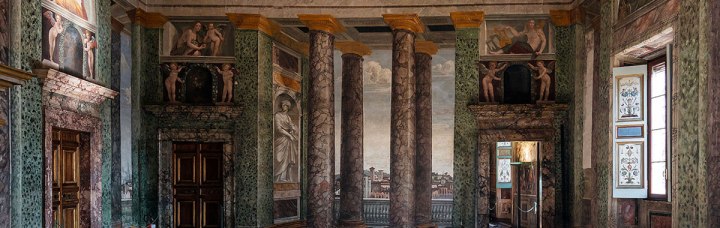
Hall of Perspectives, Villa Farnesina, frescoes painted by Baldassare Peruzzi, ca. 1510–16. Built for Agostino Chigi, the villa was acquired by the Farnese family in 1577.
◊ ◊ ◊ ◊ ◊
From ArtHist.net and the American University of Rome:
Architecture and the Literary Imagination, 1350–1750
American University of Rome, 6–8 November 2025
Organized by Fabio Barry and Paul Gwynne
Proposals due by 1 October 2025
Architecture and the Literary Imagination solicits conference papers that will broaden the repertoire of literary sources for understanding European architecture from around 1350 to 1750 and foster dialogue across disciplines. Architectural historians typically rely on histories for facts, and treatises for theories. A much wider range of texts records the reception of real buildings, the capacity to imagine fantastic ones, and the reciprocity between architecture and literature: poetry, dramaturgy, the picaresque novel, inauguration or consecration speeches, travelogues, epigraphy, and so on.
‘Architecture’ includes cities, civic buildings, palaces, villas, housing, individual rooms, gardens, grottoes, the constructions of nature itself, fountains, monuments, engineering, and decorations from vault painting to topiary. Our focus is largely Europe, but encompasses the Ottoman Empire, all territories ringing the Mediterranean basin, and descriptions of architecture transmitted by the global missions of the Church or travellers.
The source language may be in any vernacular, and we are also interested in Neo-Latin, Neo-Greek, and Classical Arabic as legacy languages of cultural transmission across history and borders. A particular theoretical concern is the intermedial relationship between immaterial words and solid buildings—however that may be defined.
A collection of essays from the conference will be published, subject to peer review, in an edited volume of the new book series, Architecture & the Literary Imagination (Harvey Miller Publishers, series editors, Fabio Barry and Paul Gwynne).
Papers will be 30 minutes in length and preferably in either English or Italian. Please send an abstract of 200 words by 1 October to Fabio Barry (rabirius@cantab.net) and Paul Gwynne (p.gwynne@aur.edu).










 Enfilade
leave a comment