New Book | Castle Howard
Coming this fall, from Rizzoli:
Christopher Ridgway, with photographs by Mattia Aquila and Nicholas Howard, Castle Howard: A Grand Tour of England’s Finest Country (Paris: Flammarion, 2025), 364 pages, ISBN: 978-2080445865, £100 / $130.
 An exclusive tour of a famous English historic house—featured in period dramas including Bridgerton and Brideshead Revisited—set on acres of beautiful parkland and gardens.
The iconic architectural marvel Castle Howard is the epitome of English baroque magnificence. Nestled in the rolling hills of North Yorkshire, this grand estate was commissioned by Charles Howard, 3rd Earl of Carlisle, and masterfully crafted by Sir John Vanbrugh and Nicholas Hawksmoor in the early eighteenth century. The residence’s facades reveal Vanbrugh’s signature flair for the dramatic, while inside, extravagant frescoes, intricately carved stonework, and antique furnishings tell the captivating story of centuries of aristocratic elegance. Recent renovations, undertaken by American designer Remy Renzullo, have rejuvenated the castle’s bedrooms, merging history with contemporary opulence.
The domain’s sprawling parkland features meticulously landscaped gardens, a tranquil lake, a monumental neoclassical mausoleum and pyramids, and the breathtaking Atlas fountain. This comprehensive monograph explores the history of Castle Howard, its architecture, its gardens, and the generations of the Howard family who have lived there for more than three hundred years. Featuring previously unpublished archival documents, as well as photographs of the sumptuous interiors and art collections, this book is a celebration of a British national treasure, whose timeless beauty has captured the imagination of filmmakers for decades.
Christopher Ridgway, curator at Castle Howard since 1984, has lectured extensively on the history of country houses. He coauthored The Irish Country House: A New Vision (yeartk). Mattia Aquila is an interior design and architecture photographer. His photographs have appeared in Venice: A Private Invitation (2022) and Pierre Frey: A Family Legacy of Passion and Creativity (2023). Nicholas Howard manages Castle Howard with his wife, Victoria.
Call for Papers | Architecture and the Literary Imagination, 1350–1750
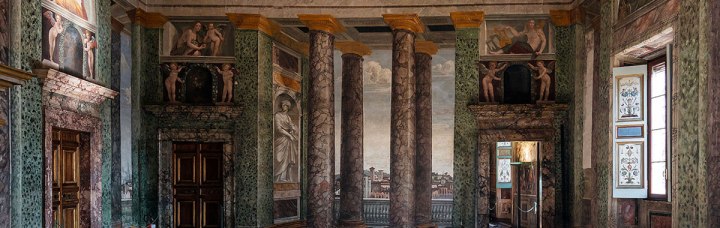
Hall of Perspectives, Villa Farnesina, frescoes painted by Baldassare Peruzzi, ca. 1510–16. Built for Agostino Chigi, the villa was acquired by the Farnese family in 1577.
◊ ◊ ◊ ◊ ◊
From ArtHist.net and the American University of Rome:
Architecture and the Literary Imagination, 1350–1750
American University of Rome, 6–8 November 2025
Organized by Fabio Barry and Paul Gwynne
Proposals due by 1 October 2025
Architecture and the Literary Imagination solicits conference papers that will broaden the repertoire of literary sources for understanding European architecture from around 1350 to 1750 and foster dialogue across disciplines. Architectural historians typically rely on histories for facts, and treatises for theories. A much wider range of texts records the reception of real buildings, the capacity to imagine fantastic ones, and the reciprocity between architecture and literature: poetry, dramaturgy, the picaresque novel, inauguration or consecration speeches, travelogues, epigraphy, and so on.
‘Architecture’ includes cities, civic buildings, palaces, villas, housing, individual rooms, gardens, grottoes, the constructions of nature itself, fountains, monuments, engineering, and decorations from vault painting to topiary. Our focus is largely Europe, but encompasses the Ottoman Empire, all territories ringing the Mediterranean basin, and descriptions of architecture transmitted by the global missions of the Church or travellers.
The source language may be in any vernacular, and we are also interested in Neo-Latin, Neo-Greek, and Classical Arabic as legacy languages of cultural transmission across history and borders. A particular theoretical concern is the intermedial relationship between immaterial words and solid buildings—however that may be defined.
A collection of essays from the conference will be published, subject to peer review, in an edited volume of the new book series, Architecture & the Literary Imagination (Harvey Miller Publishers, series editors, Fabio Barry and Paul Gwynne).
Papers will be 30 minutes in length and preferably in either English or Italian. Please send an abstract of 200 words by 1 October to Fabio Barry (rabirius@cantab.net) and Paul Gwynne (p.gwynne@aur.edu).
Call for Papers | Animals Inside
From ArtHist.net:
Animals Inside: A History of Objects and Furniture for Pets in Domestic Interiors
HEAD – Genève, Geneva, 17 November 2025
Organized by Javier Fernández Contreras and Youri Kravtchenko
Proposals due by 15 September 2025
The Master of Arts in Interior Architecture (MAIA) at HEAD – Genève studies the role of interior spaces in shaping contemporaneity, paying particular attention to human–non-human entanglements. This includes the dynamic relationships between humans and animals within the domestic sphere, a relationship that has transformed radically across time and geography.
This conference invites designers, architects, historians, researchers, artists, and theorists to explore the history of objects and furniture designed for pets in domestic interiors, from antiquity to today. We aim to investigate when and how animals entered the home, and more crucially, when their presence began to transform its design through specific furniture and objects created for their use.
From the ornately crafted birdcages of imperial courts to Victorian aquariums, and from today’s wall-mounted cat gyms to AI-powered talking buttons for dogs—these objects offer a unique lens through which to examine changes in domestic space, material culture, design, and our understanding of interspecies cohabitation.
We welcome contributions that
• Offer a 30-minute presentation based on original research or practice-based investigation
• Clearly specify the geographic and historical context of the case study
• Examine any type of non-human animal (birds, dogs, cats, fish, reptiles, etc.)
• Investigate any historical period, from ancient civilizations to contemporary design
• Address a range of objects and furnishings, such as aquariums, terrariums, bird cages, pet beds, perches, feeders, cat trees, wall gyms, litter furniture, wearables, communication devices, or smart pet furnishings
Please submit a proposal to javier.fernandez-contreras@hesge.ch and youri.kravtchenko@hesge.ch by 15 September 2025 with the following items:
• Title of your presentation
• Abstract (300–500 words)
• Biographical note (150 words)
• Affiliation and contact details
Call for Submissions | Metropolitan Museum Journal
Metropolitan Museum Journal 61 (2026)
Submissions due by 15 September 2025
The Editorial Board of the peer-reviewed Metropolitan Museum Journal invites submissions of original research on works of art in the Museum’s collection. The Journal publishes Articles and Research Notes. Works of art from The Met collection should be central to the discussion. Articles contribute extensive and thoroughly argued scholarship—art historical, technical, and scientific—whereas Research Notes are narrower in scope, focusing on a specific aspect of new research or presenting a significant finding from technical analysis, for example. The maximum length for articles is 8,000 words (including endnotes) and 10–12 images, and for research notes 4,000 words (including endnotes) and 4–6 images. Articles and Research Notes in the Journal appear in print and online, and are accessible in JStor on the University of Chicago Press website.
The process of peer review is double-anonymous. Manuscripts are reviewed by the Journal Editorial Board, composed of members of the curatorial, conservation, and scientific departments, as well as scholars from the broader academic community. Submission guidelines are available here. Please send materials to journalsubmissions@metmuseum.org. The deadline for submissions for Volume 61 (2026) is 15 September 2025.
Exhibition | L’étoffe des Lumières
Now on view at the Musée Jean-Jacques Rousseau:
L’étoffe des Lumières: Vêtements et accessoires au XVIIIe siècle
The Fabric of Enlightenment: Clothing and Accessories in the 18th Century
Musée Jean-Jacques Rousseau, Montmorency, 5 April — 26 October 2025

Antoine Vestier, Portrait de femme, 1750–90, oil on canvas (Paris: Musée Cognacq-Jay).
Réalisée en partenariat avec La Dame d’Atours, spécialiste de la reconstitution historique, cette exposition met en lumière les transformations vestimentaires de l’époque à travers une sélection de costumes, d’accessoires, de gravures et de peintures. Reflet d’une société en pleine mutation, la mode du XVIIIe oscille entre luxe aristocratique et quête de simplicité, en écho aux idéaux de Jean-Jacques Rousseau. Philosophe des Lumières, à la fois familier des salons et critique des artifices, il prône un retour à l’authenticité qui inspire encore aujourd’hui. Les costumes raffinés de La Dame d’Atours dialoguent avec des œuvres prêtées par le Musée Cognacq-Jay et les collections montmorencéennes, offrant une immersion inédite à la croisée de l’histoire sociale, de la mode et des arts. Ce parcours enrichi de dispositifs ludiques invite petits et grands à découvrir cette époque fascinante sous toutes les coutures.
New Book | Mrs Kauffman and Madame Le Brun
From Bloomsbury Publishing:
Franny Moyle, Mrs Kauffman and Madame Le Brun: The Extraordinary Entwined Lives of Two Eighteenth-Century Painters (London: Apollo, 2025), 496 pages, ISBN: 978-1801107440, $45.
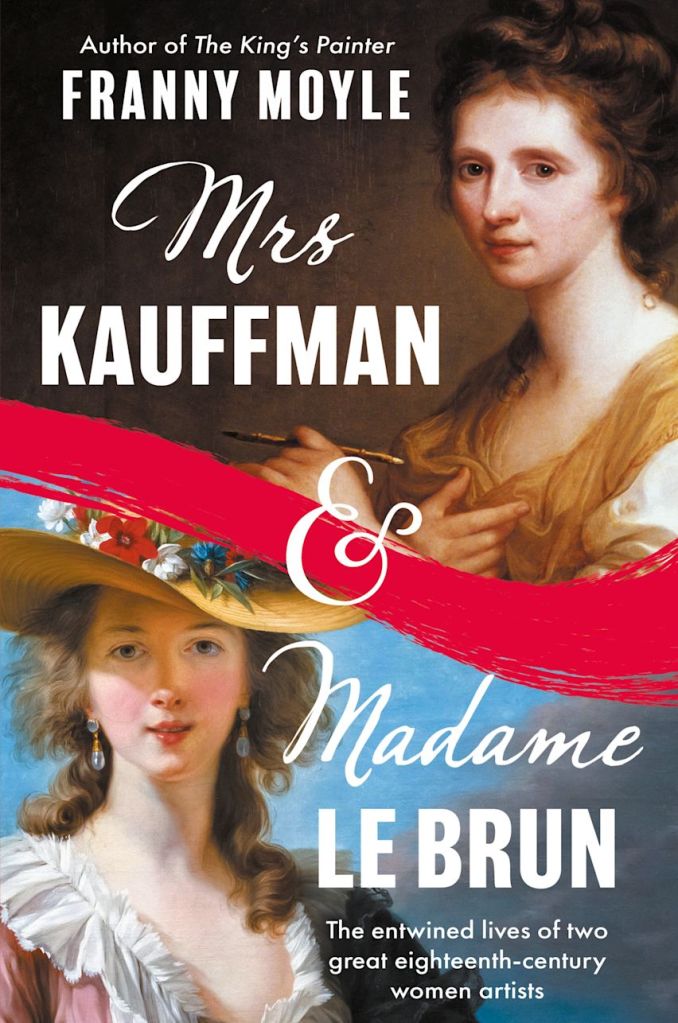 In the late autumn of 1789, two of Europe’s most celebrated painters met in Rome. One, Angelica Kauffman, was a Swiss-born prodigy who had conquered the art scenes of London and Italy. The other, Élisabeth Louise Vigée Le Brun, a Parisienne portraitist and favourite of the ancien regime, had just fled revolutionary France under threat of violence and scandal. Both were feted in their time, both were trailblazers in a male-dominated world—visionaries who helped define eighteenth-century art and feminism before the term existed.
This dual biography, framed within a thrilling story, restores these two extraordinary but unjustly overlooked figures to their rightful place in history. Set against a backdrop of revolution, empire and Enlightenment, it traces the dramatic lives and remarkable careers of Vigée Le Brun and Kauffman: artists who not only achieved unparalleled success and influence, but did so while pushing the boundaries of what women could be, both on canvas and in society. With vivid storytelling, one of the most gifted living writers of artistic biography, Franny Moyle, reclaims their legacies. She examines how each artist navigated fame, scandal and exile; explores the relationships between them and their peers; and considers how they were caught up in the huge cultural cross-currents that were reshaping Europe.
Through their work and their lives, they spoke boldly to the roles of women in public life, highlighted the prejudices and abuses suffered by their sex, reimagined and celebrated the female subject, and challenged the institutions that sought to contain them. Through them we encounter icons such as Marie Antoinette (whose portrait by Le Brun scandalised French society) and Catherine the Great, as well as cultural figures such as Emma Hamilton and Madame de Staël. The most notable men of their time—monarchs, statesman, aristocrats, artists, and more—are also woven into the fabric of the tale. Mrs Kauffman and Madame Le Brun is a timely, revelatory history that not only brings two forgotten artists into view, but rethinks the story of European art itself.
Franny Moyle is a British television producer and author. Her first book Desperate Romantics was adapted into the BBC drama serial of the same title by screenwriter Peter Bowker. Her second book Constance: The Tragic and Scandalous Life of Mrs Oscar Wilde was published in 2011 to critical acclaim. In 2016 she released The Extraordinary Life and Times of J.M.W Turner.
New Book | Daring: The Life and Art of Elisabeth Vigée Le Brun
The life of Vigée Le Brun, as targeted to teenagers; from The Getty (for the context of the cover design, see Elisabeth Egan, “The Book Cover Trend You’re Seeing Everywhere,” The New York Times 21 June 2025) . . .
Jordana Pomeroy, Daring: The Life and Art of Elisabeth Vigée Le Brun (Los Anges: Getty Publications, 2025), 112 pages, ISBN: 978-1947440104, $22.
 The dramatic life story of Elisabeth Vigée Le Brun, one of the greatest portrait painters of all time.
Supremely talented and strategically charming, Elisabeth Vigée Le Brun (1755–1842) overcame tragedy and broke gender barriers to reach the height of success as a portrait painter, first in Paris, and then across Europe. After losing her father at age twelve and facing financial insecurity, she fought to gain access to artistic training and opportunity. She was pressured to marry at age twenty, to an art dealer who both helped and harmed her career. Vigée Le Brun deployed her intelligence and beauty to attract powerful clients, who relied on her to style the personal identities they projected to the world. Vigée Le Brun’s salons were the talk of Paris, and she became court painter to Marie Antoinette. Then came the French Revolution, when marginalized groups demanded change to centuries-old systems of oppression. Vigée Le Brun was forced to reexamine her alliances and run for her life, taking her young daughter but leaving her husband behind. Making her way through the countrysides and capitals of Europe and Russia—including a stay at the imperial court of Catherine the Great—the artist conquered fear and adversity to refashion her life and art. Ages thirteen and up.
Jordana Pomeroy is director and CEO of the Currier Museum of Art and former chief curator at the National Museum of Women in the Arts.
Exhibition | Marie Antoinette Style
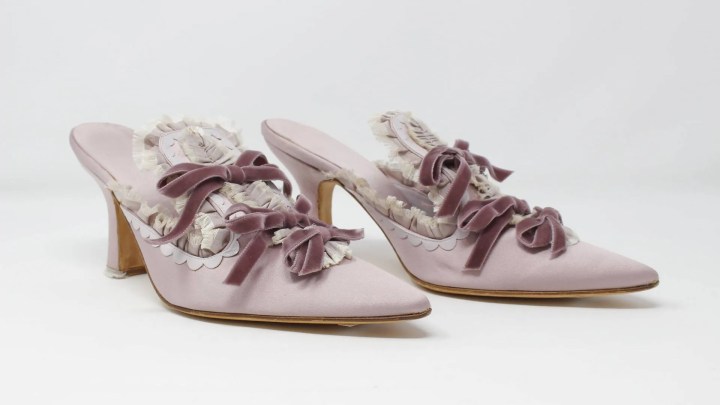
Manolo Blahnik, Antonietta, 2005.
◊ ◊ ◊ ◊ ◊
Curator Sarah Grant provides a preview of the exhibition with a focus on scent in a recorded talk from the study day The Museum and the Senses, held at the Barber Institute of Fine Arts (February 2025). From the press release for the exhibition:
Marie Antoinette Style
Victoria & Albert Museum, London, 20 September 2025 – 22 March 2026
Curated by Sarah Grant
Opening in September 2025 at V&A South Kensington, Marie Antoinette Style will be the UK’s first exhibition on the French queen Marie Antoinette (1755–1793). It will explore the origins and countless revivals of the style shaped by the most fashionable queen in history. Marie Antoinette not only contributed to the fashions, interiors, gardens, and fine and decorative arts of her own time, but continued to influence more than two and a half centuries of graphic and decorative arts, fashion, photography, film, and performance. This excessive, lavish, and feminine style will come to life through some 250 objects, including exceptional loans from the Château de Versailles never before seen outside France. Historical and contemporary fashion, alongside audio visual installations and immersive curation, will explore how and why Marie Antoinette, the person, has provided a constant source of inspiration. The exhibition will consider afresh the legacy of this complex figure whose style, youth, and notoriety have contributed to her timeless appeal. The exhibition will also trace the cultural impact of the Marie Antoinette style and her ongoing inspiration for leading designers and creatives, from Sofia Coppola and Manolo Blahnik to Moschino and Vivienne Westwood.

François-Hubert Drouais, Portrait of Marie Antoinette, Queen of France, in a Court Dress, 1773, oil on canvas (London: V&A, Jones Collection, 529-1882).
On display will be exceptionally rare personal items owned and worn by Marie Antoinette including richly embellished fragments of court dress, the Queen’s own silk slippers, and jewels from her private collection. Other highlights include personal effects such as the queen’s dinner service from the Petit Trianon, a selection of her accessories, and intimate items from her toilette case. A scent experience will re-create scents of the court and the perfume favoured by the Queen herself. The exhibition will also feature contemporary clothing including couture pieces by designers such as Moschino, Dior, Chanel, Erdem, Vivienne Westwood, and Valentino, along with costumes made for Sofia Coppola’s Oscar winning Marie Antoinette (staring Kirsten Dunst), as well as shoes designed for the film by Manolo Blahnik.
Sarah Grant, curator of Marie Antoinette Style, said: “The most fashionable, scrutinised, and controversial queen in history, Marie Antoinette’s name summons both visions of excess and objects and interiors of great beauty. The Austrian archduchess turned Queen of France had an enormous impact on European taste and fashion in her own time, creating a distinctive style that now has universal appeal and application. This exhibition explores that style and the figure at its centre, using a range of exquisite objects belonging to Marie Antoinette, alongside the most beautiful fine and decorative objects that her legacy has inspired. This is the design legacy of an early modern celebrity and the story of a woman whose power to fascinate has never ebbed. Marie Antoinette’s story has been re-told and re-purposed by each successive generation to suit its own ends. The rare combination of glamour, spectacle, and tragedy she presents remains as intoxicating today as it was in the eighteenth century.”
Presented chronologically, the first section, Marie Antoinette: The Origins of a Style, begins in 1770 and ends at Marie Antoinette’s execution in 1793. It sets the scene by presenting her life and the story of the beginnings of the style she shaped. On display will be key pieces of furniture, fashion, jewellery, porcelain, and musical instruments from her court, revealing her roles and interests as queen consort. It will consider the way in which she embraced some aspects of enlightenment thought, through her approach to maternity and childhood and support of new technologies. It will also address the ‘let them eat cake’ mythology and mythmaking that surround the queen to this day, drawing on recent research on early modern women, queenship, and celebrity. Highlights in this section include a replica of the Boehmer and Bassenge diamond necklace, from the diamond necklace affair of 1784–85, commissioned for Madame du Barry in 1772. The original necklace was famously stolen, broken up, and sold in Bond Street; the replica will sit alongside the Sutherland diamond necklace from the V&A collection, thought to be made from the original diamonds.
The first section will also display exceptionally rare loans that have never before left France, including personal effects such as the queen’s dinner service from the Petit Trianon, her accessories, and items from her toilette case. Other personal items include the queen’s armchair from the V&A’s collection with Marie Antoinette’s monogram and a jatte téton / bol sein or ‘breast cup’—one of four from the queen’s Sèvres Rambouillet dairy service delivered in 1787—which has led to the persistent though erroneous belief that it was modelled on the queen’s own breast, inspiring modern-day examples. Finally, this section includes the last note Marie Antoinette wrote before she died, on a blank page in her prayer book.
 The second section, Marie Antoinette Memorialised: The Birth of a Style Cult, explores the revival of Marie Antoinette’s style in the mid-1800s, at the impetus of Empress Eugénie. A romanticised and sentimental view of the queen took hold, and a phenomenal wave of interest continued throughout the century, peaking again in the 1880s and 1890s. Elements of Marie-Antoinette’s style became the ‘French’ or ‘French Revival’ style—the dominant style in Britain and North America for over fifty years. English collectors sought to acquire objects, furniture, and mementoes associated with the queen, and important collections of eighteenth-century French art were formed. Highlight objects include fancy dress costumes by Worth and other couturiers and photographs by Eugène Atget and Francis Frith.
Marie Antoinette: Enchantment and Illusion, the exhibition’s third section, looks to the late 19th century when the Marie Antoinette style entered a new phase of fantasy, magic, and fairy tales. The queen’s image came to embody escapism and beauty, as well as decadence and debauchery. Objects and artworks will illustrate this shifting narrative through the Art Nouveau and Art Deco periods, including the evening dress designs of couturiers such as Jeanne Lanvin and the Boué Soeurs, alongside luminous watercolour illustrations by Golden Age illustrators Erté, George Barbier, and Edmund Dulac.
The final section, Marie Antoinette Re-Styled, considers the modern and contemporary legacy of the Marie Antoinette style from the 20th century to the present day, in fashion, performance, and pop culture. Couture pieces by designers such as Moschino, Dior, Chanel, Erdem, Vivienne Westwood, and Valentino alongside photographs by Tim Walker and Robert Polidori will highlight Marie Antoinette’s continued influence on fashion globally. Costumes, accessories, film, and stills will bring to life the queen’s enduring legacy in film, stage, and even music videos. Artist Beth Katleman and designer Victor Glemaud will also showcase contemporary works inspired by elements of Marie Antoinette’s timeless style and period.
Support for the V&A is more vital than ever. Marie Antoinette Style is sponsored by Manolo Blahnik, with support from Kathryn Uhde.
Sarah Grant, ed., with forewords by Antonia Fraser, Manolo Blahnik, and Sofia Coppola, Marie Antoinette Style (London, V&A Publishing, 2025), 304 pages, ISBN: 978-1838510541, £40 / $70.
V&A East Storehouse Opens
◊ ◊ ◊ ◊ ◊
The V&A Storehouse has now been open six weeks. The East London building, designed by Diller Scofidio + Renfro, houses some 250,000 objects, 350,000 books, and nearly 1,000 separate archives (with the David Bowie Collection scheduled to open in September). With costs undisclosed, estimates range from £64 to £100million (or more). I found the above video by Jessica ‘The Museum Guide’ to be helpful for conceiving of the space from afar. The storehouse is being compared to a cabinet of curiosities and IKEA. I’ll look forward to critical responses that aim to understand the project in terms of what a museum is now expected to be or do. There are obviously plenty of new things in play here; one would seem to be a new way of navigating the individual vs. group experience of a museum. –CH
From the V&A press release (28 May) . . .
• For the first time, visitors can step inside V&A East Storehouse—the V&A’s unique museum experience and busy working store designed by architects Diller Scofidio + Renfro.
• Visitors can now get closer to their national collections than ever before through the V&A’s radical new Order and Object experience—now live.
• Over 1,000 objects ordered so far—with the most-ordered object a 1954 Balenciaga evening dress.
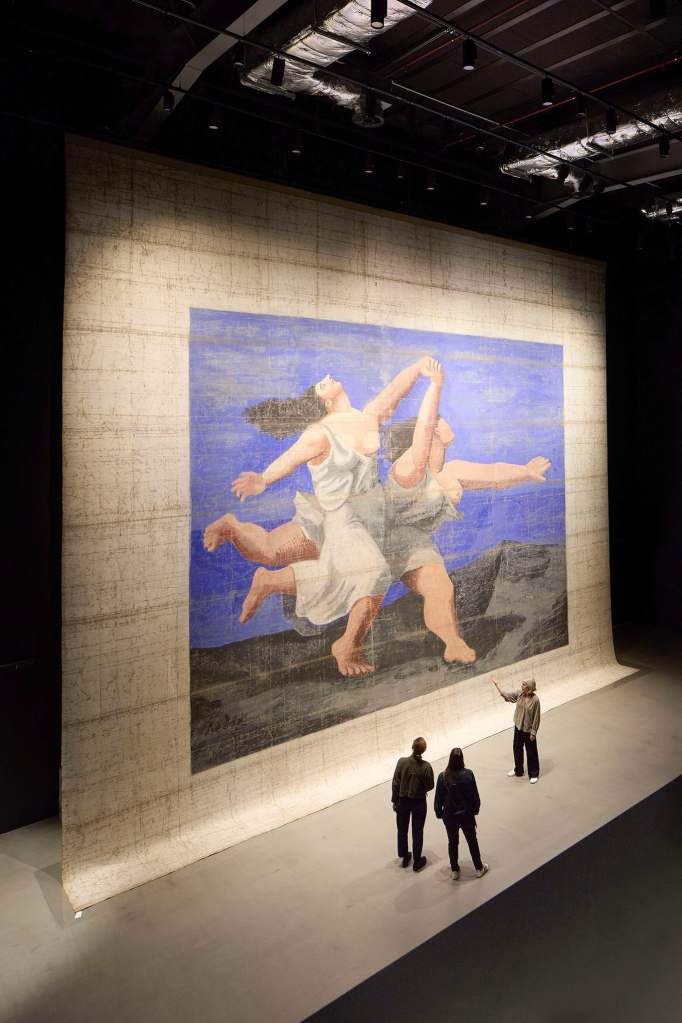
• The largest Pablo Picasso work in the world—the rarely displayed Ballets Russes Le Train Bleu stage cloth—is now display for the first time in over a decade alongside a series of monumental objects from architect Frank Lloyd Wright’s 1930s Kaufmann Office to the 15th-century Spanish Torrijos ceiling.
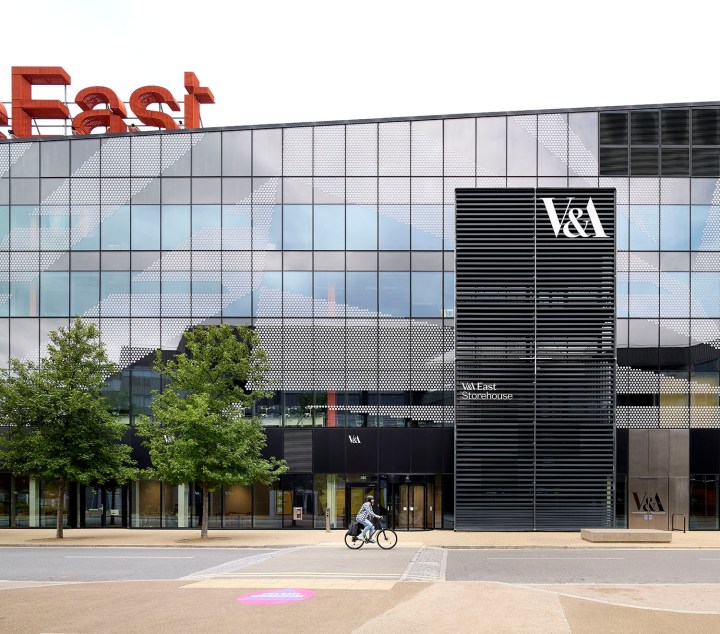 On Saturday, 31 May 2025, the V&A’s new working store and visitor attraction, V&A East Storehouse, opens its doors to the public for the first time following 10 years of planning and extensive audience consultation, with input from V&A East’s Youth Collective. Designed by world-renowned architects Diller, Scofidio + Renfro, it opens as part of East Bank, the new cultural quarter in the Queen Elizabeth Olympic Park supported by the Mayor of London.
A ground-breaking new museum experience spanning four levels, and at 16,000m2—bigger than 30+ basketball courts—V&A East Storehouse takes over a large section of the former London 2012 Olympics Media and Broadcast Centre (now Here East). It is a new purpose-built home for over 250,000 objects, 350,000 books, and 1,000 archives. A world-first in size, scale, and ambition, V&A East Storehouse immerses visitors in over half a million works spanning every creative discipline from fashion to theatre, streetwear to sculpture, design icons to pop pioneers. A busy and dynamic working museum store with an extensive self-guided experience, visitors can now get up-close to their national collections on a scale and in ways not possible before.
Tim Reeve, Deputy Director and COO, V&A, who developed the concept for V&A East Storehouse, said: “V&A East Storehouse is a completely new cultural experience and backstage pass to the V&A, transforming how people can access their national collections on a scale unimaginable until now. From conservation and how we care for our collections and cultural heritage around the world, to the artistry of our Museum Technicians and new research—there’s so much to discover. I hope our ground-breaking V&A East Storehouse opens to the public on Saturday 31 May visitors enjoy finding their creative inspiration and immersing themselves in the full theatre and wonder of the V&A as a dynamic working museum.”
Through the V&A’s radical new Order an Object service, anyone can now book to access any object at V&A East Storehouse, for free, seven-days-a-week. From mid-century furniture to ancient Egyptian shoes and Roman frescoes, an early 14th-century Simone Martini painting, Leigh Bowery costumes, Althea McNish fabrics, vintage band t-shirts and performance posters, and avant-garde fashion and couture from Balenciaga, Schiaparelli, Comme des Garcons, Issey Miyake and Vivienne Westwood, there’s something for everyone to explore. Since going live on 13 May, over 250 appointments have been booked to see over 1,000 objects from 14th-century and contemporary ceramics to a 17th-century carpet from Iran, 1930s wedding dresses and Julia Margaret Cameron photographs. So far, the most popular item ordered is a 1954 pink silk taffeta evening dress by Cristóbal Balenciaga.
Elizabeth Diller, Founding Partner, Diller Scofidio + Renfro, the firm that designed the architecture for V&A East Storehouse, said: “To celebrate the heterogeneity of the V&A’s collection of collections—spanning a broad variety of mediums, scales, and historical periods—visitors will experience a sense of being immersed in a vast cabinet of curiosities. The Collections Hall invites visitors to explore pre-curated works surrounding them, not according to conventional curatorial logics or standard storage taxonomies, but guided instead by their own curiosities. It has been a joy to work with the V&A’s curators and conservators in creating this new kind of institution: neither warehouse nor museum, but rather a hybrid shared by staff and the public with expanded opportunities for access and exchange.”
Museums Minister, Sir Chris Bryant said: “It’s great to see the V&A innovating in this way—V&A East Storehouse makes it possible for everyone to delve into a massive treasure trove of art, design and performance history in ways never seen before.”
 The Mayor of London, Sadiq Khan, said: “V&A East Storehouse is a brand-new, groundbreaking museum experience in East Bank, London’s new educational and cultural district, that will revolutionise access to the world’s leading collection of art, design and performance. I’m proud to be supporting this landmark project, which will allow Londoners and visitors to go behind the scenes for the first time ever and explore some incredible treasures, from Roman artefacts and modern-day music archives to the largest Picasso work in the world, all for free. It’s the next building to open at East Bank and marks a hugely significant moment in our work to create the most ambitious cultural development in decades, helping us to ensure London stays the creative capital of the world.”
From the moment they emerge into the central Weston Collections Hall, visitors will be captivated by stunning vistas across all levels, surrounded by a cross-section of the V&A’s collections. Spanning ancient Buddhist sculpture to PJ Harvey’s guitar, paintings by Angelica Kauffman’s circle, costumes worn by Vivien Leigh, works by Sir Frank Bowling and Hew Locke, items from the Glastonbury Music Festival, Suffragette scarves, vintage football shirts, Thomas Heatherwick’s model for the London 2012 Olympic Cauldron and road signs designed by Margaret Calvert, visitors can take their own path through over 100 mini curated displays hacked into the ends and sides of the storage racking.
Six large-scale objects anchor the space, on display for the first time in decades. Highlights include the 1930s Kaufmann Office, the only complete Frank Lloyd Wright interior outside of the US, an exquisite 15th-century carved and gilded wooden ceiling from the now lost Torrijos Palace in Spain, and a full-scale 20th-century Frankfurt Kitchen designed by Margarete Schütte-Lihotzky.
Also on show is a building section from Robin Hood Gardens, a former residential estate in east London, the 17th-century Agra Colonnade, an extraordinary example of Mughal architecture from the bathhouse at the fort of Agra, and the largest Picasso work in the world—a monumental Ballets Russes Le Train Bleu theatre stage cloth. At 10 metres high and 11 metres wide, the Picasso-signed stage cloth has been rarely seen since its debut in 1924. It is on display in the new David and Molly Lowell Borthwick Gallery of epic proportions, built to show the V&A’s striking collection of large-scale textiles and theatre stage cloths on rotation. These large objects are brought further to life with a series of co-production projects in collaboration with young east Londoners, communities, and creatives, highlighting multiple new voices and perspectives across the space, including oral histories, new films, publications, and artworks in response.
V&A East Storehouse is the first of V&A East’s two new cultural destinations to open in east London. The second, V&A East Museum, is scheduled to open in spring 2026 and celebrates making and creativity’s power to bring change. Created with young people and rooted in east London’s heritage, V&A East Museum spotlights the people, ideas, and creativity shaping global culture right now.
Call for Papers | Idioms of Rococo in Switzerland

Interior view, Reformierte Kirche Trogen, Hans Ulrich Grubenmann (architect), Andreas and Peter Anton Moosbrugger (stucco work), 1779–82.
(Photograph by Noelle Paulson)
◊ ◊ ◊ ◊ ◊
From the Call for Papers:
Idioms of Rococo in Switzerland
Session at the 6th Swiss Congress for Art History
Vereinigung der Kunsthistorikerinnen und Kunsthistoriker in der Schweiz (VKKS), Geneva, 7–9 September 2026
Session convened by Maarten Delbeke, Nikos Magouliotis, and Noelle Paulson
Proposals due by 12 September 2025
The 18th century transformed Switzerland: proto-industrialization brought new material wealth to rural homes, while mercantile elites built mansions to fit increasingly cosmopolitan tastes. Simultaneously, confessionalization continued to alter the religious and architectural landscape. Switzerland was a territory divided by language, class, and religion, yet visually unified through the broad adoption of Rococo ornament, from the facades of urban mansions to rural interiors, to decorations for Catholic and Protestant churches.
We argue that the rocaille’s ubiquity in Swiss art and architecture should not be seen as the homogenizing effect of a cultural hegemony. Rather, it may be understood as a process where different groups adapted it to their circumstances and generated distinct decorative idioms, which could serve antagonistic identities. There was not just one Swiss Rococo, but many.
The project Swiss Rococo Cultures examines this hypothesis by focusing on East Switzerland, but we are interested in mapping parallel cases throughout the country. We welcome papers that deal with any of the following questions:
• Which agents facilitated Rococo’s dissemination? How did the idiom transform through different artistic media and scales, from miniatures to buildings?
• How could Rococo and its iconographies adapt to different social spheres? How was this ornamental repertoire applied to Catholic and Protestant churches?
• How did the Rococo relate to the emerging spirit of Swiss patriotism and nationalism at the time of the Helvetic Society?
• When did the Rococo end? Can its continued use in folk art into the 19th century help us revise canonical chronologies? What do current practices of collection, display, and preservation tell us about Rococo’s long history?
• How does the specific case of the Rococo in Switzerland challenge notions of the idiom? How might we consider the Rococo to be a visual repertoire that crosses boundaries of geography, language, confession, and class?
We welcome contributions in German, English, French, and Italian, in the hope of assembling a multilingual session that reflects the topical and institutional diversity of the field and fosters young academics. All speakers will receive a contribution to their travel and accommodation costs and will be exempt from the congress registration fee.
Please send an abstract (1 page, maximum 3000 characters) and a short curriculum vitae with institutional affiliation and contact details to the session conveners (maarten.delbeke@gta.arch.ethz.ch; nikolaos.magouliotis@gta.arch.ethz.ch; and paulson@arch.ethz.ch) by 12 September 2025. Please also CC the Congress Bureau of the 6th Swiss Congress for Art History in Geneva at vkks2026@unige.ch. More information on the conference is available here.
Session Conveners
Prof. Dr. Maarten Delbeke, Dr. Nikos Magouliotis, and Dr. Noelle Paulson (SNSF Project: Swiss Rococo Cultures: Idioms of Ornament and the Architecture of East Switzerland).










 Enfilade
leave a comment