New Book | Canova: La Riconoscenza
From Hirmer, with distribution by The University of Chicago Press:
Fernando Mazzocca, Canova: La Riconoscenza (Munich: Hirmer Publishers, 2025), 200 pages, ISBN: 978-3777443034, $52.
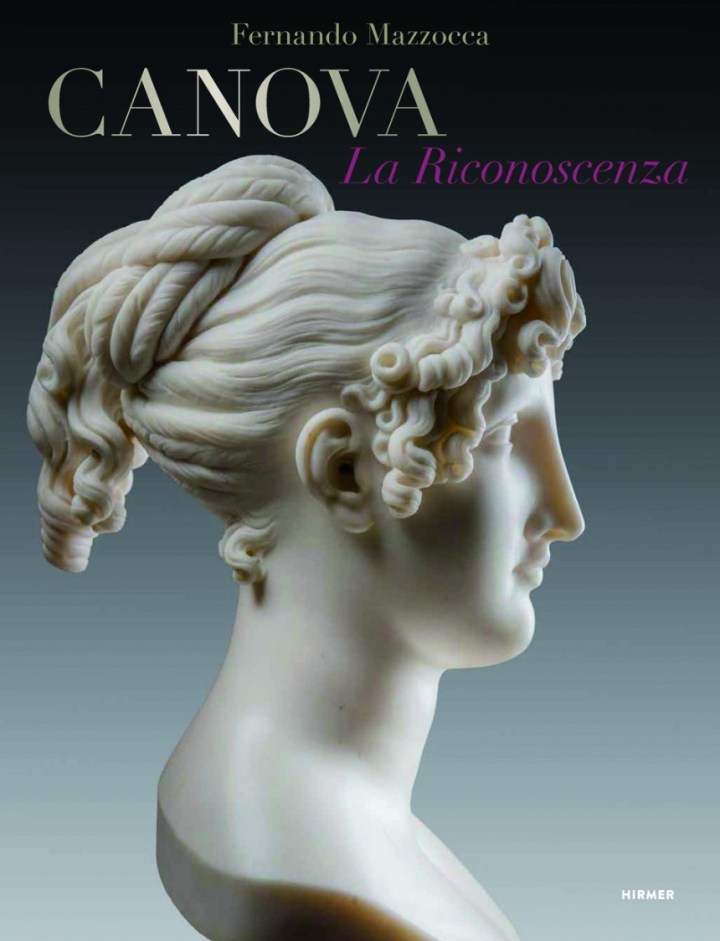 Antonio Canova (1757–1822) invented a new genre with his ‘ideal heads’. They were intended as gifts for close friends and persons he admired as an expression of his affection and gratitude. Starting with his famous bust, La Riconoscenza, this magnificent large-format volume offers an impressive survey of his unique expressions of friendship. La Riconoscenza, Canova’s masterpiece, was long thought to have been lost. Created as a tribute to his most important critic, the cultural theorist Quatremère de Quincy, the sculpture was commissioned by the artist Marquise de Grollier as a gift for their mutual friend. Together, these three distinguished individuals left their mark on the cultural life of their time. Here, Fernando Mazzocca traces the history of the genesis of La Riconocenza through the remarkable correspondence of Canova, de Grollier, and de Quincy.
Fernando Mazzocca is a leading Canova specialist and a former professor at the Università Ca’ Foscari in Venice and La Statale in Milan.
Workshop | Art and Conflict in Times of Climate Change
From the conference programme:
Art and Conflict in Times of Climate Change
Forum Transregionale Studien, Berlin, 17–18 July 2025
Organized by Emily McGiffin, Feng Schöneweiß, T Pritchard, and Antonio Montañes Jimenez
A British Academy SHAPE Research Project in collaboration with the 4A_Lab (KHI in cooperation with Stiftung Preußischer Kulturbesitz) and the Forum Transregionale Studien.
Climate change has happened more than once in the histories of planet Earth and those of human beings. Notably more recent, and historically documented, occurrences include the so-called Medieval Climate Anomaly (ca. 950–1250 CE), the Little Ice Age (ca. 1300–1850) and indeed the contemporary Anthropogenic climate crisis in times of the Anthropocene. From the Russian famine at the beginning of the 17th century following severe winters triggered by volcanic eruptions in Peru, to severe flooding in Kenya, Tanzania and Burundi displacing almost a million people, such climatic shifts have affected and are affecting enormous numbers of people around the planet.
Unsurprisingly, endemic to the periods of climate changes are conflicts. These conflicts drastically affect human lives, thus we find both conflicts and the climatic shifts that precipitated them reflected in and entangled with cultural productions. One example is the paintings created by Dutch masters of people ice-skating and revelling on frozen rivers and enjoying the curious prosperity brought by conflict with Spain. Another is from Song-dynasty China: Facing deforestation and military conflicts with northern Jurchen powers, metropolitan regions of the Song increasingly shifted from firewood to coal as energy source, which corelated with producing some of the finest porcelain glazes in Chinese history. These historical instances resonate strongly with the contemporary music of Syrian activists, who are grappling with the effects of drought and Civil war. In multifaceted ways, the making of arts, broadly defined as the cultural expression of human lived experience, has been entangled with both the violent forces of climatic change, conflicts, and crises.
To examine the complex connections and correlations between art and conflict in times of climate change, this workshop focuses on (1) how cultures have been shaped by the concurrent forces of war and changing environments, and (2) how these lived experiences are expressed through art and literature. Researchers will contribute works-in-progress across disciplinary boundaries, including anthropology, art and cultural history, environmental and digital humanities, postcolonial literature, besides film and media studies. Taking a necessarily planetary perspective, the workshop will interrogate and explore artistic creation and armed conflicts in historical and contemporary climate changes, and will explore pertinent and indeed timely topics across historical and geographical boundaries.
Core questions
• How was/is artistic creation, and cultural expression in general, conditioned and/or oriented by non-human beings and beyond-human factors, such as deforestation, ocean currents, monsoon, El Niño, orbital facing, and volcanic activities?
• How have these factors been represented, and what are the complexities of representing and recording such profound cultural memories?
• How were/are violence and environmental disruption intertwined within cultural memories, and constituted in material, oral, visual and textual cultures?
• What methodologies could contemporary researchers use and develop to address the aforementioned questions from interdisciplinary perspectives?
• How could formats of interdisciplinary collaboration, such as this workshop, enhance academic research on common questions, further knowledge transfer across sectors, and enable actions for positive changes?
Contacts
Feng Schöneweiß, 4A_Lab Postdoctoral Fellow, feng.schoeneweiss@khi.fi.it
Antje Paul, 4A_Lab Program Coordinator, antje.paul@khi.fi.it
t h u r s d a y , 1 7 j u l y
9.30 Welcome by Georges Khalil (Forum Transregionale Studien) and Hannah Baader (4A_Lab / Kunsthistorisches Institut in Florenz – Max-Planck-Institut)
9.50 Welcome by Feng Schöneweiß (4A_Lab)
10.00 Concept Note by T Pritchard (The University of Edinburgh)
10.20 Keynote
• Katrin Kleemann (German Maritime Museum – Leibniz Institute for Maritime History) — Climate History Perspectives: Echoes of Conflict and Culture
11.00 Coffee Break
11.30 Panel 1 | Extraction, Transition, and Repair
Chair: T Pritchard (The University of Edinburgh)
• Rebecca Macklin (University of Aberdeen) — Visualising Relations in the Tar Sands: Extraction, Aesthetics, and Repair
• Emily McGiffin (The University of Warwick) — ‘God has riches, I have cows’: Field Notes on Cultural Heritage in the Bauxite Zone
12.30 Lunch
13.30 Panel 2 | Anthropologies of Collaboration and Conflicts
Chair: Christopher Williams-Wynn (Freie Universität Berlin)
• Antonio Montañes Jimenez (University of Oxford) — Scarcity, Family Memories, and Conflict: Methodological Notes and Collaborative Insights
• Freya Hope (University of Oxford) — Anarchy, Art, and Alternative Worldmaking: New Travellers’ Historicity of Resistance
14.30 Coffee Break
15.00 Film Screening (work in progress) and Discussion (hybrid)
Film and presentation: Matthias De Groof, University of Antwerp / University of Amsterdam
Discussants: Antonio Montañes Jimenez, Rebecca Macklin, Emily McGiffin, and Feng Schöneweiß
16.30 Coffee Break
17.00 Lecture (online and in-person)
Chair: Hannah Baader (4A_Lab / KHI)
• Sugata Ray (UC Berkeley) — Das Paradies: The Anthropocene Extinction in the Early Modern World
f r i d a y , 1 8 j u l y
9.30 Panel 3 | Climate and the Arts of Change
Chair: Parul Singh (Kunsthistorisches Institut in Florenz – Max-Planck-Institut)
• Tenaya Jorgensen (Trinity College Dublin) — Climatic Stress and Political Fragmentation: Environmental ‘Pull Factors’ in Viking Raiding Strategies in Ninth-Century Francia
• Feng Schöneweiß (4A_Lab) — Celadon Aesthetics, Gunpowder, and Energy Transition in Song-dynasty China
• T Pritchard (The University of Edinburgh) — ‘As if the world should straight be turn’d to ashes’: Comprehending Climate Change and Conflict in the Early 17th Century
11.00 Coffee Break
11.30 Panel 4 | Resilience and Memories (hybrid)
Chair: Mahroo Moosavi (4A_Lab)
• Ammar Azzouz (University of Oxford) — A Revolution of Art
• Rebecca Hanna John (Zentralinstitut für Kunstgeschichte) — Preservation and Extinction: On the Entanglement of Ecological and Decolonial Perspectives in Jumana Manna’s Artistic Practice
12.30 Lunch
13.30 Roundtable Discussion
15.00 Concluding Remarks by Emily McGiffin and Feng Schöneweiß
Symposium | Culture and Heritage in Napoleonic Spain
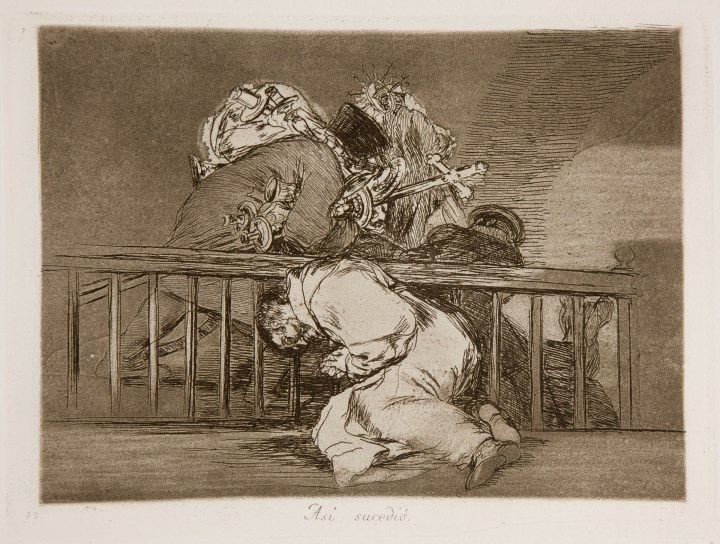
Francisco José de Goya y Lucientes, Así sucedió (This is How It Happened), from Los desastres de la guerra (The Disasters of War), 1810–14
(Madrid: Museo Nacional del Prado)
◊ ◊ ◊ ◊ ◊
From The Prado:
Cultura y Patrimonio en la España napoleónica:
Expolio, protección y transformación
In-person and online, Museo Nacional del Prado, Madrid, 22–23 September 2025
En los últimos años han sido numerosos los estudios que han valorado con mayor perspectiva el gobierno de José I (1808–1813) y la España napoleónica, entendiéndola como un periodo de plena correspondencia con la crisis general del entorno europeo. Se trataría no tanto de un periodo de ‘gobierno intruso’, sino del reflejo del orden napoleónico que trataba de imponerse en Europa y que suponía, también para nuestro país, una iniciativa reformadora que acababa definitivamente con el Antiguo Régimen, lo que motivó que contara con firmes defensores. Sus iniciativas culturales y artísticas tuvieron igualmente gran repercusión, por más que el desarrollo de la guerra dificultara su realización. La eliminación de las órdenes religiosas liberalizó un gran patrimonio artístico que, aunque se trató de vehicular en iniciativas tan novedosas como el llamado Museo Josefino, en ocasiones terminó siendo motivo de expolios y destrucciones. En este simposio se estudiarán estos fenómenos complejos y su repercusión, contemplándolos en relación al entorno europeo contemporáneo. El simposio se vincula temáticamente a la Cátedra del Prado 2024, que impartió la profesora Bénédicte Savoy, si bien atiende prioritariamente al específico caso de lo ocurrido en España con las políticas napoleónicas que afectaron al patrimonio cultural.
Es posible la asistencia presencial a las sesiones hasta completar el aforo, así como la asistencia en línea, mediante el enlace a la plataforma Zoom que se facilitará a los inscritos. Al realizar la inscripción es necesario escoger una modalidad de asistencia. Las ponencias se impartirán en la lengua en la que aparecen enunciados sus títulos. Habrá traducción simultánea. Contacto: centro.estudios@museodelprado.es.
Actividad realizada en colaboración con el proyecto de I D I Bellas artes, cultura e identidad nacional. La construcción del relato artístico entre la Ilustración y el Liberalismo. Textos e imágenes (PID20222-136475OB-I00), financiado por el Ministerio de Ciencia e Innovación y de la Fundación Séneca, proyecto 21936/PI/22, titulado Cultura y nación. Las bellas artes entre la Ilustración y el Liberalismo.
m o n d a y , 2 2 s e p t e m b e r
9.00 Acreditación de asistentes
9.30 Inauguración y Presentación
• Javier Arnaldo (Museo Nacional del Prado)
• David García López (Universidad de Murcia)
10.00 Sección 1 | Expoliaciones artísticas en la época napoleónica
Modera David García López
• Pillage et appropiations d’art à l’époque napoléonienne en Allemagne et en Autriche (Expolios y apropiaciones de arte durante la época napoleónica en Alemania y Austria) — Bénédicte Savoy (Technische Universität Berlin)
• La ocupación napoleónica y la usurpación de los bienes artísticos — Manuel Moreno Alonso (Universidad de Sevilla)
• El expolio artístico del Mariscal Soult en España y el saqueo sevillano — Ignacio Cano Rivero (Museo de Bellas Artes de Sevilla)
• Las colecciones reales durante el periodo napoleónico — Virginia Albarrán Martín (Patrimonio Nacional)
13.00 Debate
16.00 Sección 2 | Espacios para la protección de las artes
Modera: Joaquín Álvarez Barrientos
• El Museo Josefino: una institución cultural en su contexto nacional y europeo — Pierre Géal (Université Stendhal)
• El museo napoleónico en el Real Alcázar de Sevilla — Rocío Ferrín Paramio (Patrimonio Nacional, Reales Alcázares de Sevilla)
• La Academia de San Fernando como instrumento del poder napoleónico en las políticas culturales — Itziar Arana (Museo Nacional del Prado)
• El tráfico de pinturas en el Madrid josefino — David García López (Universidad de Murcia)
18.30 Debate y fin de la jornada
t u e s d a y , 2 3 s e p t e m b e r
10.00 Sección 3 | Transformaciones y nuevos horizontes de las políticas relativas a los bienes culturales
Modera: Javier Arnaldo
• Le Musée Napoléon, aux sources du mythe du musée universel (El Museo Napoleón, los orígenes del mito del museo universal) — Philippe Malgouyres (Musée du Louvre)
• Debates artísticos y sus consecuencias en la restauración de las obras requisadas durante las campañas napoleónicas — Ana González Mozo (Museo Nacional del Prado)
• La política cultural de José I, proyectos y consecuencias — Joaquín Álvarez Barrientos (CSIC)
• Le Gallerie private romane all’inizio dell’Ottocento: dispersioni, riorganizzazioni, riallestimenti (Las galerías privadas en Roma al inicio del siglo XIX: dispersiones, reorganizacines y reordenamientos) — Giovanna Capitelli (Università Roma Tre)
• La nascita delle Gallerie dell’Accademia di Venezia negli anni del Regno d’Italia, 1805–1814 (El nacimiento de la Galería de la Academia de Venecia durante los años del Reino de Italia, 1805–1814) — Giulio Manieri Elia (Gallerie dell’Accademia di Venezia)
13.30 Debate y conclusiones finales
Eight New Acquisitions at Mia
From the press release (26 June 2025) . . .
The Minneapolis Institute of Art (Mia) announces the acquisition of eight exceptional works spanning nearly eight centuries, from a rare 13th-century Limoges enameled gemellion to contemporary photography by Carrie Mae Weems. These diverse acquisitions significantly strengthen key areas of the museum’s collection while addressing important gaps in others. Highlights include: a pair of monumental pedestals by Giacomo Raffaelli featuring the largest micromosaic compositions the artist ever attempted; an early Sèvres porcelain vase in the legendary ‘bleu nouveau’ glaze; a winter landscape by Blanche Hoschedé-Monet marking a pivotal moment in the artist’s emergence from Claude Monet’s tutelage; and a technically masterful Oribe tea bowl from early 17th-century Japan. Also acquired is the museum’s first Latin American colonial religious painting—a Virgin of Guadalupe painting attributed to the circle of artist Manuel de Arellano—that continues building one of Mia’s newer collecting areas.
“These remarkable acquisitions demonstrate our ongoing commitment to building a truly global collection that honors artistic excellence across time periods and cultures,” said Katie Luber, Nivin and Duncan MacMillan Director and President of Mia. “These works will enhance our visitors’ understanding of the diverse artistic traditions that have shaped human expression, from 13th-century France to 17th-century Japan, to the United States in the 2020s. Whether we are filling crucial gaps in our holdings—like our first colonial Latin American religious painting—or strengthening existing collections, our goal remains the same: to present the most compelling and comprehensive story of art’s power to illuminate the human experience across centuries and continents.”
Carrie Mae Weems (American, born 1953), Painting the Town #4, 2021 (printed 2024).
This pigment print by Carrie Mae Weems exemplifies the artist’s masterful ability to transform documentary photography into profound social commentary and significantly strengthens Mia’s contemporary photography holdings. At first glance, Painting the Town #4 appears to be an abstract composition of vibrant painted rectangles, reminiscent of Mark Rothko or Robert Motherwell. Closer examination reveals it to be a boarded-up Portland storefront—complete with knotty plywood and covered graffiti—photographed in 2021, during the aftermath of the 2020 protests following George Floyd’s murder. Weems’ art historical references are deliberate. By evoking abstract expressionist aesthetics in this pandemic-era streetscape, she lures in viewers but then confronts them with the raw signifiers of contemporary social upheaval. Part of her acclaimed Painting the Town series, this work represents the rare pandemic project that transcends mere documentation. One of America’s most influential living artists, Weems’ four-decade career has consistently given voice to silenced stories while investigating the intersections of history, identity, and power.
Circle of Manuel de Arellano, Virgen de Guadalupe, 1700–50.
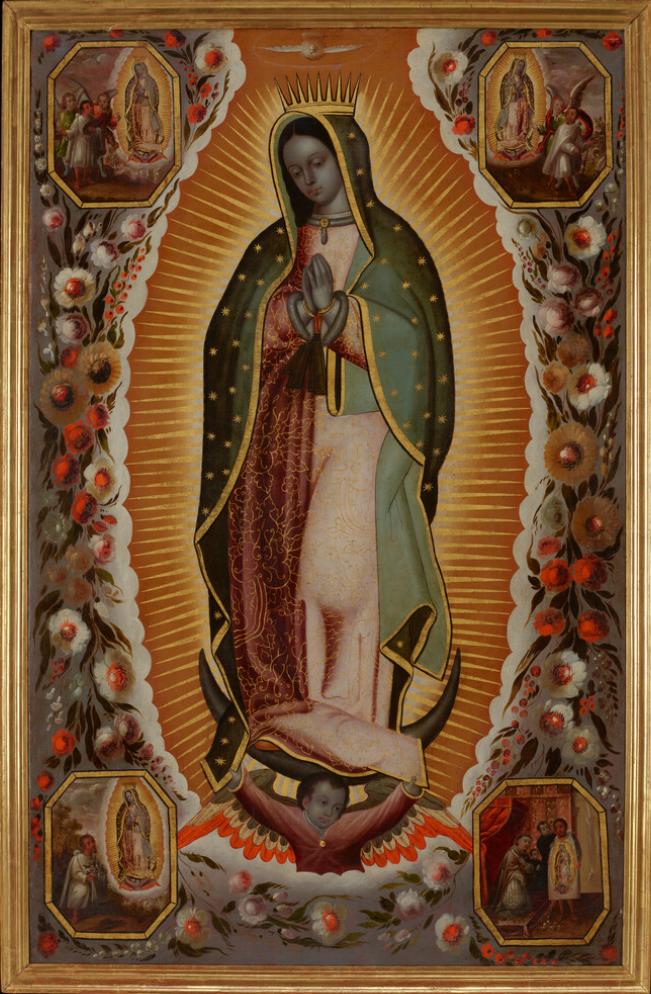
Circle of Manuel de Arellano, Virgen de Guadalupe (detail), 1700–50, oil on canvas (Minneapolis: Mia, The William Hood Dunwoody Fund, 2025.39).
This exceptional oil on canvas represents a pivotal addition to Mia’s collection as the first Latin American religious image from the colonial period, from which distinctive artistic traditions emerged with the Spanish imposition of Catholicism blending with Indigenous religions. Attributed to the circle of Manuel de Arellano, the renowned Mexican artist who, along with his father Antonio, operated a prominent studio in Mexico City during the late 17th and early 18th centuries, this work exemplifies the innovative approach the Arellanos brought to traditional Guadalupe iconography.
The Virgin of Guadalupe depicted here represents one of the most widely recognized and culturally significant religious images in the Americas—an enduring symbol, declared patroness of New Spain in 1746 and later empress of the Americas in 1933. The painting synthesizes diverse iconographic traditions: The dark-skinned Virgin wears a light-pink tunic with golden floral motifs and a star-covered blue mantle, standing on a crescent moon supported by an angel whose wings bear the colors of the Mexican flag. This blends the Virgin of the Apocalypse imagery from Revelation with Immaculate Conception iconography, while incorporating Indigenous elements that reflect the legend of the Virgin’s appearance to Juan Diego at Tepeyac Hill, a site sacred to the Aztec goddess Tonantzin.
Enameled gemellion with horse and rider, ca. 1250–75, Limoges, France.
This exceptional enameled gemellion represents a significant addition to the museum’s medieval collection and showcases the full splendor of Limoges champlevé enamel technique on gilded copper, demonstrating the workshop traditions that made this French city renowned throughout medieval Europe. Moreover, the rarity of this gemellion cannot be overstated—fewer than 110 examples of these Limousin hand-washing vessels are known to survive from the Middle Ages.
As a catch basin lacking the characteristic pouring spout, it represents half of what would have originally been a paired set, used for the ritualized washing of hands in both religious and secular contexts. The vessel’s secular iconography of horse and rider reflects the sophisticated courtly culture of the 13th century, when such imagery proliferated on luxury objects—many of which eventually found their way into ecclesiastical treasuries as pious donations. The object highlights the technical mastery of champlevé enameling, where colored glass is fused into carved copper channels and enhanced with precious gilding.
Giacomo Raffaelli (Italian, 1753–1836), Pair of marble, micromosaic, and gilt-bronze pedestals, 1790s.
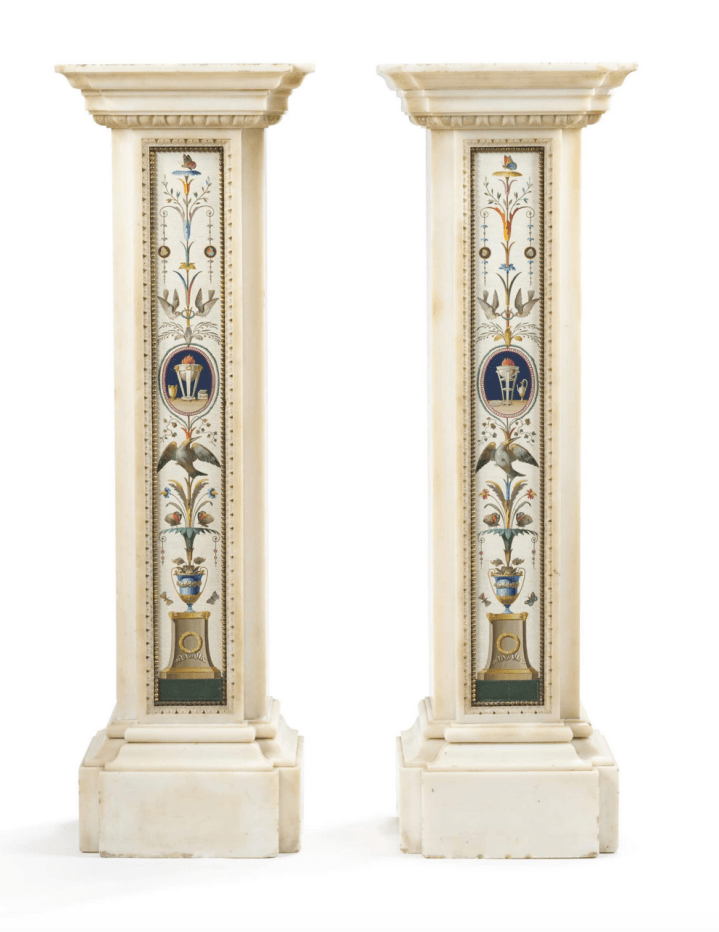
Giacomo Raffaelli, Pair of Italian marble, micromosaic, and gilt-bronze pedestals, 1790s, each 114 × 37 × 29 cm (Minneapolis: Mia, The Walter C. and Mary C. Briggs Trust Fund and gift of funds from John Lindahl, 2025.37.1.1, 2).
These pedestals by Giacomo Raffaelli represent the pinnacle of 18th-century Italian decorative arts by the undisputed master of micromosaic technique. The pedestals showcase his revolutionary approach to the ancient art of mosaic, employing tesserae so minutely crafted that hundreds—even thousands—fit within a single square inch, refining the art form to a new level that dates back to classical antiquity. Constructed from Carrara marble and enhanced with gilt bronze, these pedestals elevate the functional object of the pedestal to the realm of high art through their integration of precious materials and extraordinary craftsmanship. Moreover, the micromosaic panels on these pedestals are among the largest continuous compositions Raffaelli ever attempted, far exceeding the intimate scale of the snuffboxes and bonbonnières for which he is best known. The iconography—featuring birds, flowers, vases, and butterflies symbolizing Psyche and the soul—connects to the most prestigious commission of 18th-century Rome: Palazzo Braschi, the lavishly decorated residence of Pope Pius VI’s nephew. These objects reinforce Mia’s already strong collections of Italian 18th-century decorative arts—and will provide visitors with an unparalleled example of how Roman workshops operated during this golden age of decorative arts.
Sèvres Porcelain Factory (Paris, 1756–present), Greek vase with medallions, ca. 1765.
In the 1760s, the Manufacture Royale de Sèvres—the supreme expression of French state-sponsored artistry—moved away from Rococo frivolity toward the clarity of neoclassicism. This exceptional—and exceptionally rare—Greek vase exemplifies this dramatic shift, with its bold rectilinear Greek meander pattern encircling a form derived from a fluted column base. It also showcases the legendary ‘bleu nouveau’, the lapis lazuli imitation glaze that became an iconic color in French design. Only nine of these vases were ever produced. This pristine example strengthens Mia’s neoclassical collections, documenting a transformative period when European decorative arts shifted focus to the simplicity of classical antiquity. It is the earliest Sèvres porcelain in Mia’s collection and the museum’s first example of this celebrated 18th-century blue glaze technique.
Blanche Hoschedé-Monet (French, 1865–1947), Snowy Country Road, Le Val near Giverny, 1888.
This winter landscape by Blanche Hoschedé-Monet represents a pivotal moment in both the artist’s career and the broader story of Impressionism at Giverny. Painted in early 1888 when the artist was just 23, this oil on canvas captures the snowy country road leading to the family home she shared with her stepfather, Claude Monet. The work has been newly identified as her likely first submission to the Paris Salon, marking her emergence as an independent artist after five years of accompanying Monet on his daily painting excursions.
Hoschedé-Monet was Monet’s only true pupil and later became instrumental in completing his monumental Water Lilies cycles. Executed during Monet’s absence in Antibes, the painting embodies his hopes for her artistic development, as he wrote to her mother: “I hope that Blanche, left to her own devices, will make a serious effort.” The artist demonstrates remarkable technical sophistication in her handling of snow effects, balancing bold white impasto with subtle shadows of blue, gray, and green, while injecting warmth through delicate touches of pink and yellow. For Mia, this acquisition builds on the museum’s already strong collection of Giverny-related works, joining masterpieces by Claude Monet, Theodore Robinson, and Frederick Carl Frieseke.
Louis Welden Hawkins (French / born Germany, 1849–1910), Sa demeure, ca. 1899.
Louis Weldon Hawkins began his career as a naturalist painter before aligning himself with more radical symbolist circles in the 1890s. This enigmatic garden scene captures a moment of synthesis between these two styles: the composition is of a scene of nature, yet is filled with mysterious objects—a broom, bucket, rope, table, chairs, and blue cloth draped over a branch—that function as symbolic clues without revealing their meaning. The curving apple tree branch reflects the influence of Japanese prints on symbolist artists of the period, while two sensitively rendered chickadees perch as though engaged in secret conversation, adding to the work’s air of quiet mystery. Kept with its original frame, this mid-career work provides Mia’s visitors an exceptional opportunity to encounter the sophisticated visual poetry that defined symbolist painting at its height. Executed in an unusual, nearly square format that enhances its contemplative quality, Hawkins created a scene that is simultaneously specific and timeless. And the painting’s elusive title—Sa demeure (‘his home’, or ‘its home’)—further compounds its mysterious allegory.
Clog-shaped tea bowl with wisteria motif, early 17th century, Japan, Edo period (1603–1868).
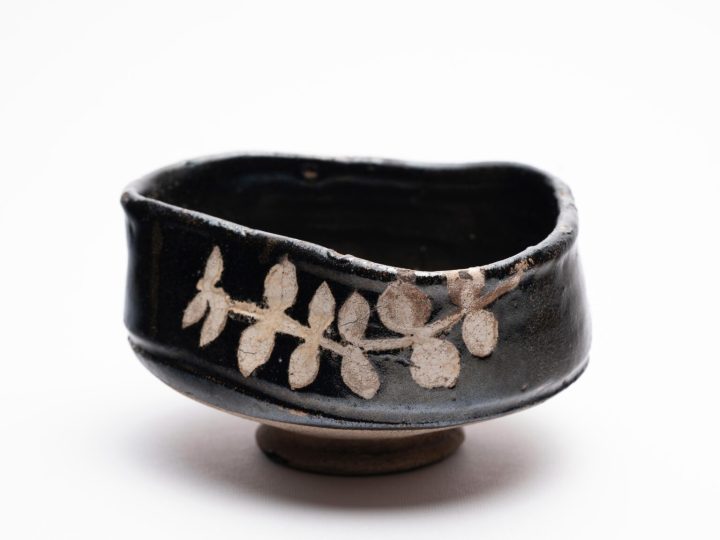
Clog-shaped tea bowl with wisteria motif, Japan, early 17th century. Mino ware, black Oribe type; glazed stoneware with glaze inlays (Minneapolis: Mia, The Mary Griggs Burke Endowment Fund established by the Mary Livingston Griggs and Mary Griggs Burke Foundation. 2025.45).
This clog-shaped tea bowl represents one of the most complex and labor-intensive examples of black Oribe ceramics, embodying the radical aesthetic experimentation that defined early 17th century Japanese tea culture. Named after the influential tea master and samurai Furuta Oribe, this style emerged from the Mino kilns of Gifu Prefecture during a brief but revolutionary period when tea practitioners pushed novelty to its limits, seeking what contemporaries described as the ‘warped’ (hizumitaru) aesthetic. The bowl’s sophisticated decoration—where black glaze was selectively scraped away and exposed areas were then filled with white clay slip, requiring each motif to be glazed separately rather than uniformly—demonstrates the extraordinary precision demanded by Oribe ware production. The horizontal spray of wisteria flowers, traditionally associated with early summer and typically depicted in vertical clusters, suggests this work may have been a special seasonal commission.
While Mia has an extensive Japanese ceramics collection, this work is a significant addition reflecting Japan’s enduring tea culture. The bowl’s deliberately triangular profile defies conventional ceramic forms. At the same time, its construction showcases exceptional technical mastery: after wheel-throwing and shaping, artisans omitted the traditional foot rim in favor of an intricately crafted, separately fabricated high-splayed foot with hollow interior, possibly influenced by imported glass or metalware bases. It captures a pivotal moment when Japanese tea masters embraced deliberate irregularity and bold innovation, forever changing the aesthetic landscape of ceremonial tea culture.
Call for Papers | Turner 250
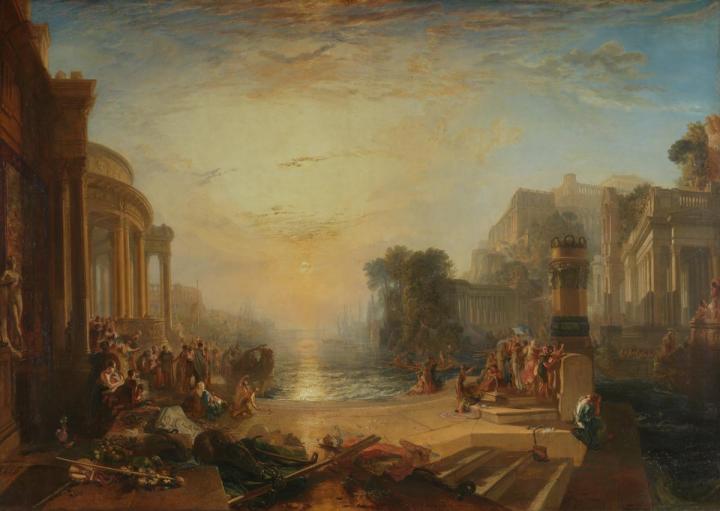
J.M.W. Turner, The Decline of the Carthaginian Empire, exhibited in 1817, oil on canvas, 170 × 239 cm
(London: Tate, Accepted by the nation as part of the Turner Bequest 1856, N00499)
◊ ◊ ◊ ◊ ◊
From the Call for Papers:
Turner 250
Tate Britain, London, 4–5 December 2025
Proposals due by 31 July 2025
2025 marks two hundred and fifty years since the birth of Romantic painter J.M.W. Turner (1775–1851). Conscious of the future, he took care to secure his legacy. But what is that legacy? Timed to coincide with the Turner and Constable exhibition at Tate Britain and to help bring celebrations of Turner’s 250th anniversary year to a close, this conference will take Turner’s art and life as a starting point for exploring what it means to research Turner and to curate his work today.
Thanks in part to the gift of the Turner Bequest, Turner is one of the most highly documented artists, and his life and work have inspired extensive scholarship, exhibitions, and creative responses across a range of art forms. We want to open up discussions about how we tell his story in 2025, how we display and respond to his work, and how singular works—such as The Slave Ship—or entire bodies of work have generated their own afterlives. What new contexts can we use to read and reinterpret his work? How much does our focus on Turner through a monographic lens help or hinder fresh perspectives? Where will studies of Turner take us next?
Reflecting Turner’s own approach to his art, the event will encourage dialogue between historical and contemporary perspectives, and across different disciplines, to consider Turner in his own time and the resonances and interpretations of his vision today. We welcome presentations in a variety of forms—such as illustrated talks or short videos. Each presentation should last around fifteen minutes, whether it is a spoken paper or another form of contribution.
We invite proposals on any topic, but are particularly interested in the following themes:
• Curating Turner now: What do audiences want? What do they already know about Turner? What impact does staging a Turner exhibition have on public engagement and attendance?
• Turner’s contemporaries: Who were his peers, and who has been overshadowed?
• Turner contemporary: Artists inspired by Turner or responding to his legacy in their own work.
• Researching Turner in an age of climate crisis / eco-critical turn.
• The artist’s bequest / the monograph: What opportunities and challenges come with an artist’s bequest or a concentrated focus on a single figure?
Please submit the following by 12 midnight (BST) on 31 July, with ‘Turner 250’ as the subject line, to pmc.events@paul-mellon-centre.ac.uk
• A 250-word abstract describing your proposed contribution
• A 250-word biography
Please combine your abstract and biography into a single Word document and send it as an email attachment. Incomplete or late submissions will not be considered. We will provide a speaker’s fee of £150 and cover reasonable travel and accommodation costs. If you have any access requirements or need adjustments, please let us know and we will do our best to accommodate them.
Organised by Tate Britain in collaboration with the Paul Mellon Centre for Studies in British Art and supported by The Manton Foundation Fund for Historic British Art.
Alixe Bovey Appointed Editor-in-Chief at British Art Studies
From the Paul Mellon Centre announcement (16 June 2025) . . .
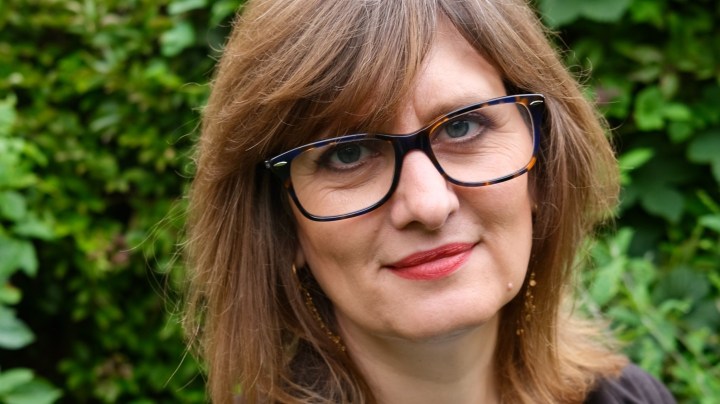 Alixe Bovey has been appointed to the position of British Art Studies (BAS) Editor-in-Chief. In this role she will lead on the development of material for publication in the journal, commission new articles and projects, and work collaboratively with authors. BAS is an innovative space for new peer-reviewed scholarship on all aspects of British art, co-published by Paul Mellon Centre for Studies in British Art and the Yale Center for British Art.
Alixe is Professor of Medieval Art History at The Courtauld, where she specialises in the art and culture of the Middle Ages. Her particular interests include illuminated manuscripts, visual storytelling and the relationship between myth and material culture across historical periods and geographical boundaries. Her publications explore a variety of medieval and early Renaissance topics, including Gothic art and immateriality (2015), monsters (2002, 2013), English genealogical rolls (2005, 2021), and monographic studies including Jean de Carpentin’s Book of Hours (Paul Holberton Press, 2011). Following a ten-year stint as Head of Research then Executive Dean and Deputy Director of The Courtauld, she is currently at work on a new book exploring the vibrant culture of storytelling in word and image in fourteenth-century London. Alongside her historical research, she is keenly interested in the creative relationship between practice and art history, and has organised a variety of programmes that bring works of art, artists and art historians together.
Sarah Victoria Turner, Director of PMC, comments: “We are so excited to have Alixe leading British Art Studies and I know she will do this with huge curiosity and commitment to publishing original research on British art. She has been an advocate for the journal and our approach to digital publishing.”
Alixe took up the role in June 2025 with a tenure of two years. Researchers interested in publishing with BAS are warmly encouraged to contact Alixe with questions, ideas or manuscripts for submission at baseditor@paul-mellon-centre.ac.uk.
Renovations at The Huntington Library Scheduled to Begin in 2026
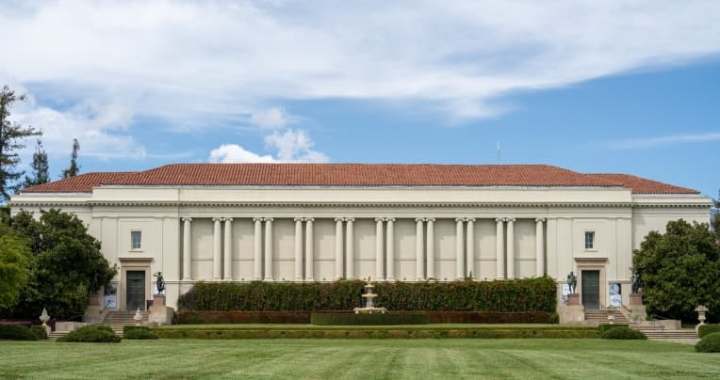
Library Exhibition Hall and West Hall, The Huntington, San Marino, California
(Photo by David Esquivel)
◊ ◊ ◊ ◊ ◊
From the press release (24 June 2025) . . .
Modernization of The Huntington’s Library building aims to connect collections, expand conservation capacity, enhance research access, and deepen public engagement.
Key Takeaways
• A multiyear renovation will strengthen how the Library and Art Museum’s collections support research, conservation, and public engagement.
• Plans include an 8,000-square-foot expansion of conservation studio capacity, redesigned exhibition spaces, and a new gallery focused on the history of science.
• The groundbreaking is planned for spring 2026.
• During construction, the Library will remain open to researchers, while a new exhibition series in the Art Museum showcases the Library’s book and manuscript collections.
In spring 2026, The Huntington will begin an extensive renovation of its Library building, designed in 1919 by architect Myron Hunt, a leading figure of early 20th-century Southern California architecture. The project will revitalize the Library’s landmark exhibition halls and replace outdated back-of-house space with modern facilities that serve both the Library and Art Museum. The unified Library/Art Building (LAB) will be a transformative 83,000-square-foot modernization that honors the building’s historic character while reimagining its spaces for interdivisional collaboration. The design is being led by RAMSA (Robert A.M. Stern Architects). Samuel Anderson Architects is providing expertise on collections storage and conservation studio design.
The idea took shape when President Karen R. Lawrence sought a single solution to meet needs that emerged in both the Library and Art Museum. Her proposal reflected the institution’s strategic plan, which calls for integrated, cross-divisional approaches under the guiding principle of “One Huntington.” With support from senior colleagues and the Board of Trustees, the concept advanced as a unified investment in conservation infrastructure, collections care, and the visitor and researcher experience.
The LAB will replace legacy book stacks with state-of-the-art storage for more than eight linear miles of the Library’s book and manuscript collections, along with the Art Museum’s 38,000 works on paper. Light-filled, modernized spaces for consultation, collaboration, and meetings will support cross-disciplinary exchange among staff, fellows, and general readers. The building will also include a dedicated conservation studio for treating paintings and objects.
“This is the most ambitious building project in The Huntington’s history,” President Lawrence said. “It reflects our commitment to stewardship, scholarship, and public engagement, and to creating spaces that will serve our collections and our communities for the next century.”
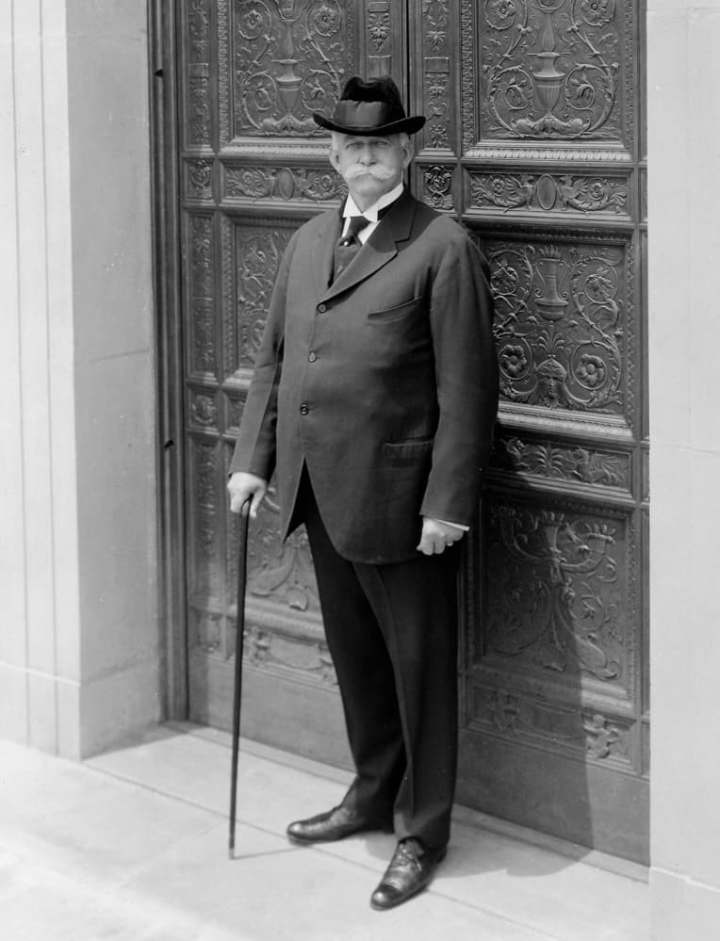
Photograph of Henry E. Huntington in front of the Library’s bronze doors, ca. 1920 (The Huntington Library, Art Museum, and Botanical Gardens).
Henry E. Huntington was once asked whether he planned to write an autobiography describing his career. He demurred and said in response, “This Library will tell the story; it represents the reward of all the work that I have ever done and the realization of much happiness.”
A century later, The Huntington ranks among the world’s great independent research libraries, holding a growing collection of some 12 million rare books, manuscripts, photographs, prints, drawings, and ephemera. Each year, the Library welcomes thousands of researchers, including more than 175 fellows in the nation’s largest humanities research program. To further support these visiting fellows, The Huntington is also developing Scholars Grove—a 33-unit residential complex that will provide convenient, reasonably priced housing and community space on campus.
“The Library has always anchored The Huntington’s commitment to knowledge and public access,” said Sandra Brooke Gordon, Avery Director of the Library. “Now, we’re evolving that legacy with revitalized spaces designed to support collaboration and a broader community of researchers. The LAB will also enhance the experience of the hundreds of thousands of visitors who each year discover the Library’s collections in our exhibition halls.”
While the Library’s exhibition halls are closed for renovation, visitors can experience some of its most iconic and unexpected works in the exhibition series Stories from the Library, located in the Huntington Art Museum.
Stories from the Library debuted 21 June 2025, with two exhibitions: one centered on Geoffrey Chaucer’s Canterbury Tales, the other on visionary figures who have shaped Los Angeles. The series will continue through 2028. The research library will remain open throughout construction of the LAB. All of the Library’s collections will be on site and available to researchers.
The LAB will also become the new home for the Art Museum’s extensive collection of works on paper—over 38,000 drawings, watercolors, and prints, representing upwards of 80% of its holdings. Because these works are light sensitive, this major part of the art collection is rarely accessible to the public in gallery displays. A new Works on Paper Study Center will provide space for consultation, research, and display, expanding access for scholars, students, and early-career professionals.
“Housing the museum’s works on paper and library collections under one roof will deepen scholarship and spark new forms of inquiry,” said Christina Nielsen, Hannah and Russel Kully Director of the Art Museum. “This kind of proximity will foster not only interdisciplinary research but richer, more nuanced exhibitions.”
The Art Museum’s collection features over 45,000 artworks from Europe, America, and East Asia that span more than 2,000 years. Conserving paintings and objects across the Art Museum and Library’s collections helps preserve fragile materials for future generations and yields new information about how they were made and used.
The LAB will not only integrate staff but also significantly enhance experiences for general visitors to The Huntington. A new gallery dedicated to the history of science will replace the former “Beautiful Science” exhibition with “Worlds Unfolding: Science on the Page.” The new installation will showcase the Library’s extensive holdings in science, technology, and medicine. It will feature a diverse selection of medieval through modern works on topics ranging from astronomy, anatomy, and geology to electricity, the aerospace industry, and futuristic dream worlds of science fiction.
Expanding public access to its collections has long been central to The Huntington’s mission, and today, a wide range of readers makes use of its research resources. Any adult working on a research project that is well served by the collections is welcome to apply for a reader’s card. Fifteen percent of recent consultations have come from beyond the traditional ranks of advanced researchers, reflecting the Library’s broadened access for artists, writers, and community researchers. The LAB will support this wider audience with accessible study areas, clearer navigation, and more streamlined access to research materials—ensuring that rare items are both useable and protected.
As groundbreaking approaches in spring 2026, The Huntington nears completion of its $126.6 million fundraising campaign. More than $100 million has already been committed by foundations and donors who recognize the project’s long-term impact.
Generous support for the Stories from the Library exhibition series is provided by the Robert F. Erburu Exhibition Endowment. Additional support is provided by The Neilan Foundation, the Steinmetz Foundation, and Laura and Carlton Seaver.
The Decorative Arts Trust Announces 2025 Publishing Grants
From the press release:
The Decorative Arts Trust is thrilled to announce the five recipients of our 2025 Publishing Grants. The Birmingham Museum of Art in Birmingham, Alabama; the Florence Griswold Museum in Old Lyme, Connecticut; The Preservation Society of Newport County in Newport, Rhode Island; and Victoria Mansion in Portland, Maine, received Publishing Grants under the ‘Collections and Exhibitions’ category. Dr. Mariah Kupfner received a Publishing Grant for ‘First-Time Authors’.
In August 2026, the publication of Roll Call: 200 Years of Black American Art will be an integral part of the 75th anniversary celebration of the Birmingham Museum of Art. Planned alongside a companion exhibition, the publication will also serve as a comprehensive survey of the Museum’s collection of works by African American and Black American artists who live(d) and work(ed) in America, including its superb holdings of Southern quilts and ceramics.
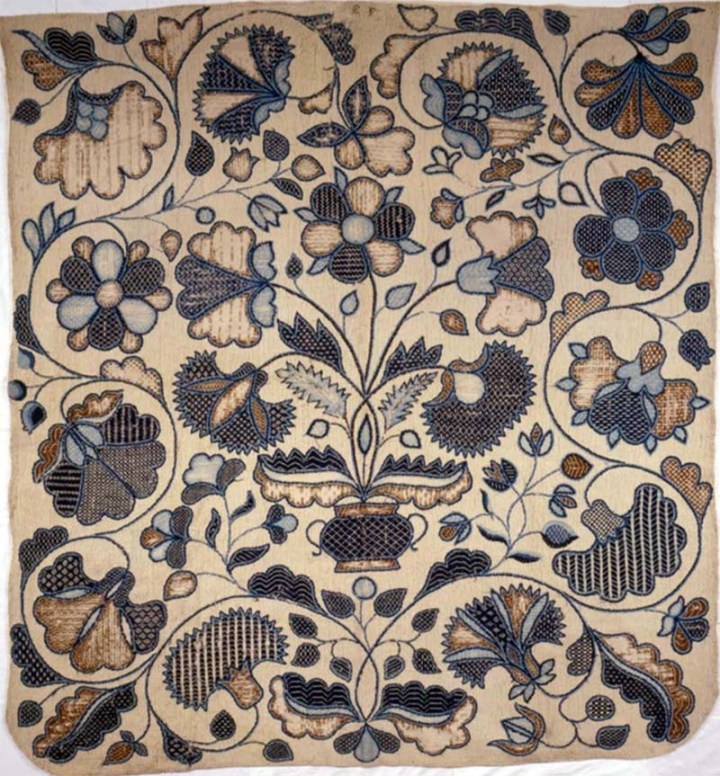
Elizabeth Foote, Bed rug, ca. 1778, Colchester, CT, hand-embroidered wool on plain woven wool ground (Courtesy of the Connecticut Historical Society, Gift of Mrs. J.H.K. Davis).
In 2022, the Florence Griswold Museum presented the exhibition New London County Quilts & Bed Covers, 1750–1825, which showcased exquisite, rarely-seen quilted petticoats, appliqued bed covers, bed rugs, and stuffed whitework quilts hand-crafted by women and girls of this region of Connecticut. The accompanying publication, set to be completed by April 2027, shares the scholarship generated for the exhibition, addressing an understudied and continuously evolving area of material culture that will open emerging areas of study for rising scholars.
Treasures of the Newport Mansions, the first ever collections catalogue for The Preservation Society of Newport County (PSNC), will span centuries and highlight the organization’s distinctive material content. Among the most significant in the United States, PSNC’s holdings uniquely encompass extraordinary objects within their original historical contexts. Presenting approximately 100 objects, the catalogue, which will be published by February 2027, will highlight advanced research made by experts and early-career scholars across multiple disciplines.
Victoria Mansion’s ‘Bold, Designing Fellows’: Italian Decorative Painters and Scenic Artists in the United States, 1820–1880 is inspired by many years of research on the Bolognese artist Giuseppe Guidicini. Previously unknown, Guidicini was responsible for the 1860 design and decoration of the wall and ceiling paintings that fill Victoria Mansion. The publication is set to be completed by May 2026 and will chronicle Guidicini’s history from his training in Bologna to his accomplishments in New York, Cincinnati, and Richmond.
Publishing Grant recipient Dr. Mariah Kupfner is an Assistant Professor of American Studies and Public Heritage at Penn State Harrisburg and earned her PhD from Boston University. She will publish Crafting Womanhood: Needlework, Gender, and Politics in the United States, 1810–1920 with the University of Delaware Press in August 2026. This publication looks closely at gendered textiles, reading them as essential sources of historical meaning and self-making.
Visit the Decorative Arts Trust’s website to learn more about the Publishing Grants program. Applications for the next round of grants are due by 31 March 2026.
New Book | America, América
As someone long unsettled by the ambiguity around the word ‘American’ (I recall being confused by it as a kid), I found Greg Grandin’s July 4 opinion piece for The New York Times immensely satisfying. His latest book appeared in April from Penguin. –CH
Greg Grandin, America, América: A New History of the New World (Penguin Press, 2025), 768 pages, ISBN: 978-0593831250, $35.
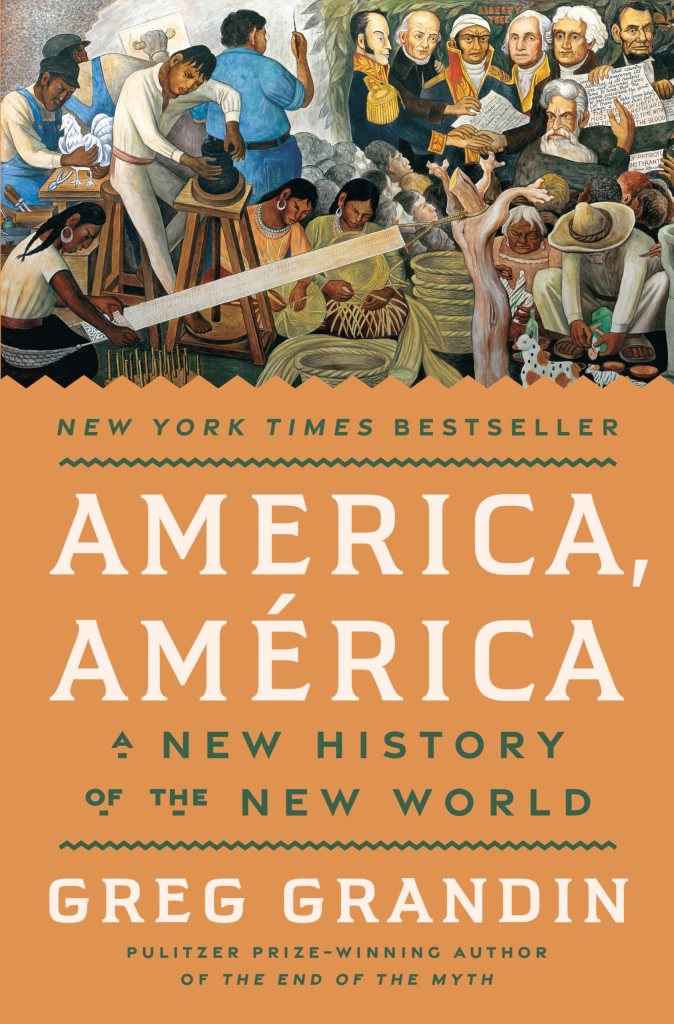 From the Pulitzer Prize–winning historian, the first comprehensive history of the Western Hemisphere, a sweeping five-century narrative of North and South America that redefines our understanding of both.
The story of how the United States’ identity was formed is almost invariably told by looking east to Europe. But as Greg Grandin vividly demonstrates, the nation’s unique sense of itself was in fact forged facing south toward Latin America. In turn, Latin America developed its own identity in struggle with the looming colossus to the north. In this stunningly original reinterpretation of the New World, Grandin reveals how North and South emerged from a constant, turbulent engagement with each other.
America, América traverses half a millennium, from the Spanish Conquest—the greatest mortality event in human history—through the eighteenth-century wars for independence, the Monroe Doctrine, the coups and revolutions of the twentieth century, and beyond. Grandin shows, among other things, how in response to U.S. interventions, Latin Americans remade the rules, leading directly to the founding of the United Nations; and how the Good Neighbor Policy allowed FDR to assume the moral authority to lead the fight against world fascism.
Grandin’s book sheds new light on well-known historical figures like Bartolomé de las Casas, Simón Bolívar, and Woodrow Wilson, as well as lesser-known actors such as the Venezuelan Francisco de Miranda, who almost lost his head in the French Revolution and conspired with Alexander Hamilton to free America from Spain; the Colombian Jorge Gaitán, whose unsolved murder inaugurated the rise of Cold War political terror, death squads, and disappearances; and the radical journalist Ernest Gruening, who, in championing non-interventionism in Latin America, helped broker the most spectacularly successful policy reversal in United States history. This is a monumental work of scholarship that will fundamentally change the way we think of Spanish and English colonialism, slavery and racism, and the rise of universal humanism. At once comprehensive and accessible, America, América shows that centuries of bloodshed and diplomacy not only helped shape the political identities of the United States and Latin America but also the laws, institutions, and ideals that govern the modern world. In so doing, Grandin argues that Latin America’s deeply held culture of social democracy can be an effective counterweight to today’s spreading rightwing authoritarianism.
A culmination of a decades-long engagement with hemispheric history, drawing on a vast array of sources, and told with authority and flair, this is a genuinely new history of the New World.
Greg Grandin is the author of The End of the Myth, which won the Pulitzer Prize; The Empire of Necessity, which won both the Bancroft and Beveridge prizes in American history; Fordlandia, which was a finalist for the Pulitzer Prize, the National Book Award, and the National Book Critics Circle Award; and a number of other widely acclaimed books. He is the Peter V. and C. Vann Woodward Professor of History at Yale University.
Exhibition | Philadelphia, The Revolutionary City
From the APS:
Philadelphia, The Revolutionary City
American Philosophical Society Museum, Philadelphia, 11 April — 28 December 2025
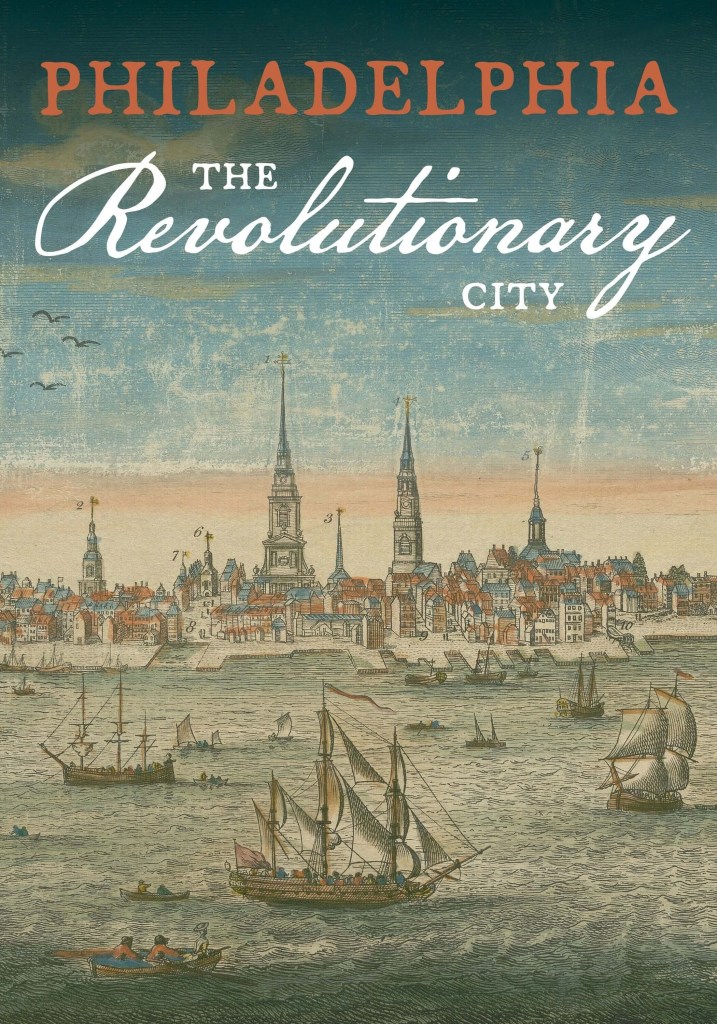 Philadelphia, The Revolutionary City illuminates the lived experiences of Philadelphians leading up to, during, and after the fight for independence. It showcases historic documents and material culture, ranging from diaries and newspapers to political cartoons and household objects. Beginning with the Stamp Act in 1765, the exhibition traces key events through the late 1780s and the impacts they had on communities living within and around the city. The exhibition features a range of voices and stories, offering windows into this turbulent period of change and presenting Revolution-era Philadelphia as a vibrant and growing city.
This exhibition is inspired by the innovative digital archive The Revolutionary City: A Portal to the Nation’s Founding, recently launched by the American Philosophical Society, the Historical Society of Pennsylvania, and the Library Company of Philadelphia, in partnership with the Kislak Center for Special Collections, Rare Books and Manuscripts and the Museum of the American Revolution. Philadelphia, The Revolutionary City brings together rare manuscript material and objects from the APS’s Library and Museum holdings, and the collections of these partners, as well as loans from regional institutions, and nearby historic houses and museums.
The related publication is distributed by the University of Pennsylvania Press:
Philadelphia, the Revolutionary City (Philadelphia: The American Philosophical Society Press, 2025), 110 pages, ISBN: 978-1606181225, $30. With contributions by Patrick Spero, Michelle Craig McDonald, John Van Horne, David R. Brigham, Caroline O’Connell, and Bayard Miller.
The book includes a fully-illustrated object checklist with information for each item as well as a curatorial statement about the project’s development. Additionally, it features three essays, one from each of the directors of the special collection libraries, focusing on key objects within each collection, plus an essay on the origins of the digital project and its ongoing work. Each essay offers a unique perspective on Philadelphia’s revolutionary history and a range of stories that can be found in these archives and on the digital portal.










 Enfilade
leave a comment