Exhibition | Flora Yukhnovich’s Four Seasons
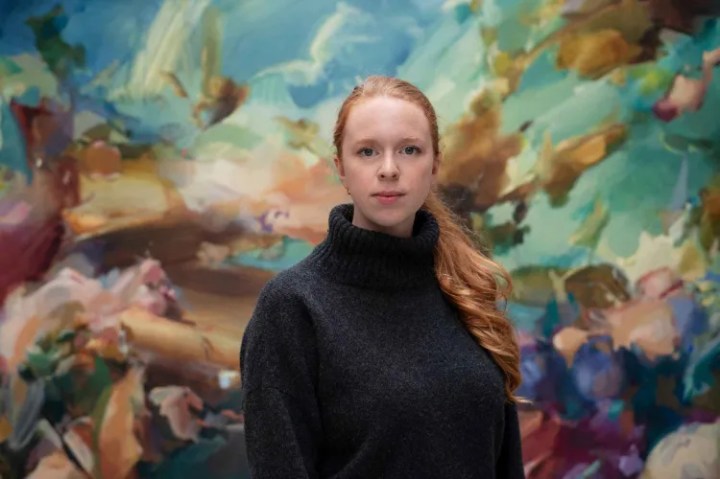
Flora Yukhnovich in Her London Studio, 2024
(Photo by Kasia Bobula © Flora Yukhnovich)
◊ ◊ ◊ ◊ ◊
Opening this week at The Frick; see the preview by Ted Loos for The New York Times (28 August 2025) . . .
Flora Yukhnovich’s Four Seasons
The Frick Collection, New York, 3 September 2025 — 9 March 2026
Taking inspiration from the French Rococo, Italian Baroque, and Abstract Expressionist movements, Flora Yukhnovich (b. England, 1990) creates works that are at once modern and timeless by translating historic compositions into contemporary abstractions. Using the Frick’s Four Seasons by François Boucher as a point of departure, Yukhnovich’s site-specific mural will cover the walls of the museum’s Cabinet. This project is accompanied by the publication of a new volume in the Frick’s acclaimed Diptych series, which highlights a single masterpiece from the permanent collection by pairing complementary essays by a curator and a contemporary artist, musician, or other cultural luminary. This volume will feature a text by Yukhnovich and an essay by Xavier F. Salomon, the Frick’s Deputy Director and Peter Jay Sharp Chief Curator, on the significance of Boucher’s beloved series.
Flora Yukhnovich’s Four Seasons is made possible by Hauser & Wirth and Victoria Miro.
Xavier Salomon and Flora Yukhnovich, Boucher’s Four Seasons (London: D. Giles, 2026), 80 pages, ISBN: 978-1913875732, $30.
New Book | The Frick Collection: The Historic Interiors
From Rizzoli:
Xavier Salomon, with photographs by Miguel Flores-Vianna, The Frick Collection: The Historic Interiors (Rizzoli Electa, 2025), 240 pages, ISBN: 978-0847874361, $65.
 After a multiyear renovation, The Frick Collection returns to its lauded Gilded Age mansion on New York’s Fifth Avenue. Spectacular photography by Miguel Flores-Vianna and insightful text by Xavier F. Salomon, the museum’s chief curator, unite to celebrate one of the preeminent fine and decorative art collections in the world.
Richly illustrated with newly commissioned photography, this publication chronicles the history of the iconic 1914 residence of industrialist Henry Clay Frick, while offering a room-by-room tour that showcases each space’s evolution from a private residence to part of The Frick Collection. The personal and cultural significance of the mansion’s interiors is explored, from the stately drawing rooms and intimate boudoirs to the galleries that house masterpieces by Bellini, Fragonard, Goya, Ingres, Manet, Rembrandt, Titian, and Vermeer.
The mansion at One East Seventieth Street stands as a testament to Frick’s refined taste, immense wealth, and unparalleled art collection. The reader will experience a captivating exploration of the mansion’s creation, from Frick’s initial vision of a “comfortable, well-arranged house, simple, in good taste, and not ostentatious” to the multifaceted collaboration between the strong-willed patron and his team of architects, interior decorators (including Sir Charles Carrick Allom and Elsie de Wolfe), and art dealers. This book is a reintroduction to the marvels of the Frick’s collections and an introduction to the gloriously revived interiors of an internationally lauded jewel of a museum.
Xavier F. Salomon is Deputy Director and Peter Jay Sharp Chief Curator at The Frick Collection. Miguel Flores-Vianna is a London-based writer, editor, and photographer, whose images appear regularly in Architectural Digest and Cabana magazine.
Journal of the History of Collections, July 2025
The long eighteenth century in the latest issue:
Journal of the History of Collections 37.2 (July 2025)
a r t i c l e s
• Christian Huemer and Tom Stammers, “Perspectives on the Study of the Art Market,” pp. 215–20.
As interest in art-market studies continues to grow, the editorial team of the Journal of the History of Collections decided to interview Christian Huemer, director of the Belvedere Research Center in Vienna, and editor of the Brill series Studies in the History of Collecting & Art Markets; and Tom Stammers, who is leading the new MA in Art and Business at the Courtauld Institute of Art in London, to find out more about the subject and how it does and does not overlap with the study of collecting.
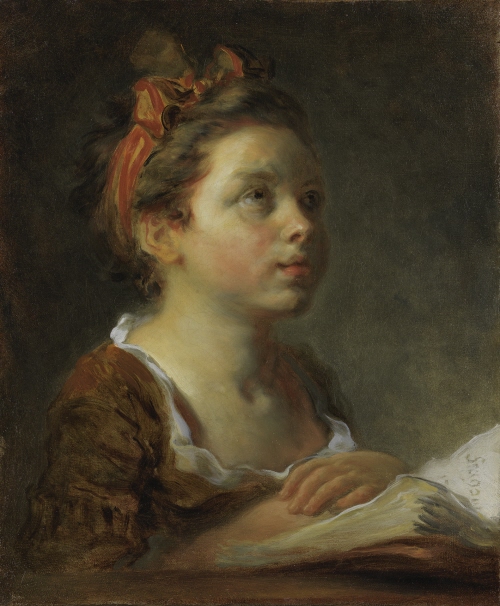
Jean-Honoré Fragonard, Girl Reading a Book, ca. 1770s, oil on canvas (London: The Wallace Collection).
• Yuriko Jackall, “French Art / English Taste: Richard Wallace’s Fragonards,” pp. 269–82.
Although an active collector of a broad range of objects, Sir Richard Wallace is more commonly known for his taste in nineteenth-century pictures, arms and armour, Renaissance maiolica and Kunstkammer objects than for his interest in eighteenth-century French painting. Nonetheless, he did add two significant works by Jean-Honoré Fragonard, Girl Reading a Book and A Boy as Pierrot, to the large and distinguished collection of rococo art that he had inherited from his supposed father, the 4th Marquess of Hertford. This paper focuses on these two acquisitions, and suggests that their purchase represents a calculated move by Wallace to enhance the existing holdings of his collection. By adding these two paintings, he sought not only to augment the art-historical value of the collection that it was now his responsibility to shepherd, but also to improve its appeal within the context of late nineteenth-century British taste.
• Ollie Croker, “The Architect as Agent: Charles Heathcote Tatham at Woburn Abbey and Castle Howard,” pp. 359–72.
The acquisition of Classical antiquities by the British nobility in the late eighteenth and early nineteenth centuries occurred within a complex social network. While the activities of prominent figures within this network have been well documented, those of lesser-known agents remain overlooked. This discussion focuses on Charles Heathcote Tatham (1772–1842), an architect involved in acquiring vases and sculptures for display at Woburn Abbey and Castle Howard. Acquisitions for both houses coincide with Tatham’s work designing galleries for these two estates. This suggests a means of collecting that has been less often studied: an architect is commissioned to acquire objects specifically for the interior decoration of his own architectural creations. Tatham’s dual role as architect and agent raises questions about the nature of these acquisitions, and the cultural associations his clients aimed to establish.
r e v i e w s
 • Wu Yunong, Review of Becky MacGuire, Four Centuries of Blue and White: The Frelinghuysen Collection of Chinese and Japanese Export Porcelain (Ad Ilissvm, 2023), pp. 391–92.
• Adriana Turpin, Review of Ulrike Müller, Private Collectors in Brussels, Antwerp, and Ghent, ca.1780–1914: Between Public Relevance and Personal Pleasure (Brepols, 2024), pp. 392–94.
• Marjorie Schwarzer, Review of Jonathan Conlin, The Met: A History of a Museum and its People (Columbia University Press, 2024), pp. 394–96.
• Jonathan Conlin, Review of Erica Ciallela and Philip Palmer, eds., Belle da Costa Greene: A Librarian’s Legacy (DelMonico Books, 2024) and Vanessa Sigalas and Jennifer Tonkovich, eds., Morgan―The Collector: Essays in Honor of Linda Roth’s 40th Anniversary at the Wadsworth Atheneum Museum of Art (Arnoldsche Verlagsanstalt, 2023), pp. 396–97.
Call for Articles | Sequitur (Fall 2025): Currents
◊ ◊ ◊ ◊ ◊
From the Call for Papers:
Sequitur, Fall 2025 | Currents
Submissions due by 26 September 2025
The editors of SEQUITUR, the graduate student journal published by the Department of History of Art & Architecture at Boston University, invite current and recent MA, MFA, and PhD students to submit content on the theme of “Currents” for our Fall 2025 issue.
This issue invites submissions that consider how artistic activity and material culture make visible, help detect, and even resist the invisible forces at work in our world. When used in the scientific fields of meteorology or hydrology, currents describe the perpetual motion of air and water. In the study of the humanities, the term might connote a prevailing trend or the zeitgeist of a particular historical moment.
Furthermore, scholarship in the blue humanities frames oceanic and cultural currents as part of an assemblage, suggesting that the ocean’s liquid perpetual motion and heterogeneous material composition are more than just a backdrop for human culture. At its surface, the ocean has served as a site of imperial conquest, extractivism, and militarization, but is also a site of migration, diaspora, and resistance. Scholars Kimberley Peters and Philip Steinberg even use the concept of the ocean, and all that it intermingles with, as a “Hypersea” to describe how the ocean exceeds its liquid form, perpetual cycles, or a specific body of water by permeating and shaping physical matter, such as the atmosphere and our bodies, but especially our imaginations. Peters and Steinberg’s work provokes further consideration of what art historical scholarship might look like when informed by natural and social currents that exceed their boundaries and inscribe one another.
From 17th-century Dutch still life painters’ fascination with the products of colonial and transoceanic trade to contemporary work such as Hito Stereyl’s Liquidity Inc. (2014), which draws parallels between liquid currents and the fluidity of financial assets, identities, and borders in a digital world, artists, architects, and collectors have responded to the questions and conditions shaped by natural and social currents. This issue seeks to collect scholarship spanning antiquity to the present that grapples with such currents as complex, historical assemblages and asks where art might serve as a tool to interrogate them.
Possible subjects may include, but are not limited to:
• Currents, Movement, and Temporality: Flow; perpetual motion; flux; swell; direction; circulation; pushing and pulling; present; contemporary; prevailing; instant; prediction; ongoing; trends
• Currents and Systems: Weather patterns; transoceanic drift; mapping; hydrocommons; oceanic and atmospheric ecologies; rivers; oceans
• Currents and Culture: (Un)intended distribution (shells, marine salvage, etc.); spirituality and religion (ritual, baptism, purification, etc.); contact zones; migration; undercurrents
• Currents and Scholarship within the Oceanic Turn: transoceanic imaginaries (Elizabeth DeLoughrey); a “poetics of planetary water” (Steve Mentz); tidalectics (Kamau Brathwaite); the Undersea, and other theoretical methods (including works of Stacy Alaimo, Hester Blum, John R. Gillis, Epeli Hau’ofa, Melody Jue, Astrida Neimanis, Serpil Oppermann, or Philip Steinberg, among many others)
SEQUITUR welcomes submissions from graduate students in the disciplines of art history, architecture, archaeology, fine arts, material culture, visual culture, literary studies, queer and gender studies, disability studies, memory studies, and environmental studies, among others. We encourage submissions that take advantage of the digital format of the journal.
Founded in 2014, SEQUITUR is an online biannual scholarly journal dedicated to addressing events, issues, and ideas in art and architectural history. SEQUITUR, edited by graduate students at Boston University, engages with and expands current conversations in the field by promoting the perspectives of graduate students from around the world. It seeks to contribute to existing scholarship by focusing on valuable but often overlooked parts of art and architectural history. Previous issues of SEQUITUR can be found here.
We invite full submissions in the following categories. Please submit your material in full for consideration in the publication:
Feature essays (1,500 words)
Content should present original material that falls within the stipulated word limit (1,500 words). Please adhere to the formatting guidelines available here.
Visual and creative essays (250 words, up to 10 works)
We invite M.Arch. or M.F.A. students to showcase a selection of original work in or reproduced in a digital format. We welcome various kinds of creative projects that take advantage of the online format of the journal, such as works that include sound or video. Submissions should consist of a 250-word artist statement and up to 10 works in JPEG, HTML, or MP4 format. All image submissions must be numbered and captioned and should be of good quality and high resolution.
We invite proposals for the following categories. Please write an abstract of no more than 200 words outlining your intended project:
Exhibition reviews (500 words)
We are especially interested in exhibitions currently on display or very recently closed. We typically prioritize reviews of exhibitions in the Massachusetts and New England area.
Book or exhibition catalog reviews (500 words)
We are especially interested in reviews of recently published (1–3 years old) books and catalogs.
Interviews (750 words)
Please include documentation of the interviewee’s affirmation that they will participate in an interview with you. Plan to provide either a full written transcript or a recording of the interview (video or audio).
Research spotlights (750 words)
Short summaries of ongoing research written in a more casual format than a feature essay or formal paper. For research spotlights, we typically, but not universally, prioritize doctoral candidates who plan to use this platform to share ongoing dissertation research or work of a comparable scale.
To submit, please send the following materials to sequitur@bu.edu:
• Your proposal or submission
• A recent CV
• A brief (50-word) bio
• Your contact information in the body of the email: name, institution, program, year in program, and email address
• ‘SEQUITUR Fall 2025’ and the type of submission/proposal as the subject line
All submissions and proposals are due 26 September 2025. Please remember to adhere to the formatting guidelines available here. Text must be in the form of a Word document, and images should be sent as .jpeg files. While we welcome as many images as possible, at least one must be very high resolution and large format. All other creative media should be sent as weblinks, HTML, or MP4 files if submitting video or other multimedia work. Please note that authors are responsible for obtaining all image copyright releases before publication. Authors will be notified of the acceptance of their submission or proposal the week of 15 October 2025, for publication in January 2026. If you have any questions, please do not hesitate to contact the SEQUITUR editors at sequitur@bu.edu.
The SEQUITUR Editorial Team
Ada, Emma, Hamin, Isabella, Jenna and Megan
SAAM Fellowships in American Art
From SAAM:
Fellowships in American Art | Smithsonian American Art Museum
The Smithsonian American Art Museum and its Renwick Gallery invites applications to its premier fellowship program, the oldest and largest in American art. Scholars from any discipline whose research engages the art, craft, and visual culture of the United States are encouraged to apply, as are those who foreground new perspectives, materials, and methodologies. Fellowships are residential and support full-time research in the Smithsonian collections. SAAM is devoted to advancing excellence in art history and encourages candidates from all backgrounds to apply.
Each fellow is provided a carrel in SAAM’s Research and Scholars Center. There, they have access to the museum’s collection of over 46,500 works, specialized study collections and databases, the Smithsonian’s Archives of American Art, and an 180,000-volume branch library specializing in American art. The Research and Scholars Center is a short walk from other Smithsonian museums and libraries, the Library of Congress, the National Archives, and the National Gallery of Art. Regular workshops, seminars, and lectures provide a forum for lively scholarly exchange and professional advancement.
Candidates may apply to one or more of the following three opportunities:
• SIFP Fellowships at SAAM
SAAM hosts fellows through the Smithsonian Institution Fellowship Program (SIFP) and awards its own named fellowships to predoctoral, postdoctoral, and senior candidates from this general pool. Stipend:$10,000 for a ten-week term at the graduate student level; $45,000 for a twelve-month term at the predoctoral level; $57,000 for a twelve-month term at the postdoctoral and senior levels. Deadline: 15 October 2025.
• Betsy James Wyeth Fellowship in Native American Art
This joint fellowship at SAAM and the National Museum of the American Indian is awarded for a twelve-month term at the predoctoral level or a nine-month term at the postdoctoral or senior level. Stipend: $53,000. Deadline: 15 October 2025.
• Audrey Flack Short-Term Fellowship
One fellowship is awarded annually at the predoctoral, postdoctoral, or senior level for a one-month term. Stipend: $5,000. Deadline: 1 February 2026.
For general information about our program, visit AmericanArt.si.edu/fellowships. For further guidance on how to apply, watch our tutorial on SAAM’s YouTube channel.
Exhibition | Un/Bound: Free Black Virginians, 1619–1865
Now on view at the VMHC:
Un/Bound: Free Black Virginians, 1619–1865
Virginia Museum of History and Culture, Richmond, 14 June 2025 — 4 July 2027
 Bringing together artifacts and rich stories from across the Commonwealth, Un/Bound: Free Black Virginians, 1619–1865 tells the stories of free Black Virginians from the arrival of the first captive Africans in 1619 to the abolition of slavery in 1865. It is one of the first museum exhibitions to cover the subject in depth.
Through powerful artifacts, first-person accounts, and more than 200 years of stories, visitors will discover how Virginia’s people of color achieved their freedom, established communities, and persevered within a legal system that recognized them as free but not equal. Featured alongside artifacts spanning hundreds of years will be newly commissioned portraits by award-winning photographer Ruddy Roye, who TIME named ‘Instagram Photographer of the Year’, of some of the descendants of free Black Virginians who shared their stories and objects to help create the exhibition.
Building upon research about centuries of free Black Virginians and regional exhibitions focused on local communities, Un/Bound endeavors to encapsulate the broader, statewide story in depth and at a yet-to-be-seen scale through a collection of artifacts and rich histories told by descendants and experts. This exhibition was created by the VMHC in collaboration with subject matter experts and five institutions of higher education—Norfolk State University, Virginia State University, William & Mary, Longwood University and Richard Bland College—bringing together resources and knowledge to tell a compelling story of Virginia. The exhibition is on display alongside VMHC’s multiyear commemorative exhibitions and displays related to America’s 250th anniversary.
The accompanying book is published by D. Giles:
Cassandra Newby-Alexander, Melvin Patrick Ely, Sabrina Watson, Evanda Watts-Martinez, and Stephen Rockenbach, Un/Bound: Free Black Virginians, 1619–1865 (London: D. Giles, 2025), 176 pages, ISBN: 978-1913875619, $30.
On the eve of the Civil War, around 60,000 Black men, women and children lived free in the state of Virginia, often alongside enslaved neighbours. This volume is a history documenting the richness and variety of their lives. Although many stayed in Virginia, living, working and thriving despite serious threats to their lives, some moved north or, further still, across the Atlantic to Liberia. In studying the lives of free Black Virginians prior to emancipation, this volume explores an under-told and inspirational story of Virginia’s past. By delving into collections across the Commonwealth, whether the records of the state or testimonies left by free Black people themselves, this new volume fills a critical gap in our understanding of Virginia’s Black history.
c o n t e n t s
Foreword — James W. Dyke, Jr., Tim Sullivan, and Alvin J. Schexnider
Acknowledgments — Jamie O. Bosket
Introduction — Elizabeth M. Klaczynski
1 Black Freedom in Slaveholding Virginia — Melvin Patrick Ely
2 The Christian Faith and Legacies of Liberation in Virginia’s Free Black Society — Evanda S. Watts-Martinez
3 Free Black People in Rural Virginia: Forms of Resistance — Sabrina G. Watson
4 Joseph Jenkins Roberts, Free Black Émigrés, and the Liberian Experiment — Cassandra L. Newby-Alexander
5 Education, Politics, and the Legacy of Free Black Virginians after Emancipation — Stephen Rockenbach
Afterword — Jamie O. Bosket
Contributors
Endnotes
Index
Exhibition | Slavery and Freedom in Northampton, 1654–1783
Now on view at Historic Northampton (as noted on Philippe Halbert’s Instagram account) . . .
Slavery and Freedom in Northampton, 1654–1783
Historic Northampton, Northampton, Massachusetts, 3 July 2025 — 11 December 2026
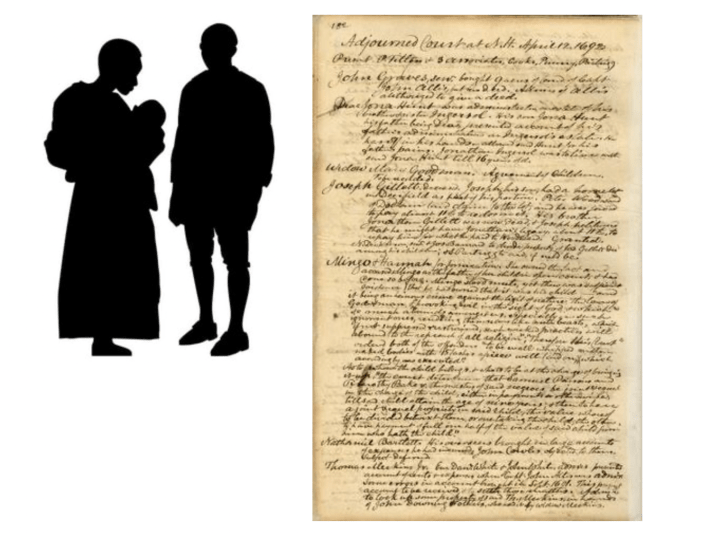
Silhouette of Hannah, her baby, and Mingo. In 1692, the court decided that the ownership of Hannah’s baby would be shared by her enslaver Timothy Baker and Mingo’s enslaver Samuel Parsons. A copy of the 1692 court document was transcribed on page 182 of the Judd Manuscript in the collection of Forbes Library, Northampton, MA.
For at least 129 years, slavery was part of the fabric of everyday life in Northampton. At least 50 enslaved individuals lived here from the town’s English settlement in 1654 until 1783 when slavery was abolished in Massachusetts. The exhibit Slavery and Freedom in Northampton, 1654–1783 features life-sized silhouettes of men, women, and children who were enslaved. On each silhouette are details about individual lives based upon information gleaned from historic documents. Their histories reveal aspects of enslavement and examples of freedom, and resistance to oppression.
The exhibit tells what we currently know about the lives of these enslaved individuals and how some gained freedom, started families, and purchased property. It also describes the ways in which Northampton enslavers exerted power and control over their lives. Included is a printmaking series, Glimmers of Past People, by artist Merisa Skinner reflecting on the local legacy of the transatlantic slave trade.

Composite image of the bill of sale of Venus to Jonathan Edwards from the collection of Yale University with a graphic silhouette of Venus by Design Division, Inc.
◊ ◊ ◊ ◊ ◊
Venus was born in West Africa and separated from her family. This bill of sale indicates that she was sold in Newport, Rhode Island by a ship captain and slave trader to Northampton’s minister Jonathan Edwards. Leah was also enslaved by Jonathan Edwards. Some historians think that Edwards renamed Venus to Leah when she was baptized. It is also possible that Venus died and Leah was a different person who replaced her.
Exhibit design by Michael Hanke of Design Division, Inc. with Historic Northampton and a team of scholars and archivists based upon research by the Northampton Slavery Research Project. Artwork for the background murals was created by artist Nancy Haver.
Exhibition | Fault Lines: Art, Imperialism, and the Atlantic World
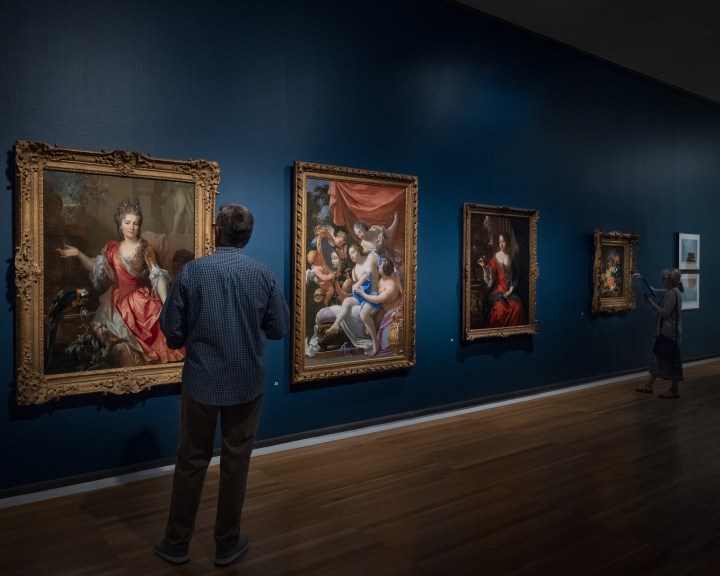
Installation view of Fault Lines: Art, Imperialism, and the Atlantic World at the Carnegie Museum of Art, 2025 (Photo by Zachary Riggleman). Paintings include from left to right: Nicolas de Largillière, Portrait of a Woman and an Enslaved Servant, 1696 (The Metropolitan Museum of Art, 03.37.2); Simon Vouet, The Toilet of Venus, ca. 1640 (Carnegie Museum of Art); and Peter Lely, Portrait of Louise Renee de Penencoet de Kerouaille, Duchess of Portsmouth, ca. 1670–1680 (Carnegie Museum of Art).
◊ ◊ ◊ ◊ ◊
Now on view at the Carnegie Museum of Art:
Fault Lines: Art, Imperialism, and the Atlantic World
Carnegie Museum of Art, Pittsburgh, 12 July 2025 — 25 January 2026
Organized by Marie-Stéphanie Delamaire
In the wake of Europe’s imperial expansion, which included the colonization of North and South America and the Caribbean in the 16th and 17th centuries, extensive military and economic activity transformed the regions that border the Atlantic Ocean. A new world—the Atlantic World—emerged, in which wars, competitive trade, and the enslavement of millions of Africans created new societies in Africa, Europe, and the Americas.
As ideas, knowledge, and beliefs moved together with people and materials across the ocean, shaping new mindsets and understandings of the world, European elite culture singled out certain objects as art, to be appreciated primarily for their beauty and emotional power. In that process, which also led to the creation of the first art museums, a rift opened between our understanding of these works of art and the political forces and transoceanic networks that made their creation possible. Acknowledging the fault lines of art history, this exhibition explores what can be imagined when works in the collection are brought in conversation with those made by artists who lived at the fluid boundaries of the Atlantic world’s entangled empires.
The exhibition is organized by Marie-Stéphanie Delamaire, curator of European and American art.
The 20-page gallery guide can be downloaded here»
Lecture | Restoration of the Chancellerie d’Orléans in Paris
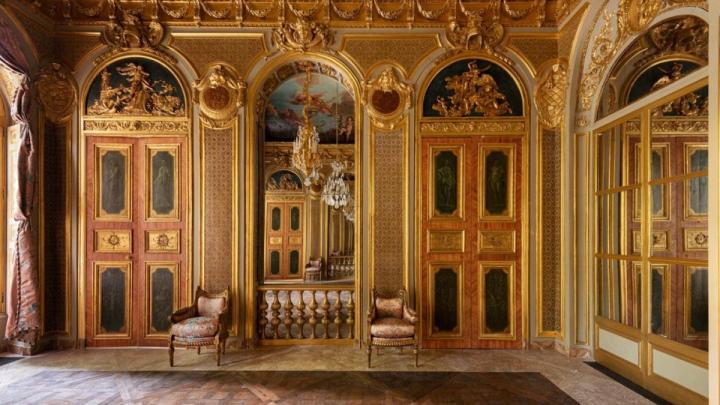
Grand salon de la Chancellerie d’Orléans remonté à l’hôtel de Rohan, 2021 (© Archives nationales de France / Nicolas Dion and Nicolas Cantin).
◊ ◊ ◊ ◊ ◊
In November at BGC:
Bénédicte de Montlaur and Cinzia Pasquali
Reconstructing and Restoring an 18th-Century Parisian Landmark
A Selz Lecture in 18th- and 19th-Century French Decorative Arts and Culture
Bard Graduate Center, New York, 5 November 2025
For over twenty years, World Monuments Fund undertook the remarkable task of restoring the historic Chancellerie d’Orléans. Built in Paris in the early eighteenth century, the Chancellerie displays a decorative program consisting of paintings, stucco, and wood carving by some of the leading artists of the time. In the early twentieth century, the interior was dismantled and put into storage. These treasures were forgotten for nearly a century, until World Monuments Fund began work to reconstruct and restore the spaces. In this presentation, World Monuments Fund president and CEO Bénédicte de Montlaur is joined by the project’s conservator, Cinzia Pasquali. Together, they will narrate the history of the Chancellerie and the conservation work that brought this important example of Rococo interiors back to public view.
Bénédicte de Montlaur is the president and CEO of World Monuments Fund (WMF), leading its mission to safeguard irreplaceable heritage working with local communities worldwide. She is responsible for defining and implementing WMF’s strategic vision in more than thirty countries and leading an international team of seventy employees, as well as an additional four hundred cultural conservation professionals around the world. Under her tenure, WMF has developed the programs Crisis Response Fund and the Climate Heritage Initiative, has opened offices in France and China, and has expanded the International Council of World Monuments Fund, which currently boasts nine chapters globally. De Montlaur’s background mixes culture and the arts, politics, international diplomacy, and human rights. Prior to joining WMF, de Montlaur spent two decades as a senior diplomat with the French Ministry of Foreign Affairs. She served as Cultural Counselor at the French Embassy in the United States, where she led France’s largest international cultural advocacy network and its two partner foundations—Albertine and FACE—directing a team of ninety people in ten US offices. Previously, she was deputy assistant secretary in charge of North Africa at the French Ministry of Foreign Affairs in Paris, United Nations Security Council negotiator on Africa and the Middle East in New York, and French Embassy first secretary in Damascus, Syria. De Montlaur studied sociology and Arabic at the École Normale Supérieure (Ulm) and public affairs at Sciences Po, Paris. She was a Marshall Memorial Fellow at the German Marshall Fund. She has served on the boards of several cultural and educational institutions and is currently a board member of the Maison Francaise at Columbia University. In 2011 she curated an original photographic exhibition entitled Islam and the City. Beyond her professional accomplishments, de Montlaur is a polyglot—speaking French, English, Arabic, and Spanish—and completed the New York City Marathon in 2011 and 2024.
Cinzia Pasquali is a conservator-restorer specializing in painting and sculpture, trained at the Istituto Centrale per il Restauro (ISCR) in Rome and holding a master’s degree in conservation-restoration from Université Paris III. She has led major restoration projects in Italy and France, including the Galerie d’Apollon at the Louvre, the Hall of Mirrors at Versailles, and the Grande Singerie at Chantilly. Cinzia led the restoration of the interior decors of the Chancellerie d’Orléans. Collaborating with the Centre for Research and Restoration of the Museums of France (C2RMF), she has restored key masterpieces by Leonardo da Vinci, Bronzino, and Piero di Cosimo. Internationally recognized for her expertise in painting diagnostics, she frequently works with museums and contributes to academic conferences and publications. She also helped establish a conservation training program in the Maghreb and Middle East through the European TEMPUS project.
Wednesday, 5 November 2025, 6pm
38 West 86th Street, Lecture Hall
gallery@bgc.bard.edu
$15 General | $12 Seniors | Free for people associated with a college or university, people with museum ID, people with disabilities and caregivers, and BGC members. Book tickets here.
Bard Graduate Center is grateful for the generous support of the Selz Foundation.
Lecture | Matthew Hirst on the Restoration of Woburn Abbey
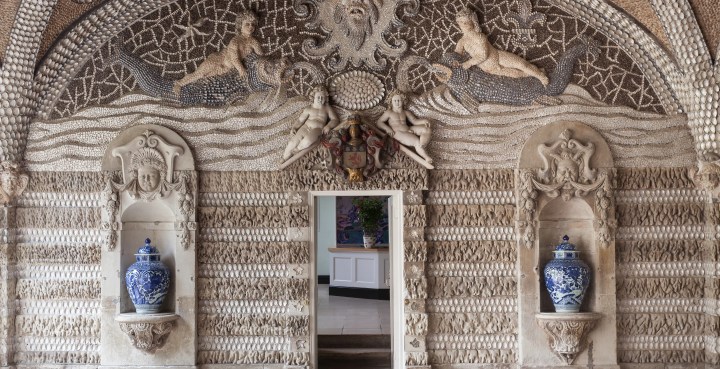
Grotto at Woburn Abbey, Bedfordshire. Originally a Cistercian abbey, Woburn became the seat of the Russell family and the Dukes of Bedford in the 16th century. The house was rebuilt in the early 17th century, with a second rebuilding undertaken in the mid-18th century to designs by Henry Flitcroft and John Sanderson. The Grotto is one of the few surviving 17th-century shellwork rooms in Britain.
◊ ◊ ◊ ◊ ◊
From the Rijksmuseum:
Matthew Hirst | The Transformation of Woburn Abbey
Daniel Marot Lecture, Rijksmuseum, Amsterdam, 16 September 2025
Matthew Hirst will speak about the restoration and refurbishment of Woburn Abbey, home of the Duke and Duchess of Bedford, and one of the great historic treasure houses of Britain.
In November 2019 Woburn Abbey closed to visitors to undergo a generational programme of restoration and refurbishment which will ensure the survival of this remarkable house and collection for centuries to come. Works are still underway—the house has undergone a transformation—and when it reopens the collections, much of which will have been conserved, will be redisplayed to dramatic effect. The new presentation will showcase the history and development of Woburn Abbey from monastic times to the present day. Matthew will highlight some of the changes that can be expected, in particular the renaissance of the Grotto Apartment, a suite of three rooms from the early 17th century created for the 4th Earl of Bedford. He will also share some of the more intriguing discoveries that have been made along the way and give a flavour of what can be expected when the Abbey reopens to the public.
Matthew Hirst is Curator of the Woburn Abbey Collection. He began his career at Waddesdon Manor. In 2007 he took up the new post of Head of Arts & Historic Collections for the Devonshire Collections, managing a major conservation programme and the representation of many of the historic interiors at Chatsworth. In 2015 Matthew moved to Woburn Abbey, and has since researched and developed a major representation and restoration of the house, marking the largest programme of works at the Abbey since it opened to the public in 1955. Matthew is also a trustee of the Wentworth Woodhouse Preservation Trust and the Leche Trust.
Every year, the Daniel Marot Fund/Rijksmuseum Fund organises the Daniel Marot Lecture, which provides a podium for a national or international expert in the field of interior history and applied art.
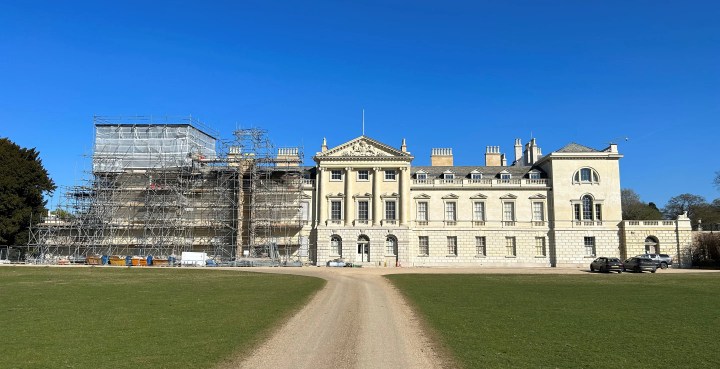
West front, Woburn Abbey, Bedfordshire.
◊ ◊ ◊ ◊ ◊
From Woburn:
Much work has been completed including the project to reinstate and restore the curtain walls that enclose the Great Court to the rear of the Abbey. These impressive structures were in a state of decay due to the nature the stone used to build them in the eighteenth century. Following a lengthy planning process they have now been completely rebuilt, using Portland stone and traditional materials with modern engineering.
The curtain walls project is just one aspect of our current programme of works. Dramatic changes to the guest arrival are now underway, and thanks to a grant from Historic England, we have restored the east range of the North Court and reinstated the original roofline, not seen since it was destroyed by fire in 1947.
Guided both by rigorous research and the requirements of modern family life, the Abbey’s interiors are being conserved and re-presented, underpinned by essential services work and using traditional materials and methods.
Major highlights of our conservation programme include the restoration of Issac de Caus’s 17th-century Grotto with the famous shell-lined interior at its centre. A remarkable survival through successive architectural change, this fantastical room is unique and will be at the heart of the home, serving as the new guest entrance.
For the first time in over 250 years and following a five-year conservation programme, the Mortlake Tapestries will hang once again in the room for which they were commissioned by the 5th Earl of Bedford, and elsewhere wall-finishes will be recreated from historic evidence. The Long Gallery and the family’s Dining Room, with its famous collection of Venetian paintings by Canaletto, will be redecorated to reflect the taste of the present generation, informed and guided by the past.










 Enfilade
leave a comment