Exhibition | Chardin and the Marcille Family
Opening soon at the Musée des Beaux-Arts Orléans:
The Marcille Chardin Family: A Passion from Orléans
Les Chardin des Marcille: Une passion orléanaise
Musée des Beaux-Arts, Orléans, 9 September 2025 — 11 January 2026
Rarely has a painting aroused so much passion as Le Panier de fraises des bois (1761) by Jean Siméon Chardin, the quintessential work of French painting, put up for sale in 2022 and acquired for a record price by the Musée du Louvre after having remained in the prestigious collection of the Orléans-born Eudoxe Marcille (1814–1890) since the mid-19th century.
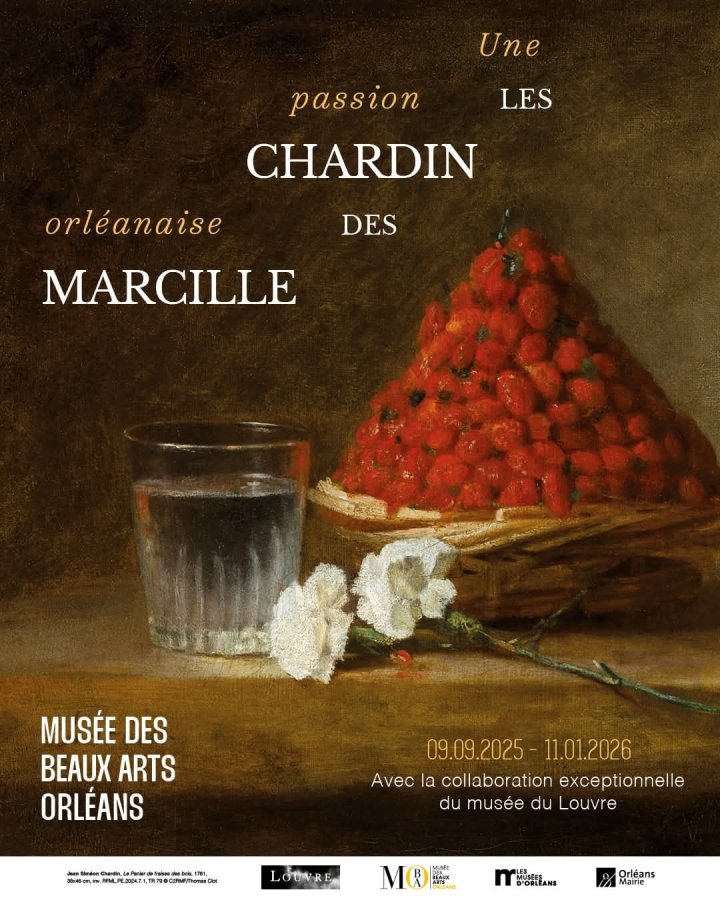 His name alone evokes that of Chardin. His father, François Marcille (1790–1856), from a family of seed brokers in the Beauce region, had taken a visionary interest, as early as 1822, in all those artists from the time of Louis XV that nobody looked at anymore, to the point of assembling the largest collection of his time, with 4,500 works including dozens of Bouchers, Fragonards, Greuze, Prud’hon and Géricault… and, above all others, thirty Chardin. This consuming passion was passed on with his collection to his two sons, Eudoxe and Camille. Camille, who became curator of the Chartres museum, and Eudoxe, director of the Musée d’Orléans from 1870 to 1890, continued to promote Chardin’s work, even buying back after their father’s death, beyond the works he had designated for each, what could continue to be assembled from this ideal nucleus. Quite naturally, the Goncourt brothers, great biographers of 18th-century artists, drew on this reference collection, in which Chardin’s entire career is represented, to write the first biography of the painter of silent still lifes and pantries in 1863.
Chardin was at home in Orléans and, in a way, always had been. His friendship with Aignan Thomas Desfriches (1715–1800), the entrepreneur who had made Orléans an artistic capital in the 18th century, could be seen in the checkered scarf Chardin wears in his self-portrait, which came from Desfriches’ home. Desfriches himself owned numerous paintings by Chardin. He was followed by Casimir de Cypierre (1783–1844), son of the Intendant d’Orléans under Louis XVI, whose name a quay bears, who owned at least three. François Marcille and his son Eudoxe continued to nurture this Orléans passion. Around the exceptional loan of Panier de fraises des bois, five other Chardin paintings from the legendary Marcille collection are brought together for the first time since the 1979 retrospective. They are accompanied by the Self-portrait with bezicles (spectacles), an eventful acquisition which, in 1991, brought this artist, so dear to the heart of Orléans, into the pastel cabinet, but whose memory alone inhabited the collections. Chardin, more than ever, is at home in the Musée d’Orléans, which this family of discreet enthusiasts has helped to elevate, through François’ research and Eudoxe’s twenty years at the service of its collections, into a place of rediscovery and sharing.
With the exceptional participation of the Musée du Louvre. The exhibition benefits from exceptional loans from the Musée du Louvre, the Musée Jacquemart-André, the Musée de Picardie, private collectors, and the Marcille family descendants.










 Enfilade
leave a comment