New Book | Shakespearean Objects in the Royal Collection, 1714–1939
So satisfying to see publications emerge from the AHRC-funded project Shakespeare in the Royal Collection. –CH
From Oxford UP:
Kirsten Tambling, Shakespearean Objects in the Royal Collection, 1714–1939: From National Treasure to Family Heirloom (Oxford: Oxford University Press, 2025), 256 pages, ISBN: 978-0198964483, $100.
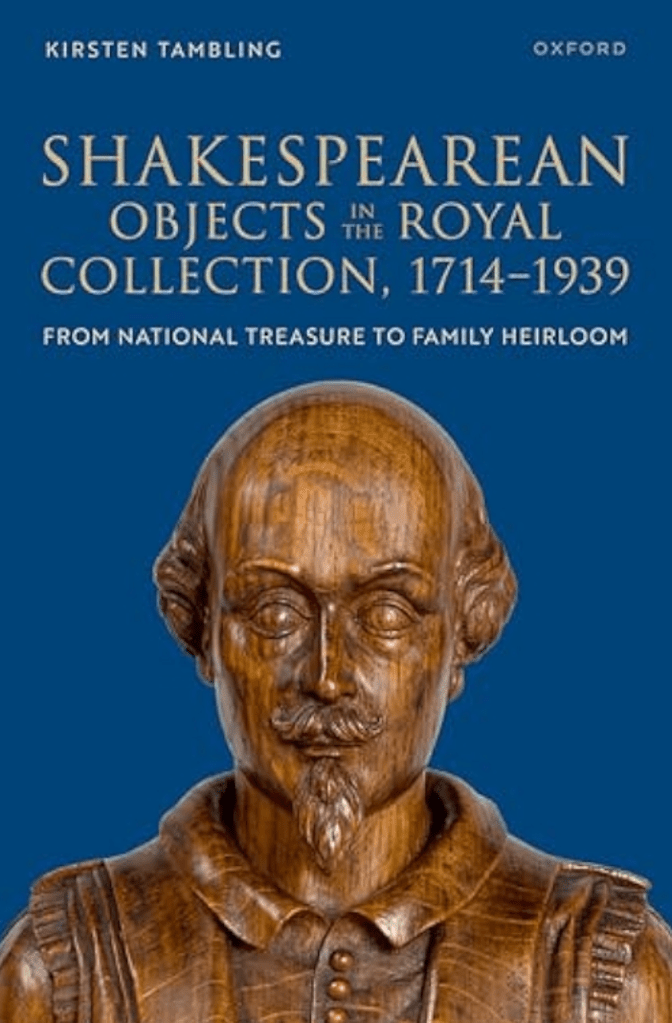 The British royal collection includes nearly 2,000 objects with a connection to Shakespeare. What stories do these objects tell of the relationship between the man often described as Britain’s ‘national poet’ and Britain’s royal family? Royal collecting of Shakespeare did not really begin until 1714, and has therefore broadly tracked the development, and entrenchment, of the Hanoverian—and latterly the Saxe-Coburg Gotha—royal family. Not entirely coincidentally, this period also saw a general increase in public interest in objects associated with Shakespeare’s life and biography, often to the detriment of Shakespeare’s works—a development partially spearheaded by the ‘Shakespeare Jubilee’ masterminded by the actor David Garrick at Stratford-upon-Avon in 1769. The histories of specific works of art in the royal collection, from Thomas Gainsborough’s painting of Mary Robinson to a collection of relic objects relating to ‘Herne’s Oak’ and Shakespeare’s mulberry tree, reveal how royal engagement with Shakespearean objects between 1714 and 1939 contributed to the development of a new constitutional settlement between the monarchy and its subjects under George IV, Queen Victoria, and George V and Queen Mary. During this period, objects relating to Shakespeare—increasingly regarded (by the royal family) as nostalgic souvenirs from a fantastical national past—were useful tools in shoring up these ideas, and in yoking the fortunes of the British monarchy to a new vision of shared national history.
Kirsten Tambling completed her PhD in History of Art at Birkbeck, University of London on the art of Jean-Antoine Watteau and William Hogarth. She was a postdoctoral research associate for ‘Shakespeare in the Royal Collection’ and subsequently Associate Lecturer on the Curating the Art Museum programme at the Courtauld Institute of Art. She has worked in various museums and collections, including the Royal Collection Trust and Watts Gallery, where she was co-curator of the exhibition James Henry Pullen: Inmate, Inventor, Genius (2018). She has published articles on eighteenth-century art, the intersection of art and psychiatry, and the history of collections.
c o n t e n t s
Introduction
1 Remembering Perdita
2 A Present from Stratford
3 Old Wives’ Tales
4 Sweet Anne Page and the Family Settlement
Coda: Queen Mary Arranges the Collection
Conclusion: Serried Accumulations
New Book | Shakespeare’s Afterlife in the Royal Collection
From Oxford UP:
Sally Barnden, Gordon McMullan, Kate Retford, and Kirsten Tambling, eds., Shakespeare’s Afterlife in the Royal Collection: Dynasty, Ideology, and National Culture (Oxford: Oxford University Press, 2025), 272 pages, ISBN: 978-0198923152, $40.
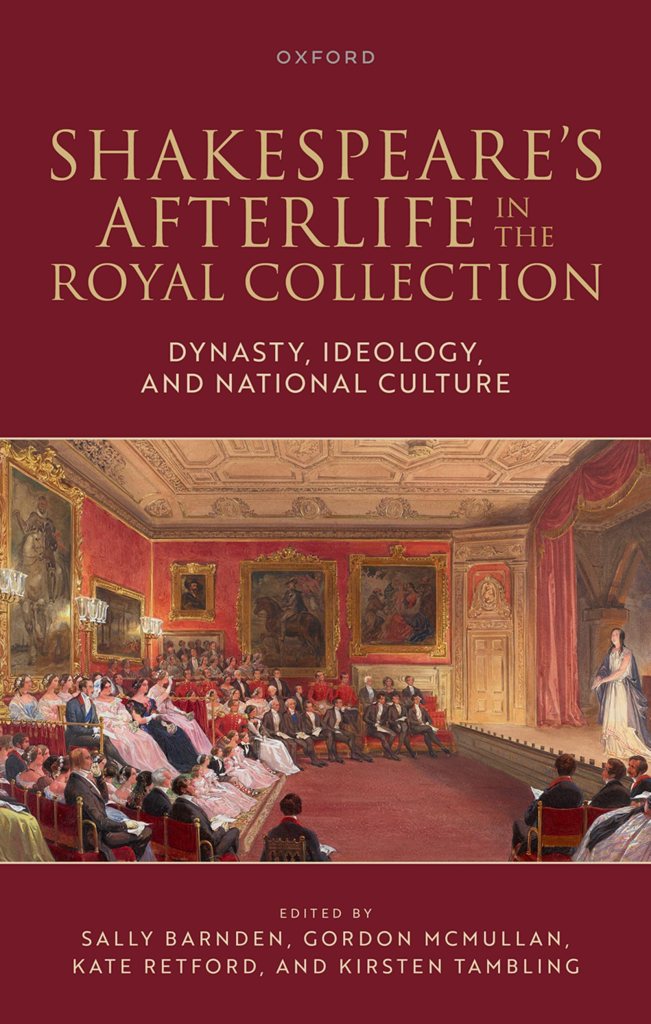 This collection of essays and images explores a series of objects in the Royal Collection as a means of assessing the interrelated histories of the British royal family and the Shakespearean afterlife across four centuries. Between the beginning of the eighteenth century and the late twentieth, Shakespeare became entrenched as the English national poet. Over the same period, the monarchy sought repeatedly to demonstrate its centrality to British nationhood. By way of close analysis of a selection of objects from the Royal Collection, this volume argues that the royal family and the Shakespearean afterlife were far more closely interwoven than has previously been realized.
The chapters map the mutual development over time of the relationship between members of the British royal family and Shakespeare, demonstrating the extent to which each has gained sustained value from association with the other and showing how members of the royal family have individually and collectively constructed their identities and performed their roles by way of Shakespearean models. Each chapter is inspired by an object in (or formerly in) the Royal Collection and explores two interconnected questions: what has Shakespeare done for the royal family, and what has the royal family done for Shakespeare? The chapters range across the fields of art, theatre history, literary criticism, literary history, court studies and cultural history, showing how the shared history of Shakespeare and the royal family has been cultivated across media and across disciplines.
c o n t e n t s
Introduction — Sally Barnden, Gordon McMullan, Kate Retford, and Kirsten Tambling
1616
1 The ‘Disappointment’ of Charles I’s Shakespeare Second Folio — Gordon McMullan
1700
2 Henry V and Early Hanoverian Self-Fashioning — Emrys Jones
3 ‘A Wild and Unruly Youth’ — Kate Retford
4 Moral Painting — Shormishtha Panja
5 David Garrick and the President’s Chair — Anna Myers
6 Queen Charlotte and the Royal Narratives of Boydell’s Shakespeare Prints — Rosie Dias
7 George III and the Other ‘Mad King’ — Arthur Burns
8 Disability and Mutable Spectatorship — Essaka Joshua
9 Fake and Authentic Shakespeare — Fiona Ritchie
1800
10 ‘Well-Authenticated Blocks’ — Mark Westgarth
11 Why Did George IV Own a Shakespeare First Folio? — Emma Stuart
12 From Performance to Portfolio — Kate Heard
13 Hamlet Disowned — Michael Dobson
14 Princess Victoria and the Cult of Celebrity — Lynne Vallone
15 Shakespeare in the Rubens Room — Eilís Smyth
16 Monument and Montage — Sally Barnden
17 Puck and the Prince of Wales — Gail Marshall
18 Much Ado about Tapestry — Morna O’Neill
19 Disappearances and The Durbar — Vijeta Saini
1900
20 ‘All England in Warm Sepia’: Queen Mary and the Church of the Holy Trinity — Kirsten Tambling
21 Shakespeare in Miniature — Elizabeth Clark Ashby
22 Shashibiya — Eleine Ng-Gagneux
23 Cultural (Dis)inheritance and the Decline of Empire in The Prince’s Choice — Kathryn Vomero Santos
Bibliography
New Book | Shakespeare and the Royal Actor: Performing Monarchy
From Oxford UP:
Sally Barnden, Shakespeare and the Royal Actor: Performing Monarchy, 1760–1952 (Oxford: Oxford University Press, 2025), 272 pages, ISBN: 978-0198894971, $110.
 Shakespeare and the Royal Actor argues that members of the royal family have identified with Shakespearean figures at various times in modern history to assert the continuity, legitimacy, and national identity of the royal line. It provides an account of the relationship between the Shakespearean afterlife and the royal family through the lens of a broadly conceived theatre history suggesting that these two hegemonic institutions had a mutually sustaining relationship from the accession of George III in 1760 to that of Elizabeth II in 1952. Identifications with Shakespearean figures have been deployed to assert the Englishness of a dynasty with strong familial links to Germany and to cultivate a sense of continuity from the more autocratic Plantagenet, Tudor, and Stuart monarchs informing Shakespeare’s drama to the increasingly ceremonial monarchs of the modern period. The book is driven by new archival research in the Royal Collection and Royal Archives. It reads these archives critically, asking how different forms of royal and Shakespearean performance are remembered in the material holdings of royal institutions.
Sally Barnden is a Lecturer in Literature and Visual Culture at Swansea. She has taught Shakespeare and early modern literature at King’s College London, the University of Oxford, Queen Mary University, Brunel, and Central School of Speech and Drama. Her first book, Still Shakespeare and the Photography of Performance, was published by Cambridge University Press in 2020, and her scholarship has been published in Shakespeare Bulletin, Theatre Journal, and in the collection Early Modern Criticism in a Time of Crisis. As part of the AHRC-funded project ‘Shakespeare in the Royal Collection,’ she co-created a database and virtual exhibition, which are available online at http://www.sharc.kcl.ac.uk.
c o n t e n t s
Introduction
1 Player Queens
2 Libertines
3 Warlike Effigies
4 Domestic Virtues
5 Royal Bodies
Epilogue










 Enfilade
leave a comment