Exhibition | William Blake: Burning Bright
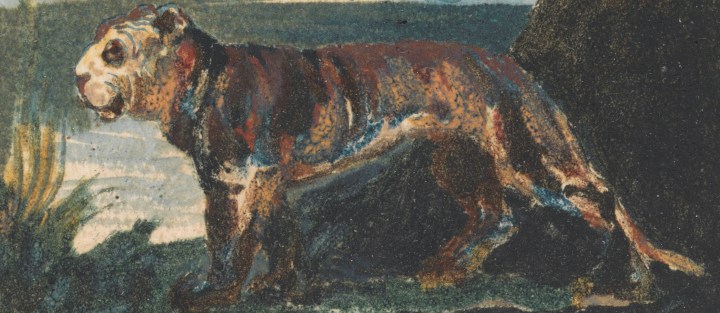
William Blake, The Tyger (Plate 42, from Songs of Innocence and of Experience), detail, 1794, color-printed relief etching with hand coloring in watercolor (New Haven: Yale Center for British Art, Paul Mellon Collection).
◊ ◊ ◊ ◊ ◊
Now on view at YCBA:
William Blake: Burning Bright
Yale Center for British Art, New Haven, 26 August — 30 November 2025
Curated by Elizabeth Wyckoff and Timothy Young
One of the most compelling figures in the history of British art and poetry, William Blake (1757–1827) developed an idiosyncratic worldview during a tumultuous era that witnessed the American and French Revolutions. He expressed his radical perspectives on religious belief, politics, and society through highly original illuminated books, watercolors, paintings, and poetry. This exhibition showcases the Yale Center for British Art’s impressive collection of works by Blake, with special focus on the inventive hand-printed publications that bring to life his poetry and prophecies.
 The YCBA’s extensive holdings include Blake’s most innovative and celebrated books, such as Songs of Innocence and of Experience (1789–94) and The First Book of Urizen (1794). Blake’s mastery of watercolor painting and his phenomenal imaginative powers are evident in the one-of-a-kind illustrations for The Poems of Thomas Gray (between 1797 and 1798) and in the only fully hand-colored version of his culminating poem, the 100-page Jerusalem (1804–20). This stunning presentation highlights the artist’s ambitious vision and skill, as well as his unparalleled contributions to art, literature, and spirituality.
Born in London at a time of major social change and upheaval, Blake aspired to be an artist and a poet from a young age. During his apprenticeship, he developed an elegant black-and-white engraving style that he deployed in both commissioned and original prints and book illustrations. He is best known for devising an unorthodox technique to create colorful illuminated books that merged his poetry and his art. His most notable innovation was a method for printing text and image from a single copper plate. Blake’s work was largely unacknowledged during his lifetime, yet today his striking imagery and stirring words are widely celebrated.
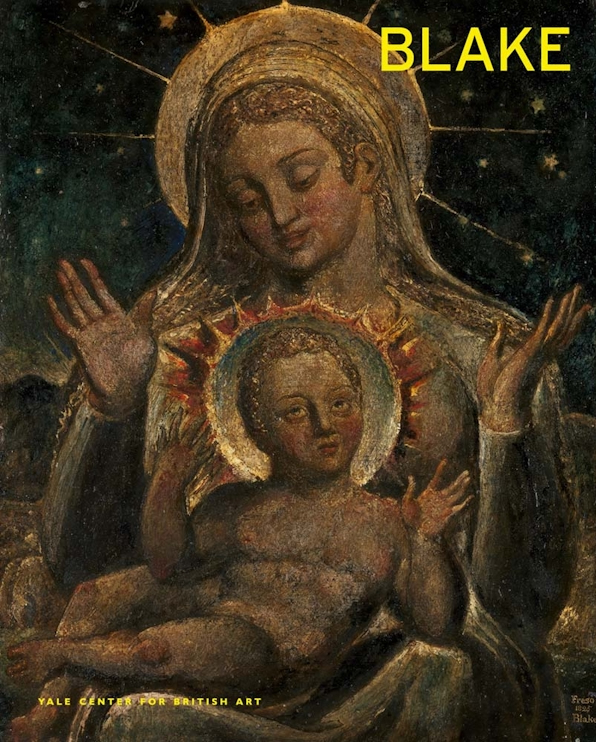
Blake, the second volume in the YCBA’s Collection Series, examines the art and methods of William Blake through the lens of one of the great collections of his work. Written by Elizabeth Wyckoff, with an essay by Sarah T. Weston, the book features exquisite reproductions of his paintings, watercolors, prints, and illustrated books, including the only hand-colored copy of his epic poem Jerusalem.
Elizabeth Wyckoff, Blake (New Haven: Yale Center for British Art, 2025), 136 pages, ISBN: 978-0300284577, $40. With an essay by Sarah Weston.
◊ ◊ ◊ ◊ ◊
Programs exploring multiple dimensions of Blake’s life, work, and legacy will accompany the exhibition. Please visit britishart.yale.edu for the most up-to-date information.
Opening Celebration
Thursday, September 4, 4pm
A conversation with exhibition curators Elizabeth Wyckoff, Curator of Prints and Drawings, and Timothy Young, Curator of Rare Books and Manuscripts, followed by gallery talks and a reception.
The Enduring Influence of William Blake
Thursday, October 30, 5pm
Author John Higgs will talk with Timothy Young, Curator of Rare Books and Manuscripts.
Songs from the Imagination: Music Inspired by the Poetry of William Blake
Thursday, November 20, 5pm
Yale Voxtet, the Institute of Sacred Music’s select group of graduate student singers, will perform in the Library Court.
Create Community: Imagined Worlds in the Art of William Blake and Hew Locke
Thursdays, October 2, 16, and 23, 5:30pm
This three-part workshop will explore William Blake: Burning Bright and Hew Locke: Passages through a close investigation of material and process. Enrollment is limited to twelve people, and preregistration is required.
Curator Tours
Thursdays, September 18, October 30, and November 20, 4pm
Docent Tours
Saturdays, 3pm
Exhibition | Nusantara: Six Centuries of Indonesian Textiles
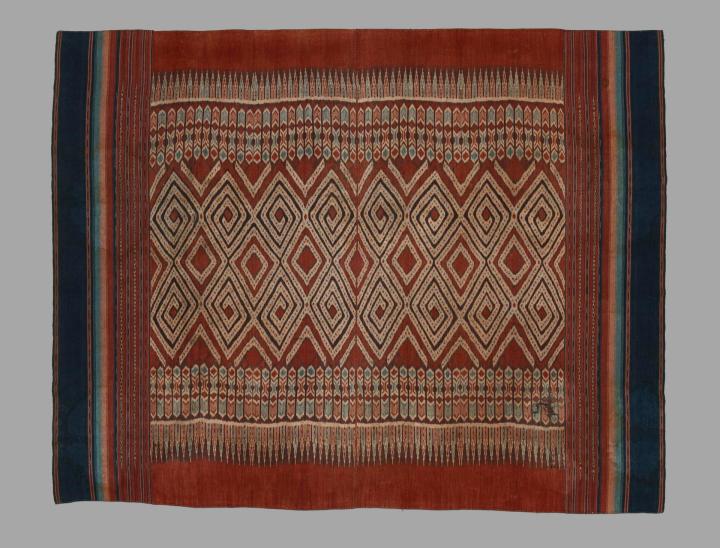
Ceremonial Weaving (Palu), late 18th–early 19th century, cotton, warp-faced plain weave, warp ikat, made in Sulawesi, Indonesia, 195 × 154 cm (New Haven: Yale University Art Gallery, Gift of Robert J. Holmgren and Anita E. Spertus, 2017.48.4).
◊ ◊ ◊ ◊ ◊
From the press release for the exhibition:
Nusantara: Six Centuries of Indonesian Textiles
Yale University Art Gallery, New Haven, 12 September 2025 — 11 January 2026
Organized by Ruth Barnes with the assistance of Arielle Winnik
Celebrating the largest collection of Indonesian textiles in the Western Hemisphere
The Yale University Art Gallery is pleased to present Nusantara: Six Centuries of Indonesian Textiles, a sweeping exhibition that celebrates the elaborate textile heritage of Indonesia and explores the ancient interisland links found in this vast maritime region. Presenting more than 100 examples of unparalleled craftsmanship and artistic innovation, the exhibition offers a singular opportunity to dive deep into the cultural and historical significance of one of the finest collections of Indonesian textiles in the Western Hemisphere.
The wide array of textiles from the 14th to the 20th century displayed in the exhibition are drawn from the Gallery’s holdings. Central to the Gallery’s Department of Indo-Pacific Art, the textile collection boasts approximately 1200 examples from Indonesia and Sarawak (Malaysia). Significant pieces include over 600 textiles originally acquired by Robert J. Holmgren and Anita E. Spertus, later presented to the Gallery by Thomas Jaffe. This group features weaving from maritime Southeast Asia, where textiles are not just artistic creations but serve an important role in ceremonies and rituals. They also embody gender roles and social status, reflecting the wearer’s identity and heritage.
The Indonesian islands of Sumatra and Sulawesi hold an important place within the Gallery’s collection, counting more than 200 and 100 examples each, respectively. The remainder of the collection encompasses textiles from regions throughout Indonesia, showcasing the country’s rich cultural diversity.
Indonesia has historically been at the crossroads of major trade routes, resulting in a blend of Indigenous and foreign influences. In the 10th and 11th centuries, Indonesian textiles began to show the Influence of Indian designs. The impact of Chinese and later Islamic cultures is also evident, yet these borrowed motifs were transformed into distinctively Indonesian traditions. Drawing its title from the original name for the Indonesian archipelago, Nusantara, the exhibition offers an unprecedented opportunity to view the full range of rich imagery and technical mastery of this remarkable art form.
The exhibition is made possible by Hunter Thompson, the National Endowment for the Arts, the Helen Frankenthaler Foundation, and the Robert Lehman, B.A. 1913, Endowment Fund. It was organized by Ruth Barnes, the Thomas Jaffe Curator of Indo-Pacific Art, with the assistance of Arielle Winnik, the Donna Torrance Assistant Curator of Indo-Pacific Art.
Call for Papers | Diplomatic Gifts

Mughal Artist, Europeans Bring Gifts to Shah-Jahan (July 1633), detail ca. 1635–50, 34 × 24 cm
(Royal Collection Trust, RCIN 1005025.t).
◊ ◊ ◊ ◊ ◊
From the Call for Papers (which includes French and Italian versions) . . .
Diplomatic Gifts in the Modern and Contemporary Eras:
Definitions, Changes, and Patrimonialisation on a Global Scale
French Academy in Rome – Villa Medici, Rome, 2-3 March 2026
Proposals due by 15 October 2025
The eloquent evidence of peaceful trade, diplomatic gifts have been the subject of significant research in recent decades. Following Marcel Mauss’s seminal work on the anthropology of gift-giving, historians of modern diplomacy (Frigo; Bély) have focused on the material and political contexts in which intercultural and interreligious exchanges have taken place. While connected history has taken significant objects as its landmarks (Subrahmanyam; Gruzinski; Cooke), art history (Castelluccio; Rado) has profitably focused on the relationships between diplomacy and trade, on technical and artistic transfers, and on circuits and actors, particularly from the perspective of the involvement of royal, imperial or national factories. Researchers have placed strong emphasis on case studies in specific areas of exchange or types of gifts. More recently, legal historians have analysed how contemporary regulations have sought to replace frequent corrupt practices with transparency.
Using connected, material and post-colonial art histories, as well as cultural anthropology and museography, this symposium wishes to better understand these ‘ambassador objects’ (Kasarhérou) in their semantic richness, materiality and temporalities, and to consider the fertile ‘rhizomes’ (Bachir Diagne) that they fertilise in other territories. The aim of this reflection is, first of all, to take a fresh look at the definitions and sometimes tenuous distinctions between diplomatic gifts, tributary presents and spoils of war, commemorative commissions or creations, as well as their different roles (symbolic, emotional, pacifying, political, etc.) in the institution of international relations and the ritualisation of exchanges, by combining especially anthropology and political history. The aim is to analyze, by comparing narratives, the status they have on both sides of the chain, in various contexts.
The cultural practice of friendship gifts immediately raises the question of the conditions under which they are commissioned and produced, as well as the symbolic value of the materials. As studies articulating history of diplomacy and history of trade (Zhao and Simon; Schaub; Guerzoni) have demonstrated, gifts solicit support from local skills and crafts, as well as factories, or innovative technologies, while also promoting, legitimising and celebrating the high level of mastery of their producers, echoing in this way the prosperity and perfect governance of the territory that produced them. Concerning the creators, they may be employed by the powerful, or even benefit, as autonomous artists, from competition between princes. In some cases, particularly in interfaith relations, the emissaries themselves may be involved in the creation of these gifts. Alongside the use of traditional Indigenous productions or commissioned works, the potential use of hybrid objects or ‘border objects’ will also be examined—objects that carry acclimated external cultures and embody multiple layers of meaning, such as dynastic gifts. By addressing the choice of objects and their materiality in the light of economic and socio-cultural phenomena, and without neglecting the history of religion and the weight of ideologies, the conference aims to compare the order processes, the methods of adaptation and the balance between norms and freedoms, by recontextualising practices and examining the underlying strategies of domination.
If the uniqueness of a ceremonial gift lies in the richness and sophistication of its message, which simultaneously represents the giver and is tailored to the recipient, in the magnificence of its execution or material, but also in the ritual of its presentation, the typologies of chosen objects are many: official portraits, carpets, militaria, tableware, naturalia, costumes, jewellery and watches, religious or apotropaic objects, or even animals and court dwarfs, etc. The presentations will explore a variety of cases and will pay particular attention to certain specific objects that are, by their very nature, diplomatic gifts, such as presentation portraits, medals, handsteinen, or peace pipes.
Considering the long history of diplomatic relations, the conference aims above all to fully analyse the evolving agency of gifts, from the strengthening of princely dynastic alliances to the consolidation of nation states, as well as the way in which the objects offered construct and potentially reconfigure links. How do these objects fit into a policy of gift-giving, whether serial or renewed over time? According to what rituals must these witnesses, which seal the agreement, themselves reactivate the alliance (counter-gift, reconnection journey, etc.)? How are they perceived and understood a few years after they were offered, and when they become part of discourses on patrimonialisation, especially in places dedicated to their collective conservation, which are themselves, in turn, active tools? What reflections about space and display accompany these objects, with what staging, visual strategies, and what use of materials during the diplomatic encounter, and once they have been deposited with the recipient? What discourses and narratives do they represent? Furthermore, what happens to gifts that do not reach their intended recipients, and what is their symbolic impact? Some gifts, testimonies of peaceful ties, have been appropriated by other dominant, colonising or occupying powers: what were the sometimes complex circuits, cultural or propagandistic issues, and effects of semantic transfers?
The conference, hosted by the Académie de France à Rome – Villa Médicis, will also benefit from visits to relevant sites and collections and from a comparison with contemporary practices of protocol exchanges. It will debate from polycentric perspectives, encouraging cross-views on the phenomena and analysing sources bilaterally or multilaterally. Particularly welcome, without exclusions, are contributions focusing on enlarged geographical frameworks (from the Viceroyalty of New Spain to the Mughal or Chinese courts, from Versailles or Venice to Topkapi or Damascus, from the court of the Oba to that of Portugal, etc.) and shedding light on the following themes:
• Diplomatic gifts, their variations, and definitions
• The conditions under which gifts were made and the role of intermediaries (artists, princes, ministers, diplomats, protocol officers, building superintendents, merchants, etc.)
• The object’s lives, its staging and locations (palaces, studioli, cabinets of curiosities, galleries, official salons, etc.), ephemeral decorations, and architecture
• The meanings of the offering in context and its impact on international relations, the links between diplomatic gifts and commercial or religious strategies
• Analysis of representations, in all their forms, of exchanges of gifts (diplomatic embassies, Christian missions, ecumenical meetings, alliances, dynastic celebrations, translation ceremonies, etc.)
• The variety of commemorations of the gift (including discursive and spectacular forms) and cross-analysis of visual, literary, and historical narratives
• Patrimonialisation of diplomatic gifts: from princely collections to missionary, ethnographic, national, presidential, or transnational museums
• The evolution of gifts in relation to diplomatic practices (codification, professionalisation)
• Aborted gifts and unexpected captures, the authentication and falsification of diplomatic gifts with their material traces, provenance research on diplomatic gifts
• Diplomatic donations in the context of regulatory practices (sumptuary laws, transparency policies, etc.)
Interested researchers should send a proposal for a paper with a title and abstract (maximum 3000 characters) and a biographical presentation (maximum 5–10 lines) with their current affiliation to the following addresses by 15 October 2025: natachapernac@yahoo.fr; valqhristova@yahoo.fr; and patrizia.celli@villamedici.it. Proposals and papers may be submitted in French, Italian, or English. The organisation will cover the accommodation and meals of the speakers and will help in finding financial support for their travel expenses.
Organizing Committee
• Patrizia Celli, assistante chargée des colloques et du secrétariat du Département d’histoire de l’art – référente archives, Académie de France à Rome – Villa Médicis
• Alessandro Gallicchio, directeur du Département d’histoire de l’art, Académie de France à Rome – Villa Médicis
• Valentina Hristova, maîtresse de conférences en histoire de l’art moderne, Université de Picardie Jules Verne, Amiens
• Natacha Pernac, maîtresse de conférences en histoire de l’art moderne, Université Paris-Nanterre
Scientific Committee
• Lucien Bély, professeur émérite d’histoire moderne, Paris, Sorbonne Université, membre de l’Institut, Académie des sciences morales et politiques
• Francesco Freddolini, Professore associato di storia dell’arte moderna, Rome, Sapienza – Università di Roma
• Serge Gruzinski, directeur de recherche émérite en histoire, Paris, CNRS / EHESS
• Guido Guerzoni, historian and economist, adjunct professor, Milan, Università Luigi Bocconi
• Mei Mei Rado, Assistant Professor of Textile and Dress History, New York, Bard Graduate Center
Call for Articles | Mexican Art in Europe, 16th–21st Centuries
From ArtHist.net:
Mexican Art and Its Collections in Europe, 16th–21st Centuries: Interwoven Histories
Edited volume in preparation for submission
Proposals due by 31 October 2025; completed papers will be due by 28 February 2026
We invite contributions to an edited volume that will explore the histories, meanings, and trajectories of Mexican art in European contexts, from the early modern period to the present day. Building on the discussions initiated at the international conference Mexican Art and Its Collections in Europe (16th–21st Centuries): Interwoven Histories (2025), this book seeks to highlight the complexities of artistic transfer, collection, display, and reception of Mexican art across the continent. While Mexican-European artistic relations have often been studied in connection with major Western European centers, we particularly welcome perspectives that address Central and Eastern Europe as crucial—though often overlooked—sites of collecting, exhibiting, and interpreting Mexican art.
Possible topics include (but are not limited to):
• The circulation of Mexican artworks and objects in Europe from the 16th century onwards
• European collecting practices and their political, colonial, and cultural contexts
• Exhibitions of Mexican art in Europe and their impact on audiences and scholarship
• Transatlantic artistic exchanges between Mexico and Europe in the 19th and 20th centuries
• Cold War cultural diplomacy and Mexican art in Eastern and Central Europe
• Contemporary artistic dialogues, curatorial strategies, and institutional collaborations
• Methodological approaches to studying transcultural art histories
All contributions and abstracts should be submitted in English. Abstracts (max 300 words) and a short bio (max 150 words) should be submitted by 31 October 2025 to Dr. Emilia Kiecko, Institute of Art History, University of Wrocław, emilia.kiecko@uwr.edu.pl. Acceptance notification will be communicated by 15 November 2025. Full papers (6,000–8,000 words) will be due by 28 February 2026.
Conference | Impressions of Empire: Works on Paper
From ArtHist.net:
Impressions of Empire: Works on Paper as
Agents of Intermedial Translation and Cultural Exchange
Online and in-person, Colnaghi Gallery, London, 25–26 September 2025
The Colnaghi Foundation and Athena Art Foundation in London are delighted to host this symposium exploring how works on paper were used to construct meaning and identity, and engendered the intermediary exchange of artistic ideas during the period of global empire and colonisation. The symposium will be hosted both online and in the Colnaghi Gallery in London.
t h u r s d a y , 2 5 s e p t e m b e r , online and in-person
12.30 Arrival
13.00 Welcome
13.15 Session One
• Chloé Glass (Research Associate, Prints and Drawings, Art Institute of Chicago) — Decoding Stefano della Bella’s Etchings
• Eunice Yu (DPhil Candidate, University of Oxford) — Collecting and Constructing National Identity in Print: Translations of Empire from the Black Sea to the Adriatic
14:20 Coffee and Tea Break
14.45 Session Two
• Emily Cadger (PhD candidate, University of British Columbia and Adjunct Lecturer at the University of Western Washington) — Political Poppies and Beautiful Books: Illustrated Floral-hybrids as Interpreters of Empire in the Fin-de-siècle Children’s Books of Walter Crane
• Vivian Tong (Lecturer in Chinese Art History at the Hong Kong Baptist University) — Images of Nature in a Global Horticultural Expansion: Sketching a Story of Sino-European Commerce, Cultural Exchange, and Colonial Expansion with Chinese Export Watercolours in the 18th and 19th Centuries
• Joseph Litts (PhD Candidate, Department of Art & Archeology, Princeton University) — The Plantation Landscapes of Anna Atkins and Anne Dixon, online presentation
16.15 Break
16.30 Session Three
• Linda Mueller (Post-doctoral Researcher, University of Zurich) — Drawing the Contract: Visualizing Obligation in the Early Modern Mediterranean and Atlantic Worlds
• Gonzalo Munoz-Vera (Assistant Professor, Virginia Tech School of Architecture) — Rediscovering Latin America: Robert Burford’s Panorama of Lima (1834) through the Eyes of Lieutenant William Smyth, online presentation
17:45 Drinks
f r i d a y , 2 6 s e p t e m b e r , online only
11.00 Welcome
11.10 Session One
• Victoria Adams (PhD, the University of Auckland Waipapa Taumata Rau) — The Art of the Empire in the ‘Britain of the South’: Works on Paper in the British Art Section of the 1906–1907 New Zealand International Exhibition
• Chandni Jeswani (Art and Architectural Historian) — Mapping Kashi: Pilgrimage Cartographies and Colonial Translations on Paper
12.15 Break
12.45 Session Two
• Michael Hartman (Jonathan Little Cohen Associate Curator of American Art, Hood Museum of Art, Dartmouth) — Collecting Portraits to Control Land in 18th-Century British North America
• Catherine Dossin (Associate Professor of Art History, Purdue University) — Harbors of Power: Maritime Identity and Colonial Ambition in 18th-Century French Prints
14.00 Break
14.30 Session Three
• Annemarie Iker (Lecturer in Writing, Princeton University) — Cuba and Catalan Modernisme
• Ashar (Usher) Mobeen (PhD Candidate, Western University) — Palimpsests of the Heavens: Empire, Epistemicide, and the Papered Sky
15.15 Closing Remarks
Call for Articles | Expanding the Narrative of Historic House Museums
From ArtHist.net:
History Dis-placed: Expanding the Narrative of Historic House Museums
Volume edited by Karen Shelby and Emily Stokes-Rees
Proposals due by 31 October 2025
History Dis-placed: Expanding the Narrative of Historic House Museums concentrates on the unique histories and challenges of house museums through a time of unprecedented crisis and change. In addition to being historic landmarks, house museums can be sites of civic engagement and reflection, centers for activism and cultural discourse, and places for public events and gatherings. In the digital age, house-museums have had to renegotiate these identities and interactions with contemporary audiences through innovative practices. Together, the chapters in this volume collectively assert that HHMs can survive as important sources of local history, building support in the local community. These are museums that are challenging us to think differently, overturning conventional paradigms, and taking risks.
Historic house museums are becoming spaces not just of memory, but of activism, dialogue, and cultural regeneration. These changes reflect a growing awareness among museum professionals that the ‘living history’ techniques once popularized in the field may reinforce romanticized or incomplete narratives. Today, interpretive strategies must look beyond static domestic tableaux to explore how the house—as both a physical and symbolic space—contains multiple, often contested, histories. As Vagnone and Ryan assert, “The breath of a house is the living that takes place within it, not the structure or its contents” (2016, 21).
This volume addresses the evolving interpretive practices within historic house museums through four interrelated thematic sections: Visionary Programming, Beyond These Walls, Virtual Vitality, and Sites of Social Justice. Together, these sections reflect a growing movement within the field to reimagine not only what stories are told, but how, where, and for whom they are told. Each section explores a facet of this interpretive shift, offering case studies, theoretical insights, and practical approaches to reframing the work of house museums in the twenty-first century.
Visionary Programming
The first section, Visionary Programming, explores how historic house museums are implementing bold and innovative approaches to interpretation. Moving beyond traditional period rooms and didactic tours, these programs often prioritize collaboration with artists, scholars, descendant communities, and local stakeholders. Through immersive installations, performance-based experiences, and participatory storytelling, such programming seeks to foster emotional engagement, critical reflection, and a deeper sense of connection between past and present. The case studies in this section examine how curators and educators are reconfiguring house museums as sites of inquiry, experimentation, and shared authority.
Beyond These Walls
While the historic house itself remains a central interpretive anchor, many institutions are increasingly working to contextualize their narratives within broader spatial, social, and historical frameworks. The second section, Beyond These Walls, highlights efforts to extend interpretation beyond the physical boundaries of the house. Contributors consider how museums are addressing issues such as land dispossession, enslavement, migration, and community memory—often through partnerships, neighborhood-based initiatives, or landscape interpretation. By reframing the house as part of a larger network of historical and contemporary relationships, these approaches challenge insular narratives and reinforce the museum’s role within the public sphere.
Virtual Vitality
The third section, Virtual Vitality, addresses the increasing use of digital technologies to enhance access, engagement, and interpretation. As early as 1994, John Driscoll asked questions that remain salient today: what can we do with a digital museum? Is it possible to create a pro-active and creatively engaged audience? How can museums present a digital image of an object that functions as an artifact? And, for the purposes of the volume, how can house museums, despite digital and virtual programs, retain the intimacy and aura that differentiates them from other museums? While the COVID-19 pandemic accelerated the adoption of virtual tools across the museum world, many institutions have since embraced the digital realm not as a substitute for physical visitation, but as a space for new forms of storytelling, education, and collaboration. From virtual tours and online exhibitions to digital archives and interactive platforms, this section explores how house museums are leveraging technology to reach wider and more diverse audiences. Contributors also reflect on the epistemological implications of digitization: what is gained, what is transformed, and what is lost when interpretation moves beyond material culture and embodied experience.
Sites of Social Justice
The fourth section will provide case studies that expand upon the research of Marianna Clair. Clair, in 2016, began to look into the connection among the appreciation of local heritage, the creation of activists in local communities, and how to educate citizens about social issues. An example is The Tenement Museum in the Lower East Side of New York City. The museum presents and interprets a variety of immigrant experiences on the Lower East Side, but also draws on connections between the past and the present to underscore national conversations about immigration. But, as outlined in “House or Home? Rethinking the House Museum Paradigm,” the creation of new house museum over a century ago was to “protect and enshrine American virtue” that was guided by assimilation politics and beliefs. Thus, this chapter will address all types of historicized political activism (Potvin, 2010).
Together, these four sections articulate a vision of the historic house museum as a dynamic, inclusive, and socially engaged institution. Rather than serving solely as vessels of preservation, house museums are increasingly positioned as active participants in contemporary cultural and political discourse. This volume demonstrates how reimagined interpretive practices can make these sites more relevant, equitable, and responsive to the complexities of the histories they are entrusted to tell.
In this Call for Papers, we ask for contributions that examine how historic house museums are navigating decolonial practices, confronting difficult pasts, and opening space for marginalized voices in innovative new ways. The book explores a variety of themes, as they relate to the four thematic sections noted above. Contributors may address the following:
• The role of descendant communities in shaping interpretive direction
• New exhibition models for underrepresented histories
• House museums as civic spaces for protest, reflection, and healing
• Digital storytelling and participatory interpretation
• Theoretical frameworks for understanding domestic space as contested ground
Please submit abstracts of 250–500 words and a two-page CV to co-editors: Karen Shelby, karen.shelby@baruch.cuny.edu, and Emily Stokes-Rees, ewstokes@syr.edu.
AHRC Studentship | Sarah Sophia Banks (1744–1818)
From the British Library:
Rediscovering a Woman Collector at the British Library:
New Sources and Perspectives on Sarah Sophia Banks
Supervised by Felicity Myrone, Maddy Smith, and Alice Marples
Applications due by 28 November 2025
Extensive materials collected by Sarah Sophia Banks (1744–1818), one of the most important antiquarian collectors of her time, were divided at her death and are held across the British Library, Royal Mint, and Prints & Drawings and Coins & Medals departments at the British Museum. Varying institutional interests and practicalities have impacted their visibility, and the focus of scholarship to date has been on the holdings at the Museum and only her prints and ephemera in nine albums in the Library (L.R.301.h.3-11). This studentship will explore the significant holdings that are yet to be explored at the British Library, revealing Banks’s own cross-format interdisciplinary knowledge taxonomy in detail for the first time.
Banks wrote catalogues of her own collections and kept notes regarding provenance, many of which have been overlooked to date. This project will use these sources to rediscover the full extent and original arrangement, purpose and source of Banks’s prints, drawings, ephemera, books and manuscripts, focusing on those at the British Library. The student will explore Banks’ networks of knowledge, methods of collecting, network of contacts, and her strategies and systems for categorising her visual and textual materials. The project asks larger questions around the role of women collectors, knowledge practices, collecting history and scholarship, the emergence of (male) expertise, disciplinary norms and museological frameworks in the 18th and 19th centuries, and the relative status of visual and textual knowledge. While Joseph Banks’s collections as a whole and Sarah Sophia Banks’s collections beyond the Library have had sustained academic attention, her holdings at the Library remain largely underexplored. This project matches the recent full cataloguing of her collections at the Royal Mint and British Museum, facilitating cross-institutional research, and impacting practically upon reader access to and understanding of these materials and their provenance.
Banks organises her collections by subject and chronologically, notes the date and often the source of each item, quotes and cross-references other texts and authorities in inserted notes, and writes catalogues of her own collections. Research questions on these rich sources could include:
• How and when did Sarah Sophia Banks acquire her collections? What do her annotations reveal about her network and collecting practices in the 18th century? How do these names connect with the Banks collections beyond the Library?
• What knowledge systems and material ordering practices did she employ? How did she order and construct her unique assemblages? What does this tell us about gendered ways of structuring collections?
• How did her collecting constitute a form of ‘worldmaking’, particularly given her and her family’s social and global networks and perspectives?
• What is the evidence for Banks’s knowledge of other collections (in Britain or abroad)? How did this impact on her own practices?
• How did the nascent professionalism of male collecting and museology in her lifetime affect her collecting?
• Is she quoting from her own (or her brother’s) copies of works in her notes and cross-references? Can we reconstruct her library as a whole? How much survives?
• Can we reconstruct how the collection was physically placed, and what does this reveal about its history, value, visibility and use?
Banks’s social networks and intellectual enterprise have received scholarly attention from literary and art historical scholars. The project would complement existing scholarship by, for example, Edward Besly, 2023; Jan Bondeson, 2001; R.J. Eaglen, 2008; Catherine Eagleton, 2013, 2014; Arlene Leis, 2013, 2014; Anthony Pincott, 2004; Gillian Russell, 2015, 2018, 2020; and Kacie L. Wills and Frica Y. Hayes, 2020, 2024. But these and other scholars have focussed on the few ‘known’ print albums at the Library, mentioning in passing, or ignoring our wider holdings altogether. The project would extend this research to our wider Banks collections, connecting their collecting histories to broader social themes, issues of gender and historical knowledge and, specifically for the Library, our efforts to improve the visibility of our works on paper.
The student’s cataloguing will reveal Banks’s collections to all, with meaningful impact at the British Library and beyond. The history of collections has come to the fore of decolonial debates and activism in recent years and these issues are of important consideration in the Galleries, Libraries, Archives, Museums and Academic sector. There is now a rich scholarly and critical literature which the student will be encouraged to engage with, contributing to conversations both within and beyond the Library. Work on Joseph Banks is well developed and demonstrates the global connections of the family. His links to the slave trade are acknowledged by recent work at the British Library and at other institutions (including, for example, the Natural History Museum and Royal Botanic Gardens, Kew). Following guidelines recently established by IDCoP, the Inclusive Description Community of Practice at the Library, the student will investigate Sarah Sophia Banks’s provenance network, recuperating a female collector’s collecting against the wider context of empire and social privilege which she inhabits. Overall, the project offers varied and hands-on, practical experience of identifying, securing, describing and researching prints, drawings, ephemera, books and manuscripts.
More information is available here. Pleae direct questions to the British Library Research Development Office – Postgraduate inbox, pgr@bl.uk, and Felicity Myrone, Lead Curator Western Prints and Drawings, Felicity.myrone@bl.uk.
British Library Co-Supervisors
Felicity Myrone (Lead Curator of Western Prints and Drawings)
Maddy Smith (Lead Curator, Printed Heritage 1600–1900)
Alice Marples (Research and Postgraduate Development Manager)
New Book | Shakespearean Objects in the Royal Collection, 1714–1939
So satisfying to see publications emerge from the AHRC-funded project Shakespeare in the Royal Collection. –CH
From Oxford UP:
Kirsten Tambling, Shakespearean Objects in the Royal Collection, 1714–1939: From National Treasure to Family Heirloom (Oxford: Oxford University Press, 2025), 256 pages, ISBN: 978-0198964483, $100.
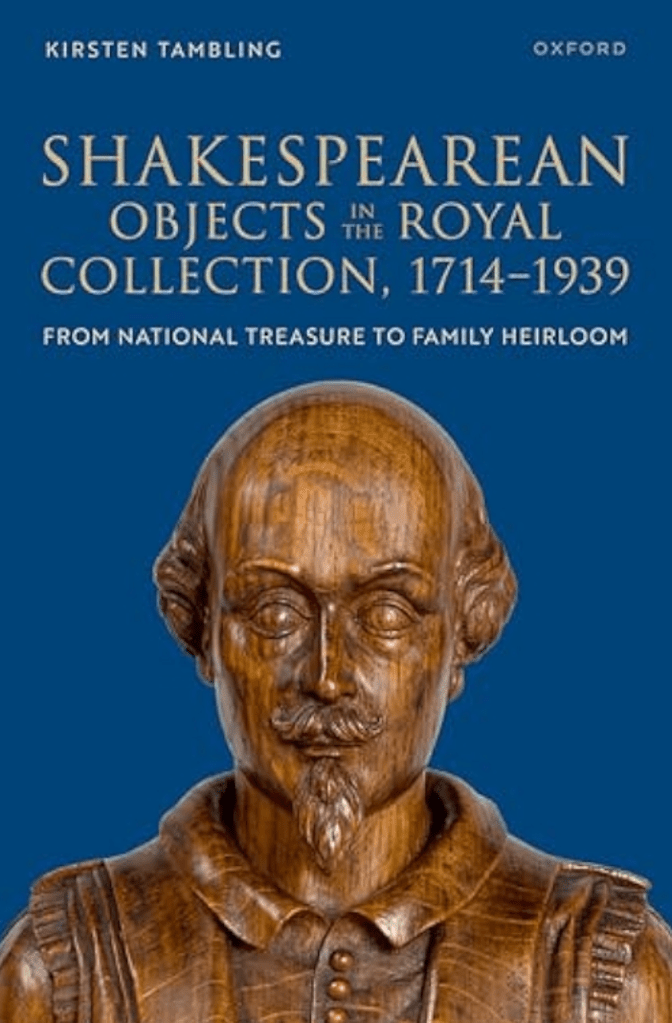 The British royal collection includes nearly 2,000 objects with a connection to Shakespeare. What stories do these objects tell of the relationship between the man often described as Britain’s ‘national poet’ and Britain’s royal family? Royal collecting of Shakespeare did not really begin until 1714, and has therefore broadly tracked the development, and entrenchment, of the Hanoverian—and latterly the Saxe-Coburg Gotha—royal family. Not entirely coincidentally, this period also saw a general increase in public interest in objects associated with Shakespeare’s life and biography, often to the detriment of Shakespeare’s works—a development partially spearheaded by the ‘Shakespeare Jubilee’ masterminded by the actor David Garrick at Stratford-upon-Avon in 1769. The histories of specific works of art in the royal collection, from Thomas Gainsborough’s painting of Mary Robinson to a collection of relic objects relating to ‘Herne’s Oak’ and Shakespeare’s mulberry tree, reveal how royal engagement with Shakespearean objects between 1714 and 1939 contributed to the development of a new constitutional settlement between the monarchy and its subjects under George IV, Queen Victoria, and George V and Queen Mary. During this period, objects relating to Shakespeare—increasingly regarded (by the royal family) as nostalgic souvenirs from a fantastical national past—were useful tools in shoring up these ideas, and in yoking the fortunes of the British monarchy to a new vision of shared national history.
Kirsten Tambling completed her PhD in History of Art at Birkbeck, University of London on the art of Jean-Antoine Watteau and William Hogarth. She was a postdoctoral research associate for ‘Shakespeare in the Royal Collection’ and subsequently Associate Lecturer on the Curating the Art Museum programme at the Courtauld Institute of Art. She has worked in various museums and collections, including the Royal Collection Trust and Watts Gallery, where she was co-curator of the exhibition James Henry Pullen: Inmate, Inventor, Genius (2018). She has published articles on eighteenth-century art, the intersection of art and psychiatry, and the history of collections.
c o n t e n t s
Introduction
1 Remembering Perdita
2 A Present from Stratford
3 Old Wives’ Tales
4 Sweet Anne Page and the Family Settlement
Coda: Queen Mary Arranges the Collection
Conclusion: Serried Accumulations
New Book | Shakespeare’s Afterlife in the Royal Collection
From Oxford UP:
Sally Barnden, Gordon McMullan, Kate Retford, and Kirsten Tambling, eds., Shakespeare’s Afterlife in the Royal Collection: Dynasty, Ideology, and National Culture (Oxford: Oxford University Press, 2025), 272 pages, ISBN: 978-0198923152, $40.
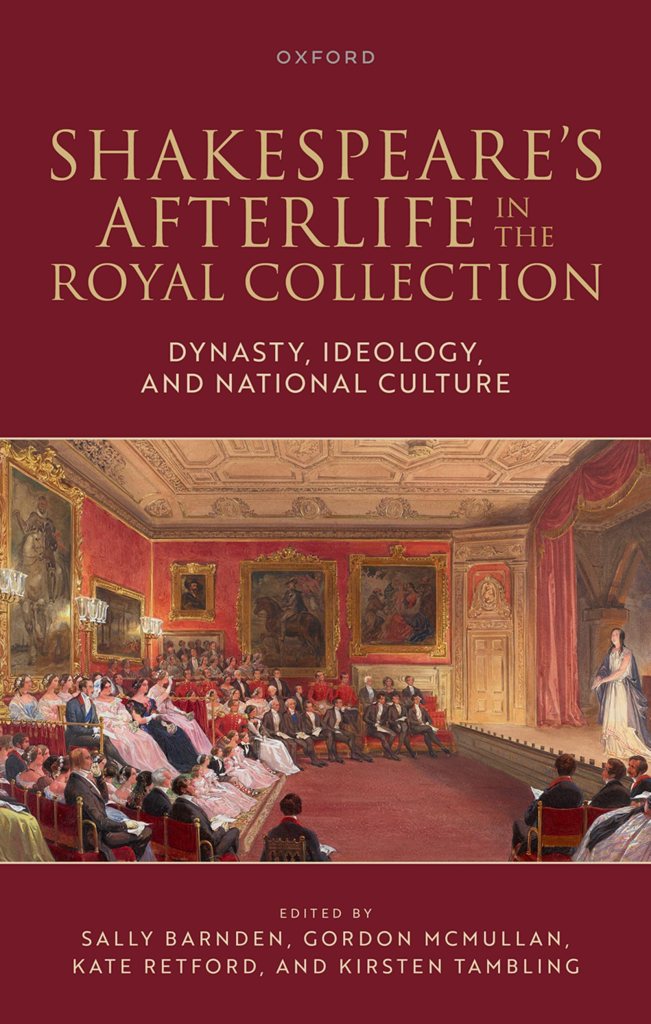 This collection of essays and images explores a series of objects in the Royal Collection as a means of assessing the interrelated histories of the British royal family and the Shakespearean afterlife across four centuries. Between the beginning of the eighteenth century and the late twentieth, Shakespeare became entrenched as the English national poet. Over the same period, the monarchy sought repeatedly to demonstrate its centrality to British nationhood. By way of close analysis of a selection of objects from the Royal Collection, this volume argues that the royal family and the Shakespearean afterlife were far more closely interwoven than has previously been realized.
The chapters map the mutual development over time of the relationship between members of the British royal family and Shakespeare, demonstrating the extent to which each has gained sustained value from association with the other and showing how members of the royal family have individually and collectively constructed their identities and performed their roles by way of Shakespearean models. Each chapter is inspired by an object in (or formerly in) the Royal Collection and explores two interconnected questions: what has Shakespeare done for the royal family, and what has the royal family done for Shakespeare? The chapters range across the fields of art, theatre history, literary criticism, literary history, court studies and cultural history, showing how the shared history of Shakespeare and the royal family has been cultivated across media and across disciplines.
c o n t e n t s
Introduction — Sally Barnden, Gordon McMullan, Kate Retford, and Kirsten Tambling
1616
1 The ‘Disappointment’ of Charles I’s Shakespeare Second Folio — Gordon McMullan
1700
2 Henry V and Early Hanoverian Self-Fashioning — Emrys Jones
3 ‘A Wild and Unruly Youth’ — Kate Retford
4 Moral Painting — Shormishtha Panja
5 David Garrick and the President’s Chair — Anna Myers
6 Queen Charlotte and the Royal Narratives of Boydell’s Shakespeare Prints — Rosie Dias
7 George III and the Other ‘Mad King’ — Arthur Burns
8 Disability and Mutable Spectatorship — Essaka Joshua
9 Fake and Authentic Shakespeare — Fiona Ritchie
1800
10 ‘Well-Authenticated Blocks’ — Mark Westgarth
11 Why Did George IV Own a Shakespeare First Folio? — Emma Stuart
12 From Performance to Portfolio — Kate Heard
13 Hamlet Disowned — Michael Dobson
14 Princess Victoria and the Cult of Celebrity — Lynne Vallone
15 Shakespeare in the Rubens Room — Eilís Smyth
16 Monument and Montage — Sally Barnden
17 Puck and the Prince of Wales — Gail Marshall
18 Much Ado about Tapestry — Morna O’Neill
19 Disappearances and The Durbar — Vijeta Saini
1900
20 ‘All England in Warm Sepia’: Queen Mary and the Church of the Holy Trinity — Kirsten Tambling
21 Shakespeare in Miniature — Elizabeth Clark Ashby
22 Shashibiya — Eleine Ng-Gagneux
23 Cultural (Dis)inheritance and the Decline of Empire in The Prince’s Choice — Kathryn Vomero Santos
Bibliography
New Book | Shakespeare and the Royal Actor: Performing Monarchy
From Oxford UP:
Sally Barnden, Shakespeare and the Royal Actor: Performing Monarchy, 1760–1952 (Oxford: Oxford University Press, 2025), 272 pages, ISBN: 978-0198894971, $110.
 Shakespeare and the Royal Actor argues that members of the royal family have identified with Shakespearean figures at various times in modern history to assert the continuity, legitimacy, and national identity of the royal line. It provides an account of the relationship between the Shakespearean afterlife and the royal family through the lens of a broadly conceived theatre history suggesting that these two hegemonic institutions had a mutually sustaining relationship from the accession of George III in 1760 to that of Elizabeth II in 1952. Identifications with Shakespearean figures have been deployed to assert the Englishness of a dynasty with strong familial links to Germany and to cultivate a sense of continuity from the more autocratic Plantagenet, Tudor, and Stuart monarchs informing Shakespeare’s drama to the increasingly ceremonial monarchs of the modern period. The book is driven by new archival research in the Royal Collection and Royal Archives. It reads these archives critically, asking how different forms of royal and Shakespearean performance are remembered in the material holdings of royal institutions.
Sally Barnden is a Lecturer in Literature and Visual Culture at Swansea. She has taught Shakespeare and early modern literature at King’s College London, the University of Oxford, Queen Mary University, Brunel, and Central School of Speech and Drama. Her first book, Still Shakespeare and the Photography of Performance, was published by Cambridge University Press in 2020, and her scholarship has been published in Shakespeare Bulletin, Theatre Journal, and in the collection Early Modern Criticism in a Time of Crisis. As part of the AHRC-funded project ‘Shakespeare in the Royal Collection,’ she co-created a database and virtual exhibition, which are available online at http://www.sharc.kcl.ac.uk.
c o n t e n t s
Introduction
1 Player Queens
2 Libertines
3 Warlike Effigies
4 Domestic Virtues
5 Royal Bodies
Epilogue










 Enfilade
leave a comment