Conference | Servants, Labourers, and the Manorial World
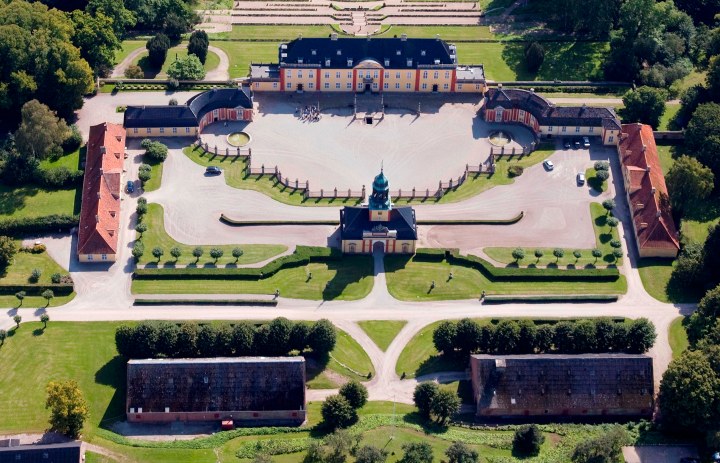
Johan Cornelius Krieger, Ledreborg Castle, Denmark (about 30 miles west of Copenhagen). Most of the house was constructed in the 1740s.
◊ ◊ ◊ ◊ ◊
From ENCOUNTER:
Servants, Labourers, and the Manorial World: Alternative Perspectives
9th ENCOUNTER Conference
Ledreborg Castle, Denmark, 9–11 October 2025
The European Network for Country House and Estate Research (ENCOUNTER) is pleased to host its ninth conference, organized in collaboration with The Danish Research Centre for Manorial Studies and Gammel Estrup, The Danish Manor Museum.
The manor or country house is often viewed exclusively as a stage for the economic and political elite of the past, a setting for splendour, luxury, and self-presentation. However, the world of the manor also included a well-defined hierarchy consisting of landowning families, tenant farmers, servants, craftsmen and labourers, all negotiating the dynamics of power. Ideally, the manor operated as a paternalistic institution built on mutual obligations: masters provided care and protection and subordinates offered work, loyalty and obedience. This relationship was both a practical arrangement and an ideological framework, a power dynamic and a manifestation of social inequality.
These historical structures could however be a source of both resistance and conflict as well as support and benevolence. On a larger scale, country houses became both targets and symbols during major confrontations, from peasant revolts to revolutions and civil wars. On a smaller scale, historical court records reveal conflicts involving servants and owners or the owners’ representatives. Conversely, the manor provided the social framework for many people’s lives, offering employment, housing, and protection. Country house owners offered patronage and sought to cultivate the religious and moral development of their staff and communities. Loyal service was rewarded with promotions and comfortable living conditions. Manors funded churches, schools, alms-houses, and gave donations. However, the nineteenth century brought dramatic social changes, as industrialisation drew labor and wealth into the urban centres. To what extent were these changes driven by further political developments and societal reforms? Was social change in a rural context a one-way phenomenon dictated by landowners?
This ENCOUNTER conference will explore these dynamics, primarily focusing on a bottom-up perspective, highlighting the master-servant relationship in its full paternalistic scope, and addressing household, villages, rural communities, etc. This includes shedding light on the conditions and material realities for servants and workers, as well as the organisational structures. And to explore conflicts/resistance and limits within the relationship, as well as changes in the nature and conditions of the relationship over time.
ENCOUNTER was founded in Denmark in 2015 and has since provided a framework for interaction between scholars and cultural institutions in Europe sharing a professional interest in the research and interpretation of manor and country house history. The conference thus also marks the network’s 10th anniversary.
Abstracts for each paper are available here»
t h u r s d a y , 9 o c t o b e r
8.40 Bus departure from Scandic Roskilde
8.55 Bus departure from Roskilde Station
9.15 Arrival Ledreborg Estate
10.00 Welcome — Kasper Steenfeldt Tipsmark (Gammel Estrup The Danish Manor & Estate Museum) and Signe Boeskov (The Danish Research Centre for Manorial Studies)
10.15 Keynote
• Aristocratic Servants in 17th-Century Sweden: Gender, Recruitment, and Career — Svante Norrhem (Lund University)
10.55 Session 1 | Servants
Chair: Kasper Steenfeldt Tipsmark
• Servants’ Property and Material Culture on Swedish Manors, 1770–1870 — Göran Ulväng (Uppsala University)
• The Organisation of the Household: The Role of High-Ranking Servants at 19th-Century Danish Manors — Signe Boeskov and Søren Broberg Knudsen (The Danish Research Centre for Manorial Studies)
• Behind the Scenes of the Manor — Aina Aske (Vestfoldmuseene IKS) and Lars Jacob Hvinden-Haug (Norwegian Institute for Cultural Heritage Research, NIKU)
• Hidden Doors and Secret Passages: Telling the Story of Servants in Eidsvoll House — Solveig Therese Dahl (Eidsvoll 1814, The Norsk Folkemuseum foundation)
13.00 Lunch
14.10 Guided tour Ledreborg
15.25 Session 2 | Labour and Estate Community
Chair: Paul Zalewski (European University of Viadrina)
• The Transition from Serfdom to the Industrial Worker in the Vodka Distillery of the Estonian Manor during the 19th Century — Mirje Tammaru (Estonian Academy of Arts)
• Arm Wrestling: Agency and Negotiations between Tenant Farmers and the Big House: An Alternative Perspective from Four 18th-Century Estates in the Netherlands — Gerrit van Oosterom, (independent researcher)
• Labourers on the Estate—Esbogård, 1770–1920 — Tryggve Gestrin (Espoo City Museum)
• Work, Family, Security: The Relationships and Life Strategies within the Håkansböle Manor Community — Eeva Kotioja (Vantaa City Museum)
17.30 Discussion and break
18.45 Dinner at Restaurant Herthadalen
f r i d a y , 1 0 o c t o b e r
8.10 Bus departure from Scandic Roskilde
8.25 Bus departure from Roskilde Station
8.45 Arrival Ledreborg Estate
9.30 Early Career Keynote
• Early Modern Estates as Communities of ‘Care’: Medical Practice across the Social Hierarchy in Rural England, 1650–1750 — Emma Marshall (University of Birmingham and University of York)
10.10 Session 3 | Care and Crisis
Chair: Hanneke Ronnes (University of Groningen)
• A Manorial World in Miniature? The Hospital of Laurvig County in the 18th Century — Arne Bugge Amundsen (University of Oslo)
• The State, the Subjects, and the Lord: Conflicts at Ängsö Manor, 1690–1710 — Joakim Scherp (Stockholm University and The Riksdag Library)
• Caring Beyond the Grave? The Estate of Denis Roest van Alkemade (1720–1791) — Thijs Boers (Amsterdam Museum and University of Amsterdam)
12.15 Lunch
13.35 Bus departure for Gisselfeld
14.30 Guided tour of Gisselfeld
16.45 Departure for Vallø
17.20 Guided tour of Vallø
19.00 Dinner at Vallø Slotskro
s a t u r d a y , 1 1 o c t o b e r
8.10 Bus departure from Scandic Roskilde
8.25 Bus departure from Roskilde Station
9.30 Guided tour of Gjorslev
11.15 Departure for Gavnø
12.35 Lunch at Café Tulipanen / Guided tour of Gavnø
14.45 Bus departure
16.15 Arrival Scandic Roskilde
16.30 Arrival Roskilde Banegård










 Enfilade
leave a comment