Conference | 18th-C. Painting between Italy and the Hapsburg Empire
From the Department of Art History at the Universität Wien:
Settecento Malerei: Cultural Transfer between Italy and the Habsburg Territories
Online and in-person, Department of Art History of the University of Vienna, 23–24 October 2025
Organized by Eleonora Gaudieri and Erika Meneghini
Registration due by 19 October 2025
 The beginning of the Settecento was characterised by a considerable expansion of the transalpine art market, driven by a strong interest in collecting Italian artworks. This phenomenon attracted numerous Italian artists, including many painters, to Vienna and its allies, the courts of the German prince-electors of Schönborn, Wittelsbach and others. At the same time, a number of Austrian painters were encouraged to further their training in Italy, where they were profoundly influenced by the local visual language. The high quality and renowned tradition of Italian painting, fostered by a dense network of international connections, enabled numerous artists of Italian origin, as well as Italians by adoption, to pursue successful careers at the Habsburg imperial court in Vienna. This phenomenon must be understood within the broader context of the diplomatic and artistic networks that connected Vienna with key centres on the Italian peninsula, such as Venice, Bologna, Rome, and Naples.
The two-day workshop will provide a wide-ranging exploration of 18th-century Italian painting as a focal point for transfer phenomena between the Italian peninsula and the domains of the Habsburg Empire, with a special focus on Vienna as the imperial capital. The proceedings will open with the keynote speech by Cecilia Mazzetti di Pietralata. The subsequent sixteen presentations have been organised into four sections, reflecting the variety of perspectives through which these historical and artistic phenomena can be approached: Collecting Italian Painting in the Habsburg Empire; Artworks and Material Objects as Vehicles of Cultural Transfer; Artists as Transregional Agents Between Italy and the Habsburg Regions; and The Role of Academies and Museums in the Transfer of Knowledge. The objective of this study day is on one hand to examine the meanings and functions of Italian painting within the socio-political and cultural context of the Habsburg imperial court in Vienna and its allied courts; and on the other hand, to explore the various dynamics that fostered the transfer of Italian painting and Italian artistic knowledge to Vienna and the territories of the then Habsburg Empire.
The conference languages are English, German, and Italian. A livestream of the event will be available. Please confirm your attendance in-person or online via email to settecentomalerei@gmail.com by 19 October. If you have any questions, please contact the organisers: Eleonora Gaudieri and Erika Meneghini.
Dr. Eleonora Gaudieri, eleonora.gaudieri@univie.ac.at
Postdoctoral Researcher (APART-GSK funding programme, ÖAW)
Department of Art History, University of Vienna
Erika Meneghini MA, erika.meneghini@univie.ac.at
PhD Candidate
Department of Art History, University of Vienna
The workshop is supported by the Department of Art History and the Vienna Center for the History of Collecting at the University of Vienna. Funding is provided by the Faculty of Historical and Cultural Studies at the University of Vienna, the City of Vienna, and the Austrian Academy of Sciences.
t h u r s d a y , 2 3 o c t o b e r
9.00 Welcome
9.30 Keynote
• Cecilia Mazzetti di Pietralata (University of Cassino and Southern Lazio) — Vienna italiana: Forme e attori dello scambio culturale tra Sei e Settecento, tra immigrazione artistica e vocazione internazionale dell’aristocrazia europea
10.30 Coffee Break
10.50 Section 1 | Collecting Italian Painting in the Habsburg Empire
Moderator: Silvia Tammaro
• Stefan Albl (Schloss Eggenberg & Alte Galerie, Graz) — Il dilemma della scelta: L’arrotino di Giacomo Francesco Cipper
• Ilaria Telesca (University of Naples ‘Federico II’) — Arte e potere: La committenza artistica dei viceré austriaci di Napoli
• Jiří Štefaňák (Masaryk University, Brno) — Non multa, sed multum: Italian Painting in the Collections of the Moravian Aristocracy at the End of the 18th Century
12.30 Lunch Break
14.00 Section 2 | Artworks and Materials Objects as Vehicles of Culture Transfer
Moderator: Eleonora Gaudieri
• Ada Berktay (Sakıp Sabancı Museum, Istanbul) — Lepanto as Material Allegory: Naval Triumph and the Politics of Display in Italian and Habsburg Visual Culture
• Tomáš Kowalski (Monuments Board of the Slovak Republic, Bratislava) — Baroque Illusion: Italian Settecento Frescoes in Slovakia
• Beatrice Bolandrini (Università e-Campus; Accademia del Lusso, Milan) — Anton Giorgio Clerici ed Annibale Visconti, ‘consiglieri intimi’ di Carlo VI e Maria Teresa, committenti di Giambattista Tiepolo e Mattia Bortoloni
• Tomáš Valeš (Masaryk University, Brno) — Shared, ‘Recycled’, Reinvented: Art of Venetian Settecento in the Hands of ‘Viennese’ 18th-Century Painters
• Erika Meneghini (University of Vienna) — From Naples to Vienna and the Habsburg Lands: The Artistic Reception of Francesco Solimena’s Oeuvre beyond the Alps
19.00 Conference Dinner
f r i d a y , 2 4 o c t o b e r
9.00 Section 3 | Artists and Transregional Agents between Italy and the Habsburg Regions
Moderator: Erika Meneghini
• Francesco Ceretti (University of Pavia) — Pietro Bellotti: Da Venezia alle corti mitteleuropee
• Eleonora Gaudieri (University of Vienna) — Daniele Antonio Bertoli: Traces of his Activity at the Habsburg Court in Vienna
• Enrico Lucchese (University of Campania ‘Luigi Vanvitelli’) — I soggiorni viennesi e nei territori asburgici di Antonio Pellegrini (1675–1741)
• Sanja Cvetnić (University of Zagreb) — Federico Bencovich as Transregional Artist
• Laura Facchin (University of Insubria, Varese) — Angelica Kauffmann: Painter of the Habsburg Court from Milan to Vienna
12.00 Lunch Break
13.30 Section 4 | The Role of Academies and Museums in the Transfer of Knowledge
Moderator: Stefan Albl
• Susanne Müller-Bechtel (University of Würzburg) — Figur–Pose–Wissen: Das akademische Aktstudium als epistemische Kunstpraxis in Rom, Wien und Mailand
• Lorenzo Giammattei (Sapienza University of Rome) — The Antique in the Drawings of Austrian Artists in Rome in the Second Half of the 18th Century
• Paolo Pastres (Independent Researcher, Udine) — Vienna e Firenze nel Settecento: Due modelli museali a confronto
15.00 Coffee Break
15.20 Final Discussion
16.45 Optional visit to the Schönbrunn Chapel and the Blue Staircase
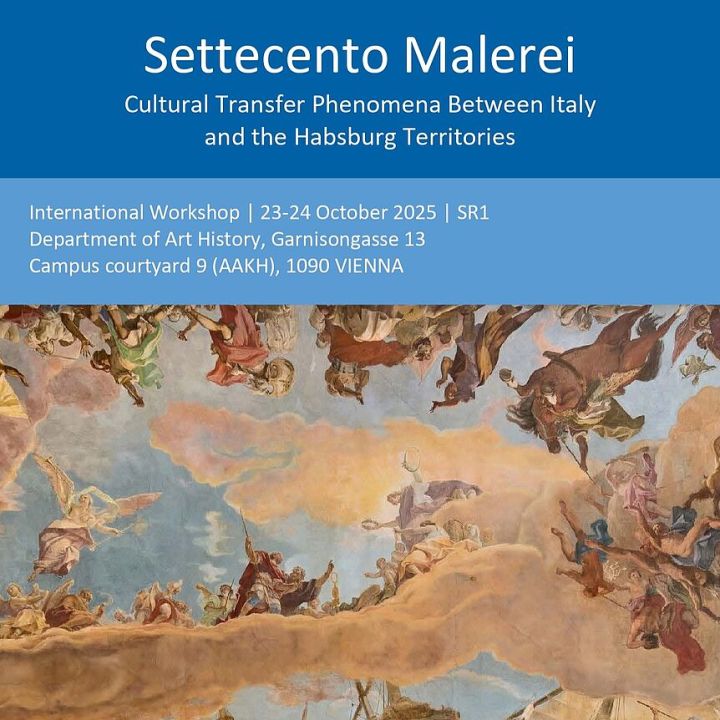
Poster Image: Sebastiano Ricci, Allegory of the Princely Virtues, Blue Staircase, Schönbrunn Palace, 1702 (Vienna).
Exhibitions | Casanova and Venice / Casanova and Europe
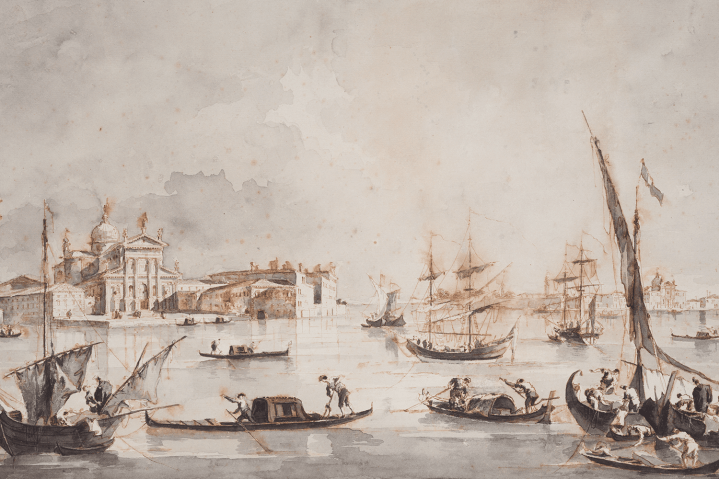
Francesco Guardi, View of San Giorgio Maggiore
(Venice: Fondazione Giorgio Cini)
◊ ◊ ◊ ◊ ◊
From the Fondazione Giorgio Cini:
Casanova and Venice
Palazzo Cini, Venice, 27 September 2025 — 2 March 2026
Casanova and Europe: An Opera in Multiple Acts
San Giorgio Maggiore, Venice, 17 October 2025 – 2 March 2026
 On the 300th anniversary of the birth of Giacomo Casanova (1725–1798), the Fondazione Giorgio Cini is dedicating a major exhibition and cultural project to the celebrated Venetian. The first chapter of the double exhibition opens at Palazzo Cini in San Vio on September 27. Curated by the Institute of Art History, with the participation of the Institute for Theater and Opera, the exhibition traces the multifaceted figure of Casanova—scholar, memoirist, philosopher, alchemist, traveler, and diplomat—throughout a restless century that ended with the fall of the Serenissima. Through nearly one hundred works including paintings, engravings, books, objets d’art, and documents from the Foundation’s collections and prestigious Italian and European institutions, the exhibition recounts the refined, cultured, and contradictory world of the Venetian 18th century—Casanova’s century.
The exhibition is part of a wider cultural program involving all the Fondazione Giorgio Cini institutions, with conferences, concerts, and seminars dedicated to the link between Casanova, Venice, and Europe. The aim is to present a complex and multidisciplinary portrait of one of the most iconic figures in the history of Venice, who was a central figure during the final century of the Serenissima’s existence. The Foundation celebrates the European spirit embodied by Casanova.
“The project dedicated to Casanova is an opportunity to highlight the deep connection between the Fondazione Giorgio Cini and the city, its history, and its cultural context, drawing inspiration,” explains President Gianfelice Rocca, “from the great personalities and significant themes that have shaped history. It is an opportunity to emphasise the expertise, research, and collaboration between the Foundation’s Institutes and Centres in an international context. The Foundation’s vocation is to be an active participant, through this and other events, in the global stage of dialogue based on cultural diplomacy as a useful and necessary tool to respond to an era like ours, in which cultures and civilisations risk becoming enemies, unable to listen to, understand, and collaborate with each other.”
The Scientific Director, Daniele Franco, emphasises, “Fondazione Giorgio Cini is working to propose a reading of Casanova that goes beyond the usual imagery, the ‘myth’ that has become entrenched in traditional interpretations surrounding him. The primary aim is to highlight a complex character, a man who, from Venice, travels throughout Europe, in a historical period of rapid cultural and political change, where a vision of European society begins to emerge, one that is permeated by uncertainties, tensions, and an increasingly open and complex cultural debate. In Casanova’s writings, we can find many of the contradictions and forces for change that Europe is grappling with today.”
• Casanova e Venezia, at Palazzo Cini (27 September 2025 – 2 March 2026) with a focus on Venice, the birthplace and the first stage of Casanova’s life.
• Casanova e l’Europa: Opera in più atti, on the island of San Giorgio Maggiore (17 October 2025 – 2 March 2026), a look at Europe and the network of travels, relationships, and adventures that made Casanova an ante litteram European figure. The exhibition is produced in collaboration for the staging with the Fondazione Teatro La Fenice.
◊ ◊ ◊ ◊ ◊
Note (added 2 November 2025) — The press release for Casanova e l’Europa: Opera in più atti is available here.










 Enfilade
leave a comment