Exhibition | Mary Linwood: Art, Stitch and Life
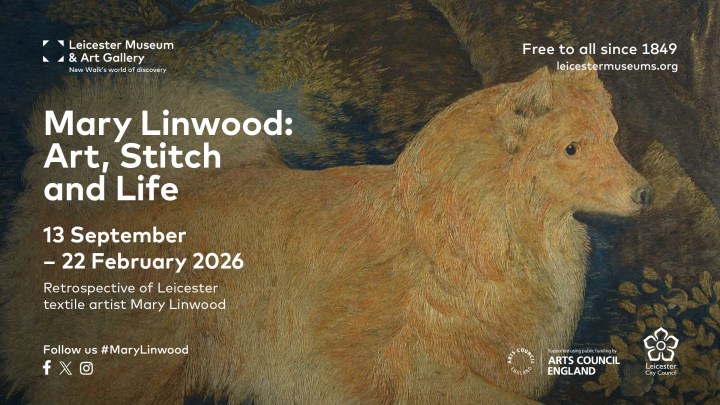
Mary Linwood, Pomeranian Dog, detail, needlework, 68 × 86 cm
(Leicester Museum & Art Gallery)
◊ ◊ ◊ ◊ ◊
Now on view, as noted by Adam Busiakiewicz for the Art History News blog:
Mary Linwood: Art, Stitch, and Life
Leicester Museum & Art Gallery, 13 September 2025 — 22 February 2026
A retrospective of the Leicester textile artist Mary Linwood (1755–1845)
Leicester’s Mary Linwood was a celebrity artist in the early 1800s but has since been largely forgotten. She created detailed embroidered versions of famous British paintings using a technique known as needle painting. Linwood was not only a talented artist but also an innovator and entrepreneur. Alongside running a successful school for young ladies in Leicester, she exhibited her embroidered works in touring exhibitions and established the first gallery in London to be run by a woman. In her lifetime, Linwood was supported by the wealthy and powerful, and was widely respected and well known. Since her death, however, she has been overlooked and undervalued. This exhibition is the first retrospective of Mary Linwood’s work since 1945, featuring 14 embroidered works from the Leicester Museums collections. Alongside these historic pieces are new textile artworks by Ruth Singer, reflecting on Linwood’s life and legacy.
Ruth Singer, Lost Threads: Mary Linwood’s Legacy (2025), 60 pages, £15. Available for purchase here.
◊ ◊ ◊ ◊ ◊
It’s also a fine opportunity to remind readers of Heidi Strobel’s recent book, The Art of Mary Linwood: Embroidery, Installation, and Entrepreneurship in Britain, 1787–1845. –CH
Call for Papers | The Art of the Syllabus
From ArtHist.net:
The Art of the Syllabus
Centre for Research in Visual Culture, University of Nottingham, January — June 2026
Proposals due by 17 November 2025
Every year the Centre for Research in Visual Culture organises its seminar programme around a given theme. This year’s theme is The Art of the Syllabus, and for the first time we are inviting scholars to propose papers to present as part of our research programme from January to June 2026.
In histories of the teaching of art, photography, and art history, the syllabus is often sidelined. Teachers, students, institutions, even government policy: these are the threads usually pulled upon to tell this history. There is a logic to this marginalisation. Without a teacher, students, or an institution, a syllabus is redundant—a dormant document awaiting activation. Moreover, even though archives are filled with records of syllabi that have been activated, anyone who has been in a classroom knows that the syllabus itself is a poor record of what was discussed. At the same time, the syllabus captures a kind of pre-history of the classroom. It is a record of the best intentions of the teacher before the reality of the students (and the institution) intervenes. By using the syllabus as the starting point for our discussions, we are hoping we might capture the histories of teaching that never came to pass as well as those that did.
If our theme relates to your current research, we would like to hear from you. We are especially interested in hearing from scholars working on pre-twentieth century histories of art, photography, and art history pedagogy, although scholars of the twentieth- and twenty-first centuries are of course welcome as well. We are less interested in hearing about completed research projects. Conversely, if you are at the beginning of a project that resonates with our call, please do consider working through your early ideas at the CRVC. Please send a short (250 word) blurb and (50 word) bio to chloe.julius@nottingham.ac.uk by 17 November. All of our seminars take place in person on Wednesdays at 4pm. Talks should be planned to run for 45 minutes to an hour, and will be followed by a lively discussion. Travel will be reimbursed up to £150.










 Enfilade
leave a comment