New Book | Americana Insights, Pennsylvania German Redware
From Penn Press:
Lisa Minardi, ed., Americana Insights 2025 (Philadelphia: University of Pennsylvania Press, 2025), 300 pages, ISBN: 979-8988533122, $65. With contributions by Johanna Brown, Laini Farrare, R. Erich Hess, Christopher Malone, Lisa Minardi, Karl Pass, Candace Perry, Jeffrey Pressman, Jean Renshaw, Justin Thomas, and Adam Zayas.
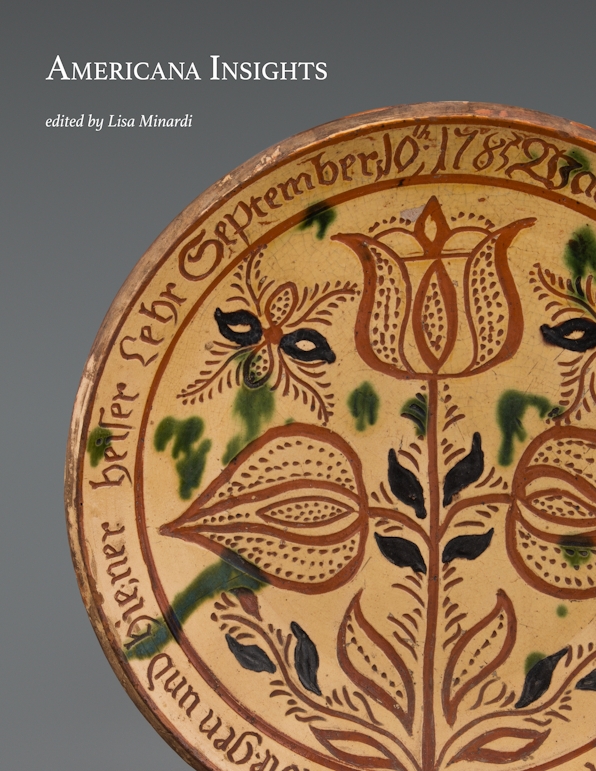 A comprehensive study of Pennsylvania German redware and a celebration of this vibrant folk art tradition
Americana Insights 2025 is the third volume in an annual series that presents the latest research and discoveries on traditional Americana, folk art, and material culture. In this volume the authors explore a beloved aspect of American folk art—Pennsylvania German redware. Focusing on redware’s production, use, and collecting in southeastern Pennsylvania from the mid-eighteenth to early twentieth century, the authors provide fresh insights into renowned potters such as Georg Hubener and Samuel Troxel as well as lesser-known figures. Other essays delve into the work of twentieth-century potters like Jacob Medinger, considered the last of the traditional Pennsylvania German potters, and Mildred Keyser, a pioneering revivalist potter. The authors also explore broader themes, including the use of political imagery and hunting iconography, and redware’s role in cultural exchange between Anglo-Americans and Pennsylvania Germans. A celebration of this vibrant folk art tradition and a vital scholarly contribution, Americana Insights 2025 represents the most comprehensive study of Pennsylvania German redware in more than a century.
Lisa Minardi is a curator and scholar of Pennsylvania German art and culture. She has organized numerous exhibitions and published extensively and was assistant curator at Winterthur Museum from 2006 to 2016. Minardi currently serves as executive director of Historic Trappe and the Center for Pennsylvania German Studies. She is a PhD candidate in the History of American Civilization Program at the University of Delaware, where she is researching the German-speaking community of early Philadelphia for her dissertation. She holds an MA from the Winterthur Program in Early American Culture and a BA in history and museum studies from Ursinus College.
Turner’s ‘Battle of Trafalgar’ Back on Display at Greenwich
◊ ◊ ◊ ◊ ◊
From the press release (via Art Daily) . . .
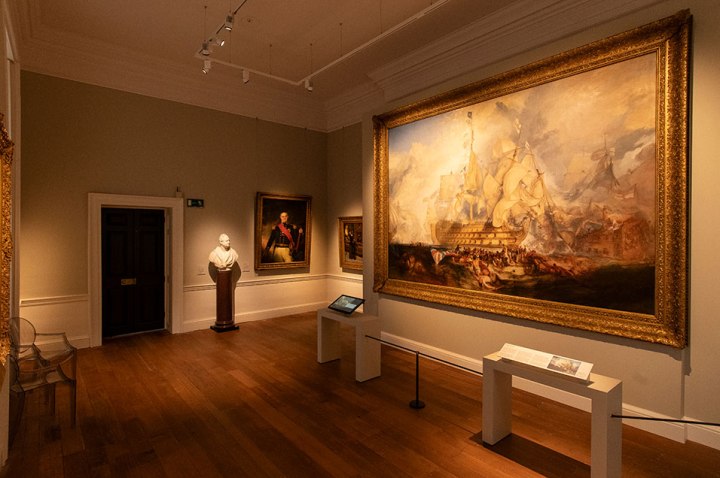
2025 marks the 250th anniversary of the birth of Joseph Mallord William Turner (1775–1851), one of Britain’s most admired Romantic painters. To commemorate this landmark anniversary, the National Maritime Museum is returning one of Turner’s most important masterpieces to display in the Queen’s House. The Battle of Trafalgar will be on public display from 21 October 2025, 220 years to the day since the Battle of Trafalgar.
Measuring more than three metres across, The Battle of Trafalgar is the largest painting that Turner ever completed. It commemorates the most decisive naval action of the Napoleonic Wars, the victory of the British Royal Navy over a combined French and Spanish fleet off Cape Trafalgar on 21 October 1805. The painting was made for King George IV in 1824—Turner’s only royal commission. It initially attracted criticism from naval officials, who complained about factual inaccuracies, but it was later acclaimed as a highlight of the Naval Gallery—a popular public art gallery set within the grounds of the Royal Hospital for Seamen at Greenwich.
In The Battle of Trafalgar, Turner captures the human drama of the action, from the struggles of the ordinary sailors to the fatal wounding of their commander, Vice-Admiral Horatio Nelson. The finished composition is a symbolic amalgamation of different moments in the battle. Nelson’s flagship, Victory, is depicted on an exaggerated scale, an artistic decision intended to emphasise the might of British naval power. The ship’s falling foremast, bearing the vice-admiral’s flag, symbolises Nelson’s demise. The signal flags spell the final three letters of ‘duty’, referencing both Nelson’s famous order, “England expects every man to do his duty,” and some of his dying words, “Thank God I have done my duty.”
The French ship Redoubtable, from which the fatal shot came, foundered in a storm after the battle but is depicted sinking in the thick of the action. In compressing the timeline, Turner emphasised the defeat of the Franco-Spanish fleet. However, while celebrating Britain’s triumph, Turner did not shy away from the brutal realities of naval warfare and encouraged respect and sympathy for sailors manning the ships on both sides of the conflict. In the centre of the image, at what would have been eye level when the painting was first displayed in St James’s Palace, the lifeless eyes of a dead seafarer gaze out. The Latin word ‘ferat’ appears in the water beside him, recalling Nelson’s motto, Palam qui meruit ferat (‘Let him who has earned it bear the Palm’). The palm referenced in the motto was a traditional symbol of victory, but the sailor’s suffering undermines this noble ideal of glory.
 In 1829, George IV had Turner’s The Battle of Trafalgar transferred from St James’s Palace to the Naval Gallery. Greenwich Hospital, where the gallery was situated, provided accommodation for elderly and disabled naval veterans, many of whom had served at Trafalgar. This made it a fitting home for Turner’s painting, given its emphasis on the labour and suffering of common sailors.
The painting was taken off display in March 2024 to protect it during a capital project at the National Maritime Museum. Its new home places it within the heart of the Museum’s fine art collection in the Queen’s House art gallery. It will be displayed alongside artworks from the Museum’s collection that tell the story of its journey from St James’s Palace to the Naval Gallery at Greenwich.
A new book has also been published celebrating this exceptional artwork. J.M.W. Turner’s The Battle of Trafalgar: Commemoration and Controversy is part of Royal Museums Greenwich’s new Spotlight series. Curator Katherine Gazzard considers the challenges that Turner faced during the creation of the painting, the public response to it and the fascinating history that led to its place at the centre of a national art collection.
Katherine Gazzard, J.M.W. The Battle of Trafalgar: Commemoration and Controversy (Greenwich: Royal Museums Greenwich, 2025), 96 pages, ISBN: 978-1068765995, £13.










 Enfilade
leave a comment