Kit Maxwell to Lead Applied Arts of Europe at the Art Institute of Chicago
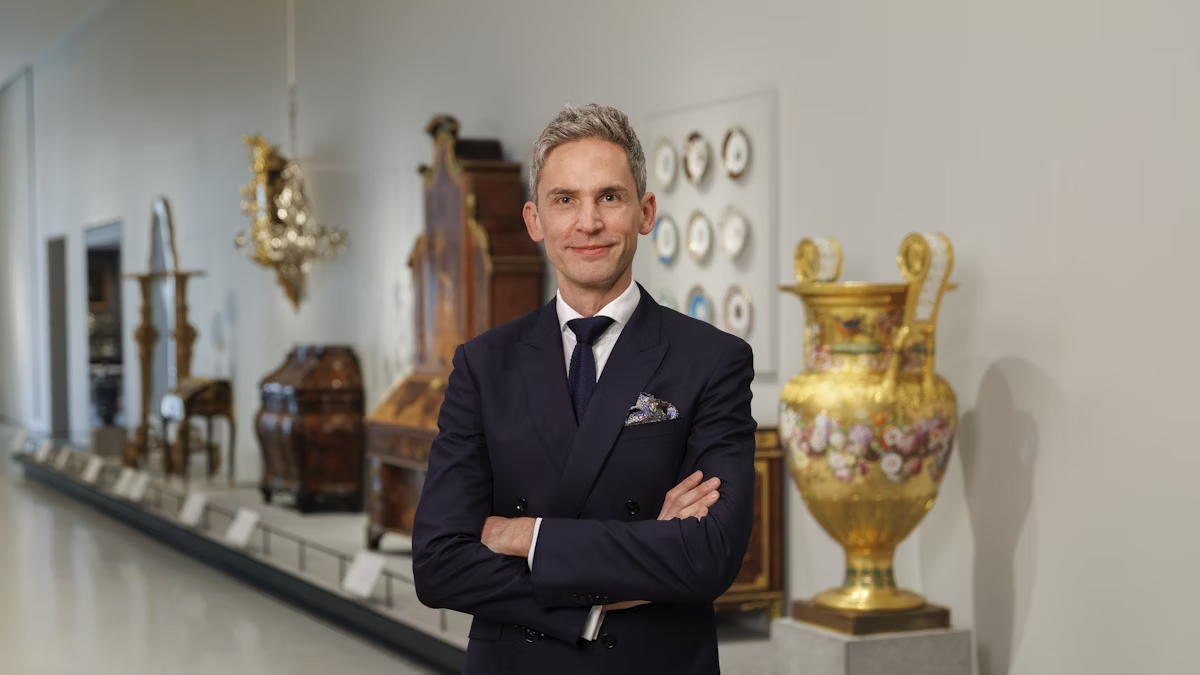
Kit Maxwell is the new Chair and Eloise W. Martin Curator of Applied Arts of Europe at the Art Institute of Chicago.
◊ ◊ ◊ ◊ ◊
From the AIC press release (13 October 2025) . . .
The Art Institute of Chicago is pleased to announce the appointment of Dr. Christopher (Kit) Maxwell to the position of Chair and Eloise W. Martin Curator of Applied Arts of Europe. In his role, Kit will lead the Applied Arts of Europe Department through continued gallery enhancements, strategic acquisitions, and dynamic gallery rotations. He has taken on this role upon Ellenor Alcorn’s retirement from the position.
Kit joined the museum in 2022 as the Samuel and M. Patricia Grober Curator of the department. He brought expertise in European ceramics and glass with a special interest in the impacts of global trade and colonial expansion on the development of European design. Through his work, Kit has contributed to the growth and development of the Applied Arts of Europe department, expanding the stories we tell through acquisitions and collection research.
“In just a few years, Kit has had a significant impact on the museum and the department,” said James Rondeau, President and Eloise W. Martin Director at the Art Institute of Chicago. “His work and collaboration played an essential role in the spectacular redesign of the recently opened Eloise W. Martin Galleries. We look forward to how his vision, expertise, and dedication will continue to build on the momentum of the department.”
The new Applied Arts of Europe galleries opened in July after a multi-year redesign project. The galleries present more than 300 objects from the Art Institute’s outstanding collection of furniture, silver, ceramics, and glass made between 1600 and 1900 and feature a new design vocabulary with cutting-edge casework and lighting. Working closely with Ellenor Alcorn, renowned Barcelona-based architectural firm Barozzi Veiga, and other colleagues, Kit co-curated this elegant installation to showcase the creativity and innovation that defined European design during an era of extraordinary transformation.
“I feel honored to have had the opportunity to work with Ellenor during her time at the museum and benefitted enormously from her incredible experience and generous collegiality,” said Kit Maxwell. “This department has so much to offer visitors—from the Thorne Miniature Rooms to the newly designed ceramics gallery—and I’m thrilled to have the opportunity to engage with our audiences in new and exciting ways.”
Prior to the Art Institute, Kit served as curator of early modern glass at the Corning Museum of Glass where he was responsible for collections from about 1250 to 1820, and researched innovations of 18th-century British glass and its relationship to global trade and colonial expansion. His 2021 exhibition at Corning, In Sparkling Company: Glass and the Costs of Social Life in Britain during the 1700s shed new light on the significance of glass in domestic, court, commercial, and scientific settings. Before the Corning Museum of Glass, Kit worked in several different capacities at the Royal Collection Trust, and from 2005 through 2010 he held the position of assistant curator in the Ceramics and Glass Section at the Victoria and Albert Museum.
Kit received his BA in the History of Art from University of Cambridge, his MA in Decorative Arts from University of London, and his PhD from University of Glasgow. His recent post-doctoral work includes a research degree in Nazi-era Provenance at the University of Glasgow, and another in Caribbean Studies at the University of Warwick.
Expanded V&A Gilbert Galleries to Open in March 2026
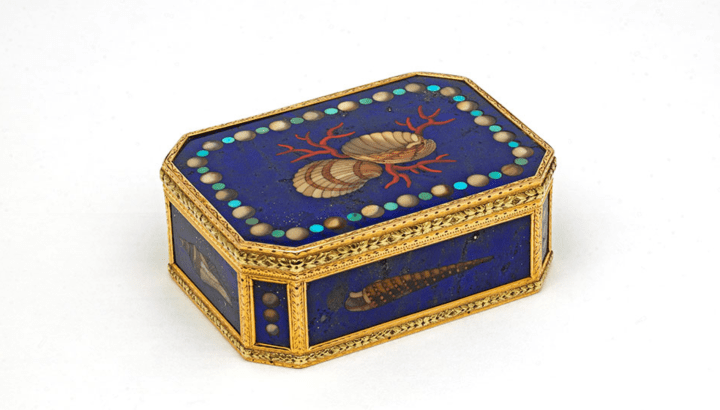
Rectangular, gold-mounted commessi di pietre dure (stone mosaics) snuffbox depicting shells and coral, Florence, Grand Ducal workshops, ca.1800
(The Rosalinde and Arthur Gilbert Collection on loan to the V&A)
◊ ◊ ◊ ◊ ◊
From the press release:
The Victoria and Albert Museum will double the size of its Gilbert Galleries in March 2026, unveiling seven newly transformed rooms dedicated to one of the world’s most dazzling collections of decorative arts. The free galleries will showcase masterpieces of silver, enamel, gold boxes, stone and glass micromosaics—including a monumental table-top made by Michelangelo Barberi for Tsar Nicholas I of Russia, newly revealed after pioneering laser cleaning by V&A conservators.
The transformation of the original gallery space will create the museum’s first double aspect gallery, overlooking both the John Madejski Garden and the Exhibition Road Quarter. The new gallery spaces have been achieved by incorporating adjacent former offices, re-opening historic brick archways and embracing natural sustainability through the reinstatement of original Victorian solar shading. As the only permanent V&A galleries devoted to a private collection the Gilbert Galleries offer a rare insight into the art of collecting and its role in shaping museums.
The new Gilbert Galleries have been designed by Citizens Design Bureau, the award-winning practice founded by Katy Marks, in their first collaboration with the V&A. The reopening marks the latest milestone in FuturePlan, the V&A’s ambitious programme of development at the South Kensington site which has transformed over 85% of the Museum’s public spaces in the past 15 years. FuturePlan combines world-class design with the restoration of the original building, creating inspiring new settings for the collections and ensuring greater access for all.
The galleries will showcase one of the world’s largest collections of glass micromosaics, now with a dedicated space allowing the majority of the objects in the Gilbert Collection to be seen together for the first time. Going on display for the very first time at the V&A are two large scale views of Rome by the master, Domenico Moglia. The large-scale format plaques, first shown in the UK at the Great Exhibition of 1851, depict views of the ruined Colosseum and the Roman Forum, intricately made with tiny pieces of coloured glass, some of only a few millimetres square. The glass micromosaic technique was developed in the 18th century in the Vatican Mosaic Workshop, which is still active today.
Over 200 gold boxes will take centre stage in a new room, displayed in the round to showcase their exquisite three-dimensional craftsmanship. Highlights include diamond-set snuffboxes commissioned by Frederick ‘the Great’ II of Prussia, including a mother-of-pearl box selected for the collection by Rosalinde Gilbert herself—offering a new lens on her role as collector and her career as a couture designer in London. Across the galleries, multisensory experiences will bring the collection to life—from touchable samples of rare stones to custom-blended scents—with extensive consultation ensuring inclusive design for neurodiverse visitors and those living with dementia. The galleries will also spotlight important new research into provenance. A dedicated room explores Nazi and Soviet looting, including the redisplay of two pairs of silver-gilt gates once taken from Kyiv-Pechersk Lavra monastery—the only examples of their kind outside the Orthodox world.
Tristram Hunt, Director of the V&A, said: “The Gilbert Galleries honour the transformative philanthropy of Rosalinde and Arthur Gilbert, celebrate some of the most exquisite works of art ever made, and now also explore the fascinating and sometimes complex histories behind them. As part of our FuturePlan transformation, this project combines cutting-edge design, pioneering conservation and the restoration of V&A South Kensington’s historic spaces to inspire creativity in every visitor.”
Alice Minter, Senior Curator of the Rosalinde & Arthur Gilbert Collection, said: “The Gilbert Collection is a feast for the eyes—from dazzling stone and glass mosaics and jewelled gold boxes to masterpieces of silver and enamel. With these new galleries, we can share the artistry of these extraordinary objects in more depth than ever before, while also asking important questions about their histories and journeys. It’s a chance for visitors to get closer to beauty, brilliance and craftsmanship on an intimate scale, but also to discover the personal stories of Rosalinde and Arthur Gilbert as collectors.”
Sir Arthur Gilbert (1913–2001, knighted in 2001) and his first wife Rosalinde (1913–1995) began their careers as fashion entrepreneurs in wartime London, showing at the V&A’s Britain Can Make It! exhibition in 1946 before moving to Los Angeles in 1949, where Arthur became a successful property developer. Their Beverly Hills home inspired a passion for historic objects, and from the 1960s they built an extraordinary collection of silver, gold boxes, enamel portrait miniatures and stone and glass mosaics, many once owned by figures such as Queen Charlotte, Tsarina/ Empress Catherine II of Russia, Frederick ‘the Great’ II of Prussia, Napoleon Bonaparte, Sir Robert and Horace Walpole, the Churchill and the Rothschild families. The collection was transferred to Great Britain in 1996 and has been in the care of the V&A since 2008.










 Enfilade
leave a comment