The Burlington Magazine, October 2025
The long 18th century in the October issue of The Burlington:
The Burlington Magazine 167 (October 2025)
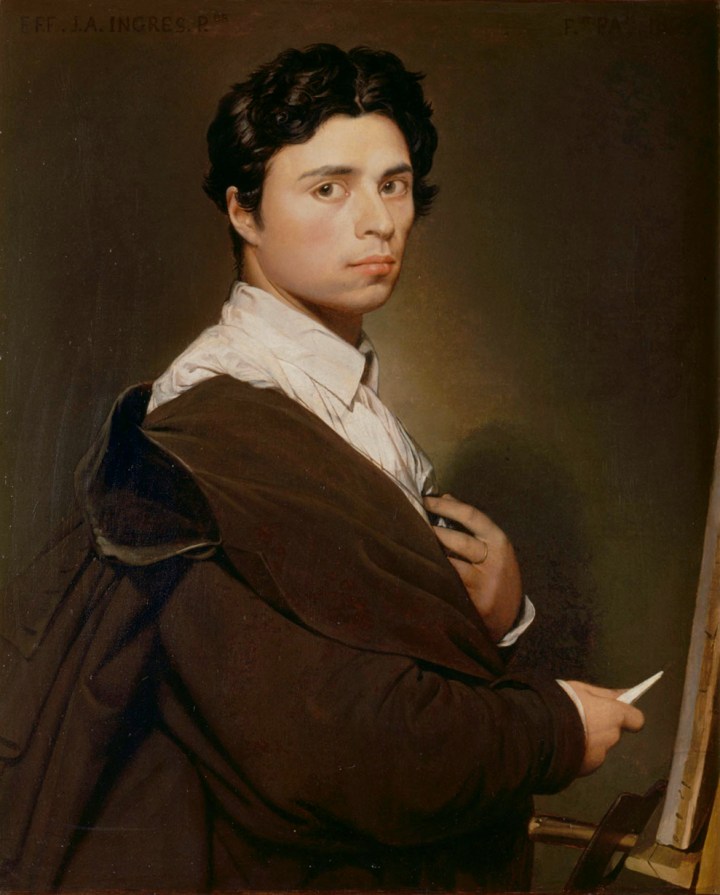
Jean-Auguste-Dominique Ingres, Self-Portrait at the Age of Twenty-Four, 1804, revised 1850–51, oil on canvas, 77 × 61 cm (Musée Condé, Chantilly).
e d i t o r i a l
• “The Story of Art at 75,” p. 959.
Gombrich’s The Story of Art is seventy-five years old this year. Its clarity of conception and expression, civilised values, and the enormous benefits that have undoubtedly resulted from its publication should be a cause for continuing admiration and celebration.
a r t i c l e s
• Sylvain Bédard, “New Proposals about Ingres’s Self-Portrait at the Age of Twenty-Four,” pp. 982–93.
Of all the self-portraits painted by Jean-Auguste-Dominique Ingres, that of 1804 now in the Musée Condé, Chantilly, remains the most discussed. The focus of criticism when it was exhibited in 1806, the painting was taken up again and transformed by the artist during his old age. Here a revised sequence for these modifications is proposed and corrections are made to its earlier history.
• Emma Roodhouse, “Scraps of Genius, Taste and Skill: Works by John Constable in the Mason Album,” pp. 994–1001.
An album emerged at auction in 2020 and was acquired by Colchester and Ipswich Museums. It included hitherto unknown and very early works by John Constable and was compiled by the Mason family, the artist’s relatives in Colchester. These juvenilia are assessed here and placed in the context of Constable’s artistic evolution and his wide social circle.
• Edward Corp, “A Recently Identified Scottish Portrait of Bonnie Prince Charlie by Katherine Read,” pp. 1012–15.
There is a set of three portraits showing the exiled King James III (1701–66) and his two sons, Prince Charles Edward Stuart (1720–88) and Prince Henry Benedict Stuart, Cardinal Duke of York (1725–1807), which are here attributed to Katherine Read (1723–78) and were painted while she was living in Rome between 1750 and 1753. The paintings, which are all in a Somerset collection, have similar dimensions and are framed within painted stone ovals, which have chips and carvings; it seems evident that they were made to be displayed together.
r e v i e w s
• Hugh Doherty, Review of the exhibition catalogue La Rotonde de Saint-Bénigne: 1000 ans d’histoire, ed. by by Franck Abert, Arnaud Alexandre, and Christian Sapin (Faton, 2025), pp. 1033–35.
• Cloe Cavero de Carondelet, Review of the exhibition catalogue Tan lejos, tan cerca: Guadalupe de México en España, ed. by Jaime Cuadriello and Paula Mues Orts (Prado, 2025), pp. 1039–41.
• Elena Cooper, Review of Cristina Martinez and Cynthia Roman, eds., Female Printmakers, Printsellers, and Print Publishers in the Eighteenth Century: The Imprint of Women, c. 1700–1830 (Cambridge: Cambridge University Press, 2024), pp. 1052–53.
• Clive Aslet, Review of Juliet Carey and Abigail Green, eds., Jewish Country Houses (Brandeis University Press, 2024), pp. 1056–57.
o b i t u a r y
• Colin Thom, Obituary for Andrew Saint (1957–2024), pp. 1059–60.
A longstanding editor for the Survey for London, an astute architectural scholar, and a personable educator, Andrew Saint effortlessly combined many skills. His time as a professor in the University of Cambridge’s Department of Architecture shaped numerous future careers, and his contributions to the Survey enriched the history of London’s urban fabric.










 Enfilade
leave a comment