Exhibition | Mécaniques d’art Présentation
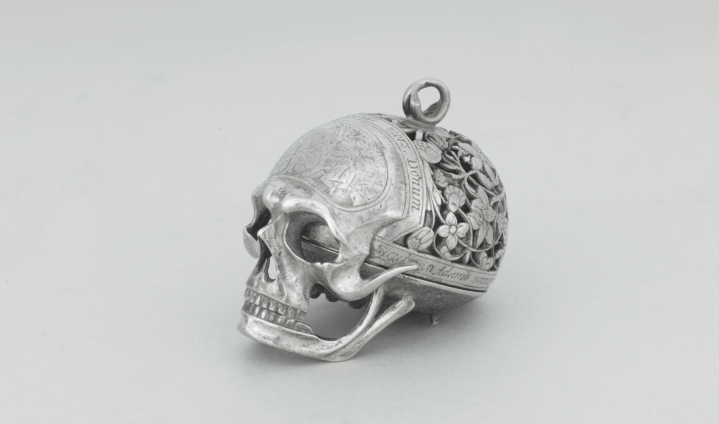
Jean Rousseau, Skull-shaped Watch, Geneva, mid-17th century, silver and gilt brass (Paris: Musée du Louvre). The engraved decoration depicts Adam and Eve and the Resurrection of Christ, with text from St. Paul.
◊ ◊ ◊ ◊ ◊
From the press release for the exhibition:
Mécaniques d’art Présentation
Musée du Louvre, Paris, 17 September — 12 November 2025
The Louvre has opened an exhibition that shines a spotlight on one of its most fascinating yet lesser-known treasures: the mechanical arts. With works spanning more than two millennia—from ancient Egyptian water clocks to contemporary horological masterpieces—the exhibition reveals humanity’s enduring desire to capture, measure, and even control time. Visitors enter a world where science, craftsmanship, and artistry intersect.
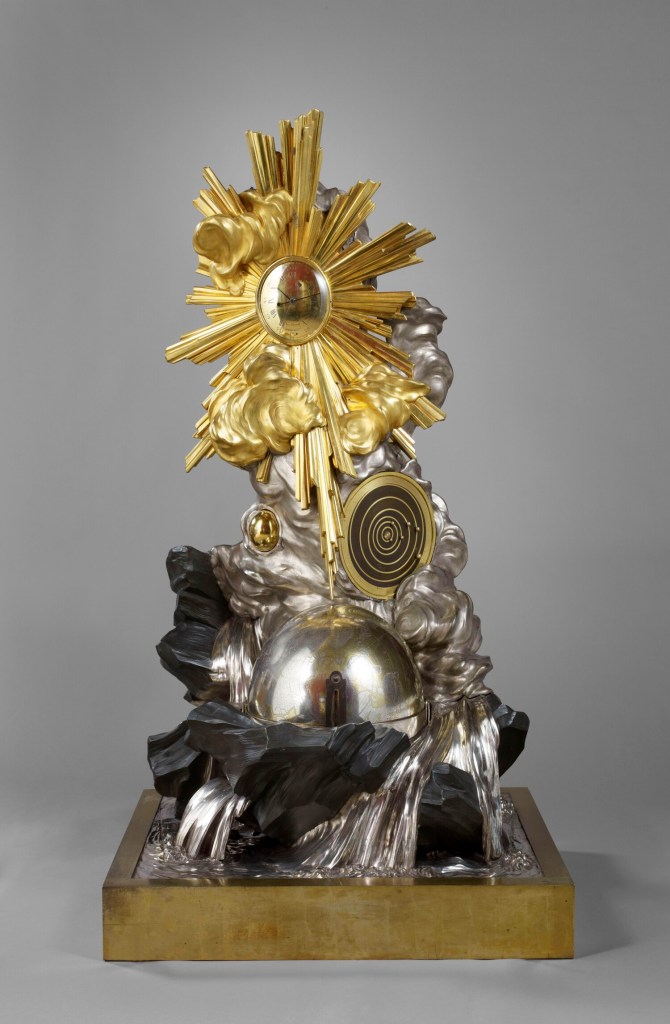
Claude Siméon Passemant, Jean-Baptiste Lepaute, and Jean-Joseph Lepaute, Clock known as The Creation of the World (La Création du Monde), 1754, wood, iron, patinated copper alloy, silver-plated and gilded copper, and glass.
Among the earliest pieces is a fragment of an Egyptian clepsydra, a water clock from the Ptolemaic period, which once measured the hours of the night by dripping water drop by drop. Fast forward to 10th-century Córdoba, and a magnificent fragment of a peacock automaton—possibly designed to dazzle with moving parts—demonstrates the ingenuity of Islamic artisans. The journey continues through Renaissance and Baroque Europe. A spherical watch signed by Jacques de La Garde in 1551, the oldest known signed French watch, showcases the refinement of early horology. Visitors can also admire a skull-shaped ‘memento mori’ watch from Geneva, a striking reminder of time’s fleeting nature. And in the grandeur of 18th-century Paris, the celebrated Creation of the World clock, presented to Louis XV in 1754, takes center stage, complete with rotating Earth, lunar phases, and a miniature planetarium.
This celebration of historic craftsmanship is paired with an exceptional loan from Swiss maison Vacheron Constantin. Their creation La Quête du Temps (The Quest for Time), unveiled for the house’s 270th anniversary, is a clock-automaton that brings the tradition of horology into the 21st century. With 23 complications—including an automaton astronomer performing 144 gestures—it unites Renaissance humanism with modern precision engineering. Beyond telling the hour, the piece offers a poetic vision of cosmic and astronomical phenomena.
The dialogue between centuries underscores how the fascination with time has always inspired technical brilliance and artistic imagination. Whether through polyhedral dials of the 17th century, armillary spheres perched on the shoulders of Atlas, or contemporary automata, the exhibition shows that the quest to master time is as much about beauty as it is about function.
More information is available here»










 Enfilade
leave a comment