Conference | 18th-C. Painting between Italy and the Hapsburg Empire
From the Department of Art History at the Universität Wien:
Settecento Malerei: Cultural Transfer between Italy and the Habsburg Territories
Online and in-person, Department of Art History of the University of Vienna, 23–24 October 2025
Organized by Eleonora Gaudieri and Erika Meneghini
Registration due by 19 October 2025
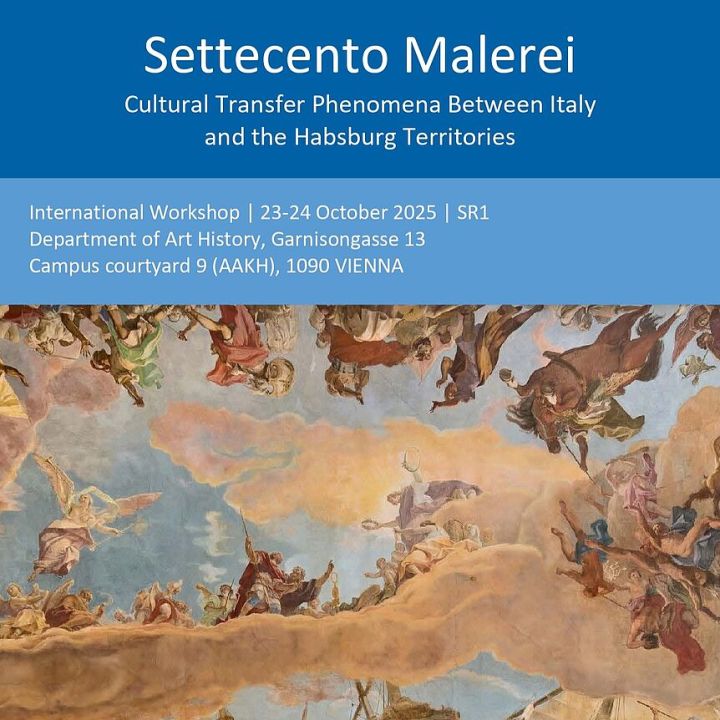 The beginning of the Settecento was characterised by a considerable expansion of the transalpine art market, driven by a strong interest in collecting Italian artworks. This phenomenon attracted numerous Italian artists, including many painters, to Vienna and its allies, the courts of the German prince-electors of Schönborn, Wittelsbach and others. At the same time, a number of Austrian painters were encouraged to further their training in Italy, where they were profoundly influenced by the local visual language. The high quality and renowned tradition of Italian painting, fostered by a dense network of international connections, enabled numerous artists of Italian origin, as well as Italians by adoption, to pursue successful careers at the Habsburg imperial court in Vienna. This phenomenon must be understood within the broader context of the diplomatic and artistic networks that connected Vienna with key centres on the Italian peninsula, such as Venice, Bologna, Rome, and Naples.
The two-day workshop will provide a wide-ranging exploration of 18th-century Italian painting as a focal point for transfer phenomena between the Italian peninsula and the domains of the Habsburg Empire, with a special focus on Vienna as the imperial capital. The proceedings will open with the keynote speech by Cecilia Mazzetti di Pietralata. The subsequent sixteen presentations have been organised into four sections, reflecting the variety of perspectives through which these historical and artistic phenomena can be approached: Collecting Italian Painting in the Habsburg Empire; Artworks and Material Objects as Vehicles of Cultural Transfer; Artists as Transregional Agents Between Italy and the Habsburg Regions; and The Role of Academies and Museums in the Transfer of Knowledge. The objective of this study day is on one hand to examine the meanings and functions of Italian painting within the socio-political and cultural context of the Habsburg imperial court in Vienna and its allied courts; and on the other hand, to explore the various dynamics that fostered the transfer of Italian painting and Italian artistic knowledge to Vienna and the territories of the then Habsburg Empire.
The conference languages are English, German, and Italian. A livestream of the event will be available. Please confirm your attendance in-person or online via email to settecentomalerei@gmail.com by 19 October. If you have any questions, please contact the organisers: Eleonora Gaudieri and Erika Meneghini.
Dr. Eleonora Gaudieri, eleonora.gaudieri@univie.ac.at
Postdoctoral Researcher (APART-GSK funding programme, ÖAW)
Department of Art History, University of Vienna
Erika Meneghini MA, erika.meneghini@univie.ac.at
PhD Candidate
Department of Art History, University of Vienna
The workshop is supported by the Department of Art History and the Vienna Center for the History of Collecting at the University of Vienna. Funding is provided by the Faculty of Historical and Cultural Studies at the University of Vienna, the City of Vienna, and the Austrian Academy of Sciences.
t h u r s d a y , 2 3 o c t o b e r
9.00 Welcome
9.30 Keynote
• Cecilia Mazzetti di Pietralata (University of Cassino and Southern Lazio) — Vienna italiana: Forme e attori dello scambio culturale tra Sei e Settecento, tra immigrazione artistica e vocazione internazionale dell’aristocrazia europea
10.30 Coffee Break
10.50 Section 1 | Collecting Italian Painting in the Habsburg Empire
Moderator: Silvia Tammaro
• Stefan Albl (Schloss Eggenberg & Alte Galerie, Graz) — Il dilemma della scelta: L’arrotino di Giacomo Francesco Cipper
• Ilaria Telesca (University of Naples ‘Federico II’) — Arte e potere: La committenza artistica dei viceré austriaci di Napoli
• Jiří Štefaňák (Masaryk University, Brno) — Non multa, sed multum: Italian Painting in the Collections of the Moravian Aristocracy at the End of the 18th Century
12.30 Lunch Break
14.00 Section 2 | Artworks and Materials Objects as Vehicles of Culture Transfer
Moderator: Eleonora Gaudieri
• Ada Berktay (Sakıp Sabancı Museum, Istanbul) — Lepanto as Material Allegory: Naval Triumph and the Politics of Display in Italian and Habsburg Visual Culture
• Tomáš Kowalski (Monuments Board of the Slovak Republic, Bratislava) — Baroque Illusion: Italian Settecento Frescoes in Slovakia
• Beatrice Bolandrini (Università e-Campus; Accademia del Lusso, Milan) — Anton Giorgio Clerici ed Annibale Visconti, ‘consiglieri intimi’ di Carlo VI e Maria Teresa, committenti di Giambattista Tiepolo e Mattia Bortoloni
• Tomáš Valeš (Masaryk University, Brno) — Shared, ‘Recycled’, Reinvented: Art of Venetian Settecento in the Hands of ‘Viennese’ 18th-Century Painters
• Erika Meneghini (University of Vienna) — From Naples to Vienna and the Habsburg Lands: The Artistic Reception of Francesco Solimena’s Oeuvre beyond the Alps
19.00 Conference Dinner
f r i d a y , 2 4 o c t o b e r
9.00 Section 3 | Artists and Transregional Agents between Italy and the Habsburg Regions
Moderator: Erika Meneghini
• Francesco Ceretti (University of Pavia) — Pietro Bellotti: Da Venezia alle corti mitteleuropee
• Eleonora Gaudieri (University of Vienna) — Daniele Antonio Bertoli: Traces of his Activity at the Habsburg Court in Vienna
• Enrico Lucchese (University of Campania ‘Luigi Vanvitelli’) — I soggiorni viennesi e nei territori asburgici di Antonio Pellegrini (1675–1741)
• Sanja Cvetnić (University of Zagreb) — Federico Bencovich as Transregional Artist
• Laura Facchin (University of Insubria, Varese) — Angelica Kauffmann: Painter of the Habsburg Court from Milan to Vienna
12.00 Lunch Break
13.30 Section 4 | The Role of Academies and Museums in the Transfer of Knowledge
Moderator: Stefan Albl
• Susanne Müller-Bechtel (University of Würzburg) — Figur–Pose–Wissen: Das akademische Aktstudium als epistemische Kunstpraxis in Rom, Wien und Mailand
• Lorenzo Giammattei (Sapienza University of Rome) — The Antique in the Drawings of Austrian Artists in Rome in the Second Half of the 18th Century
• Paolo Pastres (Independent Researcher, Udine) — Vienna e Firenze nel Settecento: Due modelli museali a confronto
15.00 Coffee Break
15.20 Final Discussion
16.45 Optional visit to the Schönbrunn Chapel and the Blue Staircase
Poster Image: Sebastiano Ricci, Allegory of the Princely Virtues, Blue Staircase, Schönbrunn Palace, 1702 (Vienna).
Exhibitions | Casanova and Venice / Casanova and Europe
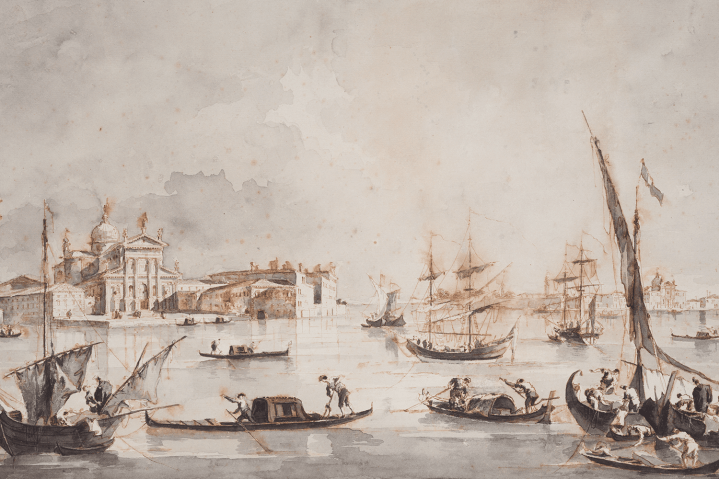
Francesco Guardi, View of San Giorgio Maggiore
(Venice: Fondazione Giorgio Cini)
◊ ◊ ◊ ◊ ◊
From the Fondazione Giorgio Cini:
Casanova and Venice
Palazzo Cini, Venice, 27 September 2025 — 2 March 2026
Casanova and Europe: An Opera in Multiple Acts
San Giorgio Maggiore, Venice, 17 October 2025 – 2 March 2026
 On the 300th anniversary of the birth of Giacomo Casanova (1725–1798), the Fondazione Giorgio Cini is dedicating a major exhibition and cultural project to the celebrated Venetian. The first chapter of the double exhibition opens at Palazzo Cini in San Vio on September 27. Curated by the Institute of Art History, with the participation of the Institute for Theater and Opera, the exhibition traces the multifaceted figure of Casanova—scholar, memoirist, philosopher, alchemist, traveler, and diplomat—throughout a restless century that ended with the fall of the Serenissima. Through nearly one hundred works including paintings, engravings, books, objets d’art, and documents from the Foundation’s collections and prestigious Italian and European institutions, the exhibition recounts the refined, cultured, and contradictory world of the Venetian 18th century—Casanova’s century.
The exhibition is part of a wider cultural program involving all the Fondazione Giorgio Cini institutions, with conferences, concerts, and seminars dedicated to the link between Casanova, Venice, and Europe. The aim is to present a complex and multidisciplinary portrait of one of the most iconic figures in the history of Venice, who was a central figure during the final century of the Serenissima’s existence. The Foundation celebrates the European spirit embodied by Casanova.
“The project dedicated to Casanova is an opportunity to highlight the deep connection between the Fondazione Giorgio Cini and the city, its history, and its cultural context, drawing inspiration,” explains President Gianfelice Rocca, “from the great personalities and significant themes that have shaped history. It is an opportunity to emphasise the expertise, research, and collaboration between the Foundation’s Institutes and Centres in an international context. The Foundation’s vocation is to be an active participant, through this and other events, in the global stage of dialogue based on cultural diplomacy as a useful and necessary tool to respond to an era like ours, in which cultures and civilisations risk becoming enemies, unable to listen to, understand, and collaborate with each other.”
The Scientific Director, Daniele Franco, emphasises, “Fondazione Giorgio Cini is working to propose a reading of Casanova that goes beyond the usual imagery, the ‘myth’ that has become entrenched in traditional interpretations surrounding him. The primary aim is to highlight a complex character, a man who, from Venice, travels throughout Europe, in a historical period of rapid cultural and political change, where a vision of European society begins to emerge, one that is permeated by uncertainties, tensions, and an increasingly open and complex cultural debate. In Casanova’s writings, we can find many of the contradictions and forces for change that Europe is grappling with today.”
• Casanova e Venezia, at Palazzo Cini (27 September 2025 – 2 March 2026) with a focus on Venice, the birthplace and the first stage of Casanova’s life.
• Casanova e l’Europa: Opera in più atti, on the island of San Giorgio Maggiore (17 October 2025 – 2 March 2026), a look at Europe and the network of travels, relationships, and adventures that made Casanova an ante litteram European figure. The exhibition is produced in collaboration for the staging with the Fondazione Teatro La Fenice.
◊ ◊ ◊ ◊ ◊
Note (added 2 November 2025) — The press release for Casanova e l’Europa: Opera in più atti is available here.
Online Talks | European Prints in Museums in the American South
From ArtHist.net:
Paper Backstories: European Prints in Southern Museums
Online, hosted by Vanderbilt University, 16 October 2025
Staged in conjunction with the Vanderbilt University Museum of Art’s Fall 2025 exhibition Paper Backs: Hidden Stories of European Prints from the VUMA Collection, this virtual symposium will bring together curators who oversee collections of European prints at museums spread across the South. Each curator will give a lightning-style, 10-minute presentation about their museum’s pre-1915 European print holdings, with the goal of making these collections better-known amongst local, regional, and global audiences of both amateurs and professionals. The symposium also seeks to initiate a collective discussion about how and why European prints often served as catalysts for the formation of institutional art collections in a region with limited public art infrastructure before the turn of the twentieth century. How did old master and early modernist European prints in particular support various progressive and post-World War I- era agendas? What challenges and opportunities face the study and promotion of such objects in the South today? Attendance is free and open to all.
Please register to receive the Zoom link.
s c h e d u l e
12pm (Central Standard Time) Courtney Wilder, The Vanderbilt University Museum of Art, Nashville
12.15 Sarah Cartwright, The John and Mable Ringling Museum of Art, Florida State University, Sarasota
12.25 Dana E. Cowen, The Ackland Art Museum, University of North Carolina-Chapel Hill, Chapel Hill
12.35 Maggie Crosland, The Birmingham Museum of Art
12.45 Nelda Damiano, The Georgia Museum, University of Georgia, Athens
1.00 Alyssa M. Hughes, The Virginia Museum of Fine Arts, Richmond
1.10 Q&A
1.30 Event concludes
Cambridge Material Culture Workshop Fall 2025
This fall’s Material Culture Pre-1850 Workshop schedule:
Cambridge Material Culture Workshop
Michaelmas 2025
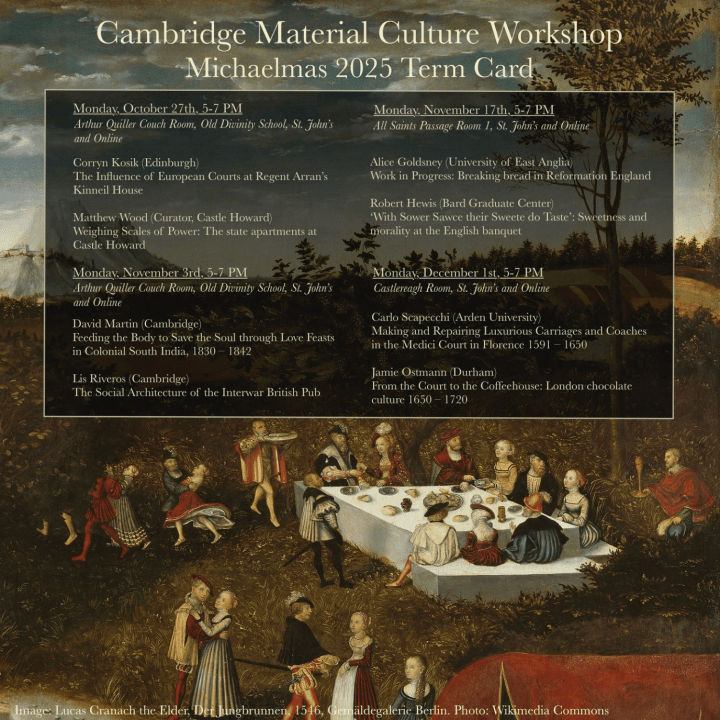 We’re excited to announce the term card for Michaelmas 2025. Each of the four sessions will meet online and in-person at St. John’s, Cambridge, starting at 5pm. For more information, please contact Tomas Brown (tbnb2@cam.ac.uk) or Sophia Feist (stcf2@cam.ac.uk).
27 October
• Corryn Kosik (Edinburgh), The Influence of European Courts at Regent Arran’s Kinneil House
• Matthew Wood (Curator, Castle Howard), Weighing Scales of Power: The State Apartments at Castle Howard
3 November
• David Martin (Cambridge), Feeding the Body to Save the Soul: Love Feasts in Colonial South India, 1830–1842
• Lis Riveros (Cambridge), The Social Architecture of the Interwar English Pub
17 November
• Alice Goldsney (University of East Anglia), Work in Progress: Breaking Bread in Reformation England
• Robert Hewis (Bard Graduate Center), ‘With Sower Sawce their Sweete do Taste’: Sweetness and Morality at the English Banquet
1 December
• Carlo Scapecchi (Arden University), Making and Repairing Luxurious Carriages and Coaches in the Medici Court in Florence, 1591–1650
• Jamie Ostmann (Durham), From the Court to the Coffeehouse: London Chocolate Culture, 1650–1720
New Book | The Killing of Jane McCrea
From Westholme Publishing:
Paul Staiti, The Killing of Jane McCrea: An American Tragedy on the Revolutionary Frontier (Yardley, PA, Westholme Publishing, 2025), 272 pages, ISBN: 978-1594164460, $30.
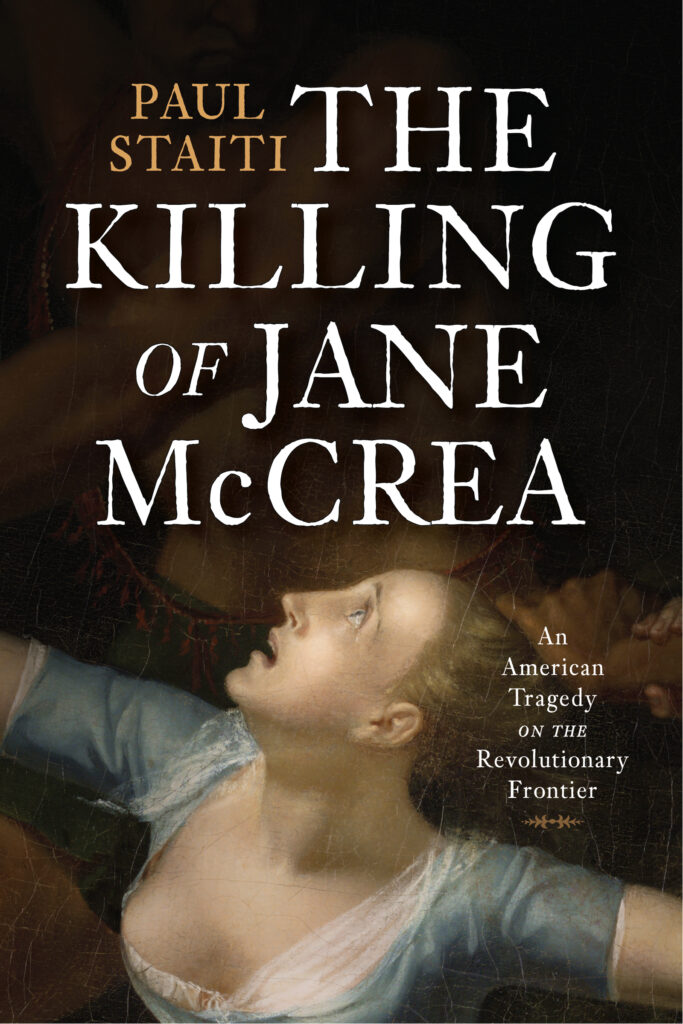 The killing of Jane McCrea on July 26, 1777, on the outskirts of a village in the northern Hudson Valley, would unexpectedly rupture the British advance from Canada that was meant to crush the American Revolution in one knockout blow. On that day, twenty-five-year-old McCrea, an unremarkable person preparing for an impending marriage, was assaulted, scalped, and killed by a group of Native Americans in the employ of British general John Burgoyne. Though the murder was but one of many civilian deaths in a fierce war zone, McCrea’s killing had far-reaching consequences for each of the three major parties involved in the Northern Campaign of 1777.
In America, McCrea became the great cause célèbre of the Revolution, the sympathetic female victim of the war symbolizing the righteousness of The Cause. In Britain, she was a human-rights tragedy that tarnished the polished surface of British honor and galvanized Whig politicians who shouted out her name in Parliament as an example of how low the nation had fallen. For Native peoples, recruited by both the British and the Americans, and caught in the middle of a war staged on ancestral grounds, McCrea’s killing was the opening salvo in a vicious chain of bloody retribution that led to the disintegration of the venerable Iroquois Confederacy and the obliteration of Native homelands. After the war, the nightmarish image of a young Jane McCrea slaughtered on the New York frontier would obsess white Americans who came to fear Native peoples as irredeemable savages. Her murder would help justify the expulsion of Indigenous tribes and open the doors for an expansionary United States that was fully intent on transforming the American continent into its own image.
The Killing of Jane McCrea: An American Tragedy on the Revolutionary Frontier by distinguished historian Paul Staiti undertakes for the first time a comprehensive investigation into McCrea’s life, death, and especially her long and strange afterlife. Using both visual arts and written records, the author reassembles the scattered fragments to illuminate a historical terrain long since shrouded in misinformation, mired in controversy, and relegated to mythology. Coming into view is a major portrait of the persons, cultures, actions, and motives that fatally converged on that hot July morning in 1777.
Paul Staiti is the author of Samuel F. B. Morse and Of Arms and Artists: The American Revolution through Painters’ Eyes. The latter was Colonial Dames of America Book of the Year in 2018 and was nominated for the Andrew Carnegie Medal for Excellence in Non-Fiction. He has written on John Singleton Copley, Gilbert Stuart, Winslow Homer, and William Michael Harnett, and has lectured widely at colleges, universities, and museums, including the National Gallery of Art and the Louvre. He holds a PhD from the University of Pennsylvania, has been the recipient of two fellowships from the The Metropolitan Museum of Art and three from the National Endowment for the Humanities. Currently he is Professor of Fine Arts on the Alumnae Foundation at Mount Holyoke College.
New Book | Murder in the Rue Marat
From Princeton UP:
Thomas Crow, Murder in the Rue Marat: A Case of Art in Revolution (Princeton University Press, 2025), 176 pages, ISBN: 978-0691274447, £25 / $30.
 How an enigmatic masterpiece of the French Revolution became a talisman of the revolutionary spirit in our own time
Jacques-Louis David’s The Death of Marat depicts the painter’s friend and fellow revolutionary Jean-Paul Marat collapsed in his bath after being fatally stabbed by a female assassin who stands just outside the frame. In this fascinating book, Thomas Crow traces the radical legacy of a painting that has been called the Pietà of the French Revolution, showing how David’s masterpiece captures the saga of that violent era in the single figure of Marat, and how it reveals itself anew today.
Crow begins by describing how the painting’s enduring power came to the fore during the countercultural tumult of the 1960s, discussing how his vocation as a scholar arose out of his own encounter with the work. He then takes readers back to 1793, telling the story of the painting’s creation through the eyes of David, his subject, and Marat’s charismatic assassin, Charlotte Corday. Charting the history of its impact across more than two centuries, Crow shows how this multilayered portrait surfaced in succeeding waves of political dissent as an enduring talisman of popular insurgency. Beautifully illustrated, Murder in the Rue Marat is an art historian’s disarmingly personal account of a painting whose hidden complexities bear witness to the promise and peril of revolution in Marat’s time and our own.
Thomas Crow is the Rosalie Solow Professor of Modern Art at New York University’s Institute of Fine Arts. His many books include Restoration: The Fall of Napoleon in the Course of European Art, 1812–1820 and The Artist in the Counterculture: Bruce Conner to Mike Kelley and Other Tales from the Edge.
Exhibition | Jacques-Louis David
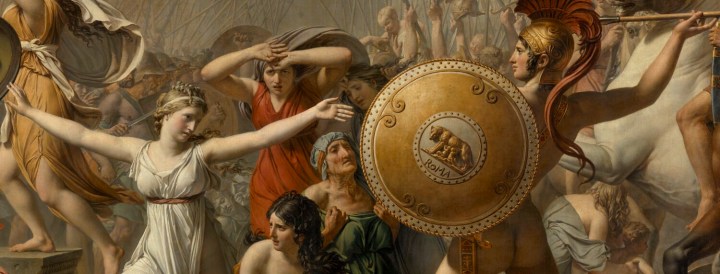
Jacques-Louis David, The Intervention of the Sabine Women, detail, 1799, oil on canvas, 3.85 × 5.22 meters
(Paris: Musée du Louvre)
◊ ◊ ◊ ◊ ◊
From the press release for the exhibition:
Jacques-Louis David
Musée du Louvre, Paris, 15 October 2025 — 26 January 2026
Curated by Sébastien Allard and Côme Fabre, with assistance from Aude Gobet
David is a towering figure. Considered the father of the French School, revered for breathing new life into painting, he produced imagery that to this day inhabits the collective imagination: from The Death of Marat to Napoleon Crossing the Alps and The Coronation of Napoleon, his paintings are the filter through which we picture the great moments of the French Revolution and the Napoleonic Empire, while his portraits bring to life the society of this period.
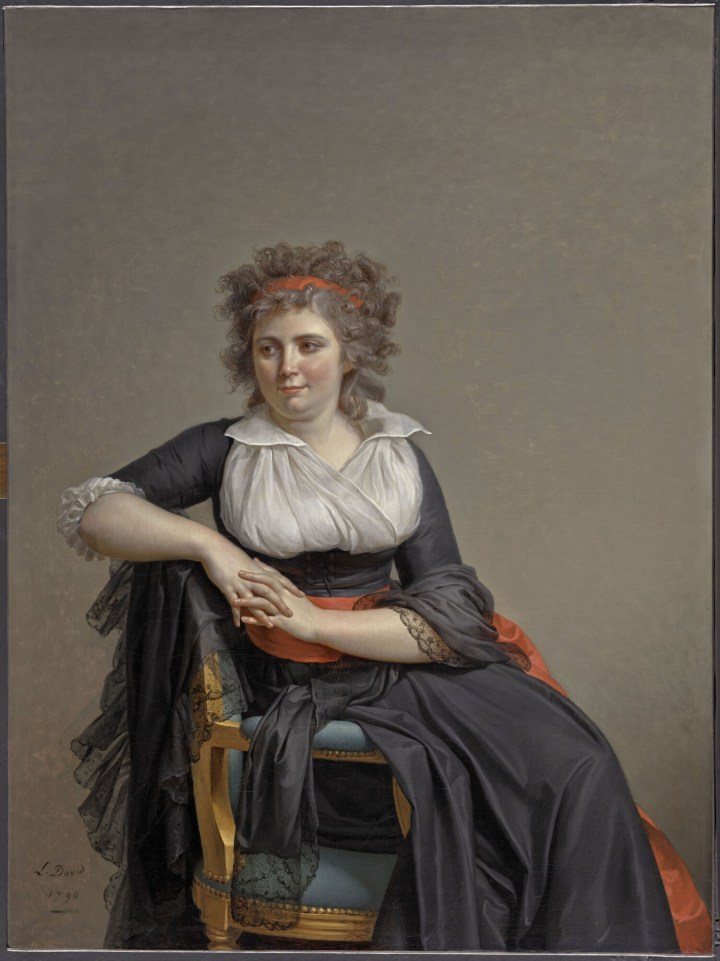
Jacques-Louis David, Portrait of Robertine Tourteau d’Orvilliers, née Rilliet (1772–1862), 1790, oil on canvas, 131 × 98 cm (Paris: Musée du Louvre / Adrien Didierjean / Sylvie Chan-Liat).
To mark the bicentennial of his death in exile in Brussels in 1825, the Musée du Louvre is offering a new perspective on a figure and body of work of extraordinary richness and diversity. The exhibition shines a light on the inventive force and expressive power of the art of Jacques-Louis David (1748–1825), whose paintings are more intensely charged with feeling than is belied by their extreme rigour. The exhibition spans the long career of an artist who witnessed six different political regimes and actively participated in the French Revolution. It gathers 100 works on special loan, including the imposing, incomplete Tennis Court Oath (Château de Versailles, long-term loan from the Musée du Louvre), and the original version of his masterpiece, the celebrated Death of Marat (Royal Museums of Fine Arts of Belgium, Brussels).
A project of such ambition could only be undertaken at the Louvre, which holds the largest existing collection of the artist’s paintings and drawings—including, first and foremost, his very large canvasses. The last major monographic exhibition devoted to David was held at the Louvre and the Château de Versailles in 1989 for bicentennial commemorations of the French Revolution. Enhanced by research conducted in the ensuing three decades, the 2025 exhibition will present a new survey revealing the unprecedented richness of David’s journey, combining artistic and political activity. Indeed, more than simply an artist observing this formative period in French history, spanning the years 1748–1825, he sought to be a prominent social actor.
The painter’s importance was unmatched in his day, for his Europe-wide artistic influence, as well as the high political offices he held in 1793–1794 alongside Robespierre, for which he suffered the consequences as a political exile after the fall of Napoleon.
The exhibition is curated by Sébastien Allard, Senior Heritage Curator, Director of the Department of Paintings, and Côme Fabre, Curator, Department of Paintings, and assisted by Aude Gobet, Head of the Department of Paintings Research Centre, Musée du Louvre. The exhibition design is by Juan-Felipe Alarcón, with graphic design by Philippe Apeloig.
Sébastien Allard, ed., Jacques-Louis David (Paris: Louvre éditions/ Hazan, 2025), 360 pages, €49.
The catalogue reflects the exhibition in offering new perspectives on David’s role and position, focusing on two essential aspects of his activity: his involvement during the French Revolution; and, after the fall of the First Empire and his exile to Brussels, his confrontation with the new generation—and Ingres, in particular—whose training he had largely overseen. The publication is divided into two parts. In the first, an essay by Sébastien Allard seeks to shift perceptions of the artist, examining his life as a coherent whole, in contrast to how historians have tended to fragment it according to the different political regimes David experienced. Sumptuous reproductions, including numerous details, help remove the proverbial dust from the image sometimes held of the painter’s work. The second part encompasses an essay by Côme Fabre on the connections between David and the Louvre; a biographical account by Aude Gobet; and a chronology of major David-related moments, from his death to today, by Morgane Weinling.
New Book | European Sculpture in the Collection of His Majesty The King
Distributed by Yale University Press:
Jonathan Marsden, European Sculpture in the Collection of His Majesty The King (London: Modern Art Press in association with the Royal Collection Trust, 2025), 4 volumes, 1648 pages, ISBN: 978-1738487813, £350 / $450.
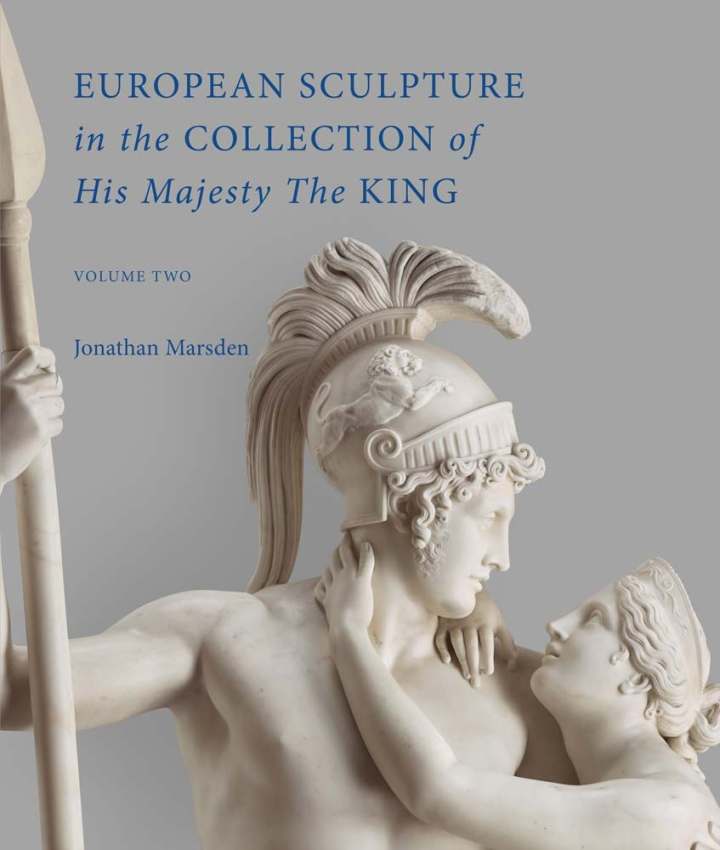 This four-volume publication marks the completion of one of the most ambitious stages in the long-term task of cataloguing sculpture in the Royal Collection.
The scope of the catalogue—covering sculpture in all materials from the fifteenth to the late twentieth century—is unprecedented. Incorporating countless new attributions and identifications and the results of conservation and scientific examination, the catalogue will be an indispensable work of reference for all students of post-medieval sculpture, impressive not only in the quality of its scholarship but also for the extent and depth of the documentation. Highlights include an exceptional group of bronze busts from the Italian and Northern Renaissance, the first bronze casts of ancient sculpture to be made in Britain, the best ensemble of French seventeenth- and eighteenth-century bronzes outside France, unrivalled examples of English portrait sculpture from the seventeenth century onwards and the most complete surviving collection of Victorian sculpture. With an introductory survey covering the relationships between British monarchs and sculptors since the seventeenth century and the impact of sculpture in the interiors of the royal palaces over the same period, the admirably clear and engaging text is essential reading for students of royal collecting. It is accompanied by almost 2,000 illustrations, most of which have been commissioned for this book.
Jonathan Marsden was Director of the Royal Collection and Surveyor of The Queen’s Works of Art from 2010 to 2017, having served as Deputy Surveyor from 1996. Prior to this, he worked for the National Trust as a Historic Buildings Representative in North Wales and Oxfordshire.
Decorative Arts Trust Prize to Fund Digital Porcelain Rooms Project
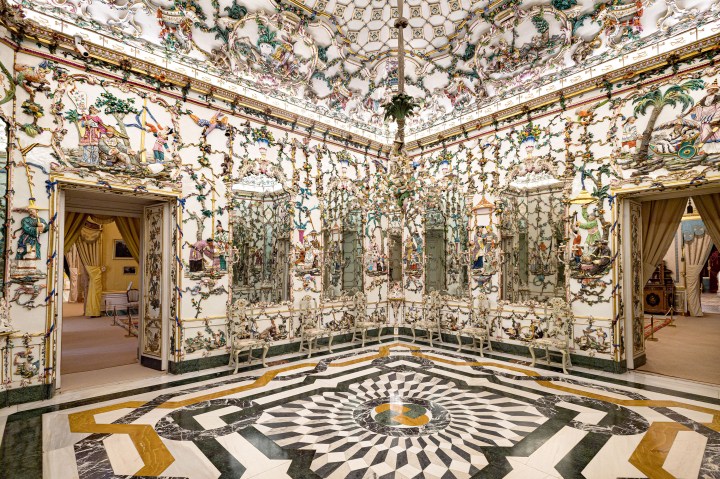
Porcelain study of Charles III of Spain, 1760–65, painted soft-paste porcelain
(Aranjuez: Patrimonio Nacional de España)
◊ ◊ ◊ ◊ ◊
From the press release:
The Decorative Arts Trust is thrilled to announce that the 2025 Prize for Excellence and Innovation will be awarded to The Digital Porcelain Rooms Project, a collaboration between the Custard Institute for Spanish Art and Culture at Southern Methodist University’s Meadows Museum and the Edith O’Donnell Institute of Art History at the University of Texas at Dallas.
The goal of the porcelain rooms project is to reanimate and reinterpret two of the most important interiors in the canon of 18th-century decorative arts: the Salottino di Porcellana in Naples, Italy, and the Gabinete de Porcelana in Aranjuez, Spain. The project embraces an expansive definition of decorative arts, examining not only the design and materiality of porcelain interiors but also the labor, technologies, and global flows that made them possible.
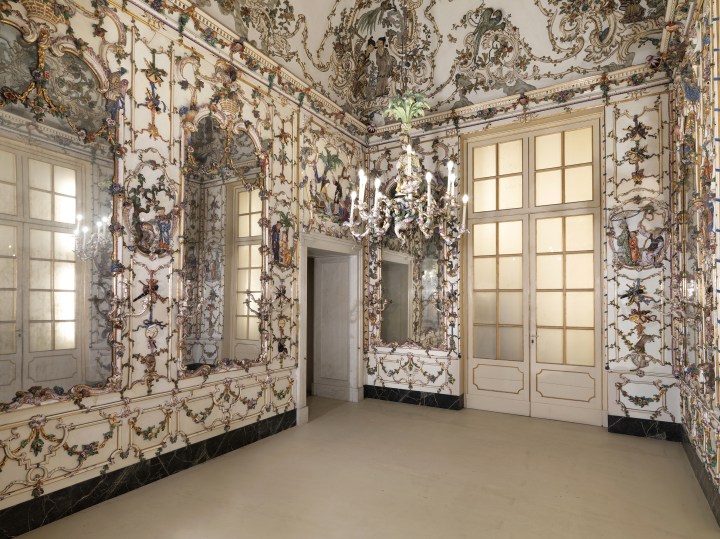
Porcelain room of Maria Amalia of Saxony, 1757–59, painted porcelain and stucco (Naples: Museo e Real Bosco di Capodimonte; photo by Luciano Romano).
Maria Amalia of Saxony’s 1757–59 Salottino di Porcellana was originally installed in the Royal Palace at Portici in Naples and is now housed at the Museo e Real Bosco di Capodimonte. Designed in the so-called Chinese taste using local craftsmen, the Salottino was left unfinished when Maria Amalia departed for Spain in 1759 but was later completed with a Roman mosaic floor, likely sourced from nearby Herculaneum. Charles III’s Gabinete de Porcelana was developed 1760–65 at the Palacio Real de Aranjuez near Toledo, Spain, reflecting his assertion of political authority through elaborate interior design.
The Digital Porcelain Rooms Project is a transnational, interdisciplinary effort that brings together curators, art historians, archaeologists, conservators, technologists, and cultural heritage leaders from leading museums, research institutes, and universities across Europe and the United States. The project involves the participation of the Museo e Real Bosco di Capodimonte, Centro MUSA Musei della Reggia di Portici, the Center for the Art and Architectural History of Port Cities at La Capraia, and the Palacio Real de Madrid.
The Decorative Arts Trust Prize for Excellence and Innovation, founded in 2020, funds outstanding projects that advance the public’s appreciation of decorative art, fine art, architecture, or landscape. The Prize is awarded to a nonprofit organization in the United States for a scholarly endeavor, such as museum exhibitions, conservation and preservation projects, and online databases. Past recipients include Drayton Hall; the Concord Museum, Cooper Hewitt, Smithsonian Design Museum; the Black Craftspeople Digital Archive; and Craft in America. Nominations are accepted through June 30, annually. For more information about the Prize for Excellence and Innovation, visit decorativeartstrust.org/prize.
Forbidden City’s Qianlong Garden Reopens after Conservation
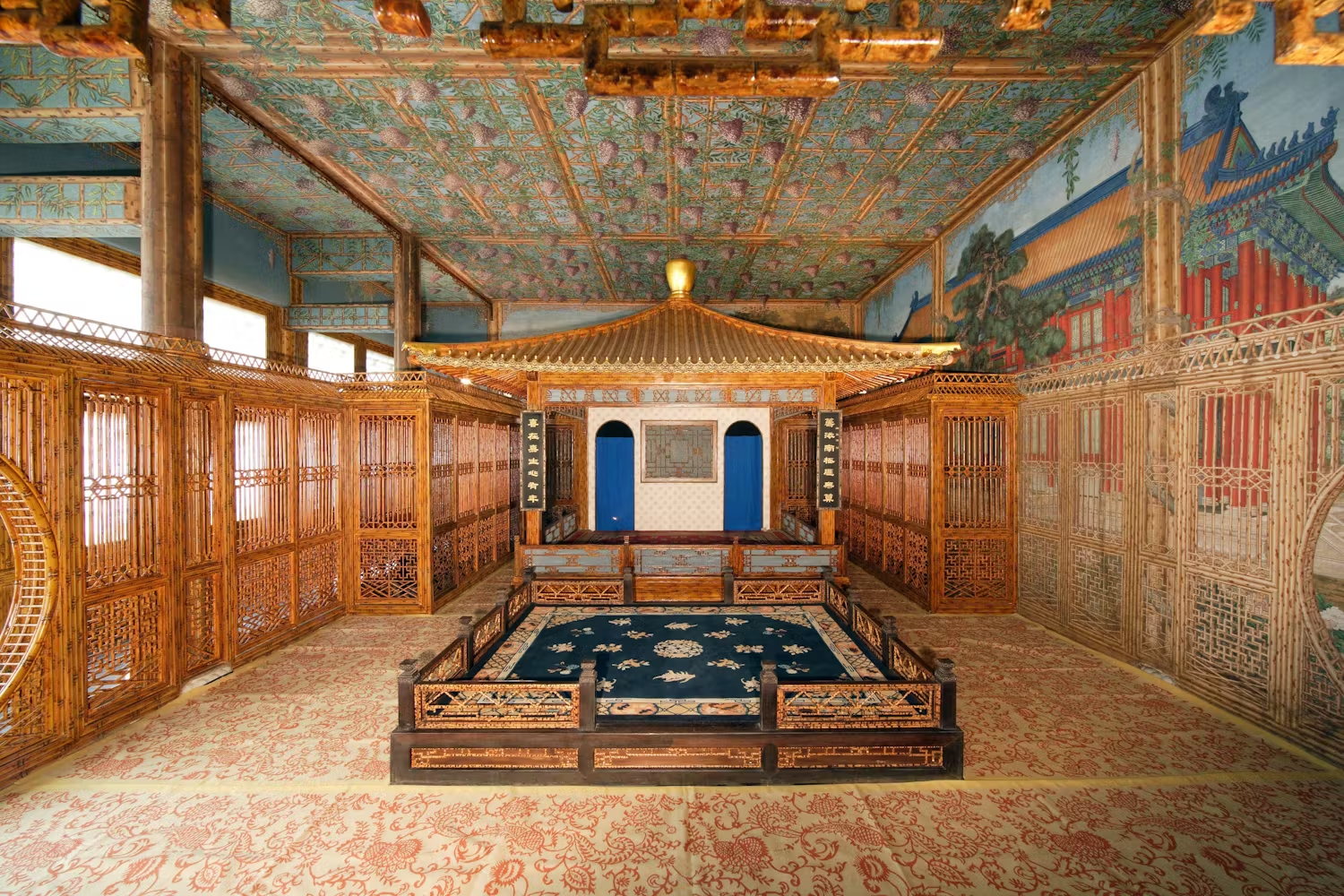
When the Qianlong Emperor abdicated in 1796, he had a retirement complex waiting for him in a 1.6-hectare space within the Forbidden City. But he never took up residence in the Palace of Tranquil Longevity, and the site has remained largely untouched ever since. It contains some of the most extraordinary examples of Chinese interior design in existence today. Pictured here, Juanqinzhai, or Studio of Exhaustion from Diligent Service, is noted for the trompe-l’oeil silk paintings on the ceiling and walls of its private theater. Its reception room also contains unusually fine bamboo thread marquetry and inner bamboo skin carvings, as well as jade inlays and sophisticated textile decorations.
◊ ◊ ◊ ◊ ◊
From the WMF press release (30 September 2025) . . .
World Monuments Fund (WMF) and the Palace Museum today announced the official public opening of the Qianlong Garden, a masterwork of 18th-century Chinese imperial design located in the northeast corner of Beijing’s Forbidden City. After a two-decade-long conservation effort, the garden has reopened. A new on-site exhibition will offer a comprehensive understanding of the Qianlong Garden’s interiors, design, and craftsmanship. The inauguration of the garden will be accompanied by the publication of the book Tranquil Longevity, Predestined Serenity: The Origins, Interpretation and Conservation of the Qianlong Garden, providing an in-depth look at the history of the Qianlong Garden and the restoration of the site.

Restored exterior of Qianlong Garden.
Constructed by the Qianlong Emperor (r. 1735–1796) as a planned retreat for his later years, the 1.6-hectare site includes 27 buildings across four courtyards, with ornate interiors that preserve original furniture, decorative finishes, and rare materials largely untouched since the 18th century. Following an extensive 25-year conservation initiative led by World Monuments Fund (WMF) in partnership with the Palace Museum, the site now features restored interiors and exteriors showcasing some of the most refined and culturally significant artistry of the Qing Dynasty. This collaboration brought together international experts and Chinese artisans to address the site’s preservation challenges, revive endangered craft techniques, and uphold the garden’s extraordinary architectural integrity.
“This is a landmark moment for heritage conservation in China,” said Hunghsi Chao, Senior Regional Director for East Asia at World Monuments Fund. “Qianlong Garden represents an unparalleled survival of imperial interior design, and its preservation requires both technical precision and deep cultural understanding. Through our work with the Palace Museum, we have not only safeguarded a historic treasure but have helped reinvigorate traditional craftsmanship and inspired new generations of conservation professionals.”
As a cornerstone of the conservation effort, WMF launched the CRAFT Educational Program (Conservation Resources for Architectural Interiors, Furniture, and Training) in 2011 to provide formal training in architectural conservation. In partnership with Tsinghua University and the Palace Museum, the program became a master’s-level conservation initiative in China to align with international standards, blending scientific methodology with traditional Chinese techniques.
“World Monuments Fund’s partnership with the Palace Museum has shown how international collaboration and local expertise can come together to achieve something truly exceptional,” said Bénédicte de Montlaur, President and CEO of World Monuments Fund. “Qianlong Garden is a living document of Qing-era craftsmanship and global influence—its preservation stands as a model for how education, science, and culture can shape the future of heritage.”

Model of the Qianlong Garden from the exhibition “Heavenly Craftsmanship: The History and Preservation of the Ningshou Palace Garden.”
A pilot project for the broader site was launched in 2002 with the restoration of Juanqinzhai (Studio of Exhaustion from Diligent Service), a pavilion known for its rare trompe l’oeil silk murals, bamboo marquetry, and theatrical stage. Conservation of Juanqinzhai revived long-lost techniques and informed all subsequent work throughout the garden. Completed interventions include the Fuwangge (Belvedere of Viewing Achievements), Zhuxiangguan (Lodge of Bamboo Fragrance), and Yucuixuan (Bower of Purest Jade), while work continues across the remaining courtyards.
“Joint projects involving the Palace Museum in China and World Monuments Fund based in the United States, beginning in 2000 and continuing to the present, have demonstrated that, in the context of globalization, different civilizations can achieve mutual understanding and respect through dialogue, communication, and cooperation, and thus jointly promote the prosperity and development of human civilization,” said Director Wang Xudong of the Palace Museum.
The inauguration ceremony welcomed representatives from the Palace Museum and World Monuments Fund, cultural leaders, and conservation experts to celebrate the public opening of the Qianlong Garden as part of the Palace Museum’s centennial. Building on the success of this project, the Palace Museum and World Monuments Fund will continue to collaborate on preservation and training initiatives throughout the Forbidden City.
Alongside the opening, the Palace Museum published Tranquil Longevity, Predestined Serenity: The Origins, Interpretation, and Conservation of the Qianlong Garden, providing an in-depth look at the storied history of Qianlong Garden. The book also details the full story of the spirit of cooperation between Chinese and American heritage professionals who faced daunting obstacles to restore the site. Readers can explore the garden and its preservation through detailed illustrations, new photography, rarely published drawings, and historic photographs of the Qianlong Garden taken during the last days of the Qing Dynasty.
The exhibition Heavenly Craftsmanship: The History and Preservation of the Ningshou Palace Garden will be on display in the garden’s Suichu Hall and the east and west side halls, presenting the historical and cultural value of the Ningshou Palace Garden and the achievements of its preservation and restoration.










 Enfilade
leave a comment