At Christie’s | Important Canaletto to Headline Christie’s Classic Week
From the press release (28 October), with press reports suggesting a $30million estimate (as noted at the Art History News blog). . .
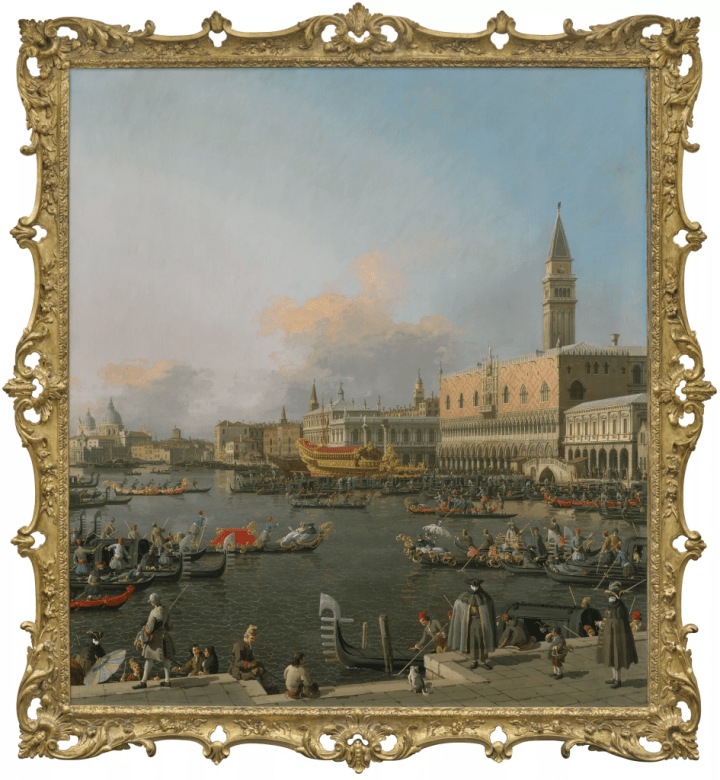
Canaletto, Venice, the Bucintoro at the Molo on Ascension Day, oil on canvas, 60 × 54 inches.
This monumental, theatrical masterpiece is unquestionably the most spectacular view of Venice painted by Canaletto in England (1746–1755). When the painting last appeared at auction at Christie’s 20 years ago as part of the Champalimaud collection, it justifiably broke all previous auction records for the artist. Venice, the Bucintoro at the Molo on Ascension Day will lead the 4 February 2026 Old Master sales in New York, with a pre-auction view in New York 29 January – 3 February 2026. Daring in composition and dazzling both in its brushwork and colourful palette, the painting was commissioned in around 1754 by the King family (later Earls of Lovelace), in whose possession it remained for almost 200 years. Other canvases from the same decorative scheme are in private collections and museums, including Washington (National Gallery of Art) and Boston (Museum of Fine Arts).
The present picture shows the Feast of Ascension Day, a key date in the Venetian calendar and a subject to which Canaletto frequently returned as it enabled him to bring the pomp and ceremony of the Venetian lagoon to life. This is Canaletto’s last known rendition of the theme from this viewpoint—his first was painted for Britain’s first Prime Minister, Robert Walpole (1676–1745), 1st Earl of Orford, sold at Christie’s, London, in July 2025 for a world record price of £31,935,000 ($43,851,545).
The Global Head of Christie’s Old Masters Department, Andrew Fletcher, said: “It is thrilling to handle the sale of Canaletto’s theatrical masterpiece which, through its scale, colour, and composition, is one of the most visually powerful paintings he ever produced. That it is so impeccably preserved—its paint surface almost as pristine as when it left the artist’s easel—makes it all the more exciting for today’s collectors, who increasingly seek the very best of the best.”
Venice, the Bucintoro at the Molo on Ascension Day will be the leading lot in what promises to be an especially strong Classics Week at Christie’s Rockefeller Center in February. This series of sales will include a number of important single-owner collections coming to the market for the first time, as well as a strong various-owner sales series, in total offering paintings, sculptures, drawings, and antiquities.
The painting will be on on view at the following locations:
• 7–12 November: Christie’s Rockefeller Center, New York, during 20/21 Marquee Week
• 20–21 November: Christie’s Henderson, Hong Kong, during Luxury Week
• 27 November–2 December: Christie’s King Street, London, during Classic Week
Conference | Rethinking Carlo Maratti (1625–1713)
From ArtHist.net and KNIR:
Rethinking Carlo Maratti (1625–1713): Patronage, Practice, Reception
Royal Netherlands Institute, Rome, 20–21 November 2025
Organized by Giovan Battista Fidanza, Guendalina Serafinelli, and Laura Overpelt
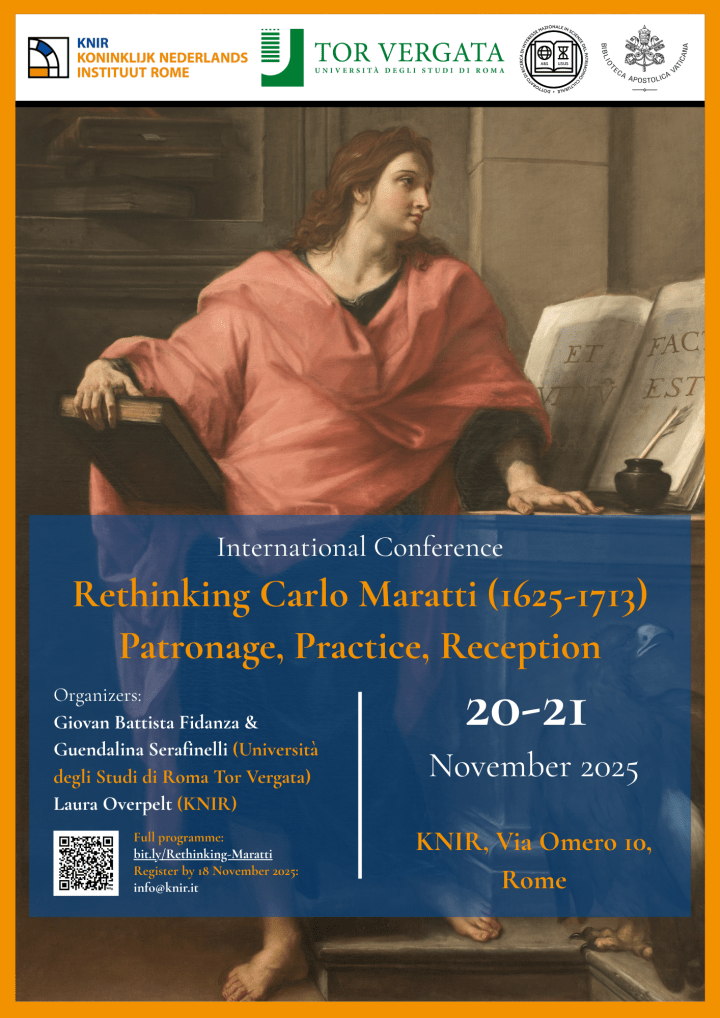 Carlo Maratti (1625–1713) stands as one of the most significant painters of late Baroque Rome—celebrated in his own time as the natural heir to Raphael and Carracci and the leading painter of the Eternal City. Maratti’s extraordinarily long and successful career linked the seventeenth and eighteenth centuries, shaping academic practice, taste, and artistic institutions well beyond his lifetime. His activity as painter, restorer, collector, ‘principe’ of the Academia di San Luca, and head of a large and international workshop placed him at the centre of Rome’s artistic and cultural networks.
Despite this prominence, Maratti’s reputation in art history has long oscillated between admiration and neglect. While traditional scholarship often portrayed him as the embodiment of academic classicism or as a symbol of stylistic decline after Bernini and Cortona, more recent research has begun to reassess the complexity of his artistic persona and his impact on the European art world. Yet, major questions remain regarding his patronage, his practices, his economic strategies, his workshop organisation, and his reception.
Marking the 400th anniversary of Carlo Maratti’s birth, this international conference seeks to offer a critical reassessment of the artist and his legacy. Bringing together established scholars and emerging researchers, it provides a forum for exploring new perspectives on Maratti’s art, practice, and influence. Special emphasis is placed on the study of unpublished archival materials, newly identified documents, and analytical approaches that shed light on the dynamics of patronage, artistic production, restoration, collecting, and reception.
The conference will take place in person at the Koninklijk Nederlands Instituut Rome (KNIR). Presentations will be given in English and Italian. A keynote lecture by Dr Arnold Witte (University of Amsterdam) will conclude the first day of the conference and can be attended remotely via Zoom. The conference is organized by Giovan Battista Fidanza and Guendalina Serafinelli (Università degli Studi di Roma Tor Vergata) and Laura Overpelt (Royal Netherlands Institute in Rome). It is supported by the Royal Netherlands Institute in Rome and the PhD Program of National Interest in Cultural Heritage at the Università degli Studi di Roma Tor Vergata, with the patronage of the Biblioteca Apostolica Vaticana.
In-person participation is free of charge, but places are limited. Please RSVP by 18 November 2025 by sending an email to info@knir.it. Kindly specify which part(s) of the conference you plan to attend, if not the entire programme. Zoom registration for the keynote lecture is available here.
t h u r s d a y , 2 0 n o v e m b e r
10.15 Welcome and Opening Remarks
• Susanna de Beer (Deputy Director of the Koninklijk Nederlands Instituut Rome); Lucia Ceci (Vice Chancellor for Communications and Head of the Dipartimento di Storia, Patrimonio culturale, Formazione e Società – Università degli Studi di Roma Tor Vergata); Tullia Iori (Vice Chancellor for Education – Università degli Studi di Roma Tor Vergata); Don Mauro Mantovani S.D.B. (Prefect of the Biblioteca Apostolica Vaticana)
• Introduction by Guendalina Serafinelli (Università degli Studi di Roma Tor Vergata) on behalf of the organizers
11.00 Session 1 | Barberini Patronage
Chair: Isabella Aurora (Biblioteca Apostolica Vaticana)
• Giovan Battista Fidanza (Università degli Studi di Roma Tor Vergata) — Carlo Maratti and His Workshop for Cardinal Carlo Barberini: Reconstructing the Significance of a Relationship
• Olga Arenga (Università degli Studi di Roma Tor Vergata) — Prince Maffeo Barberini and Carlo Maratti: New Documents in Microhistorical Perspective
• Sara Carbone (Università degli Studi di Roma Tor Vergata) — Francesco Reale in the Workshop of Carlo Maratti: Professional History in the Service of the Barberini Family
13.45 Session 2 | Transregional Patronage and Institutions
Chair: Loredana Lorizzo (Università degli Studi ‘G. d’Annunzio’ Chieti – Pescara)
• Andrea Spiriti (Università degli Studi dell’Insubria) — Maratti, the Omodei Family, and the Lombard National Church of SS. Ambrogio e Carlo al Corso in Rome: Problems and Reflections
• Laura Facchin (Università degli Studi dell’Insubria) — ‘Del signor Carlo Maratta, stimato da molti il primo che sia oggidì in quell’arte’: Reassessing the Master’s Relationship with Painting in the Savoy State
• Isabella Salvagni (Independent Scholar) — Carlo Maratti e l’ Accademia di San Luca
15.20 Session 3 | Reception and Historiography
Chair: Donatella Livia Sparti (Syracuse University)
• Guendalina Serafinelli (Università degli Studi di Roma Tor Vergata) — Niccolò Maria Pallavicini’s Ambition, the Cult of Carlo Maratti, and Bellori’s Legacy
• Laura Overpelt (Koninklijk Nederlands Instituut Rome) — A Netherlandish Perspective on Carlo Maratti: Hoogewerff and Beyond
17.00 Keynote available remotely via Zoom
Chair: Laura Overpelt (KNIR)
• Arnold A. Witte (Universiteit van Amsterdam) — Cardinals Commissioning Carlo Maratti: Shifts in Ecclesiastical Patronage around 1700
A recent biography of Maratti states that “at the turn of the century, political and economic factors caused official and aristocratic patronage to decline,” which reflects Francis Haskell’s more generic assumption of a general wane of the Roman artistic climate occurring around 1700. This keynote lecture will consider how this presumed downturn in ecclesiastical patronage in the late Seicento affected the artistic milieu in Rome and particularly how Maratti’s late career was determined by this shift.
f r i d a y , 2 1 n o v e m b e r
9.30 Session 4 | Maratti as Entrepreneur
Chair: Karin Wolfe (British School at Rome)
• Alessandro Agresti (Independent Scholar) — Nell’atelier di Carlo Maratti: Struttura, funzione e allestimento di una quadreria (con un inventario inedito del 1701)
• Adriano Amendola (Università degli Studi di Salerno) & Cristiano Giometti (Università degli Studi di Firenze) — Per un ampliamento dei committenti: Le finanze di Carlo Maratti
• Paolo Coen (Università degli Studi di Teramo) — Maratti and the Art Market: New Reflections
11.25 Session 5 | Restoration Practices
Chair: Maria Grazia D’Amelio (Università degli Studi di Roma Tor Vergata)
• Donatella Livia Sparti (Syracuse University) — The Restoration of the Loggia Farnesina Revisited (Without Bellori)
• Simona Rinaldi (Università degli Studi della Tuscia) — Materiali e tecniche nei restauri pittorici di Carlo Maratti
• Lotte van ter Toolen (Rijksuniversiteit Groningen) — From Restoring Reputations to Meddling with Memorials: Reflections on Carlo Maratti and the Pantheon
12.40 Concluding Remarks










 Enfilade
leave a comment